Hubbry Logo
Soko 522Soko 522Main
Open search
Soko 522
Community hub
Soko 522
logo
8 pages, 0 posts
0 subscribers
Be the first to start a discussion here.
Soko 522
Soko 522
from Wikipedia

The Soko 522 was a two-seater Yugoslav military training and light attack aircraft produced in the 1950s by SOKO in Yugoslavia.

Key Information

History

[edit]

The Soko 522 was designed by Yugoslav engineers Šostarić, Marjanović and Čurčić at the Ikarus Aircraft Factory in Zemun. The first prototype flew in February 1955. After the initial success of the new aircraft, production was transferred to the Soko aircraft factory in Mostar. Production lasted until 1961 and totalled 110 units. The Soko 522 was used as the primary trainer aircraft for the Yugoslav air force until it was retired in 1978.

It gained some fame for its role in war movies filmed in Yugoslavia during the 1960s and 1970s, where it was used to portray the Fw 190 German fighter. Some of its prominent movie roles were in the Yugoslav Oscar candidate Battle of Neretva and Kelly's Heroes, starring Clint Eastwood.

Operators

[edit]

Surviving aircraft

[edit]
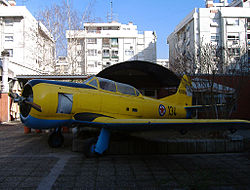
A preserved Soko 522 exhibited at the Museum of Aviation in Belgrade.
France
Serbia
  • 60132 – Soko 522 on static display at the Museum of Aviation in Belgrade.[2]
  • 60157 – Soko 522 on static display at the Museum of Aviation in Belgrade.[2]
  • 60204 – Soko 522 on static display at the Museum of Aviation in Belgrade.
  • ????? Soko 522 on static display in park at Tovariševo
Bosnia and Herzegovina
Slovenia
United States

Specifications (Soko 522)

[edit]

Data from Jane's All The World's Aircraft 1961–62[7]

General characteristics

  • Crew: 2
  • Length: 9.20 m (30 ft 2 in)
  • Wingspan: 11.00 m (36 ft 1 in)
  • Height: 3.58 m (11 ft 9 in)
  • Gross weight: 1,089 kg (2,400 lb)
  • Powerplant: 1 × Pratt & Whitney R-1340-AN-1 Wasp air-cooled radial engine, 450 kW (600 hp)

Performance

  • Maximum speed: 351 km/h (218 mph, 190 kn)
  • Range: 978 km (608 mi, 528 nmi)
  • Service ceiling: 7,000 m (23,000 ft)

Armament
Avionics
radio AN-ARC-3, VKT 100-156 MHz range 45 km at 1000 ft, 200 km at 10,000 ft
radiocompass AN-ARN-6 100-1750 kHz or AD-722

See also

[edit]

Aircraft of comparable role, configuration, and era

References

[edit]
Revisions and contributorsEdit on WikipediaRead on Wikipedia
from Grokipedia
The Soko 522 was a single-engine, two-seat trainer and light developed and produced in during the 1950s by the factory in . Designed primarily for basic and transitional pilot training in the , it featured a low-wing configuration with fixed and was powered by a R-1340-AN-1 Wasp producing 600 horsepower. The aircraft measured 9.2 meters in length, had a wingspan of 11 meters, and could reach a maximum speed of 351 km/h at , with a service ceiling of 7,000 meters and a range of 978 kilometers. It was armed with two 7.92 mm machine guns and capable of carrying four 50 kg bombs for light ground attack roles. Development of the began in the early under the design team led by engineers Ivan Šoštarić, Stanko Marjanović, Steva Ćurić, and Mirko Dabinović, with the first prototype (serial 60001) constructed at the Ikarus factory in and making its on June 19, 1955. Production shifted to the Soko facility in , where it became the factory's first serial aircraft, with a total of 110 units ordered and delivered between 1957 and 1961: 10 in 1957, 35 in 1958, 31 in 1959, and 44 by the end of 1961. Intended to bridge training from primary gliders like the Aero-3 to advanced fighters such as the S-49C and F-47D, the featured a metal construction with fabric-covered control surfaces. The Soko 522 entered service with the as its primary trainer for both active and reserve pilots, remaining in operational use until 1977 before being transferred to civilian flying clubs within the Aviation Association of . It also saw limited export and civilian registrations in countries including the , , and . Beyond military applications, the aircraft gained cultural prominence in Yugoslav cinema during the 1960s and 1970s, often modified to portray German fighters in films such as Battle of Neretva and . Although no airworthy examples survive in the former Yugoslav republics today, preserved specimens are displayed at institutions like the Aeronautical Museum in , where one unit produced on January 19, 1959, was donated on April 13, 1979.

Design and development

Origins

Following the end of , the newly established faced significant challenges in rebuilding its , which had relied heavily on Soviet-supplied and systems during the immediate postwar period. The 1948 Tito-Stalin split severed ties with the Soviet bloc, leading to an embargo on military equipment and technology transfers, which exacerbated the obsolescence of existing trainers such as the domestically produced Ikarus Aero-3 and imported models like the Zlin 381 from . This geopolitical shift prompted to pursue self-reliance in , seeking Western alliances for licensed production and design influences while initiating domestic projects to replace aging fleets ill-suited for transitioning pilots to advanced jet and piston-engine fighters. In response to these needs, the Soko 522 project originated in the early 1950s at the Ikarus Aircraft Factory in , near , where Yugoslav engineers began conceptualizing a modern primary trainer to address the shortages in basic and transitional flight instruction. The design team, led by Ivan Šoštarić, Stanko Marjanović, Steva Ćurić (also known as Čurčić), and Mirko Dabinović, collaborated to create an that could serve both military training roles and light ground-attack missions, drawing on available Western blueprints and licensed components to bypass Soviet restrictions. This effort aligned with broader Yugoslav industrial reforms, including the establishment of the factory in in 1950, which would later handle production. The initial requirements specified a two-seat, single-engine capable of basic , instrument training, and armament provisions for light attack duties, emphasizing simplicity, low-cost maintenance, and compatibility with Yugoslavia's limited industrial base. The project emphasized the use of licensed engines and materials to ensure rapid development. Construction of the first prototype commenced around 1953-1954, marking a pivotal step in Yugoslavia's push toward aviation independence amid tensions.

Design features

The Soko 522 featured an all-metal airframe constructed as a low-wing cantilever monoplane, with a two-spar stressed-skin wing structure and an oval-section fuselage divided into forward girder and rear semi-monocoque sections. This robust design emphasized durability and ease of maintenance for its primary role in pilot training, while the tail unit adopted a conventional cantilever monoplane configuration to provide straightforward handling characteristics. The landing gear was of tailwheel type, with the main wheels retracting hydraulically forward into wing root fairings and a non-retracting tail wheel, incorporating hydraulic brakes for operational reliability. Powering the aircraft was a single R-1340-AN-1 Wasp nine-cylinder air-cooled , delivering 447 kW (600 hp) and driving a two-bladed constant-speed . This , a proven American design adapted for Yugoslav production needs, was integrated at the nose with a streamlined to optimize and cooling during extended training flights, contributing to its reputation for dependable performance in basic and transitional instruction. The powerplant's output supported stable operations at various altitudes, making it suitable for the aircraft's instructional demands without excessive complexity. The cockpit arrangement consisted of tandem seating for an instructor and student, positioned under a continuous enclosed canopy with individual sliding sections for enhanced visibility and access. Dual controls were provided throughout, allowing seamless handover between occupants, while the instrumentation included essentials for instrument flight rules (IFR) training, such as radio communications equipment. This setup prioritized clear forward and peripheral views, critical for aerobatic maneuvers and formation flying in a training environment. Although primarily configured as an unarmed trainer, the Soko 522 incorporated light attack provisions with two underwing hardpoints capable of carrying up to 200 kg of ordnance total, including two 7.9 mm or 12.7 mm machine guns synchronized to fire through the arc, four 25 kg or two 50 kg bombs, and optionally two 12.7 cm rockets. These features enabled limited ground support roles when required, but the aircraft was most often operated without armament to focus on instructional priorities. Aerodynamically, the low-wing placement and rectangular wing planform were selected to ensure inherent stability at low speeds, facilitating safe recovery and slow-flight practice essential for novice pilots. The conventional tail surfaces further aided in responsive yet forgiving control inputs, promoting ease of handling during basic maneuvers and landings with the tailwheel configuration.

Production and service entry

Manufacturing process

The prototypes of the Soko 522 were constructed at the Ikarus Aircraft Factory in , , with the first prototype achieving its on 19 June 1955 under the controls of Mihajlo Grbić. Following successful evaluation of the prototypes, serial production was transferred to the aircraft factory in , , which became the primary manufacturing facility for the type. This relocation aligned with 's post-World War II efforts to centralize aviation production in regional facilities, establishing as a key hub for assembly. Full-scale serial production at the Mostar factory commenced in early 1957, marking the Soko 522 as the facility's inaugural series aircraft. The first factory-built example flew later that year, and production continued until 1961, resulting in a total of 110 units delivered to the . Annual output varied, with 10 aircraft completed in 1957, 35 in 1958, 31 in 1959, and the remaining 34 across 1960 and 1961. Manufacturing at Mostar involved the assembly of the low-wing monoplane's , including the , wings, and , powered by a single imported R-1340-AN-1 Wasp nine-cylinder rated at 600 horsepower. The process relied on skilled labor drawn from local and regional Yugoslav industries to meet the demands of series production for basic and advanced pilot training roles.

Introduction to service

The prototype of the Soko 522, designated 60001 and constructed at the Ikarus factory in , conducted its on 19 June 1955, piloted by Lieutenant Colonel Mihajlo Grbić. This initial flight marked the beginning of a testing phase that included ground trials and subsequent evaluation flights at various Yugoslav airfields, where the aircraft demonstrated satisfactory stability and handling qualities. Following successful prototype evaluations, production transitioned to the Soko factory in , with the first serial aircraft (number 60101) completing its flight in 1957. By the end of that year, over ten aircraft had been assembled and prepared for delivery, paving the way for operational integration. The Soko 522 officially entered service with the in 1957 as a primary and advanced trainer, replacing earlier models like the Aero-3 in programs. Initial allocations went to dedicated training squadrons, with serial numbers commencing at 60101 to support the expansion of pilot education. Designed to meet the Yugoslav military's requirements for basic flight instruction, the Soko 522 featured an optional light attack configuration, enabling versatility in early operational roles while prioritizing trainer duties. This introduction bolstered the Air Force's indigenous capabilities, with approximately 45 units delivered by the close of 1958 to equip training units across the country.

Operational history

Military service

The Soko 522 entered service with the Yugoslav Air Force in 1957 as a primary trainer aircraft, serving in basic and transitional pilot training roles at flight schools including the Vojna vazduhoplovna akademija (Military Aviation Academy) and the Škola rezervnih oficira avijacije (School of Reserve Aviation Officers). It equipped various light combat aviation squadrons, such as the 460th, 461st, 462nd, 463rd, 464th, and 465th, which conducted routine training operations from bases including Batajnica and Mostar. While capable of light attack duties with provisions for two 7.92 mm machine guns and up to four 50 kg bombs, the aircraft's military applications were predominantly training-focused, with occasional ground support exercises employing dummy ordnance amid the Air Force's transition to jet-powered platforms. Maintenance during service emphasized periodic overhauls of its R-1340-AN-1 Wasp to ensure reliability in training environments, though no major operational incidents involving the type were widely documented. The Soko 522 was progressively retired from inventory by 1977, supplanted by advanced jet trainers such as the , after which surviving airframes were transferred to civilian aviation associations.

Civilian and media uses

The Soko 522 found limited application in civilian contexts following its military retirement, primarily through repurposed surplus airframes for entertainment and . In the and 1970s, several examples were employed in Yugoslav and international war films, leveraging their radial-engine silhouette to stand in for the German fighter . Notable appearances include the 1969 Yugoslav production Battle of Neretva, where Soko 522s portrayed planes marked with insignia, and the 1970 American film , in which one was painted with U.S. Army Air Forces roundels to depict a P-47 . These roles capitalized on the 's availability in during filming, contributing to authentic depictions in period pieces without major modifications. Post-1977, after withdrawal from service, a small number of Soko 522s transitioned to operations, including instructional flying in clubs within and select foreign locations. These surplus supported basic pilot training and familiarization flights in club environments before eventual full retirement or static preservation. Private ownership emerged modestly, with examples exported to buyers primarily in the , , and ; one such , registered N210TU (c/n U-210), remains in hands in the United States as of 2024. No large-scale exports occurred, as production was geared toward domestic military needs, limiting broader dissemination.

Preservation and legacy

Surviving aircraft

At least eight examples of the Soko 522 are known to survive worldwide, primarily as museum exhibits or monuments, reflecting the aircraft's historical significance in Yugoslav aviation despite a total production run of around 112 units. In Serbia, four airframes are preserved at the Aeronautical Museum in Belgrade: serial numbers 60132, 60153, 60157, and 60204, all displayed as static exhibits in various states of restoration. The museum has undertaken restoration efforts on at least one example, including repainting and structural maintenance to preserve it for indoor display, with work documented as ongoing into the 2010s. Additionally, serial number 60122 stands as a static monument in Tovariševo Park, honoring local aviation heritage without active restoration. Outside Serbia, single examples exist in several countries. In , serial 60143 serves as a at , preserved outdoors in non-flyable condition. houses serial 23500/123 at the Park of Military History in Pivka, where it is exhibited indoors as part of the aviation collection, with periodic conservation to combat corrosion. In the United States, serial 60210 (c/n U-210, N210TU) is privately owned in and remains the sole known airworthy Soko 522, based in Prescott and maintained by its owner James V. White (as of ). Most surviving aircraft are maintained as non-operational displays, with exposure to the elements posing ongoing preservation challenges, though dedicated museum efforts ensure their longevity.

Cultural significance

The Soko 522 holds a symbolic role in Yugoslav heritage as the first serially produced aircraft manufactured by the factory in , marking a pivotal step in the nation's post-World War II aviation independence through indigenous design and all-metal construction. This achievement represented Yugoslavia's efforts to build a self-reliant military-industrial complex, transitioning from wooden prototypes like the Utva 213 Vihor to modern production capabilities amid geopolitical isolation. In , the Soko 522 gained prominence in Yugoslav cinema during the and , frequently standing in for German fighters to enhance the authenticity of depictions in films such as Battle of Neretva. Its radial-engine silhouette and maneuverability made it a practical surrogate for period aircraft, contributing to the realism of partisan warfare narratives in socialist-era productions. As a in Balkan , the Soko 522 is featured in key institutions like the Aeronautical Museum in , where it underscores Yugoslavia's early advancements in design and production. This display highlights its role in fostering regional engineering expertise, particularly in the transition to jet-age capabilities. In modern contexts, the Soko 522 receives occasional recognition in history and enthusiast discussions, often cited as an exemplar of non-aligned Yugoslavia's technological self-sufficiency within broader narratives of Eastern European .

Specifications

General characteristics

The Soko 522 is a two-seat, low-wing , seating one instructor and one student pilot in tandem configuration. Its dimensions include a length of 8.77 (28 ft 9 in), a wingspan of 11.00 (36 ft 1 in), and a height of 3.69 (12 ft 1 in), with a wing area of 18 m² (194 ft²). The aircraft has an empty weight of 2,012 kg (4,436 lb) and a maximum takeoff weight of 2,680 kg (5,908 lb). It is powered by a single R-1340-AN-1 Wasp air-cooled radial piston engine rated at 447 kW (600 hp), driving a two-blade, variable-pitch metal . In its light attack configuration, the Soko 522 features provisions for two 7.92 mm machine guns with 150 rounds each, along with two underwing hardpoints supporting up to four 50 kg bombs or two 127 mm (5-inch) rockets. The are basic for the era, including the AN/ARC-3 radio for communications and the AN/ARN-6 radio compass for navigation, supplemented by standard .

Performance

The Soko 522 achieved a maximum speed of 351 km/h (218 mph) at , enabling effective performance in and light attack roles during its operational era. Its operational range extended to 978 km (608 mi) with standard fuel loads, sufficient for typical mission profiles without external tanks. The aircraft's service ceiling was 7,000 m (23,000 ft), allowing it to operate in a variety of altitudes for advanced flight instruction. In terms of vertical performance, the Soko 522 demonstrated a of approximately 7.9 m/s (1,555 ft/min), supporting rapid ascents during training maneuvers. was around 149 kg/, derived from its of 2,680 kg and wing area of 18 , contributing to stable handling at higher speeds. The stood at approximately 0.17 kW/kg, calculated from the 447 kW output of its R-1340-AN-1 engine relative to the , which facilitated responsive acceleration and climb capability. For sustained operations, the Soko 522 offered an endurance of up to approximately 3 hours on training missions, based on its capacity and cruise efficiency aligning with the standard range at economical speeds. These metrics underscored the aircraft's reliability as a piston-engine trainer in the inventory.

References

Add your contribution
Related Hubs
User Avatar
No comments yet.