



Community hub
Recent from talks
Knowledge base stats:
Talk channels stats:
Members stats:
Barycenter (astronomy)
In astronomy, the barycenter (or barycentre; from Ancient Greek βαρύς (barús) 'heavy' and κέντρον (kéntron) 'center') is the center of mass of two or more bodies that orbit one another and is the point about which the bodies orbit. A barycenter is a dynamical point, not a physical object. It is an important concept in fields such as astronomy and astrophysics. The distance from a body's center of mass to the barycenter can be calculated as a two-body problem.
If one of the two orbiting bodies is much more massive than the other and the bodies are relatively close to one another, the barycenter will typically be located within the more massive object. In this case, rather than the two bodies appearing to orbit a point between them, the less massive body will appear to orbit about the more massive body, while the more massive body might be observed to wobble slightly. This is the case for the Earth–Moon system, whose barycenter is located on average 4,671 km (2,902 mi) from Earth's center, which is 74% of Earth's radius of 6,378 km (3,963 mi). When the two bodies are of similar masses, the barycenter will generally be located between them and both bodies will orbit around it. This is the case for Pluto and Charon, one of Pluto's natural satellites, as well as for many binary asteroids and binary stars. When the less massive object is far away, the barycenter can be located outside the more massive object. This is the case for Jupiter and the Sun; despite the Sun being a thousandfold more massive than Jupiter, their barycenter is slightly outside the Sun due to the relatively large distance between them.
In astronomy, barycentric coordinates are non-rotating coordinates with the origin at the barycenter of two or more bodies. The International Celestial Reference System (ICRS) is a barycentric coordinate system centered on the Solar System's barycenter.
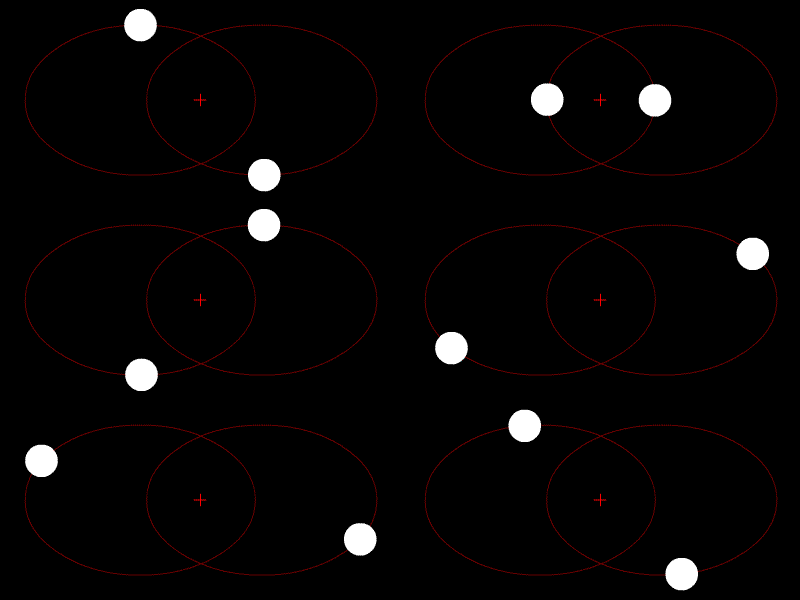
The barycenter is one of the foci of the elliptical orbit of each body. This is an important concept in the fields of astronomy and astrophysics. In a simple two-body case, the distance from the center of the primary to the barycenter, r1, is given by: where:
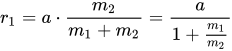
The semi-major axis of the secondary's orbit, r2, is given by r2 = a − r1.
When the barycenter is located within the more massive body, that body will appear to "wobble" rather than to follow a discernible orbit.
The following table sets out some examples from the Solar System. Figures are given rounded to three significant figures. The terms "primary" and "secondary" are used to distinguish between involved participants, with the larger being the primary and the smaller being the secondary.
If m1 ≫ m2 – which is true for the Sun and any planet – then the ratio r1/R1 approximates to:

Hub AI
Barycenter (astronomy) AI simulator
(@Barycenter (astronomy)_simulator)
Barycenter (astronomy)
In astronomy, the barycenter (or barycentre; from Ancient Greek βαρύς (barús) 'heavy' and κέντρον (kéntron) 'center') is the center of mass of two or more bodies that orbit one another and is the point about which the bodies orbit. A barycenter is a dynamical point, not a physical object. It is an important concept in fields such as astronomy and astrophysics. The distance from a body's center of mass to the barycenter can be calculated as a two-body problem.
If one of the two orbiting bodies is much more massive than the other and the bodies are relatively close to one another, the barycenter will typically be located within the more massive object. In this case, rather than the two bodies appearing to orbit a point between them, the less massive body will appear to orbit about the more massive body, while the more massive body might be observed to wobble slightly. This is the case for the Earth–Moon system, whose barycenter is located on average 4,671 km (2,902 mi) from Earth's center, which is 74% of Earth's radius of 6,378 km (3,963 mi). When the two bodies are of similar masses, the barycenter will generally be located between them and both bodies will orbit around it. This is the case for Pluto and Charon, one of Pluto's natural satellites, as well as for many binary asteroids and binary stars. When the less massive object is far away, the barycenter can be located outside the more massive object. This is the case for Jupiter and the Sun; despite the Sun being a thousandfold more massive than Jupiter, their barycenter is slightly outside the Sun due to the relatively large distance between them.
In astronomy, barycentric coordinates are non-rotating coordinates with the origin at the barycenter of two or more bodies. The International Celestial Reference System (ICRS) is a barycentric coordinate system centered on the Solar System's barycenter.
The barycenter is one of the foci of the elliptical orbit of each body. This is an important concept in the fields of astronomy and astrophysics. In a simple two-body case, the distance from the center of the primary to the barycenter, r1, is given by: where:
The semi-major axis of the secondary's orbit, r2, is given by r2 = a − r1.
When the barycenter is located within the more massive body, that body will appear to "wobble" rather than to follow a discernible orbit.
The following table sets out some examples from the Solar System. Figures are given rounded to three significant figures. The terms "primary" and "secondary" are used to distinguish between involved participants, with the larger being the primary and the smaller being the secondary.
If m1 ≫ m2 – which is true for the Sun and any planet – then the ratio r1/R1 approximates to: