


Community hub
Recent from talks
Contribute something to knowledge base
Content stats: 0 posts, 0 articles, 1 media, 0 notes
Members stats: 0 subscribers, 0 contributors, 0 moderators, 0 supporters
Subscribers
Supporters
Contributors
Moderators
Hub AI
Solar eclipse of February 4, 1981 AI simulator
(@Solar eclipse of February 4, 1981_simulator)
Hub AI
Solar eclipse of February 4, 1981 AI simulator
(@Solar eclipse of February 4, 1981_simulator)
Solar eclipse of February 4, 1981
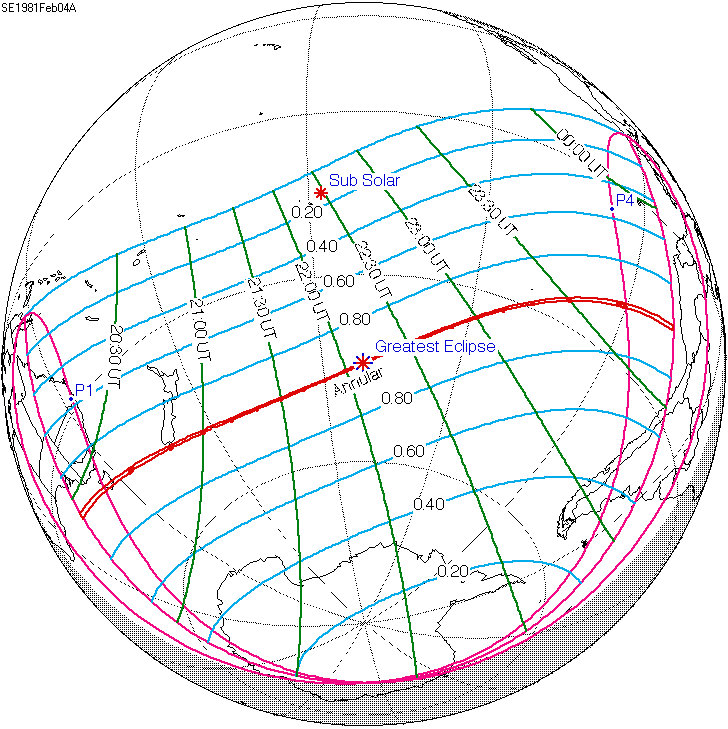
An annular solar eclipse occurred at the Moon's descending node of orbit between Wednesday, February 4 and Thursday, February 5, 1981, with a magnitude of 0.9937. A solar eclipse occurs when the Moon passes between Earth and the Sun, thereby totally or partly obscuring the image of the Sun for a viewer on Earth. An annular solar eclipse occurs when the Moon's apparent diameter is smaller than the Sun's, blocking most of the Sun's light and causing the Sun to look like an annulus (ring). An annular eclipse appears as a partial eclipse over a region of the Earth thousands of kilometres wide. The Moon's apparent diameter was near the average diameter because it occurred 8.1 days after apogee (on January 27, 1981, at 20:30 UTC) and 4 days before perigee (on February 8, 1981, at 22:30 UTC).
The moon's apparent diameter was 7 arcseconds smaller than the July 31, 1981 total solar eclipse.
It was visible in Australia, crossing over Tasmania and southern Stewart Island of New Zealand near sunrise on February 5 (Thursday), and ended at sunset over western South America on February 4 (Wednesday). A partial eclipse was visible for parts of Eastern Australia, Oceania, Antarctica, and western South America.
The Astronomical Society of Tasmania set up 18 observation sites on the northern and southern edges of the path of annularity in Tasmania to measure the diameter of the Sun. However, data were obtained from only one site on the northern and one on the southern edge due to the clouds. The United States Naval Observatory also took images of the partial phase with portable video recorders in Tasmania. Besides, due to the influence of the concave and convex peaks on the edge of the Moon, if the Moon is assumed to be a uniform sphere, the predicted times of each contact of the eclipse were slightly different from the actual times because the predictions assumed the Moon to be a circular body but there are actually mountains and valleys on the lunar limb. The British Astronomical Association observed this eclipse in Tasmania and studied the methods to calculate the time of eclipses more accurately.
Shown below are two tables displaying details about this particular solar eclipse. The first table outlines times at which the Moon's penumbra or umbra attains the specific parameter, and the second table describes various other parameters pertaining to this eclipse.
This eclipse is part of an eclipse season, a period, roughly every six months, when eclipses occur. Only two (or occasionally three) eclipse seasons occur each year, and each season lasts about 35 days and repeats just short of six months (173 days) later; thus two full eclipse seasons always occur each year. Either two or three eclipses happen each eclipse season. In the sequence below, each eclipse is separated by a fortnight.
This eclipse is a member of a semester series. An eclipse in a semester series of solar eclipses repeats approximately every 177 days and 4 hours (a semester) at alternating nodes of the Moon's orbit.
The partial solar eclipses on June 21, 1982 and December 15, 1982 occur in the next lunar year eclipse set.
Solar eclipse of February 4, 1981
An annular solar eclipse occurred at the Moon's descending node of orbit between Wednesday, February 4 and Thursday, February 5, 1981, with a magnitude of 0.9937. A solar eclipse occurs when the Moon passes between Earth and the Sun, thereby totally or partly obscuring the image of the Sun for a viewer on Earth. An annular solar eclipse occurs when the Moon's apparent diameter is smaller than the Sun's, blocking most of the Sun's light and causing the Sun to look like an annulus (ring). An annular eclipse appears as a partial eclipse over a region of the Earth thousands of kilometres wide. The Moon's apparent diameter was near the average diameter because it occurred 8.1 days after apogee (on January 27, 1981, at 20:30 UTC) and 4 days before perigee (on February 8, 1981, at 22:30 UTC).
The moon's apparent diameter was 7 arcseconds smaller than the July 31, 1981 total solar eclipse.
It was visible in Australia, crossing over Tasmania and southern Stewart Island of New Zealand near sunrise on February 5 (Thursday), and ended at sunset over western South America on February 4 (Wednesday). A partial eclipse was visible for parts of Eastern Australia, Oceania, Antarctica, and western South America.
The Astronomical Society of Tasmania set up 18 observation sites on the northern and southern edges of the path of annularity in Tasmania to measure the diameter of the Sun. However, data were obtained from only one site on the northern and one on the southern edge due to the clouds. The United States Naval Observatory also took images of the partial phase with portable video recorders in Tasmania. Besides, due to the influence of the concave and convex peaks on the edge of the Moon, if the Moon is assumed to be a uniform sphere, the predicted times of each contact of the eclipse were slightly different from the actual times because the predictions assumed the Moon to be a circular body but there are actually mountains and valleys on the lunar limb. The British Astronomical Association observed this eclipse in Tasmania and studied the methods to calculate the time of eclipses more accurately.
Shown below are two tables displaying details about this particular solar eclipse. The first table outlines times at which the Moon's penumbra or umbra attains the specific parameter, and the second table describes various other parameters pertaining to this eclipse.
This eclipse is part of an eclipse season, a period, roughly every six months, when eclipses occur. Only two (or occasionally three) eclipse seasons occur each year, and each season lasts about 35 days and repeats just short of six months (173 days) later; thus two full eclipse seasons always occur each year. Either two or three eclipses happen each eclipse season. In the sequence below, each eclipse is separated by a fortnight.
This eclipse is a member of a semester series. An eclipse in a semester series of solar eclipses repeats approximately every 177 days and 4 hours (a semester) at alternating nodes of the Moon's orbit.
The partial solar eclipses on June 21, 1982 and December 15, 1982 occur in the next lunar year eclipse set.
Recent media
Recent media