


Community hub
Recent from talks
Contribute something to knowledge base
Content stats: 0 posts, 0 articles, 1 media, 0 notes
Members stats: 0 subscribers, 0 contributors, 0 moderators, 0 supporters
Subscribers
Supporters
Contributors
Moderators
Hub AI
Solar eclipse of January 3, 1908 AI simulator
(@Solar eclipse of January 3, 1908_simulator)
Hub AI
Solar eclipse of January 3, 1908 AI simulator
(@Solar eclipse of January 3, 1908_simulator)
Solar eclipse of January 3, 1908
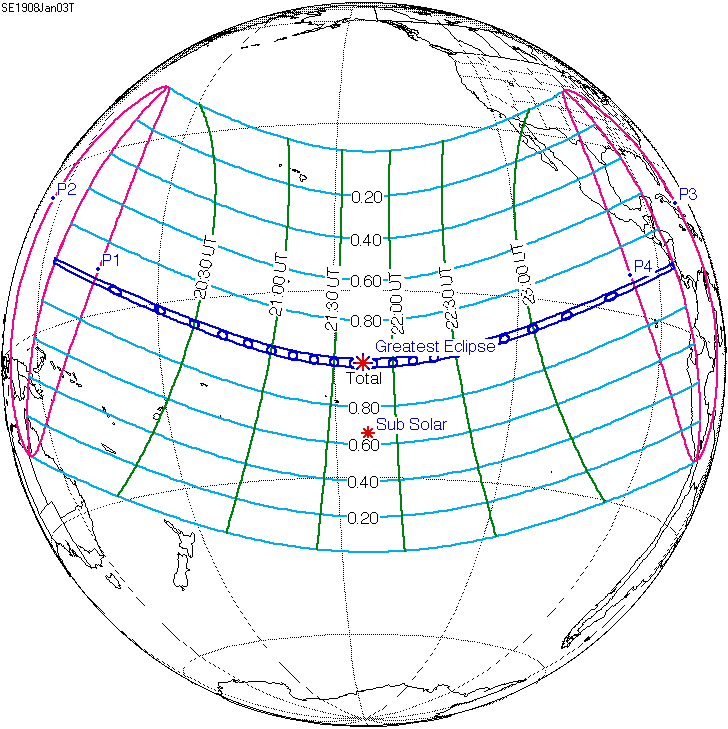
A total solar eclipse occurred at the Moon's descending node of orbit between Friday, January 3 and Saturday, January 4, 1908, with a magnitude of 1.0437. A solar eclipse occurs when the Moon passes between Earth and the Sun, thereby totally or partly obscuring the image of the Sun for a viewer on Earth. A total solar eclipse occurs when the Moon's apparent diameter is larger than the Sun's, blocking all direct sunlight, turning day into darkness. Totality occurs in a narrow path across Earth's surface, with the partial solar eclipse visible over a surrounding region thousands of kilometres wide. Occurring about 14 hours before perigee (on January 4, 1908, at 12:30 UTC), the Moon's apparent diameter was larger.
Totality was visible from Ebon Atoll in German New Guinea (now in Marshall Islands), British Western Pacific Territories (the part now belonging to Kiribati), Line Islands (now in Kiribati), Phoenix Islands (now in Kiribati) on January 4 (Saturday), and Costa Rica on January 3 (Friday). A partial eclipse was visible for parts of northern Oceania, Hawaii, southern North America, Central America, the western Caribbean, and western South America.
The eclipse was observed by astronomer William Wallace Campbell of Lick Observatory, viewed from Flint Island, Kiribati, an uninhabited island in the Line Islands. The team of Lick Observatory departed from San Francisco on November 22, 1907, and arrived in Papeete, Tahiti Island, the capital of French Polynesia on December 4. After making preparations of supplies and logistics personnel, it departed again on the evening of December 7 and arrived at Flint Island on the afternoon of 9 December.
Astronomers from the Royal Astronomical Society, Sydney Observatory and a party from Australia and New Zealand which included Francis McClean and Henry Winkelmann also observed the total eclipse near the observation site of Lick Observatory. The team successfully took images of the corona.
Shown below are two tables displaying details about this particular solar eclipse. The first table outlines times at which the Moon's penumbra or umbra attains the specific parameter, and the second table describes various other parameters pertaining to this eclipse.
This eclipse is part of an eclipse season, a period, roughly every six months, when eclipses occur. Only two (or occasionally three) eclipse seasons occur each year, and each season lasts about 35 days and repeats just short of six months (173 days) later; thus two full eclipse seasons always occur each year. Either two or three eclipses happen each eclipse season. In the sequence below, each eclipse is separated by a fortnight.
This eclipse is a member of a semester series. An eclipse in a semester series of solar eclipses repeats approximately every 177 days and 4 hours (a semester) at alternating nodes of the Moon's orbit.
The partial solar eclipses on February 23, 1906 and August 20, 1906 occur in the previous lunar year eclipse set.
Solar eclipse of January 3, 1908
A total solar eclipse occurred at the Moon's descending node of orbit between Friday, January 3 and Saturday, January 4, 1908, with a magnitude of 1.0437. A solar eclipse occurs when the Moon passes between Earth and the Sun, thereby totally or partly obscuring the image of the Sun for a viewer on Earth. A total solar eclipse occurs when the Moon's apparent diameter is larger than the Sun's, blocking all direct sunlight, turning day into darkness. Totality occurs in a narrow path across Earth's surface, with the partial solar eclipse visible over a surrounding region thousands of kilometres wide. Occurring about 14 hours before perigee (on January 4, 1908, at 12:30 UTC), the Moon's apparent diameter was larger.
Totality was visible from Ebon Atoll in German New Guinea (now in Marshall Islands), British Western Pacific Territories (the part now belonging to Kiribati), Line Islands (now in Kiribati), Phoenix Islands (now in Kiribati) on January 4 (Saturday), and Costa Rica on January 3 (Friday). A partial eclipse was visible for parts of northern Oceania, Hawaii, southern North America, Central America, the western Caribbean, and western South America.
The eclipse was observed by astronomer William Wallace Campbell of Lick Observatory, viewed from Flint Island, Kiribati, an uninhabited island in the Line Islands. The team of Lick Observatory departed from San Francisco on November 22, 1907, and arrived in Papeete, Tahiti Island, the capital of French Polynesia on December 4. After making preparations of supplies and logistics personnel, it departed again on the evening of December 7 and arrived at Flint Island on the afternoon of 9 December.
Astronomers from the Royal Astronomical Society, Sydney Observatory and a party from Australia and New Zealand which included Francis McClean and Henry Winkelmann also observed the total eclipse near the observation site of Lick Observatory. The team successfully took images of the corona.
Shown below are two tables displaying details about this particular solar eclipse. The first table outlines times at which the Moon's penumbra or umbra attains the specific parameter, and the second table describes various other parameters pertaining to this eclipse.
This eclipse is part of an eclipse season, a period, roughly every six months, when eclipses occur. Only two (or occasionally three) eclipse seasons occur each year, and each season lasts about 35 days and repeats just short of six months (173 days) later; thus two full eclipse seasons always occur each year. Either two or three eclipses happen each eclipse season. In the sequence below, each eclipse is separated by a fortnight.
This eclipse is a member of a semester series. An eclipse in a semester series of solar eclipses repeats approximately every 177 days and 4 hours (a semester) at alternating nodes of the Moon's orbit.
The partial solar eclipses on February 23, 1906 and August 20, 1906 occur in the previous lunar year eclipse set.
Recent media
Recent media