Hubbry Logo
Sydney ObservatorySydney ObservatoryMain
Open search
Sydney Observatory
Community hub
Sydney Observatory
logo
8 pages, 0 posts
0 subscribers
Be the first to start a discussion here.
Contribute something
Sydney Observatory
Sydney Observatory
from Wikipedia

The Sydney Observatory is a heritage-listed meteorological station, astronomical observatory, function venue, science museum, and education facility located on Observatory Hill at Upper Fort Street, in the inner city Sydney suburb of Millers Point in the City of Sydney local government area of New South Wales, Australia. It was designed by William Weaver (plans) and Alexander Dawson (supervision) and built from 1857 to 1859 by Charles Bingemann & Ebenezer Dewar. It is also known as The Sydney Observatory; Observatory; Fort Phillip; Windmill Hill; and Flagstaff Hill. It was added to the New South Wales State Heritage Register on 22 December 2000.[1]

Key Information

The site was formerly a defence fort, semaphore station, time ball station, meteorological station, observatory and windmills. The site evolved from a fort built on 'Windmill Hill' in the early 19th century to an observatory within the following 100 years. It is now a working museum where evening visitors can observe the stars and planets through a modern 40-centimetre (16 in) Schmidt-Cassegrain telescope and an historic 29-centimetre (11 in) refractor telescope built in 1874, the oldest telescope in Australia in regular use.[2][3]

History

[edit]

Early use of the site

[edit]
Fort Phillip, Flagstaff Hill, Sydney, c. 1841

The site of the Sydney Observatory has been a significant place in Sydney and has undergone a number of name changes. It was known as Windmill Hill in the 1790s when it was the site of the first windmill. After 1804 references are made to it as Fort Phillip or Citadel Hill, referring to the construction, but never completion, of a citadel on the site at Governor King's instruction for use in the case of an insurrection in Sydney. This was prompted by an influx of "Death or Liberty" Boys after the abortive 1798 uprising in Ireland, some of whom he believed to be of the most desperate character and cause for constant suspicion. Construction began but the citadel was not completed until Bligh had been installed in office. There were further discussions about a citadel during the Macquarie period but nothing eventuated beyond a half-built powder magazine, Francis Greenway's first work after his appointment as civil architect in 1815.[1]

In 1797, early on during the European settlement of New South Wales, Australia, a windmill was built on the hill above the first settlement. Within ten years the windmill had deteriorated to the point of being useless; the canvas sails were stolen, a storm damaged the machinery, and already by 1800 the foundations were giving way. The name of Millers Point remembers this early land use.[4]

In 1803, Fort Philip was built on the site under the direction of Governor Hunter to defend the new settlement against a possible attack by the French and also from rebellious convicts. The fort was never required to be used for any such purposes. In 1825 the eastern wall of the fort was converted to a signal station. Flags were used to send messages to ships in the harbour and to the signal station on the South Head of the harbour.

The site was known as Flagstaff Hill during and after the Macquarie era. A flagstaff had been erected on the site by 1811. Flag signalling was a cumbersome process and Commissioner Bigge advised Macquarie that it was expedient to erect a semaphore at South Head and Fort Phillip. The flag and semaphore were used for signalling in a variety of combinations.[1]

Observatory

[edit]
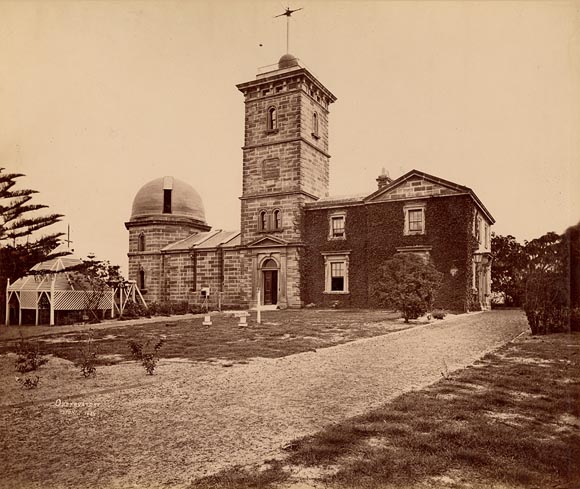
The observatory today
Sydney Observatory at night

An early observatory was established in 1788 by William Dawes on Dawes Point, at the foot of Observatory Hill, in an ultimately unsuccessful attempt to observe in 1790 the return of a comet suggested by Edmond Halley (not Halley's Comet but a different one).[5]

In 1848, a new signal station was built by the Colonial Architect, Mortimer Lewis, on top of the fort wall on Windmill Hill. At the instigation of the Governor, Sir William Denison, it was agreed seven years later to build a full observatory next to the signal station. The first Government Astronomer, William Scott, was appointed in 1856, and work on the new observatory was completed in 1858.

The most important role of the observatory was to provide time through the time-ball tower. Every day at exactly 1.00 pm, the time-ball on top of the tower would drop to signal the correct time to the city and harbour below. At the same time a cannon on Dawes Point was fired; later the cannon was moved to Fort Denison. The first time-ball was dropped at noon on 5 June 1858. Soon after the drop was rescheduled to one o'clock. The time-ball is still dropped daily at 1pm using the original mechanism, but with the aid of an electric motor, not as in the early days when the ball was raised manually.

After the federation of Australia in 1901, meteorology became a function for the Commonwealth Government from 1908, while the observatory continued its astronomical role. The observatory continued to contribute observations to The astrographic catalogue, kept time and provided information to the public. For example, each day the observatory supplied Sydney newspapers with the rising and setting times of the sun, moon and planets. A proposal to close the observatory in 1926 was narrowly avoided, but, by the mid-1970s, the increasing problems of air pollution and city light made work at the observatory more and more difficult. In 1982, the NSW Government decided that Sydney Observatory was to be converted into a museum of astronomy and related fields as part of what is now the Powerhouse Museum.

In November 1821 Governor Brisbane arrived with a set of astronomical instruments, a plan for an observatory and two personal employees with astronomical expertise - Carl Rümker and James Dunlop. Brisbane set up an observatory at the Governor's residence in Parramatta.[6] Problems developed between Brisbane and Rümker. Rümker lost his position and it was not until Brisbane had been recalled that Rümker was reinstated by the Colonial Secretary. The following year Governor Darling, the new Governor, appointed Rümker as Government Astronomer, the first to hold the title in Australia. In 1831 Dunlop was appointed Superintendent at the observatory, Rümker again losing his position while on a visit to London.[1]

Brisbane's instruments remained at Parramatta when he left and they were used in that observatory until it was closed in 1847. The recommendation for the closure came from a commission appointed by Governor Fitzroy at the prompting of London. Dunlop had become increasingly frail and negligent and the Parramatta observatory had fallen into decay. The instruments were placed in ordnance storage at the urge of Phillip Parker King, a leading astronomer in Australia.[1]

Construction of an observatory

[edit]

King argued that a government observatory should be set up, and not just the suggested time ball. King's preference for Fort Phillip to be the site was eventually accepted. In the eight years from Edmund Blacket's modest 1850 plan for the time ball observatory until its completion, the plans underwent progressive enlargement. The 1850 plan was a 4-by-4-metre (13 by 14 ft) room for a transit telescope and timekeeping apparatus with a small ante-room. In 1851 an enlarged version was presented to the Colonial Secretary but it had no time ball tower, because neither King or Blacket, the Colonial Architect, knew how it worked. The need for an Observer's dwelling was noted.[1]

Plans were redrawn in the next couple of years. When Blacket resigned in 1854 to take on the design and supervision of construction of The University of Sydney, plans were underway for an observatory that would be both functional and of architectural quality. Blacket's successor, William Weaver, replaced him on the observatory project. Weaver was appointed Colonial Architect in October 1854. Correspondence from him to Blacket in the early years indicates that Weaver was much happier in direct supervision of works than performing the duties of his desk-bound role. As head of an over-loaded department, he complained:[1]

"The arrangements for the performance of the various works, the official correspondence, the number of reports, and the examination of accounts, absorb nearly the whole time of the head of department, who practically can have little or no professional oversight of any work".

A Select Committee on the Colonial Architect's Department in August 1855 questioned an overpayment to the stonemasonry contractor of the Dead House at Circular Quay and accused him of defrauding the Government. Weaver, as head of the Department, was accused of negligence for paying him and subsequently submitted his resignation in apparent disgust. Weaver was only 18 months as Colonial Architect and of the two major architectural works to come from his Department during his term in office, the Government Printing Office at the corner of Phillip and Bent Streets no longer stands and the Sydney Observatory has been generally attributed to his successor. In fact, Sir William Denison approved Weaver's plans "for an Observatory and Astronomical resicence" in August 1855 after some specifications supplied by Denison had been incorporated. When building commenced a year later the new Colonial Architect Alexander Dawson adopted those plans.[7][1]

Little more was done until the arrival of Sir William Denison as Governor General in January 1855. Denison saw an observatory as an important addition to the colony. As a result, the £600 allocated to the time ball and building was augmented by an additional vote of £7,000 for a complete observatory and Denison wrote to the Astronomer Royal asking him to find a competent astronomer. Plans and estimates were submitted in August 1855 but Denison decided to defer the final decision on the site and design until the arrival of the astronomer.[1]

Alexander Dawson replaced Weaver as Colonial Architect in April 1856 and the new Government Astronomer, Reverend William Scott, M.A., arrived with his family in October that year. Tenders for the construction were advertised in February 1857. The successful tenderers were Charles Bingemenn and Ebenezer Dewar. The plans used appear to have been the work of Dawson rather than those of his predecessors, there being numerous references by Scott to consultations with the Colonial Architect on the design of the building. Extra work was approved after Bingemann and Dewar won their tender. This included the addition of a telescope dome and an increase in the height of the time ball tower. This increased height caused some dismay for Scott as it blocked out an increased area of the eastern sky.[1]

The completed building combined, for the first time in a major Sydney building, two architectural streams - Italian High Renaissance Palazzo and the Italian Villa forms. These contributed the symmetry of the townhouse facade for the residence and an asymmetry for the observatory born of the peculiar needs of transit room, equatorial dome and time ball tower. The building was thus elevated from basic necessity to fashionable stylishness. Dawson's budget had enabled him to emphasise the distinction between the private and the public, the domestic and the official. The style and form was overlaid with early Victorian theories of fitness and association, that style should be chosen to indicate the nature and status of the building and in some cases, the site.[1]

Operations, 1858 to 1980s

[edit]
A telescope of Sydney Observatory

Scott occupied the residence in 1858 and commenced a trial operation of the time ball in June. His initial equipment was modest, mostly the instruments from Parramatta. He did, however, obtain the money for an equatorial telescope. In 1862 Scott resigned, recommending prominent amateur astronomer John Tebbutt as his replacement. Tebbutt declined the offer and the search for a replacement was commenced. In the meantime, his assistant Henry Chamberlain Russell was left in charge of the observatory. In January 1864 the new appointee George Robarts Smalley arrived and Russell was his second in command.[1]

In 1870 Smalley died and was replaced by Russell. Russell's talent, entrepreneurial flair, intimate knowledge of how to work the political and bureaucratic system of NSW and longevity gave him a 35-year tenure as Government Astronomer and made him the Grand Old Man of physical science in the colonies. It was during Russell's period that Sydney Observatory was popularly believed to have been at its professional zenith, particularly from the 1870s through to the 1890s. Russell wasted no time in pressing the government for the necessary physical and instrumental resources to carry out his astronomical programs at the observatory. The addition of a west wing designed by colonial architect James Barnett was the main work resulting from this. It provided for a major ground floor room for Russell, a library, a second equatorial dome on a tower at its northern extremity which removed the blind spot imposed by the time ball tower. An enlarged Muntz metal dome was also placed on the old equatorial tower to accommodate a new Schroeder telescope. The telescope remains a prized and functional possession today. Russell also turned his attention to improving the residence, claiming it was not large enough to accommodate his family. In 1875 Russell succeeded in securing an extension of the observatory enclosure. Like his predecessors, he had been concerned with the restrictive nature of the observatory grounds which made siting of meteorological and auxiliary astronomical instruments difficult, if not impossible. This extension, together with the adjacent signal station give the site its present symmetrical perimeter. The Astrographic Catalogue was Russell's greatest commitment and would affect programs at the observatory for 80 years. His interest in the application of photography to astronomy and a visit to Paris in 1887 prompted Russell to take part in a "great star catalogue". The Sydney Zone of the catalogue was a massive logistical enterprise and was not practically completed until 1964. Russell died in 1907 after taking leave for an extended period of time due to ill health. His assistant Alfred Lenehan was appointed acting Government Astronomer during this period and later Government Astronomer in 1907. However, in 1906 a premier's conference resolved that the Commonwealth Government would take over meteorological work, leaving astronomy to the states. Thus, the meteorological section of the observatory became a Commonwealth agency under the direction of a former officer of the observatory, Henry Hunt. Lenehan and Hunt continuously quarrelled and did not develop a good working relationship.[1]

In January 1908 Lenehan had a stroke and never returned to work. At the same time the Commonwealth agency was installed in the observatory residence. William Edward Raymond, the officer responsible for transit work, became officer in charge for four years, until the appointment of William Ernest Cooke in 1912. Cooke was lured to Sydney from Perth Observatory with promises of a new site located in Wahroongah, then free of city lights and traffic, the purchase of modern instruments and a world trip to investigate the latest developments. None of these eventuated during Cooke's fourteen years at the observatory. In 1916 the board of visitors to the observatory was reconstituted. Russell had allowed it to lapse during his term of office and in 1917 the residence was again inhabited by the Astronomer.[1]

Photoheliograph used to photograph the sun

All government astronomers from Scott to Cooke were worried about increasing levels of city light, vibration from traffic and magnetic disturbance which rendered the Flagstaff Hill site increasingly unsuitable. Recommendations had been made by Smalley in 1864 and others in the first quarter of the twentieth century. While Russell had managed to have the astrographic telescope relocated to Pennant Hills, there was general worry over the reaction to the cost of relocation of the whole observatory. In July 1925 Cooke wrote to his minister pointing out the problems at the site and with the equipment. The State Cabinet took him at his word and in October decided to close the observatory rather than face the cost of removal and re-equipment. However, protests from the Board of Visitors, the Royal Society of NSW, the NSW Branch of the British Astronomical Association, the University of Sydney and interested members of the public caused the Government to change its mind and allow the observatory to continue - but with a heavily reduced staff and program. Most of the staff were transferred to other departments and Cooke was retired the following year. Only the time ball and completion of the astrographic program survived. This experience inhibited later Government Astronomers in their arguments for a new site.[1]

Two World Wars, a great depression and a commitment to a logistically exacting astrographic program helped reduce the vitality of the establishment in the twentieth century. The deployment of major resources to the astrographic program became something of an incubus as the twentieth century progressed. The Government Astronomers could not suspend or abort the program even if they had thought it desirable. At the same time the fulfilment of international obligations under the program was largely instrumental in the survival of the observatory.[1]

The completion of the program in 1964 and publication of the final volume in 1971 meant the observatory's days were numbered. Other fundamental reasons also contributed to the notion that the observatory was no longer a viable proposition. The transfer of meteorology to the Commonwealth in 1908 removed the observatory's most high-profile public service, electric telegraphy and radio had reduced and in time eliminated the need for local navigational and time services. Ambient city light was starting to restrict astronomical observation though the place was still suitable for the time-consuming analysis of the observations and other astronomical work together with functions such as a public observatory and a centre for public and media enquiries.[1]

Post World War II was an exciting time for Australian astronomical development, particularly in radio astronomy. These developments bypassed Sydney though the Government Astronomer Harley Wood kept a close involvement as the first president of the Astronomical Society of Australia (ASA) in 1966 and as the co-ordinator of the first International Astronomical Union (IAU) General Assembly to be held in the southern hemisphere in Sydney, 1973. Without major capital funds to develop its own specialisations in the west, Sydney remained tied to its traditional role. Despite this there was some positive activity at the observatory. During the 1950s and 1960s under Wood, the observatory enjoyed a modest renaissance. Staff numbers were built up and new equipment acquired. Both the Sydney and Melbourne sections of the Astrographic catalogue were completed and published. A new domed building was constructed in the south-east corner of the observatory to house the Melbourne star camera that replaced the original Sydney one. A new survey of the southern sky was commenced and by 1982 Wood's successor William Robertson had completed the photography and measurement was underway. Education was another aspect of the observatory's work that Wood developed. Always one of its aims, increasing numbers of visitors, including teaching students, attended the observatory.[1]

These activities commanded respect for Sydney Observatory in astronomical circles, but its image in the NSW Parliament and associated Public Service remained forgettable. Wood's annual reports failed to help this. They did not communicate any sense of excitement and worth in the observatory.[1]

Disestablishment as a functioning observatory

[edit]

The disestablishment of the observatory echoed that of fifty years earlier when Cooke stressed the need for a new location. The Chairman of the Board of Visitors wrote a letter to the Premier in 1979 urging the establishment of a remote observing site for the observatory and stressing the difficulty of the conditions at the existing site. This coincided with a nationwide review of astronomy facilities commissioned by the ASA and led by Monash University Professor of Astronomy Kevin Westfold (1980) This concluded that astronomy was a federal responsibility and that resources should be allocated to research operations, highlighting radio astronomy. The financial difficulties of the State of NSW at that time resulted in a letter from the Premier in June 1982 announcing his decision to transfer the observatory to the Museum of Applied Arts and Sciences and discontinue scientific work. Despite letters from international astronomers, and a concerted effort from now-retired Harley Wood, the Government did not rescind its decision.[1]

In July 1984 the Minister for Public Works, Ports and Roads announced an $800,000 project to restore Sydney Observatory for astronomy education, public observatory and a Museum of Astronomy. While the importance of the exterior was recognised, the interior was less fortunate. Work inside the building in the creation of the museum involved the staged removal of almost all instruments, equipment, and furniture and furnishings to the Museum's store.[8] The astrographic building was demolished and the dome, instruments and most of the glass plate and paper collection was removed to Macquarie University for future research use.[1]

In 1997 the observatory was refurbished, this time instruments were returned to their original locations or showcased. 'The "By the light of the Southern Stars" exhibition theme also included the Parramatta Observatory instruments and Indigenous Astronomy. In 1999 a major stonemasonry repair project on the observatory building commenced. This continued through to 2008. In 2002 the conservation plan was updated by Kerr, this time complimentary on the relocation and interpretation of the instruments.[1]

A number of key astronomical events have occurred in recent years, most notable are Halley’s Comet (1986), the impact of Shoemaker Levy on Jupiter (1994), Mars at its closest encounter (2003), transits of Venus (2004, 2012), Comet McNaught (2007), planetary alignments and eclipses. Thousands of people came to the observatory to view these through telescopes and to see relevant exhibitions. Further the observatory provided information about these events to many more people either directly or through the media.[1]

In 2008, for the 150th anniversary, the Signal Station building was stabilised, one of the original two flagstaffs re-constructed and an archaeological investigation commenced around the base of the fort led by NSW Government Architects, building design and Heritage office and Casey and Lowe. Original fort footings were uncovered and the base of a room which was once a bombproof inside the fort wall foundations.[1]

In 2009 permission was granted for a temporary marquee to be erected for a restricted period of time in order to raise funds. Furthermore, the Astrographic dome and instruments have been returned by Macquarie University to the Museum store where they are awaiting conservation and a Heritage NSW approved structure on the observatory site.[1] The most significant change to Sydney Observatory in 50 years, the new Eastern Dome was opened on 27 January 2015, by the Deputy Premier Troy Grant and Minister for Disability Services, John Ajaka.[1][9]

Georg Merz and Sons, vintage 7.25-inch refracting telescope

[edit]

Located at the Sydney Observatory is a vintage 7.25-inch refracting telescope on an Equatorial mount that was manufactured by the German company Georg Merz and Sons between 1860 and 1861. The 7.25-inch Merz refracting telescope arrived at Sydney Observatory, Sydney, Australia, in 1861.[10]

Description

[edit]

The observatory is a sandstone two-storey building in the Italianate style. There are two telescope domes on octagonal bases and a four-storey tower for the time-ball. The 1858 building designed by the Colonial Architect, Alexander Dawson, comprised a dome to house the equatorial telescope, a room with long, narrow windows for the transit telescope, an office for calculations, and a residence for the astronomer. A western wing was added in 1877 with office and library space and a second dome for another telescope. Some of the first astronomical photographs of the southern sky were taken at the observatory, under the direction of Henry Chamberlain Russell. The observatory also took part in the compilation of the first atlas of the whole sky, The astrographic catalogue. The part completed at Sydney took over 70 years, from 1899 to 1971, and filled 53 volumes. The observatory once contained offices, instruments, a library and an astronomer's residence. It is now a public observatory and a museum of astronomy and meteorology.[1]

The building is of Florentine Renaissance style and the storeys are divided by string courses while articulated quoins at corners, stone bracketed eaves and entablatures to openings of the residence contribute to the fine stone masonry work. A single storey wing to the north has had a timber balcony verandah with a stone balustrade built above. Windows are of twelve pane type and the doors are six panels.[11][1]

The physical condition is good.[1]

Observatory Hill affords superb views of Sydney Harbour and the bridge.

Modifications and dates

[edit]
  • 1796 – First windmill built on hill.
  • 1796–97 – to crush grain - abandoned 1806.
  • 1800 – At least two six-pounder cannons located on hill.
  • 1804 – Commencement of construction of Fort Phillip as protection versus convict uprising. Site known as Citadel Hill. Building work continued until 1806, then abandoned, with the fort unfinished.
  • 1808 – Flagstaffs erected on eastern side of Fort Phillip parapet.
  • 1823 – Semaphore and flagstaff added to hill.
  • 1838 – Dual purpose staff and telegraph masters hut noted on site.
  • 1847 – Signal Station built – finished 1848.
  • 1857 – Signal Station altered, and in 1859, took its present form by 1864.
  • 1858 – Demolition of windmill tower and construction of Observatory - finished 1859.
  • 1876–78 – West wing built. Other alterations to residence in 1907.
  • c. 1907 – Most of the residence lath and plaster ceilings replaced by decorative pressed metal ceilings and matching cornices.
  • 1907 – New staircase constructed in residence.
  • 20th century – Most observatory ceilings replaced by asbestos cement sheeting. - Addition of picture rails.
  • 1982 – Wran Government decision to cease scientific work on site, Powerhouse Museum takes responsibility for management
  • 1984–87 – DPWS manage major works to provide a museum of astronomy, exhibitions etc.
  • November 1987 – Signal Station use as by Museum agreed to by Minister for Public Works.
  • 1980s – Observatory ceilings replaced with plaster-board; some floors replaced with particle board sheeting; some basement floors quarry tiled.
  • 1985 – New staircase constructed in south west tower.
  • 1987 – Garden re-landscaping/reinstatement to conform with Russell's plan of 1893, replanting with appropriate 19th century species (oleander, agaves, plumbago) by Royal Botanic Gardens Sydney staff.[12][full citation needed]
  • 1993 – Signal Station Messengers Cottage vacated and use as museum agreed in-principle by Treasurer in 11/1993.
  • 1995 – Signal Station Messengers Cottage refurbished for use as offices by museum staff. All walls were plastered but have been progressively repaired and replaced over the years.[13][14][full citation needed]
  • 1997 – Many original instruments were conserved and restored to their former locations.
  • 2008 – The Signal Station was restored and a replica flagstaff re-instated on the South rampart of the Fort wall for the Sydney Observatory 150th celebration.[1]
  • 2015 – Opened the East Dome which caters for people with disability.[15][9] This won the National Trust's 2015 Heritage Award for Adaptive Reuse.[16]

Heritage listing

[edit]

As at 20 October 2005, the observatory is of exceptional significance in terms of European culture. Its dominant location beside and above the port town and, later, City of Sydney made it the site for a range of changing uses, all of which were important to, and reflected, stages in the development of the colony. These uses included: milling (the first windmill); defence (the first, and still extant, fort fabric); communications (the flagstaffs, first semaphore and first electric telegraph connection); astronomy, meteorology and time keeping. The surviving structures, both above and below ground, are themselves physical documentary evidence of 195 years' changes of use, technical development and ways of living. As such they are a continuing resource for investigation and public interpretation.[1]

The place has an association with an extensive array of historical figures most of whom have helped shape its fabric. These include: colonial Governors Hunter, Bligh, Macquarie & Denison; military officers and engineers Macarthur; Barrallier; Bellasis and Minchin; convicts: the as yet unnamed constructors of the mill and fort; architects: Greenway (also a convict), Lewis, Blacket, Weaver, Dawson and Barnet; signallers and telegraphists such as Jones and the family Moffitt; astronomers: particularly PP King, Scott, Smalley, Russell, Cooke and Wood.[1] The elevation of the site, with its harbour and city views and vistas framed by mature Moreton Bay fig (Ficus macrophylla) trees of the surrounding park, make it one of the most pleasant and spectacular locations in Sydney.[1]

The picturesque Italianate character and stylistic interest of the observatory and residence building, together with the high level of competence of the masonry (brick and stone) of all major structures on the site, combine to create a precinct of unusual quality;[1] Finally, the continued use of the observatory for astronomical observations and the survival of astronomical instruments, equipment (Appendix 4) and some early furniture (Appendix 3), although temporarily dispersed, and the retention of most interior spaces, joinery, plasterwork, fireplaces, and supports ensure that the observatory can remain the most intact and longest serving early scientific building in the State.[17][1] Also of significance for relationship of Commonwealth and State powers. Site of the first intercolonial conference on meteorology and astronomy.[18][1] An excellent example of a Colonial building erected for scientific purposes and continuing to perform its function at the present time. The structure makes an imposing composition atop the historic hill originally known as Flagstaff Hill and occupies the historic Fort Phillip site (1804–45). Designed by the colonial architect Alexander Dawson and built in 1858.[1][19][full citation needed]

Sydney Observatory was listed on the New South Wales State Heritage Register on 22 December 2000 having satisfied the following criteria.[1]

The place is important in demonstrating the course, or pattern, of cultural or natural history in New South Wales.

The observatory's dominant location beside and above the port town, and later, city of Sydney, made it the site for a range of changing uses. All of these were important to, and reflected changes in the development of the colony.[1] The place has an association with an extensive array of historical figures, most of whom have helped shape its fabric. These include colonial governors, military officers and engineers, convicts, architects and astronomers.[17][1]

The place is important in demonstrating aesthetic characteristics and/or a high degree of creative or technical achievement in New South Wales.

The elevation of the site with its harbour and city views and vistas framed by the mature fig trees of the surrounding park, make it one of the most pleasant and spectacular locations. The picturesque Italianate character and stylistic interest of the observatory and residence building, together with the high level of competence of the masonry (both stone and brick) of all major structures on the site, combine to create a precinct of unusual quality.[17][1]

The place has potential to yield information that will contribute to an understanding of the cultural or natural history of New South Wales.

The surviving structures, both above and below ground, are themselves physical documentary evidence of 195 years of changes of use, technical development and ways of living. As such they are a continuing resource for investigation and public interpretation.[17][1]

See also

[edit]

References

[edit]
[edit]
Revisions and contributorsEdit on WikipediaRead on Wikipedia
from Grokipedia
The Sydney Observatory is a heritage-listed astronomical facility in Millers Point, , , , renowned for its role in advancing colonial-era through astronomy, , and timekeeping. Constructed between 1857 and 1859 on Observatory Hill—formerly known as Windmill Hill or Flagstaff Hill—the building was designed in the Florentine Renaissance style by Colonial Architect Alexander Dawson, using local sandstone, and features two octagonal towers with domes for telescopes, a four-storey time-ball tower, and an attached residence for the government astronomer. Originally established to replace earlier observatories at (1788) and (1821), it was re-initiated in 1855 under Governor Sir William Denison to support , weather monitoring, and stellar mapping for the . From its opening in 1859 under first director William Scott, the observatory became a hub for precise scientific work, including the daily 1 p.m. drop of its to calibrate ships' chronometers in Harbour—a practice that began immediately and continued until the . It pioneered Australia's first weather forecasts in 1858 and produced the nation's initial weather maps in 1877 under director Henry Chamberlain Russell, who expanded meteorological records until the Bureau of Meteorology's formation around 1908. Astronomically, it contributed to international projects like the Astrographic Catalogue (1887–1926) and Carte du Ciel, with notable observations including the 1874 and , using equipment such as a 29 cm refractor installed in 1874. The site evolved from earlier uses as a (1790s), Fort Phillip (1804), and signal station (1825), reflecting 's growth as a colonial port. Following Australian Federation in 1901, functions divided: transferred federally, while state astronomy persisted until forced closure of active observations in 1982. Today, managed by MAAS () since 1982 and converted to a public in the mid-1980s, it offers tours, a 3D space theatre, and access to historic telescopes, preserving records vital for and serving as a State Heritage-listed site under the Sydney Environmental Plan 2012 for its rarity as a colonial combining timekeeping and scientific functions.

History

Pre-observatory site usage

The area encompassing Observatory Hill formed part of the traditional lands of the people, a clan of the broader nation, who served as custodians of the region for tens of thousands of years prior to European colonization. The elevated terrain, offering panoramic views over ( Harbour), likely functioned as a strategic lookout point for observing the landscape, waterways, and celestial features, aligning with the Gadigal's deep knowledge of astronomy and environmental navigation. European settlement transformed the site beginning in , when convicts under military oversight constructed the colony's first atop the hill to grind and into , essential for sustaining the growing penal population. This structure, powered by wind sails, marked the hill's initial utilitarian role in colonial and earned the location the name Windmill Hill; it operated intermittently until around 1806, when structural failures and inconsistent winds rendered it obsolete, leading to its partial demolition and replacement by other milling facilities elsewhere in Sydney. By the early 1800s, the site's prominence shifted toward defense and communication, with a flagstaff erected in 1803 as part of initial fortifications ordered by Governor Philip Gidley King to monitor maritime threats, including potential French incursions during the Napoleonic Wars. This installation formalized the hill's use as a rudimentary signal station, where flags and later semaphore systems conveyed news of approaching vessels to the settlement below, facilitating trade, mail delivery, and naval coordination. Under Governor Lachlan Macquarie (1810–1821), the signaling network expanded significantly, integrating the hill into a chain of stations across the harbor to enhance colonial administration and security. Construction of Fort Phillip commenced in 1804 on the same elevation, intended as a citadel with gun emplacements, but the project stalled by 1807 due to resource shortages, leaving incomplete walls and foundations that were repurposed for an upgraded signal station in 1825. Archaeological investigations at the site have revealed remnants from these early uses, including gunflints, metal artifacts, and building materials associated with Fort Phillip's military function, underscoring the hill's role in early colonial defense efforts. These findings, excavated in the late 20th and early 21st centuries, also include traces of the windmill's base, highlighting the layered history of on the . By the mid-1850s, amid growing demands for precise astronomical and timekeeping services, authorities selected the hill for a new , repurposing its established vantage for scientific observation.

Construction and opening

In 1855, Governor Sir William Denison initiated plans for a new in to advance astronomy, timekeeping, and , following the decline of the earlier Observatory. His memorandum to the Executive Council on 31 March 1855 led to a decision on 4 April to re-establish the facility, with funding provided by the colonial government. Initial allocations included £600 for a time-ball mechanism and related structures, later augmented to support broader construction needs. The site was selected in 1856 on Observatory Hill, the highest natural point in the city at 40 meters above , offering clear views for astronomical observations and integration with the existing signal station established there in the . Architectural plans were prepared by Colonial Architect in August 1855, with supervision later handled by Alexander Dawson after he succeeded Weaver in April 1856; construction began in 1857 and was carried out by builders Charles Bingemann and Ebenezer Dewar, completing the main structure by 1859. The design incorporated a two-story building in Italianate style, featuring octagonal towers topped with domes for telescopes, a dedicated transit room for precise stellar measurements, and living quarters for staff, all adjacent to the signal station's flagstaff and time-ball tower. The observatory became partially operational in mid-1858, with the time ball first dropped at noon on 5 June to signal accurate time to ships in the harbor. Reverend William Scott, appointed as the first Government in 1856 on the recommendation of the , arrived from England that year to oversee final preparations and begin initial meteorological recordings. By 1859, Scott commenced full astronomical observations from the completed facility, marking its official opening as a key colonial scientific institution.

Operational period (1858–1982)

The Sydney Observatory commenced operations in 1858 under the direction of the first Government Astronomer, William Scott, who oversaw the initial setup of astronomical, meteorological, and timekeeping functions from the newly completed building. Daily activities included nighttime observations of celestial bodies using the equatorially mounted refractor , daytime recordings of weather parameters such as , , and rainfall, and the distribution of accurate time signals via a daily time-ball drop at 1:00 p.m. from the tower to aid maritime navigation and synchronize clocks across the colony. These operations were supported by a small staff comprising the Government Astronomer, assistants for instrument maintenance and reduction, and meteorological observers who compiled records for public forecasts, with the first such predictions issued as early as mid-1858. William Stanley , while primarily an assayer at the Sydney Mint, contributed early meteorological observations from 1855 to 1859, including twice-daily measurements that informed the Observatory's initial climate studies until formal staffing took over. Following Scott's resignation in 1862, there was a period without a permanent director until George Robarts Smalley was appointed Government Astronomer in 1864, serving until 1870, before Henry Chamberlain Russell assumed the role for the longest tenure (1870–1905), during which the Observatory expanded significantly. In the 1870s, facilities were augmented with a new wing including a library, offices, and a dedicated chamber for an 11.5-inch refractor telescope to support emerging techniques in celestial photography and , enabling detailed stellar imaging and spectral analysis. A pivotal event was the Observatory's participation in the international Astrographic Catalogue project starting in the late , where staff photographed and cataloged stars in the southern , contributing plates over several decades to create a comprehensive global star map. Time signals evolved from visual time-ball drops to telegraph distribution by the late , allowing broader dissemination to railway and telegraph networks across . The 20th century brought structural changes and challenges, particularly after in 1901, when meteorological responsibilities transferred to the newly formed federal in 1908, integrating Observatory staff into weather observation networks while astronomy remained a ; the Bureau occupied Observatory offices until constructing its own building on the hill in 1922. After Russell's death in 1907, assistant Alfred Lenehan served as acting Government Astronomer until William Ernest Cooke's appointment in 1912. Subsequent Government Astronomers included William Ernest Cooke (1912–1927), who advanced timekeeping by pioneering signals in 1916 for Pacific ; Harley Wood (1943–1974), who oversaw operations during and after . Operations faced funding constraints and staffing shortages during both World Wars, with many assistants enlisted, reducing observational capacity and leading to scaled-back programs like the Astrographic Catalogue; post-war, urban air and from Sydney's growth further complicated nighttime viewing. By the 1920s, radio time signals supplemented telegraph methods, reflecting technological shifts that diminished reliance on the time-ball by the mid-century. Staff roles diversified to include specialized assistants for development and time service maintenance, supporting the Observatory's dual scientific mandate until its closure as an active institution in 1982.

Transition to heritage site

By the mid-20th century, the Sydney Observatory's scientific operations began a gradual decline as its core functions were progressively transferred to more specialized institutions. Timekeeping responsibilities, including radio time signals, were handed over to the Postmaster-General’s Department in 1946, marking the end of the Observatory's direct role in disseminating precise time for and public use. Similarly, meteorological duties had largely shifted to the in the 1950s, though the Observatory's on-site weather station continued operations until its closure in 1981, amid broader rationalization of state resources. Astronomical observations faced increasing challenges from urban encroachment and light pollution in central Sydney, rendering the site's skies unsuitable for serious research by the late 20th century. The last regular astronomical work ceased as funding shortages and the rise of larger, remote facilities like Siding Spring Observatory diminished the site's viability. In 1982, the New South Wales government officially ceased active astronomical and meteorological operations at the Observatory, prompted by financial pressures and the need to reallocate resources. Preservation efforts gained momentum in the , with growing recognition of the Observatory's historical and architectural value leading to its designation as a heritage site. Following closure, management was transferred to the Museum of Applied Arts and Sciences (now MAAS) in 1982, initiating its transformation into a public museum focused on astronomy and timekeeping heritage rather than active . This shift preserved the site's instruments and buildings while adapting it for educational purposes.

Architecture and facilities

Building design and layout

The Sydney Observatory's layout is strategically integrated with the topography of Observatory Hill, elevating the main structures to provide optimal northern sky views and panoramic vistas toward Harbour. The core complex consists of a two-storey main building housing offices and operational spaces, flanked by two octagonal towers supporting domed observatories, a prominent four-storey incorporating the astronomer's residence, and a single-storey north wing with a timber-framed verandah for auxiliary functions. This spatial organization, designed by with supervision by Colonial Architect Alexander Dawson in 1858–1859, maximizes the site's natural advantages for astronomical work while accommodating residential and administrative needs within a compact footprint. In architectural style, the Observatory embodies Victorian Italianate influences, merging Florentine Renaissance Palazzo solidity with Italian Villa elements, as evidenced by its robust form and decorative restraint. Constructed primarily from local , the building features articulated , string courses, and stone-bracketed that enhance its visual harmony with the surrounding landscape. Original 1858–1859 elements include a slate roof for durability, Georgian-style twelve-pane windows, and six-panel timber doors, all contributing to a functional yet elegant facade. The , initially equipped with a time-ball apparatus, rises as a defining vertical accent, underscoring the structure's role in public time dissemination. Internally, the layout delineates specialized spaces such as the central transit room for meridian observations, adjacent meteorological office for recording instruments, and dedicated underground chamber housing the time-ball mechanism, connected via subterranean passages to minimize vibrations. The equatorial dome, sheathed in iron for weather resistance, rotates via an original hand-cranked gear system, with integrated ventilation slits to regulate temperature and airflow for precise workings. These features reflect Dawson's emphasis on practical within the hill's contours, ensuring stable environments without compromising the building's cohesive design.

Key instruments and equipment

The primary instrument at Sydney Observatory was a 7.25-inch (184 mm) refracting telescope manufactured by Georg Merz and Sons in Munich, Germany, during the early 1860s. This telescope featured an achromatic objective lens and was mounted on an equatorial mount equipped with a clock drive for tracking celestial objects. It arrived in Sydney in 1861 and was installed in the observatory's north dome, achieving first light in 1862 under the direction of the first government astronomer, Reverend William Scott. A notable later addition was the 11.4-inch (29 cm) equatorial by Hugo Schroeder of , installed in 1874 in the south dome for observations including . The Schroeder refractor remains Australia's oldest working , with periodic restorations ensuring its operation for public viewing as of 2025. Complementing the main refractor were several specialized instruments introduced in the late . The transit circle, a 6-inch (152 mm) instrument built by Troughton & Simms of , was installed in 1877 to enable precise determinations of star positions by measuring their transit times across the meridian. For solar observations, a photoheliograph crafted by J.H. Dallmeyer in 1873–1874 was acquired specifically for imaging the 1874 and subsequent solar photography. Timekeeping operations relied on chronographs, including mechanical recording devices introduced in the to log precise timings of astronomical events and synchronize the observatory's time signals. Auxiliary tools supported detailed observations and . Spectroscopes, such as a model by Adam Hilger, were employed for analyzing stellar spectra, while filar micrometers—precision devices for measuring small angular separations—were attached to telescopes like the 11.4-inch refractor for refined positional work. Meteorological instruments included aneroid barometers by Short and Mason for recordings and anemometers paired with rain gauges to track and , contributing to the observatory's dual role in weather observation from its founding. Throughout the 20th century, the observatory's instruments underwent periodic maintenance and repairs to preserve functionality amid shifting priorities.

Scientific and cultural significance

Astronomical and meteorological contributions

The Sydney Observatory played a pivotal role in international astronomical efforts, particularly through its participation in the Carte du Ciel project, an ambitious initiative launched by the Paris Observatory in 1887 to photograph and catalog the entire sky using standardized photographic techniques. Under the direction of Henry Chamberlain Russell, the observatory committed to mapping southern hemisphere zones from declinations -52° to -64°, producing approximately 1,400 photographic plates between 1892 and 1948 that captured positions for over 430,000 stars down to magnitude 11. These efforts resulted in the Sydney Southern Star Catalogue, which included precise measurements of 26,926 star positions, contributing significantly to the Astrographic Catalogue's global database of southern celestial objects. The observatory's astrographic equatorial telescope enabled this systematic photography, yielding over 100,000 measured star positions in total during the project's active decades from the 1880s to the 1920s. Astronomers at , led by Russell, also conducted extensive observations of variable stars and comets, enhancing understanding of stellar variability and solar system dynamics in the southern skies. These included regular monitoring with the observatory's refractors, which supported international catalogs by providing data on brightness changes and orbital paths. Additionally, the observatory participated in early expeditions, such as the 1871 total solar eclipse observation from Cape York, , where Sydney astronomers collaborated with Melbourne counterparts to capture spectroscopic and photographic data on the solar corona. This work aligned with global standards set by the Paris Observatory for the Carte du Ciel and Greenwich Observatory for positional astronomy, fostering uniform protocols in star cataloging and measurement techniques. In , the Sydney Observatory established one of Australia's longest continuous of observations starting in , providing foundational data for national analysis. These daily measurements of temperature, rainfall, wind, and —conducted using standardized instruments like barometers and thermometers—helped develop protocols for colonial reporting and contributed to early understandings of regional patterns, including extreme events such as record July rainfall in later years. The observatory's , now archived by the , have supported long-term studies of southeastern Australian variability, offering insights into trends predating modern networks. Through these efforts, Sydney Observatory not only advanced local meteorological science but also integrated its data into broader Australian and international archives.

Role in timekeeping and navigation

The Sydney Observatory served as a vital hub for timekeeping in colonial , primarily through its time-ball system initiated shortly after its 1858 opening. Each day at 1:00 PM , a metal sphere atop the observatory's tower was dropped, providing a precise visual signal visible to ships in Sydney Harbour up to several miles away. This allowed mariners to calibrate their marine chronometers, essential for calculating during voyages. The drop was synchronized daily with astronomical observations and later refined for alignment with , achieving an accuracy of within a few seconds. The practice persisted until 1982, when the final time-ball drop marked the end of the observatory's operational timekeeping era. In support of navigation, the observatory evolved from its origins as a colonial signal station into a key provider of longitude corrections for incoming and departing vessels, directly addressing the perils of inaccurate positioning at . From the 1860s onward, it published annual nautical almanacs—such as the Sydney Observatory Almanac—compiling ephemerides, star positions, and tidal data tailored for Australian waters, which navigators used alongside chronometer ratings from the time ball. These resources were distributed to shipping companies and ports, standardizing practices across the British Empire's Pacific trade networks. Additionally, a brief integration of meteorological data from the observatory enhanced navigation forecasts by informing patterns relevant to voyage planning. Technological advancements expanded the observatory's time distribution capabilities over the decades. Telegraphic time signals were introduced in , enabling instantaneous transmission along colonial telegraph lines to post offices, railway stations, and remote signal points, thus extending precise timing beyond the harbor. From , radio broadcasts supplemented these efforts, broadcasting pips and verbal announcements for wider accessibility, including to and inland receivers. As atomic clock technology advanced in the mid-20th century, primary timekeeping duties shifted to national facilities equipped with cesium-based standards, rendering the observatory's analog systems obsolete by 1982. The observatory's contributions had a profound impact on maritime safety during Australia's colonial expansion, significantly lowering shipwreck rates on key trade routes to and by enabling reliable fixes that prevented navigational errors in treacherous coastal waters. Annual timekeeping precision, maintained through rigorous astronomical verification, stayed within seconds, fostering trust in as a dependable port of call and supporting the growth of international commerce.

Heritage and modern role

Heritage listings and preservation

The Sydney Observatory was added to the New South Wales State Heritage Register on 22 March 1999, with SHR number 01449, recognizing its rarity as a fine example of a colonial and its unique combination of time ball and observatory functions. It satisfies criteria for historical significance due to its role in reflecting colonial development in areas such as milling, defense, communications, and astronomy, as well as associative significance through links to key figures including colonial governors , , and William Denison, and scientific pioneers like William Scott, Christian Rumker, James Dunlop, and Henry Russell. Earlier interim protections emerged in the 1970s, including a 1974 classification by the National Trust of Australia (NSW), which helped prevent demolition amid growing heritage awareness. On a national level, the observatory holds exceptional significance for its contributions to Australia's scientific history, particularly in astronomy and timekeeping, and has been recognized by the (IAU) as a key astronomical heritage site through its inclusion in the IAU's Portal to the Heritage of Astronomy. This acknowledgment underscores its associations with colonial governance and pioneering astronomical work, positioning it as a tangible link to 19th-century scientific advancement in the region. Preservation efforts intensified following the observatory's operational closure in , with a major $800,000 restoration project from to 1987 focused on converting the site into a while repairing structural elements under the supervision of conservation architects. Subsequent works in the late to 2000s included dome repainting to protect against , seismic reinforcements to enhance resistance given its hilltop location, and stonework repairs addressing deterioration from urban exposure. The site's buildings and grounds are managed by the , with ongoing conservation efforts, while Museums of History NSW oversees the archival records. The observatory faces ongoing challenges from its urban proximity, including development pressures that threaten historic sightlines and public views from Observatory Hill, as seen in recent proposals around that could impact visual and cultural connections to Sydney Harbour. Archaeological protections are enforced under the Heritage Act 1977 and local plans, safeguarding remnants such as early colonial artifacts and Indigenous sites within Observatory Park, with management strategies emphasizing non-intrusive maintenance to preserve subsurface evidence of over 200 years of occupation.

Current operations as a museum and visitor center

The Sydney Observatory is operated by the as a heritage-listed and , offering daily public access from to between 12:00 pm and 6:00 pm, with guided historical tours available to during both day and night sessions. These tours provide intimate explorations of the site's grounds and building, highlighting its role as a place of scientific and cultural connection on land. Visitor facilities emphasize interactive and immersive experiences, including the 3D Space Theatre, which screens astronomy films and presentations on topics such as and celestial phenomena, often paired with telescope viewings. Nighttime stargazing sessions enable participants to observe stars, planets, and other objects through a historic 29 cm from 1874 and a modern 40 cm computer-controlled Schmidt-Cassegrain telescope, weather permitting. The observatory also functions as a versatile event venue, hosting weddings, corporate functions, and private gatherings in its interiors and outdoor spaces, with capacities up to 200 guests and panoramic views of Harbour and the Harbour Bridge. In its educational role, the observatory delivers programs focused on Australian astronomy history, including the after-school Lunar Academy for Year 10 and 11 students, a seven-week course from July to September exploring , astronomy, and related sciences. Annual events such as viewings, like the in May, draw public participation to observe celestial displays under guided supervision. Additionally, online resources support broader access, featuring virtual tours of the indoor and outdoor spaces via , allowing remote exploration of exhibits and historical elements. Recent developments since 2020 have enhanced within the precinct through ramps and elevators for general entry, though full access to tour locations remains limited. Visitor numbers reflect recovery from maintenance-related closures—including a reopening to the public on 1 May 2024—and integration with broader Sydney Harbour foreshore tourism, where the site complements attractions in The Rocks district. The 2025 program further emphasizes public engagement by exploring human connections to Sky Country, incorporating First Nations astronomical knowledge through collaborations with Keepers.

References

Add your contribution
Related Hubs
Contribute something
User Avatar
No comments yet.