
Recent from talks
Solar eclipses on the Moon
Knowledge base stats:
Talk channels stats:
Members stats:
Solar eclipses on the Moon
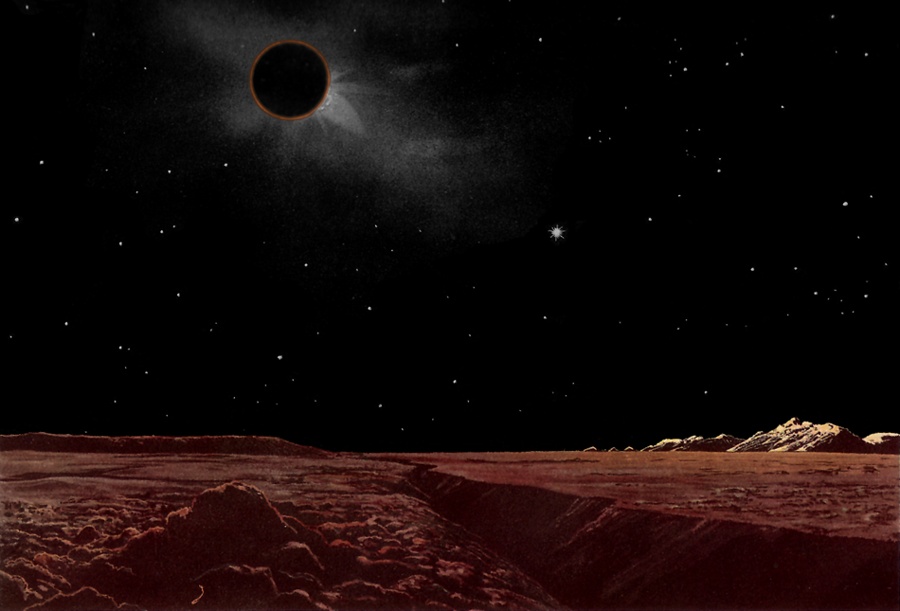
Solar eclipses on the Moon are caused when the planet Earth passes in front of the Sun and blocks its light. Viewers on Earth experience a lunar eclipse during a solar eclipse on the Moon.
These solar eclipses are only seen in the near side portion and smaller parts of the far side where Earth is seen during librations, these areas of the moon making up the visible portion of the Moon. Eclipses there are seen during the lunar sunrise and sunset and extend to the furthermost areas of the near side but mainly not in the polar areas of the Moon. While the Moon orbits Earth, Earth rotates once in nearly 24 hours, but its position at the sky is only in one position, as it never changes. This is in contrast to some other moons or other satellites orbiting other planets or dwarf planets and a few asteroids, even inside the Solar System. They are, however, very rare in the outer part of the Solar System.
The last solar eclipse on the Moon was a total eclipse on 7 September 2025, with the entire near side and tiny surroundings of the far side seeing totality. The next total eclipse will occur on 3 March 2026.
While a solar eclipse on Earth lasts for up to two and a half hours, a solar eclipse on the Moon lasts for up to five and a half hours. However, some eclipses on the Moon last for about five hours in one area, despite the Earth's shadow touching the Moon for a maximum of six hours. When the Earth and Moon are closer, eclipses are longer, and from Earth, the Moon's apparent diameter is greater than the Sun. However, when the Earth and Moon are further apart, eclipses are shorter, and from Earth, the Moon's apparent diameter is lesser than the Sun.
Solar eclipses on Earth start and end at different locations each time, while solar eclipses on the moon always begin in the westernmost parts and end in the easternmost parts of the near side, and are always around the equator. However, partial solar eclipses start near and within the polar areas.
The penumbral shadow does not appear during a solar eclipse on the Moon until it is around 25–30% obscuration. It becomes darker as the Earth blocks the sunlight until it reaches totality. In some eclipses, the penumbral shadow covers the whole surface, whereas the center of the Earth's shadow misses a portion of the Moon while every part of the Nearside sees a partial eclipse. These eclipses are very rare.[citation needed] This has not occurred since the 18th century. On Earth, they are seen as total penumbral eclipses.
The Moon passes a narrow path within the penumbra and outside the umbra, which can happen on the Earth's northern or southern penumbral edges. These eclipses can last up to four and a half hours without having any part of the Moon, notably at its poles, reaching totality.
While the Earth receives a small portion of the Moon's umbra during total solar eclipses, the Moon's near side is usually entirely covered by the Earth's umbra during total solar eclipses. Some total and all partial eclipses have at most half or a part of the Moon being in the Earth's umbra.[citation needed]
Hub AI
Solar eclipses on the Moon AI simulator
(@Solar eclipses on the Moon_simulator)
Solar eclipses on the Moon
Solar eclipses on the Moon are caused when the planet Earth passes in front of the Sun and blocks its light. Viewers on Earth experience a lunar eclipse during a solar eclipse on the Moon.
These solar eclipses are only seen in the near side portion and smaller parts of the far side where Earth is seen during librations, these areas of the moon making up the visible portion of the Moon. Eclipses there are seen during the lunar sunrise and sunset and extend to the furthermost areas of the near side but mainly not in the polar areas of the Moon. While the Moon orbits Earth, Earth rotates once in nearly 24 hours, but its position at the sky is only in one position, as it never changes. This is in contrast to some other moons or other satellites orbiting other planets or dwarf planets and a few asteroids, even inside the Solar System. They are, however, very rare in the outer part of the Solar System.
The last solar eclipse on the Moon was a total eclipse on 7 September 2025, with the entire near side and tiny surroundings of the far side seeing totality. The next total eclipse will occur on 3 March 2026.
While a solar eclipse on Earth lasts for up to two and a half hours, a solar eclipse on the Moon lasts for up to five and a half hours. However, some eclipses on the Moon last for about five hours in one area, despite the Earth's shadow touching the Moon for a maximum of six hours. When the Earth and Moon are closer, eclipses are longer, and from Earth, the Moon's apparent diameter is greater than the Sun. However, when the Earth and Moon are further apart, eclipses are shorter, and from Earth, the Moon's apparent diameter is lesser than the Sun.
Solar eclipses on Earth start and end at different locations each time, while solar eclipses on the moon always begin in the westernmost parts and end in the easternmost parts of the near side, and are always around the equator. However, partial solar eclipses start near and within the polar areas.
The penumbral shadow does not appear during a solar eclipse on the Moon until it is around 25–30% obscuration. It becomes darker as the Earth blocks the sunlight until it reaches totality. In some eclipses, the penumbral shadow covers the whole surface, whereas the center of the Earth's shadow misses a portion of the Moon while every part of the Nearside sees a partial eclipse. These eclipses are very rare.[citation needed] This has not occurred since the 18th century. On Earth, they are seen as total penumbral eclipses.
The Moon passes a narrow path within the penumbra and outside the umbra, which can happen on the Earth's northern or southern penumbral edges. These eclipses can last up to four and a half hours without having any part of the Moon, notably at its poles, reaching totality.
While the Earth receives a small portion of the Moon's umbra during total solar eclipses, the Moon's near side is usually entirely covered by the Earth's umbra during total solar eclipses. Some total and all partial eclipses have at most half or a part of the Moon being in the Earth's umbra.[citation needed]
Recent media