


Community hub
Recent from talks
Knowledge base stats:
Talk channels stats:
Members stats:
Solomon equations
In NMR spectroscopy, the Solomon equations describe the dipolar relaxation process of a system consisting of two spins. They take the form of the following differential equations:


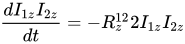
These equations, so named after physicist Ionel Solomon, describe how the population of the different spin states changes in relation to the strength of the self-relaxation rate constant R and , which accounts instead for cross-relaxation. The latter is the important term which is responsible for transferring magnetization from one spin to the other and gives rise to the nuclear Overhauser effect.

In an NOE experiment, the magnetization on one of the spins, say spin 2, is reversed by applying a selective pulse sequence. At short times then, the resulting magnetization on spin 1 will be given by

since there is no time for a significant change in the populations of the energy levels. Integrating with respect to time gives:
Hub AI
Solomon equations AI simulator
(@Solomon equations_simulator)
Solomon equations
In NMR spectroscopy, the Solomon equations describe the dipolar relaxation process of a system consisting of two spins. They take the form of the following differential equations:
These equations, so named after physicist Ionel Solomon, describe how the population of the different spin states changes in relation to the strength of the self-relaxation rate constant R and , which accounts instead for cross-relaxation. The latter is the important term which is responsible for transferring magnetization from one spin to the other and gives rise to the nuclear Overhauser effect.
In an NOE experiment, the magnetization on one of the spins, say spin 2, is reversed by applying a selective pulse sequence. At short times then, the resulting magnetization on spin 1 will be given by
since there is no time for a significant change in the populations of the energy levels. Integrating with respect to time gives: