Hubbry Logo
Sonnet 12Sonnet 12Main
Open search
Sonnet 12
Community hub
Sonnet 12
logo
8 pages, 0 posts
0 subscribers
Be the first to start a discussion here.
Sonnet 12
Sonnet 12
from Wikipedia

Sonnet 12
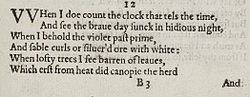
Detail of old-spelling text
The first six lines of Sonnet 12 in the 1609 Quarto

Q1


Q2


Q3


C

When I do count the clock that tells the time,
And see the brave day sunk in hideous night;
When I behold the violet past prime,
And sable curls all silver’d o’er with white;
When lofty trees I see barren of leaves,
Which erst from heat did canopy the herd,
And summer’s green all girded up in sheaves,
Borne on the bier with white and bristly beard,
Then of thy beauty do I question make,
That thou among the wastes of time must go,
Since sweets and beauties do themselves forsake
And die as fast as they see others grow;
And nothing ’gainst Time’s scythe can make defence
Save breed, to brave him when he takes thee hence.


4


8


12

14

—William Shakespeare[1]

Sonnet 12 is one of 154 sonnets written by the English playwright and poet William Shakespeare. It is a procreation sonnet within the Fair Youth sequence.

In the sonnet, the poet goes through a series of images of mortality, such as a clock, a withering flower, a barren tree and autumn, etc. Then, at the "turn" at the beginning of the third quatrain, the poet admits that the young man to whom the poem is addressed must go among the "wastes of time" just as all of the other images mentioned. The only way he can fight against Time, Shakespeare proposes, is by breeding and making a copy of himself.

Modern reading

[edit]
Clock: Hours on the clock, the time passing
Brave: Having great beauty and/or splendor [2]
Past prime: Declining from its perfection [3]
Sable: Black (A Heraldic term) [3]
Erst: Formerly, Once [3]
Summer's Green: Foliage
Sheaves: Bundles
Bier: A frame used to carry a corpse to the grave.[3]
Beard: In Elizabethan times, "beard" was pronounced as "bird" [3]
Sweets: Virtues
Others: Referencing other virtues and beauties
'gainst: Against
Breed: Offspring, Descendants
Brave: Defy .[3]

The sonnet is one long sentence, which helps to show the theme of time and its urgency.[4] It also suggests that it is one full and rounded thought, rather than many different points. There are also many contrasts showing time's power such as the words "lofty" and "barren" when describing the trees, alluding to time's power over all of nature.[4] This sonnet also shows the power of time, in that it is deadly and not merciful. Shakespeare shows time's power by using the descriptive words of "white and bristly beard," "violet past prime," and "sable curls all silver'd o'er with white." One last image to take note of is the fact that the only way to defy time is by creating new virtues and beauties. And to do this, Shakespeare tells the young man, is by creating descendants.[4] This fact is shown in the volta, the last two lines of the sonnet, when Shakespeare says, "And nothing 'gainst time's scythe can make defence, / Save breed to brave him when he takes thee hence."

Structure

[edit]

Sonnet 12 follows the structure of a typical Shakespearean sonnet.[5] It consists of 14 lines of which 12 belong to three quatrains and the last two belong to the couplet, with rhyme scheme ABAB CDCD EFEF GG. Reflecting this structure, the first three quatrains develop an argument of despair, and the couplet suggests a (somewhat) hopeful resolution. However, the argument of the poem may also be seen as reflecting the older structure of the Petrarchan sonnet: lines one through eight are the octave[6] which concerns the decay that occurs in nature, and these lines are connected through alliteration.[7] Lines nine through fourteen form a rhetorical sestet [6] concerning the decay of the beloved.

The first line is often cited as (appropriately) displaying a metronomic regularity:

  ×  /  ×  /      ×   /     ×   /      ×  / 
When I do count the clock that tells the time,
/ = ictus, a metrically strong syllabic position. × = nonictus.

Critical analysis

[edit]

The sonnet's position in the sequence at number 12 coincides with the 12 hours on a clock-face.[8] Sonnet 12 also represents the first time in which the speaker's first person pronoun, "I" (also a mark on a clock's face), dominates the poem, indicating the beginning of his voice's ascendancy in the unfolding drama of the sequence.[9] Helen Vendler proposes the poem holds two models of time: one of gradual decay, and one of an aggressive emblem-figure of Time with his scythe. These ideas call up two approaches of Death: one sad and innocent in which everything slowly wastes away, growing barren and aged, and one in which the reaper actively cuts them down and takes them away as if life had been murdered.[9]

As Vendler notes, the first 12 lines of the poem are associated with the innocent death of decay with time. Carl Atkins adds to this, describing how much of the imagery used is transmuted from lively, growing identities to macabre indifference, such as "the harvest-home .. into a funeral, and the wagon laden with ripened corn becomes a bier bearing the aged dead".[2] These lines bring Time's aging decay into the spotlight as a natural and inexorable force in the world.

The crux of Vendler's analysis comes out of the phrase 'Sweets and Beauties' in line 11. She notes that the word "Beauties" is clearly a reference back to the earlier lines containing aesthetic beauties that wither away with time, and that "Sweets" has a deeper, moral context. She holds that Beauties are outward show and Sweets are inward virtues, and that both fade with the passage of time.[9] An example of one of the 'beauties' with a virtuous provision can be found on line 6 in the 'virtuous generosity of the canopy sheltering the herd'. In Vendler's interpretation, the act of the canopy providing the herd with shelter from the elements is given freely, without expectation or need of anything in return. Such an act is classified as generosity and so is virtuous by nature. Atkins agrees, also noting that the "Sweet" favor of the canopy will share the same fate as the beauties, fading with time as the leaves disappear.[2] Michael Schoenfeldt's scholarly synopsis of the sonnet focuses on Vendler's analysis of the anthropomorphizing of the autumnal mortality, in particular the use of stark, particular words (barren, bier, beard) to replace, with anthropomorphic emphasis, more common descriptors (shed, corn, gathered, wagon, awn).[10] He views these careful linguistic choices to be essential in understanding the grim theme underlying beauty's demise.

In the latter portion of her analysis, Vendler proposes a third, voluntary approach to death. All the natural images used in the poem point to including death as part of the cycle of life and imply that some things must embrace death willingly to allow for new growth to flourish. The speaker goes on to associate breeding and procreation with a new supply of budding virtue in the final lines of the poem. This surrender of beauty and the proliferation of virtue is implied as the way to triumph over Time and Death, and is the primary message from the speaker.[9]

Interpretations

[edit]

Notes

[edit]

References

[edit]
[edit]
Revisions and contributorsEdit on WikipediaRead on Wikipedia
from Grokipedia
Sonnet 12, subtitled "When I do count the clock that tells the time," is one of 154 sonnets composed by the English playwright and poet . First published in 1609 in the quarto collection Shake-speares Sonnets by Thomas Thorpe, it forms part of the Fair Youth sequence (sonnets 1–126), which addresses an idealized young male figure, and specifically belongs to the initial procreation sonnets (1–17) that exhort the addressee to marry and father children as a means to defy mortality. The poem meditates on the relentless progression of time and its inevitable decay of natural and human beauty, culminating in the argument that only reproduction can provide enduring legacy against time's destructive force. Like all of Shakespeare's sonnets, Sonnet 12 adheres to the English (or Shakespearean) form: fourteen lines divided into three quatrains and a concluding , composed in with the ABAB CDCD EFEF GG. This structure allows for a progressive development of imagery across the quatrains, building toward the volta (turn) in the couplet, where the speaker shifts from observation to direct exhortation. The poem's language employs vivid, seasonal metaphors drawn from nature to evoke transience, reinforcing its thematic focus on impermanence. In the opening , the speaker contemplates the clock's measurement of time and the day's descent into night, establishing time as an active, consuming agent. The second extends this to organic decay, observing a violet withered past its prime and dark hair ("sable curls") silvered with age. The third shifts to arboreal , depicting once-leafy trees barren in winter and summer's greenery harvested like a corpse on a , symbolizing life's harvest by death. The closing resolves the meditation by questioning the youth's beauty's fate amid time's wastes and asserting that "nothing ’gainst Time’s can make defense / Save ," thus emphasizing procreation as the sole bulwark against oblivion.

Publication and Text

Original Publication

Sonnet 12 first appeared in print in the 1609 edition titled Shake-speares Sonnets, published in by Thomas Thorpe. This volume, printed by George Eld, collected 154 sonnets attributed to and is considered the authoritative source for the sequence. Thorpe, a publisher known for issuing works by contemporary authors, edited the collection without Shakespeare's direct involvement, as no evidence suggests otherwise. Within the 1609 quarto, Sonnet 12 occupies the twelfth position in the opening of 126 sonnets addressed to a "Fair Youth," a young nobleman idealized for his beauty and urged toward procreation to defy time's decay. The numbering as 12 has been interpreted as symbolically evoking the 12 hours on a , reinforcing the sonnet's meditation on temporal progression through imagery of clocks and seasonal cycles. No earlier printed or manuscript versions of Sonnet 12 exist; while two other sonnets (138 and 144) circulated in the 1599 anthology , the full , including Sonnet 12, shows no evidence of pre-1609 dissemination in , private manuscripts, or other publications. The quarto opens with a cryptic dedication "TO. THE. ONLIE. BEGETTER. OF. THESE. ENSVING. SONNETS. M r. W. H. ALL. HAPPINESSE. AND. THAT. ETERNITIE. PROMISED. BY. OVR. EVER-LIVING. POET. WISHETH. THE. VVELL-VVISHING. ADVENTV RER. IN. SETTING. FORTH. T. T.," where "T. T." refers to Thomas Thorpe. The identity of "Mr. W.H.," described as the "onlie begetter" (possibly the inspirer or procurer of the sonnets), remains a subject of scholarly debate, with prominent theories identifying him as William Herbert, third (a patron of Shakespeare), or Henry Wriothesley, third Earl of Southampton (to whom Shakespeare dedicated Venus and Adonis in 1593). These candidates fit the initials if rearranged or interpreted anagramatically, though no definitive proof resolves the question.

Textual Variants and Modern Editions

The sole authoritative text of Shakespeare's Sonnet 12 derives from the 1609 (Shake-speares Sonnets), which presents the poem with Elizabethan and that can affect its rhythmic flow. The full transcription from the Quarto reads as follows:
VVhen I doe count the clock that tels the time,
And ſee the braue day ſunck in hidious night,
When I behold the violet paſt prime,
And ſable curls, or ſiluer'd ore with white:
When lofty trees I ſee barren of leaues,
Which erſt from did canopie the herd
And Sommers greene all girded vp in ſheaues,
Borne on the beare with white and briſtly beard:
Then of thy do I queſtion make
That thou among the waſtes of time muſt goe,
Since ſweets and beauties do them-ſelues forſake,
And die as faſt, as they ſee others grow,
And nothing 'gainſt Times ſieth can make defence,
Saue breed to braue him, when he takes thee hence.
Notable orthographic features include the use of "VV" for "W" in the initial line, long "s" (ſ) throughout, "hidious" for modern "hideous," "sunck" for "sunk," "paſt" for "past," " ſiluer'd ore" for "silvered o'er," "leaues" for "leaves," "erſt" for "erst," "canopie" for "canopy," "Sommers" for "Summer's," " ſheaues" for "sheaves," "beare" for "bier," "queſtion" for "question," "waſtes" for "wastes," "muſt" for "must," "forſake" for "forsake," "faſt" for "fast," " 'gainſt" for "'gainst," " ſieth" for "scythe," and "Saue" for "Save." These spellings reflect compositor practices and do not alter the core meaning but influence and . Among key variants, line 4's "or ſiluer'd ore with white" has been widely emended to "all silvered o'er with white" since Lewis Theobald's 1733 edition, interpreting "or" as a potential for "all" to emphasize complete transformation of black curls to white; this change was adopted by subsequent editors including , though some scholars argue it disrupts the sonnet's theme of ongoing decay by implying totality rather than progression. Similarly, line 8's "beare" is typically emended to "" to evoke a , a correction appearing in early 18th-century editions and standardized thereafter. Line 14's "Times ſieth" is emended to "Time's ," recognizing "sieth" as a misspelling of "," the instrument of and death, with this adjustment first proposed by in 1709 and universally accepted by the . "Brave" in lines 2 and 14, meaning "splendid" or "fine," remains unchanged but is sometimes glossed as "beautiful" in modern contexts. Eighteenth- and nineteenth-century editors introduced interventions to clarify and regularize the text. Edmond Malone's edition, the first scholarly presentation of the sonnets since , retained the Quarto's wording with minor spelling modernizations (e.g., "sunk" for "sunck") but significantly altered , such as adding commas to improve , which subtly shifted rhythmic pauses and emphasis in lines like 4 and 10. Alexander Dyce's 1857 and revised 1867 editions built on Malone, adopting emendations like "all silvered o'er" and "" while standardizing contractions and apostrophes (e.g., "Time's "); Dyce also adjusted line 7's "girded up in sheaves" for smoother flow without altering substantives. These changes prioritized intelligibility over strict fidelity, influencing that affects the sonnet's meditative pace. Modern editions balance authenticity with accessibility. The Riverside Shakespeare (2nd ed., 1997), edited by G. Blakemore Evans, provides a modernized text (e.g., "hideous night," "all silvered o'er with white," "Time's ") while appending the Quarto's original spelling in appendices for comparison, emphasizing orthographic differences like "hidious" to highlight Elizabethan usage. (3rd ed., 2010), edited by Katherine Duncan-Jones, retains Quarto readings where unproblematic (e.g., "or silver'd o'er") but adopts common emendations like "" and "," with extensive glosses explaining variants such as "brave" as "splendid" and discussions of line 4's "or" as potentially meaning "ere" or "formerly" to preserve temporal nuance. Both editions include footnotes on editorial choices, avoiding speculative interpretations while documenting how variants impact phrasing.

Form and Structure

Rhyme Scheme and Meter

Sonnet 12 adheres to the Shakespearean form, consisting of 14 lines divided into three quatrains and a final , composed in with the ABAB CDCD EFEF GG. This structure, also known as the English , contrasts with the Petrarchan form by employing alternating rhymes in the quatrains that build toward the conclusive . In Sonnet 12, the specific rhymes enhance the poem's rhythmic progression and thematic with decay and transience. The first features full rhymes such as "time" and "prime" (lines 1 and 3) and "night" and "white" (lines 2 and 4), where the sharp consonants in "time" and "prime" contrast with the softer vowels in their pairs, creating an auditory shift that mirrors the transition from vitality to decline. The second continues with "leaves" and "sheaves" (lines 5 and 7) and "herd" and "beard" (lines 6 and 8), employing slant rhymes that evoke the rustling and fading of natural elements through their sounds. The third uses "make" and "forsake" (lines 9 and 11) alongside "go" and "grow" (lines 10 and 12), with the internal echoes reinforcing the inexorable passage described. The concludes with "defence" and "hence" (lines 13 and 14), a tight pairing that underscores resolution through its crisp finality. The meter is predominantly , with each line comprising ten s arranged in five iambs—an unstressed followed by a stressed one—providing a steady, heartbeat-like that suits the 's on time's relentless advance. For instance, line 1 scans as "When I do COUNT the CLOCK that TELLS the TIME," maintaining the iambic pattern throughout without significant substitutions in this sonnet. This regularity supports the poem's formal elegance, occasionally varied in Shakespeare's oeuvre for emphasis but here consistent to emphasize inexorability. Sonnet 12 also employs and to amplify its sonic texture, integrating these devices seamlessly into the metrical framework. appears in phrases like "brave day" (line 2), where the b-sound conveys boldness yielding to , and "sable curls all silver'd o'er with white" (line 4), with the s-sounds evoking the whisper of aging hair. reinforces vowel harmonies, as in "sunk in hideous night" (line 2), uniting the short u-sounds to suggest submersion, and "beauties do themselves forsake" (line 11), where the e-vowels link ideas of self-betrayal in decay. These phonetic elements heighten the auditory impact without disrupting the iambic flow.

Structural Divisions and Volta

Shakespeare's Sonnet 12 adheres to the traditional Shakespearean form of three followed by a concluding , yet it exhibits a pronounced - division that evokes the Petrarchan , with the first eight lines serving as an of observation and the final six as a of resolution. In this arrangement, the enumerates time's ravages through successive examples across the initial two , building a cumulative sense of inevitable decay, while the pivots to address the fair youth directly and propose a countermeasure. The third integrates into this , refining the argument by questioning the youth's impending subjection to time's wastes, before the delivers a resolute . The volta occurs at line 9 with the transitional "Then," marking a decisive shift from impersonal observation of natural and human decline in the octave to a personal interrogation of the youth's beauty in the sestet: "Then of thy beauty do I question make / That thou among the wastes of time must go." This turn transforms the poem's contemplative despair into argumentative urgency, contrasting the passive fading depicted earlier with an active solution centered on lineage. Despite the Shakespearean rhyme scheme, this volta at line 9—rather than the more conventional placement before the couplet—underscores the sonnet's hybrid form, blending quatrain-based progression with a Petrarchan emotional arc. Enjambment and caesura further shape the pacing, propelling the argument from accumulation of evidence to hopeful resolution. across lines 5–10 creates a fluid continuity between quatrains, mirroring the relentless flow of time's decay and sustaining momentum into the volta. Caesuras, particularly in lines 7–12, introduce deliberate pauses that heighten tension and denial, slowing the to emphasize the inexorability of loss before accelerating toward the couplet's defiant imperative. These devices collectively guide the reader from a meditative survey of mutability to an empowered exhortation, reinforcing the sonnet's structural coherence.

Themes and Imagery

Images of Time and Decay

In Shakespeare's Sonnet 12, the speaker enumerates a series of vivid natural and temporal images to illustrate the inexorable advance of time and its corrosive effect on beauty and vitality. The poem opens with the clock, described as "the clock that tells the time," which mechanically counts hours in a monotonous , evoking time's relentless, mechanical progression toward mortality. This auditory image underscores the unyielding measurement of life's decay, a motif that permeates the sonnet's early lines. The swiftly shifts to the diurnal cycle, where the speaker observes "the brave day sunk in hideous night," portraying the sun's descent as a for vitality yielding to obscurity and . This visual contrast highlights time's daily erosion of light and life, transforming splendor into desolation. Immediately following, the "violet past prime" symbolizes the transient bloom of beauty, its once-vibrant petals wilting beyond their peak, while " curls all silver'd o'er with white" depicts human hair graying with age, a tangible sign of youth's inevitable surrender to decay. These botanical and corporeal images collectively emphasize nature's and humanity's subjection to temporal decline. The second quatrain extends this theme to arboreal and seasonal motifs, with "lofty trees I see barren of leaves, / Which erst from heat did canopy the herd," illustrating winter's stripping of foliage and the loss of protective shelter once provided by summer's abundance. The harvest scene intensifies the decay: "summer's green all girded up in sheaves / Borne on the with white and bristly beard," where ripened crops are bundled like a corpse on a funeral , bearded with stubble, equating agricultural reaping to mortality's grim procession. This of the as a death rite reinforces time's role as a destroyer of seasonal renewal. Culminating the octet, the speaker questions the addressee's beauty amid "the wastes of time," a desolate of eroded remnants, while "sweets and beauties do themselves forsake / And die as fast as they see others grow," conveying the self-eroding cycle where one generation's allure fades as another's emerges, only to suffer the same fate. The personifies time explicitly with "Time's ," a sharp blade evoking the grim reaper's of life, against which all natural elements prove defenseless. These images build cumulatively to portray time not merely as a passage but as an active agent of ruination.

Procreation as Counter to Time

In Shakespeare's Sonnet 12, the speaker proposes procreation as the sole antidote to the inexorable decay wrought by time, a theme that permeates the early sequence of sonnets addressed to the Fair Youth. This belongs to the procreation group (Sonnets 1–17), where the poet repeatedly exhorts the young man to marry and father children, thereby ensuring the perpetuation of his beauty and virtue beyond his mortal lifespan. The urgency arises from the preceding of natural and human decline—such as the withering of leaves, the of hair, and the barrenness of strong oaks—which underscores time's relentless harvest. The volta in lines 13–14 crystallizes this solution: "And nothing 'gainst Time's can make defence / Save , to brave him when he takes thee hence." Here, "" refers explicitly to , positioning as the only bulwark against the personified Time wielding its , a for and dissolution. The phrase "to brave him" conveys defiance, as the children inherit and display the youth's "bounteous gift" of , challenging time's by extending the line into . This act of husbandry transforms passive decay into active legacy, aligning with the sonnet's broader ecological of cultivation and renewal. An ironic tension emerges in line 12—"And die as fast as they see others grow"—which juxtaposes the rapid succession of beauties with the potential for positive generational continuity through procreation. While the line initially evokes the futile cycle of one beauty fading as another arises, it contrasts sharply with the affirmative growth enabled by heirs, who "grow" not merely to replace but to immortalize the original. This irony highlights the youth's agency: refusal to breed accelerates personal obsolescence, whereas reproduction defies time's harvest by fostering enduring increase.

Interpretations and Analysis

Traditional Interpretations

In the nineteenth century, scholars interpreted Shakespeare's Sonnet 12 as a direct exhortation in the tradition, urging the addressee to procreate as a bulwark against the mutability wrought by time. The sonnet consolidates the procreation motifs from earlier poems in (Sonnets 1–17), presenting time's inexorable decay through natural imagery like withering violets and barren trees, culminating in the ethical call to "" and thereby defy time's . This reading aligns with Victorian views of the sonnet as a , where serves as a rational response to inevitable transience, rooted in the poem's volta that shifts from observation to admonition. The sonnet's motifs of decay draw heavily from , which revived classical concerns with time's destructive force, particularly through Ovid's . Humanist scholars and poets of the era, influenced by Ovid's depictions of transformation and dissolution (e.g., Book XV, lines 199–216 in Arthur Golding's translation), viewed mutability as a universal condition afflicting beauty and nature alike. In Sonnet 12, this manifests in the progression from diurnal cycles to seasonal barrenness and human aging ("sable curls all silvered o'er"), reflecting a humanist synthesis of pagan philosophy and Christian temporality, where time's tyranny underscores the fragility of earthly existence. Traditional interpretations consistently portray the Fair Youth as an idealized embodiment of youthful beauty, whose preservation demands propagation through lineage to counter time's erosion. The sonnet's speaker implores the youth to sire heirs, ensuring his virtues endure beyond physical decay, a theme emblematic of early modern anxieties about legacy and continuity. This view positions the youth not merely as a romantic figure but as a exemplar, whose refusal to procreate would squander divine gifts against nature's . Early twentieth-century critics reinforced this moral framework, framing time in Sonnet 12 as an ethical imperative that compels through rather than mere endurance. The sonnet's structure—its enumerative quatrains building to a thematic resolution in the —serves as a rhetorical escalation of time's destructiveness, from mechanical clocks to human , ultimately advocating familial propagation as the sole "defence" against oblivion. Critics noted the sonnet's tension between this procreative duty and the sequence's undercurrents of same-sex affection, yet upheld the ethical urgency of begetting children to achieve lasting legacy.

Modern and Contemporary Readings

In the late 20th century, analyzed Sonnet 12 as presenting dual models of time, contrasting the clock's representation of linear, gradual decay with the scythe's emblem of sudden harvest and death, thereby underscoring the poem's tension between inevitable attrition and abrupt finality. This interpretation highlights how the sonnet's shifts from measured progression to violent interruption, emphasizing time's multifaceted destructiveness. Queer readings of the , particularly in the , have emphasized homo undertones in the speaker's address to the male Fair Youth, focusing on the sensual appreciation of his transient beauty amid decay. , in his commentary on the sonnets, frames the sequence's expressions of desire for the Youth as intense affection, interpreting lines praising youthful vigor as charged with erotic longing that challenges heteronormative procreation urgings. Recent scholarship has further complicated temporal frameworks in the sonnet. A 2023 study from Oxford University describes Sonnet 12's "Janus-headed chronology," where the lost object's semblance resides in future desire yet roots in past memory, blending retrospection with anticipation to reframe time's linearity as bidirectional and psychologically layered. Complementing this, contemporary analyses continue to interrogate conventional perceptions of time in the Youth's context, positing that the sonnet disrupts linear mortality narratives by invoking cyclical renewal through natural imagery, thereby challenging fatalistic views of decay. Ecocritical perspectives extend this by viewing the poem's depictions of nature's decay—such as fading violets and barren harvests—as allegories for environmental imbalance, where the Youth's potential procreation symbolizes sustainable husbandry to counter ecological and preserve vitality against temporal ruin.

Critical Reception

Early Scholarship

In the 17th century, Shakespeare's sonnets, including Sonnet 12, circulated primarily in manuscript form among private circles, where they were alluded to in contemporary poetry as philosophical meditations on love, time, and mortality rather than conventional romantic verse. Early references, such as Francis Meres's 1598 praise of Shakespeare's "sugared sonnets" in Palladis Tamia, positioned them alongside Ovidian love poetry, emphasizing their introspective depth and exploration of human transience. By mid-century, editors like John Benson in his 1640 collection reshaped the sonnets to align with heterosexual norms, yet allusions persisted in poetic responses that treated them as contemplative pieces on decay and endurance, influencing later in their use of compressed, emblematic imagery. This approach influenced early understandings by framing the sonnet's imagery not as personal confession but as a broad reflection on , aligning with neoclassical emphasis on and philosophical generality. During the Romantic period, Samuel Taylor Coleridge's lectures from 1811 to 1819 celebrated the sonnets for their masterful compression of natural imagery, praising how Shakespeare evoked the relentless march of time through vivid, organic symbols like clocks, seasons, and barren trees. In his Literary Remains and related notes, Coleridge described the sonnets as profound imaginative achievements, where elements of serve as "symbols of states" rather than mere decoration, elevating Sonnet 12's progression from daily cycles to cosmic ruin as a pinnacle of poetic intensity. This Romantic lens shifted interpretations toward the sonnets' emotional and symbolic density, influencing views of their philosophical meditation on beauty's ephemerality. Victorian critics, exemplified by George Brandes in his 1898 William Shakespeare: A Critical Study, increasingly emphasized biographical connections, linking the sonnets—particularly those addressed to the "fair youth"—to Shakespeare's patrons such as the Earl of Southampton. Brandes argued that discerning the sonnets' autobiographical value demanded historical insight and tact, suggesting Sonnet 12's urgency about procreation reflected Shakespeare's real-life anxieties tied to and legacy under figures like , whom he identified as the sequence's inspiration. This approach reinforced the sonnet's themes of time and decay as veiled personal appeals for continuity through heirs or artistic , shaping late-19th-century scholarship's focus on the poet's social and relational context.

Recent Analyses and Studies

In the latter half of the and into the 21st, scholarship on Sonnet 12 has emphasized the poem's layered of time's destructive power, particularly the fusion of and motifs in lines 7–8, where "summer's green all girded up in sheaves / Borne on the with white and bristly beard" evokes a figure that blurs seasonal abundance with human mortality, influencing interpretations of inevitable decay across the . This reading aligns with broader examinations of growth and decay in Shakespeare's early sonnets, where natural cycles underscore the futility of resisting time without procreation. Comparative studies have highlighted connections to other sonnets in the Fair Youth sequence, noting shared autumnal motifs with , where both poems deploy seasonal barrenness—withered violets and leafless trees in Sonnet 12, twilight and dying embers in —to symbolize aging and loss, reinforcing time as an equalizer of beauty and vitality. Similarly, analyses contrast Sonnet 12's mechanical clock with the organic "waves" of time in Sonnet 60, illustrating Shakespeare's varied metaphors for temporal erosion while maintaining the procreation imperative as a counterforce. A 2019 thesis applies to explore the irony of "wasted " in Sonnet 12, arguing that the speaker's enumeration of decaying images paradoxically underscores the 's potential for legacy through , using and to idleness amid time's march. Recent work, such as a 2024 analysis, situates the sonnet within the sequence's temporal conventions, viewing its position as the 12th poem as emblematic of cyclical patterns like hours and months, which amplify the urgency of defying decay via reproduction. The sonnet's procreation theme has informed adaptations in and theater, where references to immortalizing through heirs echo in productions exploring Shakespeare's , such as interpretations that dramatize the youth's against time's . Scholarship gaps persist in interdisciplinary approaches; while eye-tracking studies since 2020 have probed cognitive processing of Shakespearean , examining rereading effects on fluency and appreciation, they predominantly focus on Sonnets 27 and 66, leaving neuroscientific analyses of Sonnet 12's temporal underexplored beyond preliminary quantitative narrative models.

References

Add your contribution
Related Hubs
User Avatar
No comments yet.