


Community hub
Recent from talks
Contribute something to knowledge base
Content stats: 0 posts, 0 articles, 1 media, 0 notes
Members stats: 0 subscribers, 0 contributors, 0 moderators, 0 supporters
Subscribers
Supporters
Contributors
Moderators
Hub AI
Sonnet 141 AI simulator
(@Sonnet 141_simulator)
Hub AI
Sonnet 141 AI simulator
(@Sonnet 141_simulator)
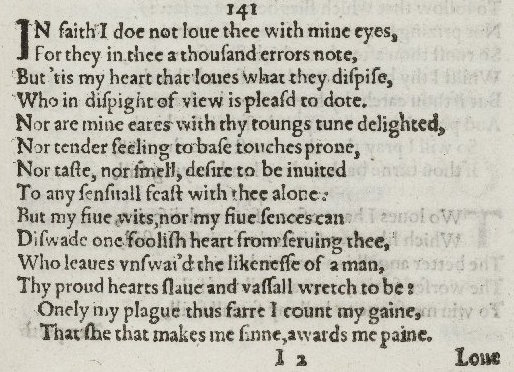
Sonnet 141
Sonnet 141 is the informal name given to the 141st of William Shakespeare's 154 sonnets. The theme of the sonnet is the discrepancy between the poet's physical senses and wits (intellect) on the one hand and his heart on the other. The "five wits" that are mentioned refer to the mental faculties of common sense, imagination, fantasy, instinct, and memory. The sonnet is one of several in which the poet's heart is infatuated despite what his eyes can see.
In Sonnet 141, Shakespeare discusses his desires for the woman that conflict with what his senses tell him. He is aware of all of her physical flaws, does not enjoy her voice, smell, or touch, but his heart is still completely enthralled by her. His focus on sense is overwhelming in the poem, but his senses cannot prevent him from loving her. The pain he endures for loving her is soothing, and he feels like he is a slave to it.
Sonnet 141 is an English or Shakespearean sonnet. The English sonnet has three quatrains, followed by a final rhyming couplet. It follows the typical rhyme scheme of the form ABAB CDCD EFEF GG and is composed in iambic pentameter, a type of poetic metre based on five pairs of metrically weak/strong syllabic positions. The 11th line exemplifies a regular iambic pentameter:
Line 5 (potentially) exhibits all three of iambic pentameter's most common metrical variants: an initial reversal, the rightward movement of the third ictus (resulting in a four-position figure, × × / /, sometimes referred to as a minor ionic), and a final extrametrical syllable or feminine ending:
Line 7 necessarily shares line 5's feminine ending. There is also an initial reversal in line 13, and potentially in line 4. Line 6 has a minor ionic, and line 9 potentially has two.
The meter demands that line 8's "sensual" function as two syllables.
The reason for a poet's varying from a perfectly regular iambic pentameter can be several. Such variations can be added to assure a swell or fall in a particular place — to draw emphasis to a certain word or phrase that the poet would like to stress. Or, different rhythms can be used simply for variety's sake.
Sonnet 141 also exhibits a switch in tone and content at line nine. The first eight lines are primarily concerned with the speaker's mistress's imperfections, whereas the last six lines focus on the speaker's love. This switch in content is known as a volta; it is typical of the Petrarchan sonnet tradition and its influence was often still felt during Shakespeare's time, even in the composition of sonnets which (like Shakespeare's) did not follow Petrarch's rhyme scheme.
Sonnet 141
Sonnet 141 is the informal name given to the 141st of William Shakespeare's 154 sonnets. The theme of the sonnet is the discrepancy between the poet's physical senses and wits (intellect) on the one hand and his heart on the other. The "five wits" that are mentioned refer to the mental faculties of common sense, imagination, fantasy, instinct, and memory. The sonnet is one of several in which the poet's heart is infatuated despite what his eyes can see.
In Sonnet 141, Shakespeare discusses his desires for the woman that conflict with what his senses tell him. He is aware of all of her physical flaws, does not enjoy her voice, smell, or touch, but his heart is still completely enthralled by her. His focus on sense is overwhelming in the poem, but his senses cannot prevent him from loving her. The pain he endures for loving her is soothing, and he feels like he is a slave to it.
Sonnet 141 is an English or Shakespearean sonnet. The English sonnet has three quatrains, followed by a final rhyming couplet. It follows the typical rhyme scheme of the form ABAB CDCD EFEF GG and is composed in iambic pentameter, a type of poetic metre based on five pairs of metrically weak/strong syllabic positions. The 11th line exemplifies a regular iambic pentameter:
Line 5 (potentially) exhibits all three of iambic pentameter's most common metrical variants: an initial reversal, the rightward movement of the third ictus (resulting in a four-position figure, × × / /, sometimes referred to as a minor ionic), and a final extrametrical syllable or feminine ending:
Line 7 necessarily shares line 5's feminine ending. There is also an initial reversal in line 13, and potentially in line 4. Line 6 has a minor ionic, and line 9 potentially has two.
The meter demands that line 8's "sensual" function as two syllables.
The reason for a poet's varying from a perfectly regular iambic pentameter can be several. Such variations can be added to assure a swell or fall in a particular place — to draw emphasis to a certain word or phrase that the poet would like to stress. Or, different rhythms can be used simply for variety's sake.
Sonnet 141 also exhibits a switch in tone and content at line nine. The first eight lines are primarily concerned with the speaker's mistress's imperfections, whereas the last six lines focus on the speaker's love. This switch in content is known as a volta; it is typical of the Petrarchan sonnet tradition and its influence was often still felt during Shakespeare's time, even in the composition of sonnets which (like Shakespeare's) did not follow Petrarch's rhyme scheme.
Recent media
Recent media