Hubbry Logo
Sonnet 20Sonnet 20Main
Open search
Sonnet 20
Community hub
Sonnet 20
logo
8 pages, 0 posts
0 subscribers
Be the first to start a discussion here.
Sonnet 20
Sonnet 20
from Wikipedia

Sonnet 20
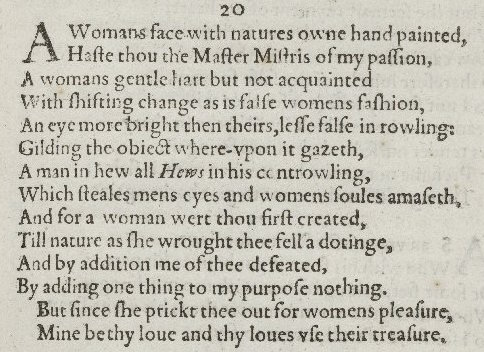
Detail of old-spelling text
Sonnet 20 in the 1609 Quarto

Q1


Q2


Q3


C

A woman’s face with Nature’s own hand painted
Hast thou, the master-mistress of my passion;
A woman’s gentle heart, but not acquainted
With shifting change, as is false women’s fashion;
An eye more bright than theirs, less false in rolling,
Gilding the object whereupon it gazeth;
A man in hue, all “hues” in his controlling,
Which steals men’s eyes and women’s souls amazeth.
And for a woman wert thou first created;
Till Nature, as she wrought thee, fell a-doting,
And by addition me of thee defeated,
By adding one thing to my purpose nothing.
But since she prick’d thee out for women’s pleasure,
Mine be thy love and thy love’s use their treasure.


4


8


12

14

—William Shakespeare[1]

Sonnet 20 is one of the best-known of 154 sonnets written by the English playwright and poet William Shakespeare. Part of the Fair Youth sequence (which comprises sonnets 1-126), the subject of the sonnet is widely interpreted as being male, thereby raising questions about the sexuality of its author. In this sonnet (as in, for example, Sonnet 53) the beloved's beauty is compared to both a man's and a woman's.

Structure

[edit]

Sonnet 20 is a typical English or Shakespearean sonnet, containing three quatrains and a couplet for a total of fourteen lines. It follows the rhyme scheme of this type of sonnet, ABAB CDCD EFEF GG. It employs iambic pentameter, a type of poetic metre based on five pairs of metrically weak/strong syllabic positions. "Only this sonnet about gender has feminine rhymes throughout."[2]

The first line exemplifies regular iambic pentameter with a final extrametrical syllable or feminine ending:

×  / ×     /    ×    / ×     /    ×    /  (×)
A woman's face with nature's own hand painted, (20.1)
/ = ictus, a metrically strong syllabic position. × = nonictus. (×) = extrametrical syllable.

Context

[edit]

Sonnet 20 is most often considered to be a member of the "Fair Youth" group of sonnets, in which most scholars agree that the poet addresses a young man. This interpretation contributes to a common assumption of the homosexuality of Shakespeare, or at least the speaker of his sonnet. The position of Sonnet 20 also influences its analysis and examinations. William Nelles, of the University of Massachusetts–Dartmouth, claims that,

Sonnet 20 splits readers into two groups: those who see an end to any clear sequence after this point, and those who read on, finding a narrative line connecting the rest of the sonnets in a meaningful pattern.[3]

Scholars have suggested countless motivations or means of organizing Shakespeare's sonnets in a specific sequence or system of grouping. Some see the division between the sonnets written to the "young man", while others do not. A number of academics believe the sonnets may be woven into some form of complex narrative, while Paul Edmondson and Stanley Wells confidently assert that the sonnets are "better thought of as a collection than a sequence, since…the individual poems do not hang together from beginning to end as a single unity…Though some of the first 126 poems in the collection unquestionably relate to a young man, others could relate to either a male or female."[3]

Sexuality

[edit]

The modern reader may read sonnet 20 and question whether or not Shakespeare's sexuality is reflected in this sonnet. When looking at the sexual connotations in this sonnet it is important to reflect on what homoeroticism meant during the time that Shakespeare was writing. Casey Charles discusses the idea that there was no official identity for a gay person at this time. There were words that identified what we would consider to be homosexual behaviour, but the idea of a "gay culture" or "gay identity" did not exist.[4] Charles goes on to say that early modern laws against sodomy had very few transgressors, which means that either people did not engage in homosexual behavior or these acts were more socially acceptable than the modern reader would think. Shakespeare's awareness of the possible homoeroticism in Sonnet 20 does not necessarily illuminate whether or not he himself was actually practicing homosexual behavior.[4]

One of the most famous accounts to raise the issue of homoeroticism in this sonnet is Oscar Wilde's short story "The Portrait of Mr. W.H.", in which Wilde, or rather the story's narrator, describes the puns on "will" and "hues" throughout the sonnets, and particularly in the line in Sonnet 20, "A man in hue all hues in his controlling," as referring to a seductive young actor named Willie Hughes who played female roles in Shakespeare's plays. However, there is no evidence for the existence of any such person.[5]

Analysis

[edit]

While there is much evidence that suggests the narrator's homosexuality, there are also countless academics[who?] who have argued against the theory. Both approaches can be used to analyze the sonnet.

Philip C. Kolin, of the University of Southern Mississippi, interprets several lines from the first two quatrains of Sonnet 20 as written by a homosexual figure. One of the most common interpretations of line 2 is that the speaker believes, "the young man has the beauty of a woman and the form of a man...Shakespeare bestows upon the young man feminine virtues divorced from all their reputedly shrewish infidelity."[6] In other words, the young man possesses all the positive qualities of a woman, without all of her negative qualities. The narrator seems to believe that the young man is as beautiful as any woman, but is also more faithful and less fickle. Kolin also argues that, "numerous, though overlooked, sexual puns run throughout this indelicate panegyric to Shakespeare's youthful friend."[6] He suggests the reference to the youth's eyes, which gild the objects upon which they gaze, may also be a pun on "gelding…The feminine beauty of this masculine paragon not only enhances those in his sight but, with the sexual meaning before us, gelds those male admirers who temporarily fall under the sway of the feminine grace and pulchritude housed in his manly frame."[6]

Amy Stackhouse of Iona University[7] explains that the form of the sonnet (written in iambic pentameter with an extra-unstressed syllable on each line) lends itself to the idea of a "gender-bending" model. The unstressed syllable is a feminine rhyme, yet the addition of the syllable to the traditional form may also represent a phallus.[8] Sonnet 20 is one of only two in the sequence with feminine endings to its lines; the other is Sonnet 87.[9] Stackhouse emphasizes the ambiguity of the addressee's gender throughout the sonnet, which is resolved only in the final three lines. She writes that many parts of the sonnet—for example the term "master mistress"—maintain uncertainty around the gender of the sonnet's subject.[8] Likewise, in her analysis, Stackhouse discusses nature and Nature, a feminine personification of nature. In her conclusion, Stackhouse writes that Nature "in the act of creation fell in love with her creature and added a penis".[8] Patrick Mahony also interperts the transsexuality of the subject, stating "Dame Nature fell in love with one of her female creatures, and to overcome her own frustration turns that creature into a man. This transsexual, a cynosure for both admiring sexes, has masculine and feminine traits"[10]

This idea of nature is also reflected in Philip C. Kolin's analysis of the last part of the poem as well.[6] Kolin goes on to say that the phrase "to my purpose nothing" also reflects this natural aspect of being created for women's pleasure. In this, however, he takes no account of Shakespeare's common pun of "nothing" ("O") to mean vagina.[11] Whereas Stackhouse would argue the poem is almost gender neutral, Kolin would argue that the poem is "playful" and "sexually (dualistic)".[6]

Martin B. Friedman, of California State College, Hayward, holds an entirely different view. Friedman believes Sonnet 20 is written by a masculine heterosexual figure involved in a heteronormative friendship, and that the various puns and language used historically related to sports present during Shakespeare's time. For example, he argues, “the terms ‘Master’ and ‘Mistress’[of line 2], used interchangeably to refer, as here, to something which is an object of passionate interest of a center of attention, come from the game of bowls.”[12] He continues to build connections between several phrases and, what he believes to be, references to terms used in gambling, more specifically in the game of bowls, which involves the rolling of a dice. Friedman claims, “And the imagery recurs in line 5: ‘An eye more bright then theirs, lesse false in rowling.’”[13] However, Cathy Shrank contends that Friedman's article was one among many attempts "to ‘save’ Shakespeare from the apparent ‘shame’ of homoeroticism".[14] Robert Matz also notes that John Benson's Poems positions Sonnet 20 in a way to imply a platonic friendship, further contending that Benson often arranged poems and assigned titles that did not exist in order to infer the subject of many of the poems had been women.[15]

In other media

[edit]

On his eighth studio album, Rufus Wainwright set Sonnet 20 to music on Take All My Loves: 9 Shakespeare Sonnets. And originally on his album "All days are Nights: Songs for Lulu," he also sets Sonnets 10 and 43.

Notes

[edit]

References

[edit]
[edit]
Revisions and contributorsEdit on WikipediaRead on Wikipedia
from Grokipedia

Sonnet 20 is the twentieth poem in William Shakespeare's sequence of 154 , comprising part of the "Fair Youth" group addressed to an idealized young whose the speaker praises.
First published in 1609 within the Shake-speares Sonnets, the sonnet depicts the youth's features—such as a 's face painted by Nature's hand, gentle heart, and bright eye—as surpassing female counterparts in constancy and allure, while embodying masculine hues that captivate both sexes.
The poem narrates Nature's initial intent to create a , interrupted by her , leading to the addition of male anatomy that thwarts the speaker's desire yet designates the youth for women's ""; the speaker thus claims exclusive "love" from him, reserving his body's "use" for procreation or sexual gratification by others.
Central to the sonnet is the "master-mistress of my passion," underscoring the youth's androgynous appeal and the speaker's frustrated longing, which has fueled scholarly debate on themes of , Platonic versus carnal love, and conventions of homoerotic admiration in .

Text and Form

Original Text and Paraphrase

The original text of Shakespeare's Sonnet 20, as it appears in the 1609 edition Shake-speares Sonnets, is as follows:
with s owne hand painted,
Hast thou the master Mistris of my passion,
A womans gentle hart but not acquainted
With shifting change as is false womens fashion,
An eye more bright then theirs, lesse false in rowling:
Gilding the object whereupon it gazeth,
A man in hew all Hews in his controwling,
Which steales mens eyes, and womens soules amazeth.
And for a wert thou first created,
Till as she wrought thee fell a doting,
And by addition me of thee defeated,
By adding one thing to my purpose nothing.
But since she prick'd thee out for womens pleasure,
Mine be thy loue, and thy loues vse their treasure.
Modernized editions typically render the text with standardized and for clarity, such as:
A with 's own hand painted
Hast , the master-mistress of my passion;
A 's gentle heart, but not acquainted
With shifting change, as is false women's fashion;
An eye more bright than theirs, less false in rolling,
Gilding the object whereupon it gazeth;
A man in hue, all hues in his controlling,
Which steals men's eyes and women's souls amazeth.
And for a woman wert first created;
Till , as she wrought thee, fell a-doting,
And by addition me of thee defeated,
By adding one thing to my purpose nothing.
But since she pricked thee out for women's pleasure,
Mine be thy love and thy love's use their treasure.
A line-by-line paraphrase in contemporary English conveys the speaker addressing a beautiful youth whose features blend feminine and masculine qualities: You possess a woman's face crafted by Nature's hand, you who rule as both master and mistress over my desire; a woman's tender heart, yet unfamiliar with the deceitful variability typical of women's ways; eyes brighter and more truthful than women's, which enhance whatever they behold; a masculine form that dominates all colors, captivating men's gazes and astonishing women's spirits. Initially formed as a woman, Nature became enamored during your creation, adding a phallus that thwarts the speaker's intent by rendering it purposeless for procreation while preserving your allure for women—thus, the speaker claims your affection, leaving physical consummation to them.

Metrical and Rhyme Structure

Sonnet 20 adheres to the Shakespearean form, comprising fourteen lines divided into three quatrains and a concluding , with a of ABAB CDCD EFEF GG. This structure facilitates a progression from descriptive exposition in the quatrains to resolution in the , a convention typical of English . The poem is written in , where each line consists of five iambs—metrical feet of one unstressed followed by one stressed (da-DUM). However, Sonnet 20 deviates from the norm by employing feminine endings in every line, adding an extra unstressed at the end of each, yielding eleven per line instead of ten. This consistent feature, unusual among , creates a rhythmic extension that aligns with the feminine rhymes, where rhyming words stress the antepenultimate (e.g., "painted" / "defeated"). Such variation enhances the sonnet's thematic emphasis on androgynous beauty without disrupting the underlying iambic pulse.

Historical Context

Composition and Publication

Sonnet 20 was first published in within the volume Shake-speares Sonnets, a collection of 154 sonnets followed by the poem A Lover's Complaint. The edition was printed by George Eld for the publisher Thomas Thorpe and sold by William Aspley. This publication occurred nearly two decades after some sonnets are believed to have been composed, suggesting prior private circulation in among literary circles. The precise date of Sonnet 20's composition remains unknown, as Shakespeare did not date his sonnets and no contemporary records specify individual timelines. Scholars generally date the sonnet sequence, including Sonnet 20, to the 1590s and early 1600s, aligning with allusions to events like the Essex rebellion in Sonnet 107 and references to plague closures of theaters. Evidence of earlier existence includes Francis Meres' 1598 mention in Palladis Tamia of Shakespeare's "sugred Sonnets," indicating some sonnets were known and admired by that time, though not identifying Sonnet 20 specifically. The quarto's dedication to "the onlie begetter of these insuing sonnets Mr. W.H." has sparked debate over whether Shakespeare authorized the publication or if it was pirated, but no definitive evidence confirms the former. The volume's arrangement, with Sonnet 20 positioned early in the "Fair Youth" sequence (sonnets 1–126), reflects editorial choices possibly by Thorpe rather than Shakespeare's original intent.

Role in the Fair Youth Sequence

Sonnet 20 forms part of the Fair Youth sequence, sonnets 1–126, addressed to a young of exceptional beauty whose allure inspires the speaker's devotion. The preceding sonnets 1–17, termed the procreation sonnets, adopt an exhortatory tone, advising the youth to marry and sire children to preserve his beauty amid time's inevitable decay. This sonnet effects a decisive shift, departing from impersonal counsel to articulate the speaker's intimate passion, portraying the youth as Nature's masterpiece—initially shaped as a but altered with genitalia, rendering him the "master-mistress of my passion." The speaker concedes physical use of the youth's form to women for pleasure and progeny, while claiming emotional reciprocity for himself, thus introducing unfulfilled desire and androgynous idealization that permeate later sonnets. Positioned immediately after this procreative imperative, Sonnet 20 interrupts the sequence's authoritative humanist framework with a guarded confession of erotic love, employing to veil direct expression. This pivot fosters a "dialogue of one" evolving into reciprocal bonds, as evidenced in sonnets 21–32, where the speaker affirms mutual affection (e.g., Sonnet 25: "I ... love and am beloved"). It thereby reorients the Fair Youth arc from and reproduction toward personal poetic legacy and emotional interdependence.

Elizabethan Cultural Norms on Male Beauty and Friendship

In , ideals of male beauty for young noblemen and courtiers emphasized an androgynous aesthetic, featuring fair, unblemished skin, golden or light hair, rosy cheeks, and a smooth, beardless countenance, which evoked classical statues of ephebic youths while aligning with humanism's revival of Greco-Roman proportions. This standard contrasted with mature masculinity, marked by beards symbolizing authority and virility after the 1540s, when Henry VIII's court popularized among older men to denote status and experience. Beardlessness in youths signified purity and potential rather than effeminacy per se, though it invited poetic comparisons to feminine allure, as in contemporary literature where smooth faces and delicate features were lauded for their harmony and lack of "coarse" labor-induced marks like tanning. Such beauty norms permeated courtly and literary culture, influenced by Petrarchan conventions adapted from Italian sonneteers, where praising a patron's or friend's physical grace served social functions like or alliance-building without inherent erotic implication. In Shakespeare's milieu, boy actors in all-male theater troupes embodied these ideals, performing female roles with and attire that blurred lines, normalizing admiration of youthful male forms as artistic or mimetic rather than deviant. Physical enhancements, such as padded doublets to accentuate broad shoulders and narrow waists, further idealized the V-shaped , prioritizing visual symmetry over bulk, as evidenced in portraits and costume treatises from the period. Male friendship, or amicizia, drew heavily from classical precedents like Cicero's De Amicitia (44 BCE) and Aristotle's Nicomachean Ethics (c. 350 BCE), which Renaissance humanists such as Sir Thomas Elyot reinterpreted in works like The Book Named the Governor (1531) to advocate bonds between virtuous equals grounded in shared intellect, moral parity, and mutual counsel. These friendships often manifested in intense emotional expressions—letters, shared lodgings, oaths of brotherhood, and public testimonials—viewed as exemplary social conduct fostering patronage and political stability, distinct from familial ties. Elyot, echoing Cicero, stressed similarity in "studies and exercises" for perfect amity, excluding women due to perceived emotional volatility, thus privileging homo-social networks in a hierarchical society. While was criminalized under the 1533 Buggery Act and condemned in religious doctrine as contrary to , normative friendships tolerated gestures that modern observers might deem intimate, such as sleeping together or hyperbolic praise, because cultural categories separated "" from illicit acts; Alan Bray notes that Elizabethan wills and monuments routinely honored such bonds without scandal, provided no genital contact was implied. This distinction arose from theological and legal focus on over orientation, absent in pre-modern taxonomies, allowing poets like Shakespeare to idealize youthful companions in terms evoking classical paiderastia of beautiful boys—recast as platonic amid England's Protestant ethic. from correspondence, like that between earls or scholars, shows friendships as instrumental for advancement, with beauty serving as a metaphor for inner excellence rather than primary desire.

Core Themes

Nature's Creation and Ideal Beauty

In Sonnet 20, Shakespeare personifies as a feminine who crafts the fair 's with meticulous care, beginning with "A woman's face with 's own hand painted," highlighting an innate, unadorned perfection that surpasses cosmetic artifice. This portrayal underscores 's role as the ultimate creator, endowing the youth with features that evoke feminine grace—such as gentle eyes and a tender heart—yet ultimately designates him for masculine purpose. The process of creation is depicted dynamically: "as she wrought thee fell a-doting," becoming enamored with her own work midway, which leads her to add "one thing to my purpose nothing," interpreting the 's as a deliberate endowment for women's rather than the speaker's. The ideal embodied in the represents Nature's pinnacle of aesthetic achievement, blending androgynous elements into a form that commands universal admiration: "master-mistress of my passion," a figure whose allure draws both and female soul. Specific endowments include "gifts" like dimples pricked out for ornamental delight and an overall form that sets the standard for human perfection, free from the "shifting change" of inconstancy associated with feminine variability. This synthesis elevates the youth beyond gendered binaries, portraying him as Nature's prototype for , initially modeled after woman but refined into a more versatile ideal. Scholars note that this creation narrative reflects Elizabethan ideals of beauty as divinely or naturally ordained harmony, where the youth's features—eyes like "two mornings," smooth cheeks—symbolize unspoiled vitality and proportion, aligning with classical notions of the kalokagathos, the union of physical beauty and moral excellence. Nature's "doting" ensures the youth's beauty remains perpetual, immune to time's decay in the poet's verse, thus immortalizing her handiwork as an of ideal form.

Gender Ambiguity and Androgyny

Sonnet 20 depicts the Fair Youth with pronounced gender ambiguity, commencing with the assertion that he possesses "a woman’s face, with ’s own hand painted" and embodies the "master-mistress of my passion." The "master-mistress" fuses masculine authority with feminine subservience, underscoring the youth's allure that defies binary categorization. This linguistic fusion highlights how the youth's beauty transcends typical male traits, evoking a composite form that captivates through blended attributes. The poem elaborates on this by attributing to the "a ’s gentle heart, but not acquainted / With shifting change, as is false women’s fashion," juxtaposing feminine tenderness with uncharacteristic fidelity, while his gaze remains "fixèd" like a man's, unswerving unlike a 's wandering eyes. 's creative act intensifies the : the "for a wert first created; / Till , as she wrought thee, fell a-doting, / And by addition me of thee defeated, / By adding one thing to my purpose nothing." Scholars interpret the "one thing" as the , appended as an afterthought to an originally form, rendering the male yet retaining feminine essence for the speaker's non-procreative desire. Such androgynous representation reflects Elizabethan cultural norms, where ideals of male beauty emphasized feminine qualities like rosy lips, smooth cheeks, and delicate contours, as evidenced in contemporary portraiture and praising ephebic youths. This convention stemmed from classical influences, including Platonic notions of beauty and the youthful male form's resemblance to female ideals before full maturation, rather than implying inherent instability. The thus employs to exalt the youth's , with Nature's "doting" error preserving his allure for platonic admiration over heterosexual utility.

Interpretive Debates

Sexuality and Desire

Sonnet 20 articulates a complex interplay of desire through its portrayal of the Fair Youth as "the master-mistress of my passion," a figure whose feminine evokes intense emotional and potentially physical longing in the speaker, while his male introduces a barrier to full . The poem's language, including the explicit reference to having "prick'd thee out for women's pleasure," underscores awareness of sexual utility, with "prick" denoting both the and the act of marking or equipping, implying the youth's body is oriented toward heterosexual use rather than the speaker's. This culminates in the couplet's resolution: "Mine be thy love and thy love's use their treasure," where the speaker claims emotional reciprocity ("love") but cedes bodily "use"—interpreted as penetration or sexual enjoyment—to women, suggesting a deliberate restraint of desire. Scholarly interpretations frequently frame this dynamic as homoerotic, positing the speaker's frustration or perversion in desiring a male whose form mimics female allure yet precludes , aligning with early modern anxieties over same-sex acts despite the absence of explicit condemnation in the text. For instance, the on "" (line 13), often read as slang for , juxtaposed with the youth's , highlights genital incompatibility, reinforcing a reading of thwarted genital desire. However, such views risk , as conventions of male friendship allowed effusive praise of youthful beauty without implying erotic intent, akin to classical models like Plato's , where ideal love transcended the physical. Alternative readings emphasize a platonic sublimation, where the sonnet resolves desire into chaste affection, consistent with the Fair Youth sequence's broader theme of immortalizing beauty through verse rather than carnal possession. Early critics like Coleridge acknowledged homoerotic undertones but attributed them to poetic convention rather than personal inclination, while historicist scholars note that Elizabethan culture lacked modern binary sexual identities, rendering "passion" a physiological response not strictly tied to genital acts. This perspective privileges the text's causal structure—Nature's "doting" addition of maleness as a protective "detraction"—over projections of contemporary queer frameworks, which may amplify eroticism amid institutional biases favoring such lenses in literary studies. Ultimately, the sonnet's desire remains ambiguously suspended, blending admiration with renunciation to affirm non-procreative bonds.

Platonic vs. Erotic Readings

Scholars debate whether Sonnet 20 articulates a platonic idealization of the Fair Youth's beauty or an expression of desire, with the poem's gender ambiguity and concluding distinction between "love" and "use" fueling divergent analyses. A platonic reading posits the as a Neoplatonic on transcendent , where the youth's androgynous form—described as having "" yet pricked for "women's pleasure"—serves as a symbol of divine harmony rather than an object of carnal pursuit. The line "by addition me of thee defeated, / By adding one thing to my purpose nothing" is seen as Nature's intervention rendering physical union impossible or undesirable, affirming the speaker's claim to emotional or spiritual "" while ceding bodily "use" (or "treasure") to women, thus upholding amid admiration. This view aligns with humanist traditions, where intense male friendships emphasized intellectual and moral elevation over sensuality, as evidenced in contemporary texts like Sidney's Arcadia. Conversely, an interpretation underscores the sonnet's charged and puns, interpreting "prick'd thee out" as phallic that reveals suppressed homosexual tension, with the as the "master-mistress of my passion" embodying a object of frustrated . The speaker's defeat by the 's male is read not as resolution but as poignant denial of consummation, amplifying desire within the Fair Youth sequence's pattern of anguished longing. Such analyses draw on the sonnets' broader homoerotic motifs, including sleepless and vows of , though they risk imposing post-19th-century sexual categories on Elizabethan expressions of affection. The sonnet's structure reconciles these poles through interpretive : its rhetorical artifice invites hermeneutic detachment (platonic chastity) while its provokes response, reflecting Shakespeare's deliberate rather than autobiographical confession. Elizabethan cultural norms tolerated aestheticized male beauty without equating it to sodomy, as legal records from 1590–1609 show prosecutions focused on acts, not sentiments; thus, platonic dominance in early readings persists, tempered by modern scrutiny of veiled sensuality.

Rejections of Modern Anachronisms

Interpretations of Sonnet 20 that project modern categories of or onto the poem have been critiqued as anachronistic, imposing 19th- and 20th-century constructs of absent from Elizabethan conceptual frameworks. Terms like "homosexual" emerged only in the late 1800s, while "" as denoting same-sex attraction dates to the mid-1900s; in Shakespeare's era, expressions of deep affection between men typically signified caritas—Christian or —rather than genital-focused desire, as evidenced by contemporary treatises on friendship such as Cicero's De Amicitia adapted for audiences. Such presentist readings overlook the criminalization of under Henry VIII's 1533 Buggery Act, which prescribed death for anal intercourse regardless of participants' sexes, yet produced few prosecutions and no allegations against Shakespeare himself, contrasting with figures like who faced explicit charges. Renaissance poetic conventions further undermine erotic overlays, as idealized male beauty was routinely feminized in sonnet sequences—drawing from Petrarchan models and Neoplatonic aesthetics—without implying deviance; poets like Philip Sidney in Astrophil and Stella and Edmund Spenser in Amoretti employed similar hyperbolic praise of youthful comeliness as a humanist celebration of divine creation, not personal lust. Male friendships in Elizabethan England permitted physical intimacy, such as shared beds or effusive letters, as normative social bonds untainted by modern sexual suspicion, per historical accounts of courtly patronage and mentorship. Academic tendencies toward queer theory, dominant since the late 20th century, often prioritize ideological deconstructions over these contextual norms, reflecting institutional biases that amplify subversive readings at the expense of empirical historical data. The sonnet's own diction reinforces non-erotic intent: Nature's "addition" of the youth's —termed a "prick" or "thing"—renders him "for women's pleasure" while providing the speaker "nothing," explicitly defeating any purported sexual purpose and redirecting toward spiritual or observational fulfillment. This aligns with platonic ideals where beauty inspires virtue or artistic , not consummation, as the speaker yields the youth's "manhood" to procreative ends with females (lines 9–14). Critics arguing for homosexual undertones strain the text's disclaimer-like structure, which scholars like interpret as a safeguard against era-specific homophobia, underscoring the poem's fidelity to heterosexual Elizabethan rather than veiled desire.

Critical Reception and Scholarship

Early Modern and 19th-Century Views

Following the 1609 publication of Shake-speares Sonnets, direct commentary on Sonnet 20 remained limited in the , as the collection garnered modest attention compared to Shakespeare's dramatic works. Manuscript copies circulating in the frequently reassigned sonnets to female beloveds through altered titles, reflecting an interpretive preference for heterosexual romance over the original's male addressee. John Benson's 1640 edition, Poems: Written by Wil. Shake-speare. Gent., rearranged the sequence and modified pronouns in several poems to imply objects of affection, though Sonnet 20's "master-mistress" formulation persisted largely intact; this editorial strategy effectively downplayed androgynous or homoerotic undertones, framing the sonnet as praise of transcendent beauty akin to classical ideals rather than personal desire. In the , renewed scholarly editions began to restore the quarto's fidelity, with Edmond Malone's variorum acknowledging the sonnets' dedication to a and defending effusive male-directed language as a Elizabethan convention of friendship poetry, not indicative of impropriety. For Sonnet 20, this positioned the youth's feminine traits and "addition" as emblematic of Nature's perfect craftsmanship, evoking platonic admiration for an androgynous form that transcended sexual utility, with the speaker's passion rendered non-physical to align with prevailing norms distinguishing amity from vice. Such views persisted amid broader discomfort with the sequence's intimacy, often leading critics to emphasize moral or aesthetic dimensions over ones. 19th-century Romantic and Victorian interpreters, influenced by ideals of intense yet chaste male bonds, further spiritualized Sonnet 20's imagery. Samuel Taylor Coleridge's private 1803 annotations highlighted the sonnet's sensual "" motif while grappling with its implications, ultimately subordinating it to broader themes of artistic creation and loss. Editors like George Wyndham, in his 1898 edition, championed the quarto's textual integrity and interpreted the poem as a on ideal beauty's ambiguity, where Nature's endowment serves women's but elevates the to an ethereal object of the poet's incorporeal love, drawing on antique topoi to eschew carnal readings. Critics such as Henry Hallam excused apparent attachments to males as transient passions, reinforcing interpretations that privileged intellectual affinity and artistic immortality over bodily desire, consistent with era-specific aversion to as a fixed identity.

20th- and 21st-Century Analyses

In the mid-20th century, New Critical approaches dominated interpretations of 20, prioritizing close reading of its linguistic texture over biographical or historical impositions. Stephen Booth's 1977 edition of Shakespeare's Sonnets offered a landmark commentary on the poem, elucidating its dense punning—such as "prick'd thee out for women" evoking both and phallic endowment—and arguing that the sustains simultaneous layers of aesthetic admiration and erotic tension without resolving into a singular intent. Booth emphasized the poem's "overfull" form, where ambiguities like the youth's "addition" (a woman's turned male) generate unresolved interpretive plenitude, reflecting Shakespeare's mastery of conventions rather than personal confession. Psychoanalytic criticism, influenced by Freudian models, emerged in the later to probe Sonnet 20 for repressed desires, often construing the youth's as a site of homoerotic projection or . However, such readings faced pushback for disregarding the sonnet's formal unity and Elizabethan , where male beauty was conventionally praised in platonic terms derived from classical sources like and ; one analysis specifically critiqued over-bawdy interpretations, asserting that not every phrase yields sexual subtext and that historical norms of non-consummated male friendship preclude modern equivalences. Helen Vendler's 1997 The Art of Shakespeare's Sonnets advanced a structural reading within the Fair Youth sequence, viewing Sonnet 20 as the poet's of non-procreative devotion to the —Nature's "masterpiece" rendered unavailable for women—while acknowledging scholarly charges of in the speaker's implied disdain for female counterparts. Vendler highlighted the sonnet's dialectical movement from idealization to renunciation, interpreting the final couplet's "hue" (use without abuse) as a deliberate pivot to spiritualized possession, distinct from carnality. Into the 21st century, interpretations proliferated in academic circles, framing the sonnet's —Nature painting a "woman's face" on a male body—as subversive evidence of same-sex attraction, often aligning it with broader narratives of Shakespeare's purported queerness. These views, while influential in literary studies, have drawn criticism for anachronistic projection onto texts, where effeminate male ideals stemmed from cultural reverence for androgynous beauty (e.g., in Sidney's Astrophil and Stella) rather than identity-based sexuality; institutional biases in contemporary scholarship, favoring revisionist sexual histories, may amplify such claims over contextual evidence. A 2007 essay revisited the sonnet's "offstage" action, cautioning against reductive insider readings of the "pricking" motif as unambiguous , instead stressing performative ambiguity in Shakespeare's erotic lexicon. Counterarguments in recent peer-reviewed work reject homoerotic conclusions outright, positing Sonnet 20 as a meditation on transcendent beauty immune to binaries or ; a 2022 study, analyzing syntactic and imagistic cues, argued that the poem celebrates Nature's androgynous artistry without implying authorial desire, attributing widespread readings to post-20th-century ideological lenses rather than textual fidelity. Such debates underscore ongoing tensions between empirical —prioritizing , meter, and sequence placement—and theoretically driven exegeses, with the latter often critiqued for subordinating verifiable Elizabethan to modern paradigms.

Legacy and Influence

Literary Allusions and Adaptations

Sonnet 20 features prominently in Oscar Wilde's short story "The Portrait of Mr. W. H.," first published in in July 1889. In the narrative, the protagonist Cyril Graham advances a theory identifying the dedicatee of , "Mr. W. H.," as Willie Hughes, a boy actor in Shakespeare's , interpreting the sonnet's "master-mistress of my passion" line (Sonnet 20, l. 2) as evidence of the youth's androgynous and Shakespearean devotion. This relies on puns in Sonnet 20, such as "hues" (l. 13) evoking "Hughes" and the "prick" (l. 13) symbolizing phallic endowment amid feminine beauty, framing the youth as an ideal for homoerotic muse and performance. Wilde's story adapts the sonnet's gender ambiguity into a fictional dialogue on literary interpretation, where characters debate biographical evidence from the sonnets, leading to dramatic consequences including a feigned and conversion to the theory. The work extends Sonnet 20's themes of idealized and unconsummated desire into a meta-commentary on art's seductive illusions, influencing subsequent biographical speculations on Shakespeare's sexuality. While direct parodies of Sonnet 20 remain scarce, its motifs of Nature's "addition" (l. 13) and withheld erotic fulfillment have echoed in modernist explorations of identity, though without verbatim adaptations in canonical poetry or novels.

Depictions in Visual and Performing Arts

In , Shakespeare's Sonnet 20 has primarily appeared in recitations and musical settings rather than full dramatic adaptations. During the , the Royal Shakespeare Company produced the "Sonnets in Solitude" series, in which actor Jonathan Broadbent delivered a of the sonnet on May 19, 2020, emphasizing its themes of androgynous beauty amid isolation. Similarly, the Grassroots Shakespeare Company's online Sonnet Series included a rendition by performer Liza Shoell, interpreting the poem's tension between feminine allure and masculine endowment through vocal delivery. Musical adaptations have highlighted the sonnet's lyrical ambiguity. set the text to music for voice and strings in his 2016 album Take All My Loves: 9 Shakespeare Songs, premiered at the on March 31, 2016, with Wainwright voicing the poet's frustrated desire. recorded a version the same year, accompanied by Eric Schneider on and Matthew Sadler on , underscoring the sonnet's early modern instrumentation echoes. Visual depictions explicitly inspired by Sonnet 20 remain scarce in documented , with no major paintings, sculptures, or illustrations singled out in scholarly or archival records as direct engagements with its of Nature's "master-mistress." Recitations, such as Kasey Mahaffy's 2017 performance at a repertory theater event, have occasionally incorporated minimalist staging to evoke the poem's painterly metaphors, but these prioritize textual fidelity over elaborate scenic design.

References

Add your contribution
Related Hubs
User Avatar
No comments yet.