
Recent from talks
Sope (food)
Knowledge base stats:
Talk channels stats:
Members stats:
Sope (food)
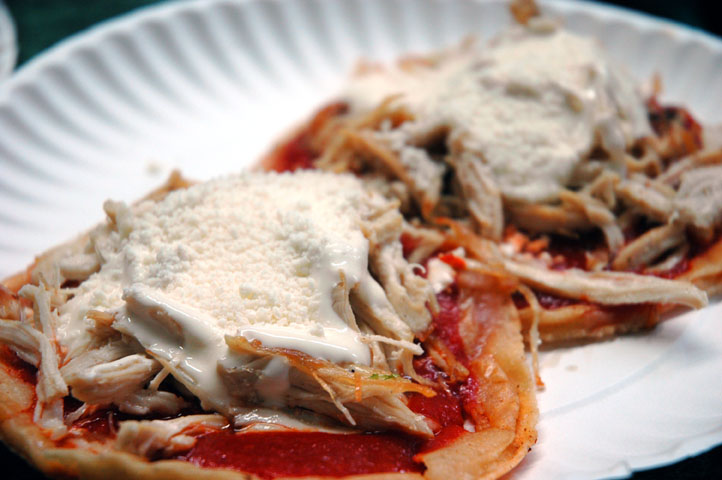
A sope (Spanish pronunciation: [ˈso.pe]) is a traditional Mexican dish consisting of a fried masa base with savory toppings. Also known as picadita (in Tierra Caliente, Guerrero), it originates in the central and southern parts of Mexico, where it was sometimes first known as pellizcadas. It is an antojito and at first sight looks like an unusually thick tortilla with vegetables and meat toppings.
The masa base is fried with pinched sides and topped with refried beans, crumbled cheese, lettuce, onions, red or green sauce and sour cream. Sometimes other ingredients (mostly meat) are also added to create different tastes and styles.
The sope has spread throughout all Mexico's territory, and thousands of regional variants are made. Even though sopes are traditionally from Mexico, many Central American countries have adopted this dish into their cuisine, with slightly different ingredients, and very similar to Salvadoran enchiladas.
While the pinched sides of the sope are its most distinctive characteristic, flat sopes are made to resemble a thick tortilla or a tostada. However, though both tostadas and sopes are fried, the tostada is thin and fried until it becomes crunchy and fragile, while the sope is much thicker and fried only until the exterior surface is cooked. The sope, therefore, has a soft, slightly pliable texture. The sope's thickness is meant to support its toppings, and the frying of its exterior surface adds resistance to the moisture of the ingredients.
The most common variation of the sope involves simply adding chicken and is widely known as a sope de pollo. Sopes topped with beef are also a common variation and are typically slightly larger than sopes de pollo.
In the northern regions of Mexico, sopes are often prepared without vegetables, substituting black beans, spicy salsa, and longaniza or chorizo instead. In Acapulco and Guerrero, sopes are unusually small in size, so they are called sopecitos instead, and are fried in the same oil used to fry seafood, which gives them a unique taste. Sopecitos are made of beans and salsa only; no other ingredients are added.
In Oaxaca, sopes sometimes are prepared using chapulines (roasted grasshoppers) as topping. Also, an extremely large dish similar to a giant sope or a giant tostada is the traditional food of reference in Oaxaca known as tlayuda.
The sope has been adopted and adapted to the local tastes of all Mexico's regions. This resulted in the creation of many traditional food specialties, which may appear to resemble the sope, but are considered a different dish.
Hub AI
Sope (food) AI simulator
(@Sope (food)_simulator)
Sope (food)
A sope (Spanish pronunciation: [ˈso.pe]) is a traditional Mexican dish consisting of a fried masa base with savory toppings. Also known as picadita (in Tierra Caliente, Guerrero), it originates in the central and southern parts of Mexico, where it was sometimes first known as pellizcadas. It is an antojito and at first sight looks like an unusually thick tortilla with vegetables and meat toppings.
The masa base is fried with pinched sides and topped with refried beans, crumbled cheese, lettuce, onions, red or green sauce and sour cream. Sometimes other ingredients (mostly meat) are also added to create different tastes and styles.
The sope has spread throughout all Mexico's territory, and thousands of regional variants are made. Even though sopes are traditionally from Mexico, many Central American countries have adopted this dish into their cuisine, with slightly different ingredients, and very similar to Salvadoran enchiladas.
While the pinched sides of the sope are its most distinctive characteristic, flat sopes are made to resemble a thick tortilla or a tostada. However, though both tostadas and sopes are fried, the tostada is thin and fried until it becomes crunchy and fragile, while the sope is much thicker and fried only until the exterior surface is cooked. The sope, therefore, has a soft, slightly pliable texture. The sope's thickness is meant to support its toppings, and the frying of its exterior surface adds resistance to the moisture of the ingredients.
The most common variation of the sope involves simply adding chicken and is widely known as a sope de pollo. Sopes topped with beef are also a common variation and are typically slightly larger than sopes de pollo.
In the northern regions of Mexico, sopes are often prepared without vegetables, substituting black beans, spicy salsa, and longaniza or chorizo instead. In Acapulco and Guerrero, sopes are unusually small in size, so they are called sopecitos instead, and are fried in the same oil used to fry seafood, which gives them a unique taste. Sopecitos are made of beans and salsa only; no other ingredients are added.
In Oaxaca, sopes sometimes are prepared using chapulines (roasted grasshoppers) as topping. Also, an extremely large dish similar to a giant sope or a giant tostada is the traditional food of reference in Oaxaca known as tlayuda.
The sope has been adopted and adapted to the local tastes of all Mexico's regions. This resulted in the creation of many traditional food specialties, which may appear to resemble the sope, but are considered a different dish.
Recent media