
Recent from talks
Lettuce
Knowledge base stats:
Talk channels stats:
Members stats:
Lettuce
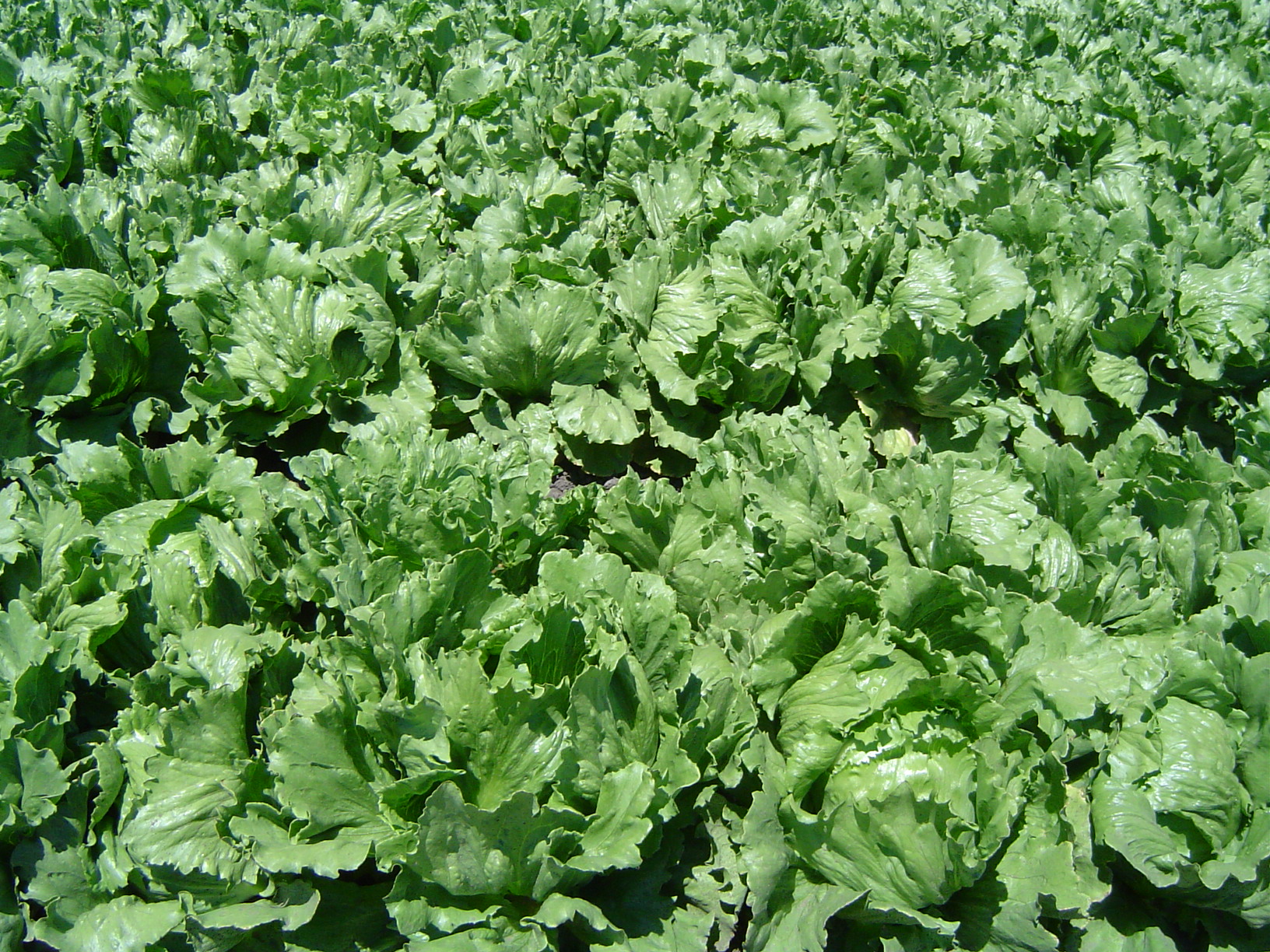
Lettuce (Lactuca sativa) is an annual plant of the family Asteraceae mostly grown as a leaf vegetable. The leaves are most often used raw in green salads, although lettuce is also seen in other kinds of food, such as sandwiches, wraps and soups; it can also be grilled. Its stem and seeds are sometimes used; celtuce (asparagus lettuce) is one variety grown for its stems, which are eaten either raw or cooked. In addition to its main use as a leafy green, it has also gathered religious and medicinal significance over centuries of human consumption. Europe and North America originally dominated the market for lettuce, but by the late 20th century the consumption of lettuce had spread throughout the world. In 2023, world production of lettuce (and chicory) was 28 million tonnes, led by China with 53% of the total.
Lettuce was originally farmed by the ancient Egyptians, who transformed it from a plant whose seeds were used to obtain oil into an important food crop raised for its succulent leaves and oil-rich seeds. Lettuce spread to the Greeks and Romans; the latter gave it the name lactuca, from which the English lettuce is derived. By 50 AD, many types were described, and lettuce appeared often in medieval writings, including several herbals. The 16th through 18th centuries saw the development of many varieties in Europe, and by the mid-18th century, cultivars were described that can still be found in modern gardens.
Generally grown as a hardy annual, lettuce is easily cultivated, although it requires relatively low temperatures to prevent it from flowering quickly. It can be plagued by numerous nutrient deficiencies, as well as insect and mammal pests, and fungal and bacterial diseases. L. sativa crosses easily within the species and with some other species within the genus Lactuca. Although this trait can be a problem to home gardeners who attempt to save seeds, biologists have used it to broaden the gene pool of cultivated lettuce varieties.
Contaminated lettuce is often a source of bacterial, viral, and parasitic outbreaks in humans, including E. coli and Salmonella.
Lactuca sativa is a member of the Lactuca (lettuce) genus and the Asteraceae (sunflower or aster) family. The species was first described in 1753 by Carl Linnaeus in the second volume of his Species Plantarum. Synonyms for L. sativa include Lactuca scariola var. sativa, L. scariola var. integrata and L. scariola var. integrifolia. L. scariola is itself a synonym for L. serriola, the common wild or prickly lettuce. L. sativa also has many identified taxonomic groups, subspecies and varieties, which delineate the various cultivar groups of domesticated lettuce. Lettuce is closely related to several Lactuca species from southwest Asia; the closest relationship is to L. serriola, an aggressive weed common in temperate and subtropical zones in much of the world.
The Romans referred to lettuce as lactuca (lac meaning "milk" in Latin), an allusion to the white substance, latex, exuded by cut stems. The name Lactuca has become the genus name, while sativa (meaning "sown" or "cultivated") was added to create the species name. The current word lettuce, originally from Middle English, came from the Old French letues or laitues, which derived from the Roman name. The name romaine came from the variety of lettuce grown in the Roman papal gardens, while cos, another term for romaine lettuce, came from the earliest European seeds of the type from the Greek island of Kos, a center of lettuce farming in the Byzantine period.
Lettuce's native range spreads from the Mediterranean to Siberia, although it has been transported to almost all areas of the world. Plants generally have a height and spread of 15 to 30 cm (6 to 12 in). The leaves are colorful, mainly in the green and red color spectrums, with some variegated varieties. There are also a few varieties with yellow, gold or blue-teal leaves.
Lettuces have a wide range of shapes and textures, from the dense heads of the iceberg type to the notched, scalloped, frilly or ruffly leaves of leaf varieties. Lettuce plants have a root system that includes a main taproot and smaller secondary roots. Some varieties, especially those found in the United States and Western Europe, have long, narrow taproots and a small set of secondary roots. Longer taproots and more extensive secondary systems are found in varieties from Asia.
Hub AI
Lettuce AI simulator
(@Lettuce_simulator)
Lettuce
Lettuce (Lactuca sativa) is an annual plant of the family Asteraceae mostly grown as a leaf vegetable. The leaves are most often used raw in green salads, although lettuce is also seen in other kinds of food, such as sandwiches, wraps and soups; it can also be grilled. Its stem and seeds are sometimes used; celtuce (asparagus lettuce) is one variety grown for its stems, which are eaten either raw or cooked. In addition to its main use as a leafy green, it has also gathered religious and medicinal significance over centuries of human consumption. Europe and North America originally dominated the market for lettuce, but by the late 20th century the consumption of lettuce had spread throughout the world. In 2023, world production of lettuce (and chicory) was 28 million tonnes, led by China with 53% of the total.
Lettuce was originally farmed by the ancient Egyptians, who transformed it from a plant whose seeds were used to obtain oil into an important food crop raised for its succulent leaves and oil-rich seeds. Lettuce spread to the Greeks and Romans; the latter gave it the name lactuca, from which the English lettuce is derived. By 50 AD, many types were described, and lettuce appeared often in medieval writings, including several herbals. The 16th through 18th centuries saw the development of many varieties in Europe, and by the mid-18th century, cultivars were described that can still be found in modern gardens.
Generally grown as a hardy annual, lettuce is easily cultivated, although it requires relatively low temperatures to prevent it from flowering quickly. It can be plagued by numerous nutrient deficiencies, as well as insect and mammal pests, and fungal and bacterial diseases. L. sativa crosses easily within the species and with some other species within the genus Lactuca. Although this trait can be a problem to home gardeners who attempt to save seeds, biologists have used it to broaden the gene pool of cultivated lettuce varieties.
Contaminated lettuce is often a source of bacterial, viral, and parasitic outbreaks in humans, including E. coli and Salmonella.
Lactuca sativa is a member of the Lactuca (lettuce) genus and the Asteraceae (sunflower or aster) family. The species was first described in 1753 by Carl Linnaeus in the second volume of his Species Plantarum. Synonyms for L. sativa include Lactuca scariola var. sativa, L. scariola var. integrata and L. scariola var. integrifolia. L. scariola is itself a synonym for L. serriola, the common wild or prickly lettuce. L. sativa also has many identified taxonomic groups, subspecies and varieties, which delineate the various cultivar groups of domesticated lettuce. Lettuce is closely related to several Lactuca species from southwest Asia; the closest relationship is to L. serriola, an aggressive weed common in temperate and subtropical zones in much of the world.
The Romans referred to lettuce as lactuca (lac meaning "milk" in Latin), an allusion to the white substance, latex, exuded by cut stems. The name Lactuca has become the genus name, while sativa (meaning "sown" or "cultivated") was added to create the species name. The current word lettuce, originally from Middle English, came from the Old French letues or laitues, which derived from the Roman name. The name romaine came from the variety of lettuce grown in the Roman papal gardens, while cos, another term for romaine lettuce, came from the earliest European seeds of the type from the Greek island of Kos, a center of lettuce farming in the Byzantine period.
Lettuce's native range spreads from the Mediterranean to Siberia, although it has been transported to almost all areas of the world. Plants generally have a height and spread of 15 to 30 cm (6 to 12 in). The leaves are colorful, mainly in the green and red color spectrums, with some variegated varieties. There are also a few varieties with yellow, gold or blue-teal leaves.
Lettuces have a wide range of shapes and textures, from the dense heads of the iceberg type to the notched, scalloped, frilly or ruffly leaves of leaf varieties. Lettuce plants have a root system that includes a main taproot and smaller secondary roots. Some varieties, especially those found in the United States and Western Europe, have long, narrow taproots and a small set of secondary roots. Longer taproots and more extensive secondary systems are found in varieties from Asia.
Recent media