Hubbry Logo
Sound filmSound filmMain
Open search
Sound film
Community hub
Sound film
logo
8 pages, 0 posts
0 subscribers
Be the first to start a discussion here.
Contribute something
Sound film
Sound film
from Wikipedia

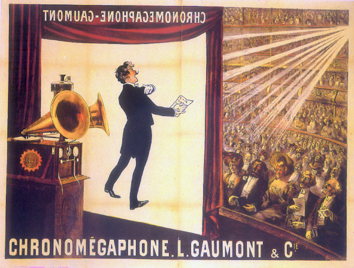
Illustration of a theater from the rear of the stage. At the front of the stage, a screen hangs. In the foreground is a gramophone with two horns. In the background, a large audience is seated at orchestra level and on several balconies. The words "Chronomégaphone" and "Gaumont" appear at both the bottom of the illustration and, in reverse, at the top of the projection screen.
1908 poster advertising Gaumont's sound films. The Chronomégaphone, designed for large halls, employed compressed air to amplify the recorded sound.[1]

A sound film is a motion picture with synchronized sound, or sound technologically coupled to image, as opposed to a silent film. The first known public exhibition of projected sound films took place in Paris in 1900, but decades passed before sound motion pictures became commercially practical. Reliable synchronization was difficult to achieve with the early sound-on-disc systems, and amplification and recording quality were also inadequate. Innovations in sound-on-film led to the first commercial screening of short motion pictures using the technology, which took place in 1923. Before sound-on-film technology became viable, soundtracks for films were commonly played live with organs or pianos.

The primary steps in the commercialization of sound cinema were taken in the mid-to-late 1920s. At first, the sound films which included synchronized dialogue, known as "talking pictures", or "talkies", were exclusively shorts. The earliest feature-length movies with recorded sound included only music and effects. The first feature film originally presented as a talkie (although it had only limited sound sequences) was The Jazz Singer, which premiered on October 6, 1927.[2] A major hit, it was made with Vitaphone, which was at the time the leading brand of sound-on-disc technology. Sound-on-film, however, would soon become the standard for talking pictures.

By the early 1930s, the talkies were a global phenomenon. In the United States, they helped secure Hollywood's position as one of the world's most powerful cultural/commercial centers of influence (see Cinema of the United States). In Europe (and, to a lesser degree, elsewhere), the new development was treated with suspicion by many filmmakers and critics, who worried that a focus on dialogue would subvert the unique aesthetic virtues of silent cinema. In Japan, where the popular film tradition integrated silent movie and live vocal performance (benshi), talking pictures were slow to take root. Conversely, in India, sound was the transformative element that led to the rapid expansion of the nation's film industry.

Early history

[edit]
On the left is a large acoustical horn, suspended from a cord that rises out of the frame. A man plays a violin in front of it. To the right, two men dance together.
Image from The Dickson Experimental Sound Film (1894 or 1895), produced by W.K.L. Dickson as a test of the early version of the Edison Kinetophone, combining the Kinetoscope and phonograph.
Eric M. C. Tigerstedt (1887–1925) was one of the pioneers of sound-on-film technology. Tigerstedt in 1915.

The idea of combining motion pictures with recorded sound is nearly as old as the concept of cinema itself. On February 27, 1888, a couple of days after photographic pioneer Eadweard Muybridge gave a lecture not far from the laboratory of Thomas Edison, the two inventors met privately. Muybridge later claimed that on this occasion, six years before the first commercial motion picture exhibition, he proposed a scheme for sound cinema that would combine his image-casting zoopraxiscope with Edison's recorded-sound technology.[3] No agreement was reached, but within a year Edison commissioned the development of the Kinetoscope, essentially a "peep-show" system, as a visual complement to his cylinder phonograph. The two devices were brought together as the Kinetophone in 1895, but individual, cabinet viewing of motion pictures was soon to be outmoded by successes in film projection.[4]

In 1899, a projected sound-film system known as Cinemacrophonograph or Phonorama, based primarily on the work of Swiss-born inventor François Dussaud, was exhibited in Paris; similar to the Kinetophone, the system required individual use of earphones.[5] An improved cylinder-based system, Phono-Cinéma-Théâtre, was developed by Clément-Maurice Gratioulet and Henri Lioret of France, allowing short films of theater, opera, and ballet excerpts to be presented at the Paris Exposition in 1900. These appear to be the first publicly exhibited films with projection of both image and recorded sound. Phonorama and yet another sound-film system—Théâtroscope—were also presented at the Exposition.[6]

Three major problems persisted, leading to motion pictures and sound recording largely taking separate paths for a generation. The primary issue was synchronization: pictures and sound were recorded and played back by separate devices, which were difficult to start and maintain in tandem.[7] Sufficient playback volume was also hard to achieve. While motion picture projectors soon allowed film to be shown to large theater audiences, audio technology before the development of electric amplification could not project satisfactorily to fill large spaces. Finally, there was the challenge of recording fidelity. The primitive systems of the era produced sound of very low quality unless the performers were stationed directly in front of the cumbersome recording devices (acoustical horns, for the most part), imposing severe limits on the sort of films that could be created with live-recorded sound.[8]

Illustration of a red-haired woman wearing a large hat, an ankle-length yellow dress, and high heels. She is holding a long baton or swagger stick and leaning against a film projector. A gramophone sits at her feet. The top of the illustration reads "Phono-Cinéma-Théâtre". Text to the left of the woman reads "Visions Animées des Artistes Celèbres", followed by a list of performers.
Poster featuring Sarah Bernhardt and giving the names of eighteen other "famous artists" shown in "living visions" at the 1900 Paris Exposition using the Gratioulet-Lioret system.

Cinematic innovators attempted to cope with the fundamental synchronization problem in a variety of ways. An increasing number of motion picture systems relied on gramophone records—known as sound-on-disc technology. The records themselves were often referred to as "Berliner discs", after one of the primary inventors in the field, German-American Emile Berliner. In 1902, Léon Gaumont demonstrated his sound-on-disc Chronophone, involving an electrical connection he had recently patented, to the French Photographic Society.[9] Four years later, Gaumont introduced the Elgéphone, a compressed-air amplification system based on the Auxetophone, developed by British inventors Horace Short and Charles Parsons.[10] Despite high expectations, Gaumont's sound innovations had only limited commercial success. Despite some improvements, they still did not satisfactorily address the three basic issues with sound film and were expensive as well. For some years, American inventor E. E. Norton's Cameraphone was the primary competitor to the Gaumont system (sources differ on whether the Cameraphone was disc- or cylinder-based); it ultimately failed for many of the same reasons that held back the Chronophone.[11]

In 1913, Edison introduced a new cylinder-based synch-sound apparatus known, just like his 1895 system, as the Kinetophone. Instead of films being shown to individual viewers in the Kinetoscope cabinet, they were now projected onto a screen. The phonograph was connected by an intricate arrangement of pulleys to the film projector, allowing—under ideal conditions—for synchronization. However, conditions were rarely ideal, and the new, improved Kinetophone was retired after little more than a year.[12] By the mid-1910s, the groundswell in commercial sound motion picture exhibition had subsided.[11] Beginning in 1914, The Photo-Drama of Creation, promoting Jehovah's Witnesses' conception of humankind's genesis, was screened around the United States: eight hours worth of projected visuals involving both slides and live action, synchronized with separately recorded lectures and musical performances played back on phonograph.[13]

Meanwhile, innovations continued on another significant front. In 1900, as part of the research he was conducting on the photophone, the German physicist Ernst Ruhmer recorded the fluctuations of the transmitting arc-light as varying shades of light and dark bands onto a continuous roll of photographic film. He then determined that he could reverse the process and reproduce the recorded sound from this photographic strip by shining a bright light through the running filmstrip, with the resulting varying light illuminating a selenium cell. The changes in brightness caused a corresponding change to the selenium's resistance to electrical currents, which was used to modulate the sound produced in a telephone receiver. He called this invention the photographophone,[14] which he summarized as: "It is truly a wonderful process: sound becomes electricity, becomes light, causes chemical actions, becomes light and electricity again, and finally sound."[15]

Ruhmer began a correspondence with the French-born, London-based Eugene Lauste,[16] who had worked at Edison's lab between 1886 and 1892. In 1907, Lauste was awarded the first patent for sound-on-film technology, involving the transformation of sound into light waves that are photographically recorded direct onto celluloid. As described by historian Scott Eyman,

It was a double system, that is, the sound was on a different piece of film from the picture.... In essence, the sound was captured by a microphone and translated into light waves via a light valve, a thin ribbon of sensitive metal over a tiny slit. The sound reaching this ribbon would be converted into light by the shivering of the diaphragm, focusing the resulting light waves through the slit, where it would be photographed on the side of the film, on a strip about a tenth of an inch wide.[17]

In 1908, Lauste purchased a photographophone from Ruhmer, with the intention of perfecting the device into a commercial product.[16] Though sound-on-film would eventually become the universal standard for synchronized sound cinema, Lauste never successfully exploited his innovations, which came to an effective dead end. In 1914, Finnish inventor Eric Tigerstedt was granted German patent 309,536 for his sound-on-film work; that same year, he apparently demonstrated a film made with the process to an audience of scientists in Berlin.[18] Hungarian engineer Denes Mihaly submitted his sound-on-film Projectofon concept to the Royal Hungarian Patent Court in 1918; the patent award was published four years later.[19] Whether sound was captured on cylinder, disc, or film, none of the available technology was adequate for big-league commercial purposes, and for many years the heads of the major Hollywood film studios saw little benefit in producing sound motion pictures.[20]

Crucial innovations

[edit]

A number of technological developments contributed to making sound cinema commercially viable by the late 1920s. Two involved contrasting approaches to synchronized sound reproduction, or playback:

Advanced sound-on-film

[edit]

In 1919, American inventor Lee De Forest was awarded several patents that would lead to the first optical sound-on-film technology with commercial application. In De Forest's system, the sound track was photographically recorded onto the side of the strip of motion picture film to create a composite, or "married", print. If proper synchronization of sound and picture was achieved in recording, it could be absolutely counted on in playback. Over the next four years, he improved his system with the help of equipment and patents licensed from another American inventor in the field, Theodore Case.[21]

At the University of Illinois, Polish-born research engineer Joseph Tykociński-Tykociner was working independently on a similar process. On June 9, 1922, he gave the first reported U.S. demonstration of a sound-on-film motion picture to members of the American Institute of Electrical Engineers.[22] As with Lauste and Tigerstedt, Tykociner's system would never be taken advantage of commercially; however, De Forest's soon would.

All-text advertisement from the Strand Theater, giving dates, times, and performers' names. At the top, a tagline reads, "$10,000 reward paid to any person who finds a phonograph or similar device used in the phonofilms." The accompanying promotional text describes the slate of sound pictures as "the sensation of the century ... Amazing! Astounding! Unbelievable".
Newspaper ad for a 1925 presentation of Phonofilm shorts, touting their technological distinction: no phonograph.

On April 15, 1923, at the New York City's Rivoli Theater, the first commercial screening of motion pictures with sound-on-film took place. This would become the future standard. It consisted of a set of short films varying in length and featuring some of the most popular stars of the 1920s (including Eddie Cantor, Harry Richman, Sophie Tucker, and George Jessel among others) doing stage performances such as vaudevilles, musical acts, and speeches which accompanied the screening of the silent feature film Bella Donna.[23] All of them were presented under the banner of De Forest Phonofilms.[24] The set included the 11-minute short film From far Seville starring Concha Piquer. In 2010, a copy of the tape was found in the U.S. Library of Congress, where it is currently preserved.[25][26][27] Critics attending the event praised the novelty but not the sound quality which received negative reviews in general.[28] That June, De Forest entered into an extended legal battle with an employee, Freeman Harrison Owens, for title to one of the crucial Phonofilm patents. Although De Forest ultimately won the case in the courts, Owens is today recognized as a central innovator in the field.[29] The following year, De Forest's studio released the first commercial dramatic film shot as a talking picture—the two-reeler Love's Old Sweet Song, directed by J. Searle Dawley and featuring Una Merkel.[30] However, phonofilm's stock in trade was not original dramas but celebrity documentaries, popular music acts, and comedy performances. President Calvin Coolidge, opera singer Abbie Mitchell, and vaudeville stars such as Phil Baker, Ben Bernie, Eddie Cantor and Oscar Levant appeared in the firm's pictures. Hollywood remained suspicious, even fearful, of the new technology. As Photoplay editor James Quirk put it in March 1924, "Talking pictures are perfected, says Dr. Lee De Forest. So is castor oil."[31] De Forest's process continued to be used through 1927 in the United States for dozens of short Phonofilms; in the UK it was employed a few years longer for both shorts and features by British Sound Film Productions, a subsidiary of British Talking Pictures, which purchased the primary Phonofilm assets. By the end of 1930, the Phonofilm business would be liquidated.[32]

In Europe, others were also working on the development of sound-on-film. In 1919, the same year that DeForest received his first patents in the field, three German inventors, Josef Engl (1893–1942), Hans Vogt (1890–1979), and Joseph Massolle (1889–1957), patented the Tri-Ergon sound system. On September 17, 1922, the Tri-Ergon group gave a public screening of sound-on-film productions—including a dramatic talkie, Der Brandstifter (The Arsonist) —before an invited audience at the Alhambra Kino in Berlin.[33] By the end of the decade, Tri-Ergon would be the dominant European sound system. In 1923, two Danish engineers, Axel Petersen and Arnold Poulsen, patented a system that recorded sound on a separate filmstrip running parallel with the image reel. Gaumont licensed the technology and briefly put it to commercial use under the name Cinéphone.[34]

US competition eclipsed Phonofilm. By September 1925, De Forest and Case's working arrangement had fallen through. The following July, Case joined Fox Film, Hollywood's third largest studio, to found the Fox-Case Corporation. The system developed by Case and his assistant, Earl Sponable, given the name Movietone, thus became the first viable sound-on-film technology controlled by a Hollywood movie studio. The following year, Fox purchased the North American rights to the Tri-Ergon system, though the company found it inferior to Movietone and virtually impossible to integrate the two different systems to advantage.[35] In 1927, as well, Fox retained the services of Freeman Owens, who had particular expertise in constructing cameras for synch-sound film.[36]

Advanced sound-on-disc

[edit]
The Voice From the Screen (1926), a film demonstrating the Vitaphone sound-on-disc process

Parallel with improvements in sound-on-film technology, a number of companies were making progress with systems that recorded movie sound on phonograph discs. In sound-on-disc technology from the era, a phonograph turntable is connected by a mechanical interlock to a specially modified film projector, allowing for synchronization. In 1921, the Photokinema sound-on-disc system developed by Orlando Kellum was employed to add synchronized sound sequences to D. W. Griffith's failed silent film Dream Street. A love song, performed by star Ralph Graves, was recorded, as was a sequence of live vocal effects. Apparently, dialogue scenes were also recorded, but the results were unsatisfactory and the film was never publicly screened incorporating them. On May 1, 1921, Dream Street was re-released, with love song added, at New York City's Town Hall theater, qualifying it—however haphazardly—as the first feature-length film with a live-recorded vocal sequence.[37] However, the sound quality was very poor and no other theaters could show the sound version of the film as no one had the Photokinema sound system installed.[38] On Sunday, May 29, Dream Street opened at the Shubert Crescent Theater in Brooklyn with a program of short films made in Phonokinema. However, business was poor, and the program soon closed.

Don Juan
Illustration of a man dressed in an orange-and-purple Elizabethan costume with puffy shoulders and sheer leggings. Accompanying text provides film credits, dominated by the name of star John Barrymore.
Poster for Warner Bros.' Don Juan (1926), the first major motion picture to premiere with a full-length synchronized soundtrack. Audio recording engineer George Groves, the first in Hollywood to hold the job, would supervise sound on Woodstock, 44 years later.

In 1925, Sam Warner of Warner Bros., then a small Hollywood studio with big ambitions, saw a demonstration of the Western Electric sound-on-disc system and was sufficiently impressed to persuade his brothers to agree to experiment with using this system at New York City's Vitagraph Studios, which they had recently purchased. The tests were convincing to the Warner Brothers, if not to the executives of some other picture companies who witnessed them. Consequently, in April 1926 the Western Electric Company entered into a contract with Warner Brothers and W. J. Rich, a financier, giving them an exclusive license for recording and reproducing sound pictures under the Western Electric system. To exploit this license the Vitaphone Corporation was organized with Samuel L. Warner as its president.[39][40] Vitaphone, as this system was now called, was publicly introduced on August 6, 1926, with the premiere of Don Juan; the first feature-length movie to employ a synchronized sound system of any type throughout, its soundtrack contained a musical score and added sound effects, but no recorded dialogue—in other words, it had been staged and shot as a silent film. Accompanying Don Juan, however, were eight shorts of musical performances, mostly classical, as well as a four-minute filmed introduction by Will H. Hays, president of the Motion Picture Association of America, all with live-recorded sound. These were the first true sound films exhibited by a Hollywood studio.[41] Warner Bros.' The Better 'Ole, technically similar to Don Juan, followed in October.[42]

Sound-on-film would ultimately win out over sound-on-disc because of a number of fundamental technical advantages:

  • Synchronization: no interlock system was completely reliable, and a projectionist's error, or an inexactly repaired film break, or a defect in the soundtrack disc could result in the sound becoming seriously and irrecoverably out of sync with the picture
  • Editing: discs could not be directly edited, severely limiting the ability to make alterations in their accompanying films after the original release cut
  • Distribution: phonograph discs added expense and complication to film distribution
  • Wear and tear: the physical process of playing the discs degraded them, requiring their replacement after approximately twenty screenings[43]

Nonetheless, in the early years, sound-on-disc had the edge over sound-on-film in two substantial ways:

  • Production and capital cost: it was generally less expensive to record sound onto disc than onto film and the exhibition systems—turntable/interlock/projector—were cheaper to manufacture than the complex image-and-audio-pattern-reading projectors required by sound-on-film
  • Audio quality: phonograph discs, Vitaphone's in particular, had superior dynamic range to most sound-on-film processes of the day, at least during the first few playings; while sound-on-film tended to have better frequency response, this was outweighed by greater distortion and noise[44][45]

As sound-on-film technology improved, both of these disadvantages were overcome.

The third crucial set of innovations marked a major step forward in both the live recording of sound and its effective playback:

Two suited men stand in a studio with a large film projector and other electrical equipment. The man on the left is holding a large phonograph record.
Western Electric engineer E. B. Craft, at left, demonstrating the Vitaphone projection system. A Vitaphone disc had a running time of about 11 minutes, enough to match that of a 1,000-foot (300 m) reel of 35 mm film.

Fidelity electronic recording and amplification

[edit]

In 1913, Western Electric, the manufacturing division of AT&T, acquired the rights to the de Forest audion, the forerunner of the triode vacuum tube. Over the next few years they developed it into a predictable and reliable device that made electronic amplification possible for the first time. Western Electric then branched-out into developing uses for the vacuum tube including public address systems and an electrical recording system for the recording industry. Beginning in 1922, the research branch of Western Electric began working intensively on recording technology for both sound-on-disc and sound-on film synchronised sound systems for motion-pictures.

The engineers working on the sound-on-disc system were able to draw on expertise that Western Electric already had in electrical disc recording and were thus able to make faster initial progress. The main change required was to increase the playing time of the disc so that it could match that of a standard 1,000 ft (300 m) reel of 35 mm film. The chosen design used a disc nearly 16 inches (about 40 cm) in diameter rotating at 33 1/3 rpm. This could play for 11 minutes, the running time of 1000 ft of film at 90 ft/min (24 frames/s).[46] Because of the larger diameter the minimum groove velocity of 70 ft/min (14 inches or 356 mm/s) was only slightly less than that of a standard 10-inch 78 rpm commercial disc. In 1925, the company publicly introduced a greatly improved system of electronic audio, including sensitive condenser microphones and rubber-line recorders (named after the use of a rubber damping band for recording with better frequency response onto a wax master disc[47]). That May, the company licensed entrepreneur Walter J. Rich to exploit the system for commercial motion pictures; he founded Vitagraph, in which Warner Bros. acquired a half interest, just one month later.[48] In April 1926, Warners signed a contract with AT&T for exclusive use of its film sound technology for the redubbed Vitaphone operation, leading to the production of Don Juan and its accompanying shorts over the following months.[39] During the period when Vitaphone had exclusive access to the patents, the fidelity of recordings made for Warners films was markedly superior to those made for the company's sound-on-film competitors. Meanwhile, Bell Labs—the new name for the AT&T research operation—was working at a furious pace on sophisticated sound amplification technology that would allow recordings to be played back over loudspeakers at theater-filling volume. The new moving-coil speaker system was installed in New York's Warners Theatre at the end of July and its patent submission, for what Western Electric called the No. 555 Receiver, was filed on August 4, just two days before the premiere of Don Juan.[45][49]

Late in the year, AT&T/Western Electric created a licensing division, Electrical Research Products Inc. (ERPI), to handle rights to the company's film-related audio technology. Vitaphone still had legal exclusivity, but having lapsed in its royalty payments, effective control of the rights was in ERPI's hands. On December 31, 1926, Warners granted Fox-Case a sublicense for the use of the Western Electric system; in exchange for the sublicense, both Warners and ERPI received a share of Fox's related revenues. The patents of all three concerns were cross-licensed.[50] Superior recording and amplification technology was now available to two Hollywood studios, pursuing two very different methods of sound reproduction. The new year would finally see the emergence of sound cinema as a significant commercial medium.

Travel

[edit]

In 1929 a "new RCA Photophone portable sound and picture reproducing system" was described in the industry journal Projection Engineering.[51] In Australia, Hoyts and Gilby Talkies Pty., Ltd were touring talking pictures to country towns.[52][53] The same year the White Star Line installed talking picture equipment on the s.s. Majestic. The features shown on the first voyage were Show Boat and Broadway.[54]

Triumph of the "talkies"

[edit]
The Jazz Singer (1927)

In February 1927, an agreement was signed by five leading Hollywood movie companies: Famous Players–Lasky (soon to be part of Paramount), Metro-Goldwyn-Mayer, Universal, First National, and Cecil B. DeMille's small but prestigious Producers Distributing Corporation (PDC). The five studios agreed to collectively select just one provider for sound conversion, and then waited to see what sort of results the front-runners came up with.[55] In May, Warner Bros. sold back its exclusivity rights to ERPI (along with the Fox-Case sublicense) and signed a new royalty contract similar to Fox's for use of Western Electric technology. Fox and Warners pressed forward with sound cinema, moving in different directions both technologically and commercially: Fox moved into newsreels and then scored dramas, while Warners concentrated on talking features. Meanwhile, ERPI sought to corner the market by signing up the five allied studios.[56]

Advertisement from the Blue Mouse Theater announcing the Pacific Coast premiere of The Jazz Singer, billed as "The greatest story ever told". A photo of stars Al Jolson and May McAvoy accompanies extensive promotional text, including the catchphrase "You'll see and hear him on Vitaphone as you've never seen or heard before". At the bottom is an announcement of an accompanying newsreel.
Newspaper ad from a fully equipped theater in Tacoma, Washington, showing The Jazz Singer, on Vitaphone, and a Fox newsreel, on Movietone, together on the same bill.

The big sound film sensations of the year all took advantage of preexisting celebrity. On May 20, 1927, at New York City's Roxy Theater, Fox Movietone presented a sound film of the takeoff of Charles Lindbergh's celebrated flight to Paris, recorded earlier that day. In June, a Fox sound newsreel depicting his return welcomes in New York City and Washington, D.C., was shown. These were the two most acclaimed sound motion pictures to date.[57] In May, as well, Fox had released the first Hollywood fiction film with synchronized dialogue: the short They're Coming to Get Me, starring comedian Chic Sale.[58] After rereleasing a few silent feature hits, such as Seventh Heaven, with recorded music, Fox came out with its first original Movietone feature on September 23: Sunrise: A Song of Two Humans, by acclaimed German director F. W. Murnau. As with Don Juan, the film's soundtrack consisted of a musical score and sound effects (including, in a couple of crowd scenes, "wild", nonspecific vocals).[59]

Then, on October 6, 1927, Warner Bros.' The Jazz Singer premiered. It was a smash box office success for the mid-level studio, earning a total of $2.625 million in the United States and abroad, almost a million dollars more than the previous record for a Warner Bros. film.[60] Produced with the Vitaphone system, most of the film does not contain live-recorded audio, relying, like Sunrise and Don Juan, on a score and effects. When the movie's star, Al Jolson, sings, however, the film shifts to sound recorded on the set, including both his musical performances and two scenes with ad-libbed speech—one of Jolson's character, Jakie Rabinowitz (Jack Robin), addressing a cabaret audience; the other an exchange between him and his mother. The "natural" sounds of the settings were also audible.[61] Though the success of The Jazz Singer was due largely to Jolson, already established as one of U.S. biggest music stars, and its limited use of synchronized sound hardly qualified it as an innovative sound film (let alone the "first"), the movie's profits were proof enough to the industry that the technology was worth investing in.[62]

The development of commercial sound cinema had proceeded in fits and starts before The Jazz Singer, and the film's success did not change things overnight. Influential gossip columnist Louella Parsons' reaction to The Jazz Singer was badly off the mark: "I have no fear that the screeching sound film will ever disturb our theaters," while MGM head of production Irving Thalberg called the film "a good gimmick, but that's all it was."[63] Not until May 1928 did the group of four big studios (PDC had dropped out of the alliance), along with United Artists and others, sign with ERPI for conversion of production facilities and theaters for sound film. It was a daunting commitment; revamping a single theater cost as much as $15,000 (the equivalent of $220,000 in 2019), and there were more than 20,000 movie theaters in the United States. By 1930, only half of the theaters had been wired for sound.[63]

Initially, all ERPI-wired theaters were made Vitaphone-compatible; most were equipped to project Movietone reels as well.[64] However, even with access to both technologies, most of the Hollywood companies remained slow to produce talking features of their own. No studio besides Warner Bros. released even a part-talking feature until the low-budget-oriented Film Booking Offices of America (FBO) premiered The Perfect Crime on June 17, 1928, eight months after The Jazz Singer.[65] FBO had come under the effective control of a Western Electric competitor, General Electric's RCA division, which was looking to market its new sound-on-film system, Photophone. Unlike Fox-Case's Movietone and De Forest's Phonofilm, which were variable-density systems, Photophone was a variable-area system—a refinement in the way the audio signal was inscribed on film that would ultimately become the standard. (In both sorts of systems, a specially designed lamp, whose exposure to the film is determined by the audio input, is used to record sound photographically as a series of minuscule lines. In a variable-density process, the lines are of varying darkness; in a variable-area process, the lines are of varying width.) By October, the FBO-RCA alliance would lead to the creation of Hollywood's newest major studio, RKO Pictures.

A middle-aged man wearing a plaid jacket and boldly striped tie grabs a younger woman wearing a sweater vest by the arm. Her hand tugs at his as they gaze into each other's eyes, he fiercely, she with surprise or concern.
Dorothy Mackaill and Milton Sills in The Barker, First National's inaugural talkie. The film was released in December 1928, two months after Warner Bros. acquired a controlling interest in the studio.

Meanwhile, Warner Bros. had released three more talkies, all profitable, if not at the level of The Jazz Singer: In March, Tenderloin appeared; it was billed by Warners as the first feature in which characters spoke their parts, though only 15 of its 88 minutes had dialogue. Glorious Betsy followed in April, and The Lion and the Mouse (31 minutes of dialogue) in May.[66] On July 6, 1928, the first all-talking feature, Lights of New York, premiered. The film cost Warner Bros. only $23,000 to produce, but grossed $1,252,000, a record rate of return surpassing 5,000%. In September, the studio released another Al Jolson part-talking picture, The Singing Fool, which more than doubled The Jazz Singer's earnings record for a Warner Bros. movie.[67] This second Jolson screen smash demonstrated the movie musical's ability to turn a song into a national hit: inside of nine months, the Jolson number "Sonny Boy" had racked up 2 million record and 1.25 million sheet music sales.[68] September 1928 also saw the release of Paul Terry's Dinner Time, among the first animated cartoons produced with synchronized sound. Soon after he saw it, Walt Disney released his first sound picture, the Mickey Mouse short Steamboat Willie.[69]

Over the course of 1928, as Warner Bros. began to rake in huge profits due to the popularity of its sound films, the other studios quickened the pace of their conversion to the new technology. Paramount, the industry leader, put out its first talkie in late September, Beggars of Life; though it had just a few lines of dialogue, it demonstrated the studio's recognition of the new medium's power. Interference, Paramount's first all-talker, debuted in November.[70] The process known as "goat glanding" briefly became widespread: soundtracks, sometimes including a smatter of post-dubbed dialogue or song, were added to movies that had been shot, and in some cases released, as silents.[71] A few minutes of singing could qualify such a newly endowed film as a "musical." (Griffith's Dream Street had essentially been a "goat gland.") Expectations swiftly changed, and the sound "fad" of 1927 became standard procedure by 1929. In February 1929, sixteen months after The Jazz Singer's debut, Columbia Pictures became the last of the eight studios that would be known as "majors" during Hollywood's Golden Age to release its first part-talking feature, The Lone Wolf's Daughter.[72] In late May, the first all-color, all-talking feature, Warner Bros.' On with the Show!, premiered.[73]

Yet most American movie theaters, especially outside of urban areas, were still not equipped for sound: while the number of sound cinemas grew from 100 to 800 between 1928 and 1929, they were still vastly outnumbered by silent theaters, which had actually grown in number as well, from 22,204 to 22,544.[74] The studios, in parallel, were still not entirely convinced of the talkies' universal appeal—until mid-1930, the majority of Hollywood movies were produced in dual versions, silent as well as talking.[75] Though few in the industry predicted it, silent film as a viable commercial medium in the United States would soon be little more than a memory. Points West, a Hoot Gibson Western released by Universal Pictures in August 1929, was the last purely silent mainstream feature put out by a major Hollywood studio.[76]

Transition: Europe

[edit]

The Jazz Singer had its European sound premiere at the Piccadilly Theatre in London on September 27, 1928.[77] According to film historian Rachael Low, "Many in the industry realized at once that a change to sound production was inevitable."[78] On January 16, 1929, the first European feature film with a synchronized vocal performance and recorded score premiered: the German production Ich küsse Ihre Hand, Madame (I Kiss Your Hand, Madame). Dialogueless, it contains only a few songs performed by Richard Tauber.[79] The movie was made with the sound-on-film system controlled by the German-Dutch firm Tobis, corporate heirs to the Tri-Ergon concern. With an eye toward commanding the emerging European market for sound film, Tobis entered into a compact with its chief competitor, Klangfilm, a joint subsidiary of Germany's two leading electrical manufacturers. Early in 1929, Tobis and Klangfilm began comarketing their recording and playback technologies. As ERPI began to wire theaters around Europe, Tobis-Klangfilm claimed that the Western Electric system infringed on the Tri-Ergon patents, stalling the introduction of American technology in many places.[80] Just as RCA had entered the movie business to maximize its recording system's value, Tobis also established its own production operations.[81]

During 1929, most of the major European filmmaking countries began joining Hollywood in the changeover to sound. Many of the trend-setting European talkies were shot abroad as production companies leased studios while their own were being converted or as they deliberately targeted markets speaking different languages. One of Europe's first two feature-length dramatic talkies was created in still a different sort of twist on multinational moviemaking: The Crimson Circle was a coproduction between director Friedrich Zelnik's Efzet-Film company and British Sound Film Productions (BSFP). In 1928, the film had been released as the silent Der Rote Kreis in Germany, where it was shot; English dialogue was apparently dubbed in much later using the De Forest Phonofilm process controlled by BSFP's corporate parent. It was given a British trade screening in March 1929, as was a part-talking film made entirely in the UK: The Clue of the New Pin, a British Lion production using the sound-on-disc British Photophone system. In May, Black Waters, which British and Dominions Film Corporation promoted as the first UK all-talker, received its initial trade screening; it had been shot completely in Hollywood with a Western Electric sound-on-film system. None of these pictures made much impact.[82]

An advertisement for the movie Blackmail featuring a young woman in lingerie holding a garment over one arm looks toward camera. Surrounding text describes the film as "A Romance of Scotland Yard" and "The Powerful Talking Picture"
The Prague-raised star of Blackmail (1929), Anny Ondra, was an industry favorite, but her accent became an issue when the film was reshot with sound. Without post-dubbing capacity, her dialogue was simultaneously recorded offscreen by actress Joan Barry. Ondra's British film career was over.[83]

The first successful European dramatic talkie was the all-British Blackmail. Directed by twenty-nine-year-old Alfred Hitchcock, the movie had its London debut June 21, 1929. Originally shot as a silent, Blackmail was restaged to include dialogue sequences, along with a score and sound effects, before its premiere. A British International Pictures (BIP) production, it was recorded on RCA Photophone, General Electric having bought a share of AEG so they could access the Tobis-Klangfilm markets. Blackmail was a substantial hit; critical response was also positive—notorious curmudgeon Hugh Castle, for example, called it "perhaps the most intelligent mixture of sound and silence we have yet seen."[84]

On August 23, the modest-sized Austrian film industry came out with a talkie: G'schichten aus der Steiermark (Stories from Styria), an Eagle Film–Ottoton Film production.[85] On September 30, the first entirely German-made feature-length dramatic talkie, Das Land ohne Frauen (Land Without Women), premiered. A Tobis Filmkunst production, about one-quarter of the movie contained dialogue, which was strictly segregated from the special effects and music. The response was underwhelming.[86] Sweden's first talkie, Konstgjorda Svensson (Artificial Svensson), premiered on October 14. Eight days later, Aubert Franco-Film came out with Le Collier de la reine (The Queen's Necklace), shot at the Épinay studio near Paris. Conceived as a silent film, it was given a Tobis-recorded score and a single talking sequence—the first dialogue scene in a French feature. On October 31, Les Trois masques (The Three Masks) debuted; a Pathé-Natan film, it is generally regarded as the initial French feature talkie, though it was shot, like Blackmail, at the Elstree studio, just outside London. The production company had contracted with RCA Photophone and Britain then had the nearest facility with the system. The Braunberger-Richebé talkie La Route est belle (The Road Is Fine), also shot at Elstree, followed a few weeks later.[87]

Before the Paris studios were fully sound-equipped—a process that stretched well into 1930—a number of other early French talkies were shot in Germany.[88] The first all-talking German feature, Atlantik, had premiered in Berlin on October 28. Yet another Elstree-made movie, it was rather less German at heart than Les Trois masques and La Route est belle were French; a BIP production with a British scenarist and German director, it was also shot in English as Atlantic.[89] The entirely German Aafa-Film production It's You I Have Loved (Dich hab ich geliebt) opened three and a half weeks later. It was not "Germany's First Talking Film", as the marketing had it, but it was the first to be released in the United States.[90]

A movie poster with text in Cyrillic. A red band spirals through the center of the image, over a green background. Around the spiral are arrayed five black-and-white photographs of male faces at various angles. Three, in a cluster at the top left, are smiling; two, at the top left and at bottom right (a young boy) look pensive.
The first Soviet talkie, Putevka v zhizn (The Road to Life; 1931), concerns the issue of homeless youth. As Marcel Carné put it, "in the unforgettable images of this spare and pure story we can discern the effort of an entire nation."[91]

In 1930, the first Polish talkies premiered, using sound-on-disc systems: Moralność pani Dulskiej (The Morality of Mrs. Dulska) in March and the all-talking Niebezpieczny romans (Dangerous Love Affair) in October.[92] In Italy, whose once vibrant film industry had become moribund by the late 1920s, the first talkie, La Canzone dell'amore (The Song of Love), also came out in October; within two years, Italian cinema would be enjoying a revival.[93] The first movie spoken in Czech debuted in 1930 as well, Tonka Šibenice (Tonka of the Gallows).[94] Several European nations with minor positions in the field also produced their first talking pictures—Belgium (in French), Denmark, Greece, and Romania.[95] The Soviet Union's robust film industry came out with its first sound features in December 1930: Dziga Vertov's nonfiction Enthusiasm had an experimental, dialogueless soundtrack; Abram Room's documentary Plan velikikh rabot (The Plan of the Great Works) had music and spoken voiceovers.[96] Both were made with locally developed sound-on-film systems, two of the two hundred or so movie sound systems then available somewhere in the world.[97] In June 1931, the Nikolai Ekk drama Putevka v zhizn (The Road to Life or A Start in Life), premiered as the Soviet Union's first true talking picture.[98]

Throughout much of Europe, conversion of exhibition venues lagged well behind production capacity, requiring talkies to be produced in parallel silent versions or simply shown without sound in many places. While the pace of conversion was relatively swift in Britain—with over 60 percent of theaters equipped for sound by the end of 1930, similar to the U.S. figure—in France, by contrast, more than half of theaters nationwide were still projecting in silence by late 1932.[99] According to scholar Colin G. Crisp, "Anxiety about resuscitating the flow of silent films was frequently expressed in the [French] industrial press, and a large section of the industry still saw the silent as a viable artistic and commercial prospect till about 1935."[100] The situation was particularly acute in the Soviet Union; as of May 1933, fewer than one out of every hundred film projectors in the country was as yet equipped for sound.[101]

Transition: Asia

[edit]
A young girl, man, and woman standing outside of a house, all looking up in the sky. The girl, on the left, is smiling and pointing skyward. The man wears a bowler hat and holds a short broom over his shoulder; the woman wears a kerchief around her head. They are surrounded by domestic objects as if just moving into or out of the house.
Director Heinosuke Gosho's Madamu to nyobo (The Neighbor's Wife and Mine; 1931), a production of the Shochiku studio, was the first major commercial and critical success of Japanese sound cinema.[102]

During the 1920s and 1930s, Japan was one of the world's two largest producers of motion pictures, along with the United States. Though the country's film industry was among the first to produce both sound and talking features, the full changeover to sound proceeded much more slowly than in the West. It appears that the first Japanese sound film, Reimai (Dawn), was made in 1926 with the De Forest Phonofilm system.[103] Using the sound-on-disc Minatoki system, the leading Nikkatsu studio produced a pair of talkies in 1929: Taii no musume (The Captain's Daughter) and Furusato (Hometown), the latter directed by Kenji Mizoguchi. The rival Shochiku studio began the successful production of sound-on-film talkies in 1931 using a variable-density process called Tsuchibashi.[104] Two years later, however, more than 80 percent of movies made in the country were still silents.[105] Two of the country's leading directors, Mikio Naruse and Yasujirō Ozu, did not make their first sound films until 1935 and 1936, respectively.[106] As late as 1938, over a third of all movies produced in Japan were shot without dialogue.[105]

The enduring popularity of the silent medium in Japanese cinema owed in great part to the tradition of the benshi, a live narrator who performed as accompaniment to a film screening. As director Akira Kurosawa later described, the benshi "not only recounted the plot of the films, they enhanced the emotional content by performing the voices and sound effects and providing evocative descriptions of events and images on the screen.... The most popular narrators were stars in their own right, solely responsible for the patronage of a particular theatre."[107] Film historian Mariann Lewinsky argues,

The end of silent film in the West and in Japan was imposed by the industry and the market, not by any inner need or natural evolution.... Silent cinema was a highly pleasurable and fully mature form. It didn't lack anything, least in Japan, where there was always the human voice doing the dialogues and the commentary. Sound films were not better, just more economical. As a cinema owner you didn't have to pay the wages of musicians and benshi any more. And a good benshi was a star demanding star payment.[108]

By the same token, the viability of the benshi system facilitated a gradual transition to sound—allowing the studios to spread out the capital costs of conversion and their directors and technical crews time to become familiar with the new technology.[109]

A young woman with long dark hair walks outside of a tent, looking down at one of two men asleep on the ground. She wears only a shawl and a knee length dress, leaving her arms, lower legs, and feet exposed.
Alam Ara premiered March 14, 1931, in Bombay. The first Indian talkie was so popular that "police aid had to be summoned to control the crowds."[110] It was shot with the Tanar single-system camera, which recorded sound directly onto the film.

The Mandarin-language Gēnǚ hóng mǔdān (, Singsong Girl Red Peony), starring Butterfly Wu, premiered as China's first feature talkie in 1930. By February of that year, production was apparently completed on a sound version of The Devil's Playground, arguably qualifying it as the first Australian talking motion picture; however, the May press screening of Commonwealth Film Contest prizewinner Fellers is the first verifiable public exhibition of an Australian talkie.[111] In September 1930, a song performed by Indian star Sulochana, excerpted from the silent feature Madhuri (1928), was released as a synchronized-sound short, the country's first.[112] The following year, Ardeshir Irani directed the first Indian talking feature, the Hindi-Urdu Alam Ara, and produced Kalidas, primarily in Tamil with some Telugu. Nineteen-thirty-one also saw the first Bengali-language film, Jamai Sasthi, and the first movie fully spoken in Telugu, Bhakta Prahlada.[113][114] In 1932, Ayodhyecha Raja became the first movie in which Marathi was spoken to be released (though Sant Tukaram was the first to go through the official censorship process); the first Gujarati-language film, Narsimha Mehta, and all-Tamil talkie, Kalava, debuted as well. The next year, Ardeshir Irani produced the first Persian-language talkie, Dukhtar-e-loor.[115] Also in 1933, the first Cantonese-language films were produced in Hong Kong—Sha zai dongfang (The Idiot's Wedding Night) and Liang xing (Conscience); within two years, the local film industry had fully converted to sound.[116] Korea, where pyonsa (or byun-sa) held a role and status similar to that of the Japanese benshi,[117] in 1935 became the last country with a significant film industry to produce its first talking picture: Chunhyangjeon (Korean춘향전; Hanja春香傳) is based on the seventeenth-century pansori folktale "Chunhyangga", of which as many as fifteen film versions have been made through 2009.[118]

Consequences

[edit]

Technology

[edit]
Movie poster featuring a large illustration of a young woman wearing a short orange-red dance outfit, high heels, and headdress. Her head is surrounded by shooting stars and sparkles. At her feet, much smaller-scaled, are two men—one is shouting through a megaphone, the other is operating a movie camera. The accompanying text is dominated by the name of star Alice White.
Show Girl in Hollywood (1930), one of the first sound films about sound filmmaking, depicts microphones dangling from the rafters and multiple cameras shooting simultaneously from soundproofed booths. The poster shows a camera unboothed and unblimped, as it might be when shooting a musical number with a prerecorded soundtrack.

In the short term, the introduction of live sound recording caused major difficulties in production. Cameras were noisy, so a soundproofed cabinet was used in many of the earliest talkies to isolate the loud equipment from the actors, at the expense of a drastic reduction in the ability to move the camera. For a time, multiple-camera shooting was used to compensate for the loss of mobility and innovative studio technicians could often find ways to liberate the camera for particular shots. The necessity of staying within range of still microphones meant that actors also often had to limit their movements unnaturally. Show Girl in Hollywood (1930), from First National Pictures (which Warner Bros. had taken control of thanks to its profitable adventure into sound), gives a behind-the-scenes look at some of the techniques involved in shooting early talkies. Several of the fundamental problems caused by the transition to sound were soon solved with new camera casings, known as "blimps", designed to suppress noise and boom microphones that could be held just out of frame and moved with the actors. In 1931, a major improvement in playback fidelity was introduced: three-way speaker systems in which sound was separated into low, medium, and high frequencies and sent respectively to a large bass "woofer", a midrange driver, and a treble "tweeter."[119]

There were consequences, as well, for other technological aspects of the cinema. Proper recording and playback of sound required exact standardization of camera and projector speed. Before sound, 16 frames per second (fps) was the supposed norm, but practice varied widely. Cameras were often undercranked or overcranked to improve exposures or for dramatic effect. Projectors were commonly run too fast to shorten running time and squeeze in extra shows. Variable frame rate, however, made sound unlistenable, and a new, strict standard of 24 fps was soon established.[120] Sound also forced the abandonment of the noisy arc lights used for filming in studio interiors. The switch to quiet incandescent illumination in turn required a switch to more expensive film stock. The sensitivity of the new panchromatic film delivered superior image tonal quality and gave directors the freedom to shoot scenes at lower light levels than was previously practical.[120]

As David Bordwell describes, technological improvements continued at a swift pace: "Between 1932 and 1935, [Western Electric and RCA] created directional microphones, increased the frequency range of film recording, reduced ground noise ... and extended the volume range." These technical advances often meant new aesthetic opportunities: "Increasing the fidelity of recording ... heightened the dramatic possibilities of vocal timbre, pitch, and loudness."[121] Another basic problem—famously spoofed in the 1952 film Singin' in the Rain—was that some silent-era actors simply did not have attractive voices; though this issue was frequently overstated, there were related concerns about general vocal quality and the casting of performers for their dramatic skills in roles also requiring singing talent beyond their own. By 1935, rerecording of vocals by the original or different actors in postproduction, a process known as "looping", had become practical. The ultraviolet recording system introduced by RCA in 1936 improved the reproduction of sibilants and high notes.[122]

Vertical section of filmstrip, showing four-and-a-half frames, each of which reads, "Sea Power for Security. The End." Alongside the frames runs a continuous vertical white band of continuously fluctuating width.
Example of a variable-area sound track—the width of the white area is proportional to the amplitude of the audio signal at each instant.

With Hollywood's wholesale adoption of the talkies, the competition between the two fundamental approaches to sound-film production was soon resolved. Over the course of 1930–1931, the only major players using sound-on-disc, Warner Bros. and First National, changed over to sound-on-film recording. Vitaphone's dominating presence in sound-equipped theaters, however, meant that for years to come all of the Hollywood studios pressed and distributed sound-on-disc versions of their films alongside the sound-on-film prints.[123] Fox Movietone soon followed Vitaphone into disuse as a recording and reproduction method, leaving two major American systems: the variable-area RCA Photophone and Western Electric's own variable-density process, a substantial improvement on the cross-licensed Movietone.[124] Under RCA's instigation, the two parent companies made their projection equipment compatible, meaning films shot with one system could be screened in theaters equipped for the other.[125] This left one big issue—the Tobis-Klangfilm challenge. In May 1930, Western Electric won an Austrian lawsuit that voided protection for certain Tri-Ergon patents, helping bring Tobis-Klangfilm to the negotiating table.[126] The following month an accord was reached on patent cross-licensing, full playback compatibility, and the division of the world into three parts for the provision of equipment. As a contemporary report describes:

Tobis-Klangfilm has the exclusive rights to provide equipment for: Germany, Danzig, Austria, Hungary, Switzerland, Czechoslovakia, Holland, the Dutch Indies, Denmark, Sweden, Norway, Bulgaria, Romania, Yugoslavia, and Finland. The Americans have the exclusive rights for the United States, Canada, Australia, New Zealand, India, and Russia. All other countries, among them Italy, France, and England, are open to both parties.[127]

The agreement did not resolve all the patent disputes, and further negotiations were undertaken and concords signed over the course of the 1930s. During these years, as well, the American studios began abandoning the Western Electric system for RCA Photophone's variable-area approach—by the end of 1936, only Paramount, MGM, and United Artists still had contracts with ERPI.[128]

Labor

[edit]
Magazine cover with illustration of a young woman wearing a form-fitting red hat staring up at a suspended microphone. Accompanying text reads, "The Microphone—The Terror of the Studios", and, in larger type, "You Can't Get Away With It in Hollywood".
The unkind cover of Photoplay, December 1929, featuring Norma Talmadge. As movie historian David Thomson puts it, "sound proved the incongruity of [her] salon prettiness and tenement voice."[129]

While the introduction of sound led to a boom in the motion picture industry, it had an adverse effect on the employability of a host of Hollywood actors of the time. Suddenly those without stage experience were regarded as suspect by the studios; as suggested above, those whose heavy accents or otherwise discordant voices had previously been concealed were particularly at risk. The career of major silent star Norma Talmadge effectively came to an end in this way. The celebrated German actor Emil Jannings returned to Europe. Moviegoers found John Gilbert's voice an awkward match with his swashbuckling persona, and his star also faded.[130] Audiences now seemed to perceive certain silent-era stars as old-fashioned, even those who had the talent to succeed in the sound era. The career of Harold Lloyd, one of the top screen comedians of the 1920s, declined precipitously.[131] Lillian Gish departed, back to the stage, and other leading figures soon left acting entirely: Colleen Moore, Gloria Swanson, and Hollywood's most famous performing couple, Douglas Fairbanks and Mary Pickford.[132] After his acting career collapsed due to his Danish accent, Karl Dane committed suicide. However, the impact of sound on the careers of film actors should not be exaggerated. One statistical analysis of silent actress career length showed that the five-year ‘survival-rate’ of actresses active in 1922 was only 10% greater than those active after 1927.[133] As actress Louise Brooks suggested, there were other issues as well:

Studio heads, now forced into unprecedented decisions, decided to begin with the actors, the least palatable, the most vulnerable part of movie production. It was such a splendid opportunity, anyhow, for breaking contracts, cutting salaries, and taming the stars.... Me, they gave the salary treatment. I could stay on without the raise my contract called for, or quit, [Paramount studio chief B. P.] Schulberg said, using the questionable dodge of whether I'd be good for the talkies. Questionable, I say, because I spoke decent English in a decent voice and came from the theater. So without hesitation I quit.[134]

Buster Keaton was eager to explore the new medium, but when his studio, MGM, made the changeover to sound, he was quickly stripped of creative control. Though a number of Keaton's early talkies made impressive profits, they were artistically dismal.[135]

Several of the new medium's biggest attractions came from vaudeville and the musical theater, where performers such as Al Jolson, Eddie Cantor, Jeanette MacDonald, and the Marx Brothers were accustomed to the demands of both dialogue and song.[136] James Cagney and Joan Blondell, who had teamed on Broadway, were brought west together by Warner Bros. in 1930.[137] A few actors were major stars during both the silent and the sound eras: John Barrymore, Ronald Colman, Myrna Loy, William Powell, Norma Shearer, the comedy team of Stan Laurel and Oliver Hardy, and Charlie Chaplin, whose City Lights (1931) and Modern Times (1936) employed sound almost exclusively for music and effects.[138] Janet Gaynor became a top star with the synch-sound but dialogueless Seventh Heaven and Sunrise, as did Joan Crawford with the technologically similar Our Dancing Daughters (1928).[139] Greta Garbo was the one non–native English speaker to retain Hollywood stardom on both sides of the great sound divide.[140] Silent film extra Clark Gable, who had received extensive voice training during his earlier stage career, went on to dominate the new medium for decades; similarly, English actor Boris Karloff, having appeared in dozens of silent films since 1919, found his star ascend in the sound era (though, ironically, it was a non-speaking role in 1931's Frankenstein that made this happen, but despite having a lisp, he found himself much in demand after). The new emphasis on speech also caused producers to hire many novelists, journalists, and playwrights with experience writing good dialogue. Among those who became Hollywood scriptwriters during the 1930s were Nathanael West, William Faulkner, Robert Sherwood, Aldous Huxley, and Dorothy Parker.[141]

As talking pictures emerged, with their prerecorded musical tracks, an increasing number of moviehouse orchestra musicians found themselves out of work.[142] More than just their position as film accompanists was usurped; according to historian Preston J. Hubbard, "During the 1920s live musical performances at first-run theaters became an exceedingly important aspect of the American cinema."[143] With the coming of the talkies, those featured performances—usually staged as preludes—were largely eliminated as well. The American Federation of Musicians took out newspaper advertisements protesting the replacement of live musicians with mechanical playing devices. One 1929 ad that appeared in the Pittsburgh Press features an image of a can labeled "Canned Music / Big Noise Brand / Guaranteed to Produce No Intellectual or Emotional Reaction Whatever" and reads in part:

Canned Music on Trial
This is the case of Art vs. Mechanical Music in theatres. The defendant stands accused in front of the American people of attempted corruption of musical appreciation and discouragement of musical education. Theatres in many cities are offering synchronised mechanical music as a substitute for Real Music. If the theatre-going public accepts this vitiation of its entertainment program a deplorable decline in the Art of Music is inevitable. Musical authorities know that the soul of the Art is lost in mechanization. It cannot be otherwise because the quality of music is dependent on the mood of the artist, upon the human contact, without which the essence of intellectual stimulation and emotional rapture is lost.[144]

By the following year, a reported 22,000 U.S. moviehouse musicians had lost their jobs.[145]

Commerce

[edit]
Movie poster featuring fifteen young women in dance outfits. The first appears to hold the word "The" in large letters. The other fourteen hold up the individual letters that spell out "Broadway Melody". Accompanying text reads, "All Talking, All Dancing, All Singing! Dramatic Sensation."
Premiering February 1, 1929, MGM's The Broadway Melody was the first smash-hit talkie from a studio other than Warner Bros. and the first sound film to win the Academy Award for Best Picture.

In September 1926, Jack L. Warner, head of Warner Bros., was quoted to the effect that talking pictures would never be viable: "They fail to take into account the international language of the silent pictures, and the unconscious share of each onlooker in creating the play, the action, the plot, and the imagined dialogue for himself."[146] Much to his company's benefit, he would be proven very wrong—between the 1927–1928 and 1928–1929 fiscal years, Warners' profits surged from $2 million to $14 million. Sound film, in fact, was a clear boon to all the major players in the industry. During that same twelve-month span, Paramount's profits rose by $7 million, Fox's by $3.5 million, and Loew's/MGM's by $3 million.[147] RKO, which did not even exist in September 1928 and whose parent production company, FBO, was in the Hollywood minor leagues, by the end of 1929 was established as one of America's leading entertainment businesses.[148] Fueling the boom was the emergence of an important new cinematic genre made possible by sound: the musical. Over sixty Hollywood musicals were released in 1929, and more than eighty the following year.[149]

Even as the Wall Street crash of October 1929 helped plunge the United States and ultimately the global economy into depression, the popularity of the talkies at first seemed to keep Hollywood immune. The 1929–1930 exhibition season was even better for the motion picture industry than the previous, with ticket sales and overall profits hitting new highs. Reality finally struck later in 1930, but sound had clearly secured Hollywood's position as one of the most important industrial fields, both commercially and culturally, in the United States. In 1929, film box-office receipts comprised 16.6 percent of total spending by Americans on recreation; by 1931, the figure had reached 21.8 percent. The motion picture business would command similar figures for the next decade and a half.[150] Hollywood ruled on the larger stage, as well. The American movie industry—already the world's most powerful—set an export record in 1929 that, by the applied measure of total feet of exposed film, was 27 percent higher than the year before.[151] Concerns that language differences would hamper U.S. film exports turned out to be largely unfounded. In fact, the expense of sound conversion was a major obstacle to many overseas producers, relatively undercapitalized by Hollywood standards. The production of multiple versions of export-bound talkies in different languages (known as "Foreign Language Version"), as well as the production of the cheaper "International Sound Version", a common approach at first, largely ceased by mid-1931, replaced by post-dubbing and subtitling. Despite trade restrictions imposed in most foreign markets, by 1937, American films commanded about 70 percent of screen time around the globe.[152]

Movie poster featuring an illustration of a goateed man wearing a straw hat, plaid shirt, short polka-dotted tie, short pants, and boots. The accompanying text is in Portuguese.
Poster for Acabaram-se os otários (1929), performed in Portuguese. The first Brazilian talkie was also the first anywhere in an Iberian language.

Just as the leading Hollywood studios gained from sound in relation to their foreign competitors, they did the same at home. As historian Richard B. Jewell describes, "The sound revolution crushed many small film companies and producers who were unable to meet the financial demands of sound conversion."[153] The combination of sound and the Great Depression led to a wholesale shakeout in the business, resulting in the hierarchy of the Big Five integrated companies (MGM, Paramount, Fox, Warner Bros., RKO) and the three smaller studios also called "majors" (Columbia, Universal, United Artists) that would predominate through the 1950s. Historian Thomas Schatz describes the ancillary effects:

Because the studios were forced to streamline operations and rely on their own resources, their individual house styles and corporate personalities came into much sharper focus. Thus the watershed period from the coming of sound into the early Depression saw the studio system finally coalesce, with the individual studios coming to terms with their own identities and their respective positions within the industry.[154]

The other country in which sound cinema had an immediate major commercial impact was India. As one distributor of the period said, "With the coming of the talkies, the Indian motion picture came into its own as a definite and distinctive piece of creation. This was achieved by music."[155] From its earliest days, Indian sound cinema has been defined by the musical—Alam Ara featured seven songs; a year later, Indrasabha would feature seventy. While the European film industries fought an endless battle against the popularity and economic muscle of Hollywood, ten years after the debut of Alam Ara, over 90 percent of the films showing on Indian screens were made within the country.[156]

Most of India's early talkies were shot in Bombay, which remains the leading production center, but sound filmmaking soon spread across the multilingual nation. Within just a few weeks of Alam Ara's March 1931 premiere, the Calcutta-based Madan Pictures had released both the Hindi Shirin Farhad and the Bengali Jamai Sasthi.[157] The Hindustani Heer Ranjha was produced in Lahore, Punjab, the following year. In 1934, Sati Sulochana, the first Kannada talking picture to be released, was shot in Kolhapur, Maharashtra; Srinivasa Kalyanam became the first Tamil talkie actually shot in Tamil Nadu.[114][158] Once the first talkie features appeared, the conversion to full sound production happened as rapidly in India as it did in the United States. Already by 1932, the majority of feature productions were in sound; two years later, 164 of the 172 Indian feature films were talking pictures.[159] Since 1934, with the sole exception of 1952, India has been among the top three movie-producing countries in the world every single year.[160]

Aesthetic quality

[edit]

In the first, 1930 edition of his global survey The Film Till Now, British cinema pundit Paul Rotha declared, "A film in which the speech and sound effects are perfectly synchronised and coincide with their visual image on the screen is absolutely contrary to the aims of cinema. It is a degenerate and misguided attempt to destroy the real use of the film and cannot be accepted as coming within the true boundaries of the cinema."[161] Such opinions were not rare among those who cared about cinema as an art form; Alfred Hitchcock, though he directed the first commercially successful talkie produced in Europe, held that "the silent pictures were the purest form of cinema" and scoffed at many early sound films as delivering little beside "photographs of people talking".[162] In Germany, Max Reinhardt, stage producer and movie director, expressed the belief that the talkies, "bringing to the screen stage plays ... tend to make this independent art a subsidiary of the theater and really make it only a substitute for the theater instead of an art in itself ... like reproductions of paintings."[163]

Black-and-white movie poster featuring a stylized illustration of the profiled head of a helmeted man on the right, facing left. Behind him, and progressively to the left, are the front parts of three more such profiles, with nearly identical helmet tips, noses, lips, and chins. The title below is followed by the line "Vier von der Infanterie".
Westfront 1918 (1930) was celebrated for its expressive re-creation of battlefield sounds, like the doomful whine of an unseen grenade in flight.[164]

In the opinion of many film historians and aficionados, both at the time and subsequently, silent film had reached an aesthetic peak by the late 1920s and the early years of sound cinema delivered little that was comparable to the best of the silents.[165] For instance, despite fading into relative obscurity once its era had passed, silent cinema is represented by eleven films in Time Out's Centenary of Cinema Top One Hundred poll, held in 1995. The first year in which sound film production predominated over silent film—not only in the United States, but also in the West as a whole—was 1929; yet the years 1929 through 1933 are represented by three dialogueless pictures (Pandora's Box (1929), Zemlya (1930), City Lights (1931)) and zero talkies in the Time Out poll. (City Lights, like Sunrise, was released with a recorded score and sound effects, but is now customarily referred to by historians and industry professionals as a "silent"—spoken dialogue regarded as the crucial distinguishing factor between silent and sound dramatic cinema.) The earliest sound film to place is the French L'Atalante (1934), directed by Jean Vigo; the earliest Hollywood sound film to qualify is Bringing Up Baby (1938), directed by Howard Hawks.[166]

The first sound feature film to receive near-universal critical approbation was Der Blaue Engel (The Blue Angel); premiering on April 1, 1930, it was directed by Josef von Sternberg in both German and English versions for Berlin's UFA studio.[167] The first American talkie to be widely honored was All Quiet on the Western Front, directed by Lewis Milestone, which premiered April 21. The other internationally acclaimed sound drama of the year was Westfront 1918, directed by G. W. Pabst for Nero-Film of Berlin.[168] Historian Anton Kaes points to it as an example of "the new verisimilitude [that] rendered silent cinema's former emphasis on the hypnotic gaze and the symbolism of light and shadow, as well as its preference for allegorical characters, anachronistic."[164] Cultural historians consider the French L'Âge d'Or, directed by Luis Buñuel, which appeared late in 1930, to be of great aesthetic import; at the time, its erotic, blasphemous, anti-bourgeois content caused a scandal. Swiftly banned by Paris police chief Jean Chiappe, it was unavailable for fifty years.[169] The earliest sound movie now acknowledged by most film historians as a masterpiece is Nero-Film's M, directed by Fritz Lang, which premiered May 11, 1931.[170] As described by Roger Ebert, "Many early talkies felt they had to talk all the time, but Lang allows his camera to prowl through the streets and dives, providing a rat's-eye view."[171]

Cinematic form

[edit]

"Talking film is as little needed as a singing book."[172] Such was the blunt proclamation of critic Viktor Shklovsky, one of the leaders of the Russian formalist movement, in 1927. While some regarded sound as irreconcilable with film art, others saw it as opening a new field of creative opportunity. The following year, a group of Soviet filmmakers, including Sergei Eisenstein, proclaimed that the use of image and sound in juxtaposition, the so-called contrapuntal method, would raise the cinema to "...unprecedented power and cultural height. Such a method for constructing the sound-film will not confine it to a national market, as must happen with the photographing of plays, but will give a greater possibility than ever before for the circulation throughout the world of a filmically expressed idea."[173] So far as one segment of the audience was concerned, however, the introduction of sound brought a virtual end to such circulation: Elizabeth C. Hamilton writes, "Silent films offered people who were deaf a rare opportunity to participate in a public discourse, cinema, on equal terms with hearing people. The emergence of sound film effectively separated deaf from hearing audience members once again."[174]

Two sumo wrestlers confront each other on a platform, their heads touching and their fists on the ground. To the side, a third man, also in a wrestling outfit, looks on. In the background, a crowd watches.
Image of sumo wrestlers from Melodie der Welt (1929), "one of the initial successes of a new art form", in André Bazin's description. "It flung the whole earth onto the screen in a jigsaw of visual images and sounds."[175]

On March 12, 1929, the first feature-length talking picture made in Germany had its premiere. The inaugural Tobis Filmkunst production, it was not a drama, but a documentary sponsored by a shipping line: Melodie der Welt (Melody of the World), directed by Walter Ruttmann.[176] This was also perhaps the first feature film anywhere to significantly explore the artistic possibilities of joining the motion picture with recorded sound. As described by scholar William Moritz, the movie is "intricate, dynamic, fast-paced ... juxtapos[ing] similar cultural habits from countries around the world, with a superb orchestral score ... and many synchronized sound effects."[177] Composer Lou Lichtveld was among a number of contemporary artists struck by the film: "Melodie der Welt became the first important sound documentary, the first in which musical and unmusical sounds were composed into a single unit and in which image and sound are controlled by one and the same impulse."[178] Melodie der Welt was a direct influence on the industrial film Philips Radio (1931), directed by Dutch avant-garde filmmaker Joris Ivens and scored by Lichtveld, who described its audiovisual aims:

To render the half-musical impressions of factory sounds in a complex audio world that moved from absolute music to the purely documentary noises of nature. In this film every intermediate stage can be found: such as the movement of the machine interpreted by the music, the noises of the machine dominating the musical background, the music itself is the documentary, and those scenes where the pure sound of the machine goes solo.[179]

Many similar experiments were pursued by Dziga Vertov in his 1931 Entuziazm and by Chaplin in Modern Times, a half-decade later.

A few innovative commercial directors immediately saw the ways in which sound could be employed as an integral part of cinematic storytelling, beyond the obvious function of recording speech. In Blackmail, Hitchcock manipulated the reproduction of a character's monologue so the word "knife" would leap out from a blurry stream of sound, reflecting the subjective impression of the protagonist, who is desperate to conceal her involvement in a fatal stabbing.[180] In his first film, the Paramount Applause (1929), Rouben Mamoulian created the illusion of acoustic depth by varying the volume of ambient sound in proportion to the distance of shots. At a certain point, Mamoulian wanted the audience to hear one character singing at the same time as another prays; according to the director, "They said we couldn't record the two things—the song and the prayer—on one mike and one channel. So I said to the sound man, 'Why not use two mikes and two channels and combine the two tracks in printing?'"[181] Such methods would eventually become standard procedure in popular filmmaking.

One of the first commercial films to take full advantage of the new opportunities provided by recorded sound was Le Million, directed by René Clair and produced by Tobis's French division. Premiering in Paris in April 1931 and New York a month later, the picture was both a critical and popular success. A musical comedy with a barebones plot, it is memorable for its formal accomplishments, in particular, its emphatically artificial treatment of sound. As described by scholar Donald Crafton,

Le Million never lets us forget that the acoustic component is as much a construction as the whitewashed sets. [It] replaced dialogue with actors singing and talking in rhyming couplets. Clair created teasing confusions between on- and off-screen sound. He also experimented with asynchronous audio tricks, as in the famous scene in which a chase after a coat is synched to the cheers of an invisible football (or rugby) crowd.[182]

These and similar techniques became part of the vocabulary of the sound comedy film, though as special effects and "color", not as the basis for the kind of comprehensive, non-naturalistic design achieved by Clair. Outside of the comedic field, the sort of bold play with sound exemplified by Melodie der Welt and Le Million would be pursued very rarely in commercial production. Hollywood, in particular, incorporated sound into a reliable system of genre-based moviemaking, in which the formal possibilities of the new medium were subordinated to the traditional goals of star affirmation and straightforward storytelling. As accurately predicted in 1928 by Frank Woods, secretary of the Academy of Motion Picture Arts and Sciences, "The talking pictures of the future will follow the general line of treatment heretofore developed by the silent drama.... The talking scenes will require different handling, but the general construction of the story will be much the same."[183]

See also

[edit]

Notes

[edit]

Sources

[edit]
  • Altman, Rick (1995). "The Sound of Sound", Cineaste, vol. 21, January 1 (archived online).
  • Altman, Rick (2005). Silent Film Sound, New York: Columbia University Press. ISBN 0-231-11662-4
  • Anderson, Joseph L., and Donald Richie (1982). The Japanese Film: Art and Industry, expanded ed. Princeton, N.J.: Princeton University Press. ISBN 0-691-05351-0
  • Barnier, Martin (2002). En route vers le parlant: histoire d'une évolution technologique, économique et esthétique du cinéma (1926–1934). Liège: Editions du Céfal. ISBN 2-87130-133-6
  • Bazin, André (1967 [1958–65]). "Cinema and Exploration", in his What Is Cinema?, trans. and ed. Hugh Gray, pp. 154–163. Berkeley and Los Angeles: University of California Press.
  • Bernds, Edward (1999). Mr. Bernds Goes to Hollywood: My Early Life and Career in Sound Recording at Columbia With Frank Capra and Others. Lanham, Maryland: Scarecrow Press (excerpted online). ISBN 0-8108-3602-5
  • Bhuyan, Avantika (2006). "Going, Going, Gone...", Screen Weekly, March 31 (available online).
  • Block, Alex Ben, and Lucy Autrey Wilson, eds. (2010). George Lucas's Blockbusting: A Decade-by-Decade Survey of Timeless Movies Including Untold Secrets of Their Financial and Cultural Success. New York: HarperCollins. ISBN 978-0-06-177889-6
  • Bognár, Desi Kégl (2000). International Dictionary of Broadcasting and Film, 2d ed. Burlington, Massachusetts: Focal Press. ISBN 0-240-80376-0
  • Bordwell, David (1985). "The Introduction of Sound", chap. in Bordwell, Janet Staiger, and Kristin Thompson, The Classical Hollywood Cinema: Film Style & Mode of Production to 1960, pp. 298–308. New York: Columbia University Press. ISBN 0-231-06054-8
  • Bordwell, David, and Kristin Thompson (1995 [1993]). "Technological Change and Classical Film Style", chap. in Balio, Tino, Grand Design: Hollywood as a Modern Business Enterprise, 1930–1939, pp. 109–41. Berkeley, Los Angeles, and London: University of California Press. ISBN 0-520-20334-8
  • Bradley, Edwin M. (1996). The First Hollywood Musicals: A Critical Filmography of 171 Features, 1927 Through 1932. Jefferson, N.C.: McFarland. ISBN 0-7864-2029-4
  • Bradley, Edwin M. (2005). The First Hollywood Sound Shorts, 1926–1931. Jefferson, N.C.: McFarland. ISBN 0-7864-1030-2
  • Brooks, Louise (1956). "Mr. Pabst", Image, no. 5, September 7.
  • Brownlow, Kevin (1968). The Parade's Gone By ... Berkeley and Los Angeles: University of California Press. ISBN 0-520-03068-0
  • Burch, Noël (1979). To the Distant Observer: Form and Meaning in the Japanese Cinema. Berkeley and Los Angeles: University of California Press. ISBN 0-520-03877-0
  • Carey, Frances (1999). The Apocalypse and the Shape of Things to Come. Toronto: University of Toronto Press. ISBN 0-8020-8325-0
  • Carné, Marcel (1932). "Cinema and the World", trans. Claudia Gorbman, in French Film Theory and Criticism: A History/Anthology, 1907–1939. Volume 2: 1929–1939, ed. Richard Abel, pp. 102–5. Princeton, N.J.: Princeton University Press. ISBN 0-691-05518-1
  • Chapman, James (2003). Cinemas of the World: Film and Society from 1895 to the Present. London: Reaktion Books. ISBN 1-86189-162-8
  • Chatterji, Shoma A. (1999). "The Culture-specific Use of Sound in Indian Cinema", paper presented at International Symposium on Sound in Cinema, London, April 15–18 (available online).
  • Cosandey, Roland (1996). "François (or Franz) Dussaud (1870–1953)", in Who's Who of Victorian Cinema: A Worldwide Survey, ed. Stephen Herbert and Luke McKernan. London: BFI Publishing (available online). ISBN 0-85170-539-1
  • Crafton, Donald (1997). The Talkies: American Cinema's Transition to Sound, 1926–1931. New York: Charles Scribner's Sons. ISBN 0-684-19585-2
  • Crawford, Merritt (1931). "Pioneer Experiments of Eugene Lauste in Recording Sound", Journal of the Society of Motion Picture Engineers, vol. 17, no. 4, October 1931, pp. 632–644. (available online).
  • Crisp, Colin G. (1997). The Classic French Cinema, 1930–1960. Bloomington/London: Indiana University Press/I. B. Tauris. ISBN 0-253-21115-8
  • Dardis, Tom (1980 [1979]). Keaton: The Man Who Wouldn't Lie Down. Middlesex, England, and New York: Penguin. ISBN 0-14-005701-3
  • Dibbets, Karel (1999). "High-tech Avant-garde: Philips Radio," in Joris Ivens and the Documentary Context, ed. Kees Bakker, pp. 72–86. Amsterdam: Amsterdam University Press. ISBN 90-5356-425-X
  • Eames, John Douglas (1985). The Paramount Story. New York: Crown. 0-517-55348-1
  • Ebert, Roger (2002). The Great Movies. New York: Broadway Books. ISBN 0-7679-1038-9
  • Eckes, Alfred E. and Thomas W. Zeiler (2003). Globalization and the American Century. Cambridge: Cambridge University Press. ISBN 0-521-80409-4
  • Eisenstein, Sergei et al. (1928). "A Statement", in his Film Form: Essays in Film Theory (1957 [1949]), trans. Jay Leyda, pp. 257–60. New York: Meridian (available online).
  • Eyman, Scott (1997). The Speed of Sound: Hollywood and the Talkie Revolution 1926–1930. New York: Simon & Schuster. ISBN 0-684-81162-6
  • Finler, Joel W. (2003). The Hollywood Story, 3d ed. London and New York: Wallflower. ISBN 1-903364-66-3
  • Freiberg, Freda (1987). "The Transition to Sound in Japan", in History on/and/in Film, ed. Tom O'Regan and Brian Shoesmith, pp. 76–80. Perth: History & Film Association of Australia (available online Archived August 21, 2006, at the Wayback Machine).
  • Freiberg, Freda (2000). "Comprehensive Connections: The Film Industry, the Theatre and the State in the Early Japanese Cinema", Screening the Past, no. 11, November 1 (available online).
  • Geduld, Harry M. (1975). The Birth of the Talkies: From Edison to Jolson. Bloomington: Indiana University Press. ISBN 0-253-10743-1
  • Glancy, H. Mark (1995). "Warner Bros. Film Grosses, 1921–51: The William Schaefer Ledger", Historical Journal of Film, Radio and Television, March.
  • Gomery, Douglas (1980). "Economic Struggle and Hollywood Imperialism: Europe Converts to Sound", in Film Sound: Theory and Practice (1985), ed. Elisabeth Weis and John Belton, pp. 25–36. New York: Columbia University Press. ISBN 0-231-05637-0
  • Gomery, Douglas (1985). "The Coming of Sound: Technological Change in the American Film Industry", in Technology and Culture—The Film Reader (2005), ed. Andrew Utterson, pp. 53–67. Oxford and New York: Routledge/Taylor & Francis. ISBN 0-415-31984-6
  • Gomery, Douglas (2005). The Coming of Sound: A History. New York and Oxon, UK: Routledge. ISBN 0-415-96900-X
  • Guy, Randor (2004). "First Film to Talk in Kannada", The Hindu, December 31 (available online).
  • Hall, Mordaunt (1930). "Because I Loved You—Germany's First Talking Film", The New York Times, January 25 (available online).[dead link]
  • Haltof, Marek (2002). Polish National Cinema. New York and Oxford: Berghahn Books. ISBN 1-57181-275-X
  • Hamilton, Elizabeth C. (2004). "Deafening Sound and Troubling Silence in Volker Schlöndorff's Die Blechtrommel", in Sound Matters: Essays on the Acoustics of German Culture (2004), ed. Nora M. Alter and Lutz Koepnick, pp. 130–41. New York and Oxford: Berghahn Books. ISBN 1-57181-436-1
  • Hijiya, James A. (1992). Lee De Forest and the Fatherhood of Radio. Cranbury, N.J., and London: Associated University Presses. ISBN 0-934223-23-8
  • Hirschhorn, Clive (1979). The Warner Bros. Story. New York: Crown. ISBN 0-517-53834-2
  • Hubbard, Preston J. (1985). "Synchronized Sound and Movie-House Musicians, 1926–29", American Music, vol. 3, no. 4, Winter.
  • Jelavich, Peter (2006). Berlin Alexanderplatz: Radio, Film, and the Death of Weimar Culture. Berkeley, Los Angeles, and London: University of California Press. ISBN 0-520-24363-3
  • Jewell, Richard B., with Vernon Harbin (1982). The RKO Story. New York: Arlington House/Crown. ISBN 0-517-54656-6
  • Joshi, Lalit Mohan (2003). Bollywood: Popular Indian Cinema. London: Dakini. ISBN 0-9537032-2-3
  • Kaes, Anton (2009). Shell Shock Cinema: Weimar Culture and the Wounds of War. Princeton, N.J.: Princeton University Press. ISBN 0-691-03136-3
  • Kemp, Philip (1987). "Josef Von Sternberg", in World Film Directors, Volume I: 1890–1945, ed. John Wakeman, pp. 1041–51. New York: H. W. Wilson. ISBN 0-8242-0757-2
  • Kenez, Peter (2001). Cinema and Soviet Society from the Revolution to the Death of Stalin. London and New York: I.B. Tauris. ISBN 1-86064-632-8
  • Koerber, Martin (1996). "Oskar Messter, Film Pioneer: Early Cinema Between Science, Spectacle, and Commerce", in A Second Life: German Cinema's First Decades, ed. Thomas Elsaesser, pp. 51–61. Amsterdam: Amsterdam University Press. ISBN 90-5356-172-2
  • Lai, Linda (2000). "Hong Kong Cinema in the 1930s: Docility, Social Hygiene, Pleasure-Seeking & the Consolidation of the Film Industry", Screening the Past, no. 11, November 1 (available online).
  • Lasky, Betty (1989). RKO: The Biggest Little Major of Them All. Santa Monica, California: Roundtable. ISBN 0-915677-41-5
  • Lee, Hyangjin (2000). Contemporary Korean Cinema: Identity, Culture, and Politics. Manchester, UK: Manchester University Press. ISBN 0-7190-6008-7
  • Liebman, Roy (2003). Vitaphone Films: A Catalogue of the Features and Shorts. Jefferson, N.C.: McFarland. ISBN 0-7864-1279-8
  • Lindvall, Terry (2007). Sanctuary Cinema: Origins of the Christian Film Industry. New York: New York University Press. ISBN 0-8147-5210-1
  • Lloyd, Ann, and David Robinson (1986). The Illustrated History of the Cinema. London: Orbis. ISBN 0-85613-754-5
  • Łotysz, Sławomir (2006). "Contributions of Polish Jews: Joseph Tykociński–Tykociner (1877–1969), Pioneer of Sound on Film", Gazeta, vol. 13, no. 3, winter–spring (available online).
  • Low, Rachael (1997a [1971]). The History of the British Film 1918–1929 (The History of British Film, Volume IV). Oxford and New York: Routledge/Taylor & Francis. ISBN 0-415-15649-1
  • Low, Rachael (1997b [1985]). The History of the British Film 1929–1939: Film Making in 1930s Britain (The History of British Film, Volume VII). Oxford and New York: Routledge/Taylor & Francis. ISBN 0-415-15451-0
  • Millard, Andre J. (2005). America on Record: A History of Recorded Sound, 2d ed. Cambridge et al.: Cambridge University Press. ISBN 0-521-83515-1
  • Milne, Tom (1980). "Rouben Mamoulian", in Cinema: A Critical Dictionary, ed. Richard Roud, pp. 658–663. New York: Viking. ISBN 0-670-22257-7
  • Moone, Tom (2004). "Joseph Tykociner: Pioneer of Sound on Film", Ingenuity, vol. 9, no. 1, March (archived online).
  • Moritz, William (2003). Optical Poetry: The Life and Work of Oskar Fischinger. Bloomington and Indianapolis: Indiana University Press. ISBN 0-86196-634-1
  • Morton, David (2006). Sound Recording: The Life Story of a Technology. Baltimore: Johns Hopkins University Press. ISBN 0-8018-8398-9.
  • Narasimham, M. L. (2006). "A Leader and a Visionary", The Hindu, September 8 (available online).
  • Nichols, Nina Da Vinci, and Jana O'Keefe Bazzoni (1995). Pirandello and Film. Lincoln and London: University of Nebraska Press. ISBN 0-8032-3336-1
  • Nolletti, Arthur (2005). The Cinema of Gosho Heinosuke: Laughter through Tears. Bloomington: Indiana University Press. ISBN 0-253-34484-0
  • Oderman, Stuart (2000). Lillian Gish: A Life on Stage and Screen. Jefferson, N.C.: McFarland. ISBN 0-7864-0644-5
  • "Outcome of Paris: Accord Signed/Total Interchangeability—Globe Divided into Three Patent Zones—Patent Exchange" (1930), Film-Kurier, July 22 (available online).
  • Pradeep, K. (2006). "When the Stars Talked", The Hindu, March 17 (available online).
  • Rajadhyaksha, Ashish, and Paul Willemen (2002 [1999]). BFI Encyclopedia of Indian Cinema, rev. ed. Oxford and New York: BFI/Oxford University Press. ISBN 0-85170-669-X
  • Ranade, Ashok Da. (2006). Hindi Film Song: Music Beyond Boundaries. New Delhi: Promilla/Bibliophile South Asia. ISBN 81-85002-64-9
  • Reade, Eric (1981 [1979]). History and Heartburn: The Saga of Australian Film, 1896–1978. East Brunswick, N.J.: Associated University Presses. ISBN 0-8386-3082-0
  • "Representative Kinematograph Shows: Singing Pictures at the Hippodrome" (1907), Kinematograph and Lantern Weekly, September 5.
  • Richie, Donald (1977). Ozu. Berkeley, Los Angeles, and London: University of California Press. ISBN 0-520-03277-2
  • Richie, Donald (2005). A Hundred Years of Japanese Film: A Concise History, 2d ed. Tokyo: Kodansha. ISBN 4-7700-2995-0
  • Ris, Peter Harry (2004). "Jayu Manse/Hurrah! for Freedom", in The Cinema of Japan & Korea, ed. Justin Bowyer, pp. 33–40. London: Wallflower Press. ISBN 1-904764-11-8
  • Robertson, Patrick (2001). Film Facts. New York: Billboard Books. ISBN 0-8230-7943-0
  • Robinson, David (1997). From Peepshow to Palace: The Birth of American Film. New York: Columbia University Press. ISBN 0-231-10338-7
  • Rollberg, Peter (2008). Historical Dictionary of Russian and Soviet Cinema. Lanham, Maryland: Scarecrow Press. ISBN 0-8108-6072-4
  • Rosen, Miriam (1987). "Luis Buñuel", in World Film Directors, Volume I: 1890–1945, ed. John Wakeman, pp. 71–92. New York: H. W. Wilson. ISBN 0-8242-0757-2
  • Ruhmer, Ernst (1901). "The Photographophone", Scientific American, July 20, 1901, vol. 85, no. 3, p. 36. (available online).
  • Ruhmer, Ernst (1908). Wireless Telephony In Theory and Practice (translated from the German by James Erskine-Murray), New York: C. Van Nostrand Company. (available online).
  • Russell, Catherine (2008). The Cinema of Naruse Mikio: Women and Japanese Modernity. Durham, North Carolina: Duke University Press. ISBN 0-8223-4312-6
  • Saunders, Thomas J. (1994). Hollywood in Berlin: American Cinema and Weimar Germany. Berkeley, Los Angeles, and London: University of California Press. ISBN 0-520-08354-7
  • Schatz, Thomas (1998). The Genius of the System: Hollywood Filmmaking in the Studio Era. London: Faber and Faber. ISBN 0-571-19596-2
  • Segrave, Kerry (1997). American Films Abroad: Hollywood's Domination of the World's Movie Screens from the 1890s to the Present. Jefferson, N.C.: McFarland. ISBN 0-7864-0346-2
  • Sponable, E. I. (1947). "Historical Development of Sound Films", Journal of the Society of Motion Picture Engineers, vol. 48, nos. 4–5, April/May (available online Archived December 22, 2009, at the Wayback Machine).
  • Spoto, Donald (1984 [1983]). The Dark Side of Genius: The Life of Alfred Hitchcock. New York: Ballantine. ISBN 0-345-31462-X
  • Stojanova, Christina (2006). "Post-Communist Cinema", in Traditions in World Cinema, ed. Linda Badley, R. Barton Palmer, and Steven Jay Schneider, pp. 95–114. New Brunswick, N.J.: Rutgers University Press. ISBN 978-0-8135-3873-0
  • "Talking Movies: They'll Never Take, Asserts Film Company's Head" (1926), Associated Press, September 3 (available online).
  • Thomson, David (1998). A Biographical Dictionary of Film, 3d ed. New York: Knopf. ISBN 0-679-75564-0
  • Time Out Film Guide (2000). Eighth ed., ed. John Pym. London and New York: Penguin. ISBN 0-14-028365-X
  • Truffaut, François (1984 [1983]). Hitchcock, rev. ed. New York: Simon & Schuster. ISBN 0-671-52601-4
  • Wagenleitner, Reinhold (1994). Coca-Colonization and the Cold War: The Cultural Mission of the United States in Austria After the Second World War, trans. Diana M. Wolf. Chapel Hill and London: University of North Carolina Press. ISBN 0-8078-2149-7
  • Wierzbicki, James (2009). Film Music: A History. New York and Oxon, UK: Routledge. ISBN 0-415-99198-6
  • Wlaschin, Ken (1979). The Illustrated Encyclopedia of the World's Greatest Movie Stars and Their Films. New York and London: Salamander/Harmony. ISBN 0-517-53714-1

Further reading

[edit]
[edit]
Revisions and contributorsEdit on WikipediaRead on Wikipedia
from Grokipedia
Sound film, also known as "talkies," refers to motion pictures that incorporate synchronized audio—primarily spoken dialogue, music, and sound effects—with the visual images, in contrast to the preceding era of silent films that depended on intertitles, live musical accompaniment, and sound effects. This technological advancement fundamentally transformed cinema by enabling more naturalistic storytelling, emotional depth, and immersive experiences for audiences, shifting production practices from visual pantomime to integrated audiovisual narratives. The introduction of sound film occurred in the late 1920s, driven by innovations like the Vitaphone system, which used phonograph discs synchronized with film projectors. The pivotal milestone came on October 6, 1927, with the premiere of Warner Bros.' The Jazz Singer, directed by Alan Crosland and starring Al Jolson, which featured the first extensive use of synchronized spoken dialogue in a feature-length film, including Jolson's iconic line, "You ain't heard nothin' yet!" Although earlier experiments with sound existed, such as short films and newsreels using sound-on-disc or sound-on-film technologies dating back to the 1890s, The Jazz Singer marked the commercial breakthrough that accelerated the industry's transition. By the end of 1927, approximately 157 U.S. theaters were equipped for sound projection, with systems supporting both disc and film-based audio. This shift had profound impacts: it revolutionized acting styles, favoring vocal performance over exaggerated gestures; prompted studios to invest in soundstages and recording equipment; and led to the decline of silent film stars while boosting musicals and dramas. By 1930, sound films had become the industry standard, with technologies evolving from early Vitaphone and Movietone systems to more advanced optical soundtracks printed directly on film strips. The era's innovations laid the foundation for modern cinema's sophisticated audio design, including stereo and surround sound developments in later decades.

Early Developments

Pre-Sound Foundations

The silent film era began in the 1890s with pioneering inventions that laid the groundwork for motion picture projection. Thomas Edison's Kinetoscope, introduced in 1894, was a peephole viewer that displayed short film loops to individual spectators, marking an early step toward capturing and replaying motion. In 1895, French inventors Auguste and Louis Lumière developed the Cinématographe, a portable device that served as both camera and projector, enabling the first public screenings of motion pictures, such as Workers Leaving the Lumière Factory, in Paris on December 28 of that year. These advancements spurred rapid growth in film production and exhibition, evolving from novelty attractions to narrative-driven features by the 1910s and 1920s, with longer films incorporating complex storytelling through visual techniques. Edison's earlier invention of the phonograph in 1877, which recorded and reproduced sound on wax cylinders, influenced early conceptions of combining audio with moving images, as he envisioned the Kinetoscope as a visual complement to phonographic recordings. This idea highlighted the potential for audiovisual integration, though silent films initially prioritized visual motion without mechanical sound synchronization. By the 1920s, silent cinema had become a global industry, with theaters worldwide presenting films that relied on projected images to convey stories. In silent film theaters from the 1890s through the 1920s, live audio accompaniment was essential to enhance the viewing experience and mask the mechanical noise of projectors. Small venues typically featured a single pianist improvising music to match on-screen action, while larger theaters employed full orchestras of seven to twelve musicians or organists using theater organs for dramatic effects. Sound effects were often created manually—such as rattling sheets for thunder or coconut shells for hoofbeats—and some presentations included live narration by lecturers or explainers, who described scenes or provided dialogue context. Cue sheets distributed by studios guided musicians in selecting appropriate scores, ensuring mood alignment with the visuals. By the mid-1920s, over 3,500 U.S. theaters boasted orchestras, reflecting the cultural centrality of live performance in cinema. Silent films faced inherent limitations due to the absence of synchronized recorded sound, compelling filmmakers to convey dialogue and narrative through intertitles—printed cards inserted between scenes—and exaggerated visual acting. Intertitles, which emerged prominently in the 1910s, provided essential exposition, character speech, or plot advancement but interrupted the visual flow and required literacy from audiences. This reliance on text and gesture restricted natural speech integration, making films universally accessible across languages via visual storytelling but highlighting the era's technological constraints in audio-visual harmony.

Initial Synchronization Experiments

In the late 19th and early 20th centuries, inventors sought to synchronize recorded sound with moving images, building on the era's phonograph and kinetoscope technologies to create rudimentary sound films, though these efforts were largely experimental and mechanically unreliable. One of the earliest attempts was the Kinetophone, developed by William Kennedy Laurie Dickson under Thomas Edison's direction, which integrated a phonograph using cylinder records with the Kinetoscope viewer. Introduced commercially in 1895, the system placed the phonograph inside the cabinet, allowing individual viewers to experience synchronized music or speech alongside short films viewed through peepholes, but synchronization relied on a mechanical linkage between the film's intermittent motion and the cylinder's rotation, often failing after brief operation. Edison revisited the concept in 1913 with an improved version employing disc records and electrical amplification for theater projection, yet it too suffered from persistent alignment issues and was discontinued by 1915 due to inadequate reliability. European pioneers pursued similar mechanical synchronization, with France leading through sound-on-disc innovations. Léon Gaumont patented the Chronophone in 1902, linking a Chrono-Bioscope projector to a Cyclophone phonograph via an electrical connection and clutch mechanism to maintain timing between film and disc playback in theaters. This system enabled short synchronized performances, such as musical acts, but required precise operator intervention to adjust for discrepancies. Early experiments with transmitting live theater audio via telephone lines, such as Clément Ader's Théâtrophone introduced in 1881 by the Compagnie du Théâtrophone, predated true recording synchronization but highlighted the demand for integrated sound, though it was not specifically tied to projected films. A primary obstacle in these systems was speed variability, as hand-cranked projectors and spring-driven phonographs operated at inconsistent rates—typically 16-18 frames per second for film and variable revolutions for records—causing rapid desynchronization where lip movements no longer matched dialogue or music. Environmental factors, like uneven winding or friction in mechanisms, exacerbated drift, limiting presentations to under two minutes before audible mismatches occurred. By 1910, Gaumont refined the Chronophone with compressed-air amplification and out-of-frame horns, demonstrating it publicly at the Gaumont-Palace theater in Paris to audiences of up to 3,000, showcasing synchronized shorts with dialogue and songs. Despite acclaim at events like the International Congress of Photographers, the system's technical instability—stemming from mechanical wear and synchronization drift—prevented widespread adoption, confining it to novelty exhibitions until the 1920s. These failures underscored the need for more robust electrical solutions, paving the way for later advancements.

Technological Innovations

Sound-on-Disc Systems

Sound-on-disc systems represented an early approach to integrating audio with motion pictures by recording sound on phonograph discs played in synchronization with the film projector. The Vitaphone system, developed through a collaboration between Warner Bros. and Western Electric—a subsidiary of AT&T—was introduced in 1926 as a pioneering electrical recording technology. It utilized 16-inch diameter shellac discs rotating at a constant speed of 33⅓ revolutions per minute (rpm), a deliberate choice to extend playback duration while maintaining audio quality suitable for theatrical projection. This setup allowed for the separation of visual and auditory elements, with the film strip containing no sound track and relying entirely on the disc for audio reproduction. The synchronization process in Vitaphone paired standard optical film with electrically recorded discs, ensuring alignment through mechanical and visual cues. A single motor drove both the projector and the turntable via a shared drive shaft, promoting consistent speed once operational. Projectionists initiated playback by aligning startup marks—cues etched on the edge of the film and disc—to start both simultaneously, after which the constant turntable speed maintained lip-sync without further intervention. This method, enhanced by Western Electric's advancements in electrical amplification, enabled louder and clearer sound reproduction compared to earlier acoustic systems. Vitaphone's debut featured in key releases that demonstrated its potential for synchronized audio. The system premiered with the 1926 film Don Juan, starring John Barrymore, which included a fully synchronized orchestral score and sound effects but no spoken dialogue, marking the first feature-length application of such technology. A year later, The Jazz Singer (1927), also produced by Warner Bros., advanced the format by incorporating spoken dialogue alongside musical performances by Al Jolson, effectively introducing the "talkie" era to mainstream audiences. Initially, Vitaphone offered advantages in audio fidelity due to its electrical recording process, which captured a wider frequency range and dynamic level than contemporary alternatives, filling large theaters with robust sound. However, practical limitations hindered widespread adoption. Each disc provided a maximum playback time of about 11 minutes per side, necessitating multiple discs and precise switches for longer films, which risked synchronization errors. Additionally, the shellac discs, formulated without abrasive fillers to reduce surface noise, experienced rapid wear, with audible degradation after roughly 20 playings in theatrical use.

Sound-on-Film Technologies

Sound-on-film technologies represented a pivotal advancement in early cinema audio, integrating sound directly onto the film strip as optical tracks parallel to the image frames, thereby eliminating the need for separate playback media. These systems emerged in the late 1920s as competitors to sound-on-disc methods, such as Vitaphone, which spurred innovations in optical recording to address synchronization challenges. The Movietone system, developed by the Fox-Case Corporation through the collaboration of Theodore Case and Earl Sponable, debuted in 1927 and utilized variable-density tracks. In this approach, sound waves modulated the intensity of a light beam, varying the optical density of the exposed film emulsion to encode audio information. The first public demonstrations of Movietone occurred in January 1927, with Fox licensing Western Electric amplifiers to enhance playback. In 1928, RCA introduced the Photophone system, which pioneered variable-area tracks for improved noise reduction and signal fidelity. Unlike variable-density methods, Photophone modulated the width of a light slit to create tracks where the area exposed on the film corresponded directly to the audio waveform amplitude, reducing surface noise during reproduction. This system was marketed aggressively to studios like Paramount, contributing to its rapid integration into production workflows. The core technical process for both systems began with a microphone converting acoustic sound into an electrical signal, which was amplified and fed to a galvanometer—a device with a mirror that oscillated in response to the signal, modulating a light source. This varying light exposed the film's emulsion in a dedicated soundtrack area, typically along the edge. After chemical development, playback involved projecting a steady light beam through the developed track onto a photocell, where variations in transmitted light generated an electrical current proportional to the original audio for amplification and reproduction through speakers. Sound-on-film systems offered key advantages over disc-based alternatives, including unlimited recording duration without the roughly 11-minute limit of 16-inch shellac discs, simplified editing since cuts to the film strip automatically aligned audio, and reduced physical wear as no separate medium degraded over repeated plays. By 1930, these benefits led to widespread adoption, with major studios like Fox, MGM, and Paramount converting to optical tracks as the industry standard, phasing out most disc synchronization.

Recording and Amplification Advances

The transition from acoustic to electronic recording revolutionized sound film by enabling higher fidelity audio capture and playback through vacuum tube technology and sensitive transducers. Prior to the 1920s, acoustic recording relied on mechanical horns to amplify sound waves directly onto recording media, limiting volume and dynamic range to small-scale applications suitable for audiences of only 10-20 people. The shift to electronic methods began with the invention of the Audion vacuum tube by Lee de Forest in 1906, patented under U.S. Patent No. 879,532, which functioned as the first practical electronic amplifier by controlling electron flow to boost weak signals without mechanical distortion. Western Electric acquired rights to the Audion in 1913 and iteratively improved it into stable triode configurations, culminating in amplifiers that could power sound for theaters accommodating thousands by the mid-1920s. Key to this transition were advancements in microphones, particularly Western Electric's condenser designs introduced in the early 1920s, such as the 394W model, which used a charged metal diaphragm and vacuum tube preamplifier to convert acoustic pressure into proportional electrical voltage with minimal coloration. These replaced less sensitive carbon microphones, offering better transient response for capturing dialogue and orchestral elements in film production. Triode-based amplifiers employed cascaded stages of Audion-derived tubes to drive early dynamic loudspeakers in large venues. Noise reduction became critical as electronic recording introduced inherent hiss from tubes and media grain; Western Electric adapted companding techniques—originally developed for telephone lines—to compress the signal's dynamic range during recording (reducing low-level noise) and expand it upon playback. Concurrently, refinements in tube circuitry and filtering improved frequency response from the initial 300-3000 Hz range to approximately 100-4300 Hz by 1926, encompassing fundamental speech formants and basic harmonic content for music, though higher frequencies remained attenuated to control noise. These electronic breakthroughs, exemplified by de Forest's Audion and its integration into Western Electric systems, made synchronized high-volume sound practical for cinema, directly supporting formats like sound-on-film by providing robust signal processing.

Global Transition to Talkies

United States Adoption

Warner Bros. invested in the Vitaphone sound-on-disc system, developed in collaboration with Western Electric, to pioneer synchronized sound in feature films. This culminated in the premiere of The Jazz Singer on October 6, 1927, at the Warner Theatre in New York City, marking the first major commercial success of a part-talking picture starring Al Jolson. The film's integration of musical sequences and spoken dialogue drew massive audiences, grossing over $2 million by 1931 and accelerating Hollywood's shift toward talkies. Following the breakthrough of The Jazz Singer, major studios rapidly converted to sound production. MGM released The Broadway Melody in 1929, recognized as the first all-talking, all-singing musical feature, which won the Academy Award for Best Picture and exemplified the new era's emphasis on integrated sound narratives. By autumn 1930, Hollywood studios produced exclusively talkies, with nearly all major U.S. films incorporating synchronized sound, reflecting a swift industry-wide transformation driven by competitive pressures and audience demand. The adoption of sound necessitated extensive theater upgrades across the United States. By the end of 1930, approximately 13,500 theaters had been equipped with sound systems, up from fewer than 1,000 in 1927, representing a massive infrastructural overhaul. These installations, which included amplifiers, speakers, and synchronization equipment, cost the industry over $20 million in the late 1920s for studio and exhibition conversions combined, though per-theater expenses dropped from around $15,000 initially to under $7,000 by 1929. The transition profoundly impacted Hollywood's cultural landscape, favoring performers with strong vocal presence while sidelining many silent-era stars. Silent film icon Vilma Bánky, known for her expressive visuals in films like The Eagle (1925), saw her career decline after her thick Hungarian accent emerged in the 1929 talkie This Is Heaven, limiting her to minor roles before retirement. Conversely, Al Jolson's dynamic singing and speaking in The Jazz Singer propelled him to stardom, embodying the vocal charisma that defined the talkie era and influencing the rise of musical performers in cinema.

European Developments

Europe's adoption of sound film from 1928 to 1932 was marked by significant delays compared to the United States, driven by fragmented national industries, economic instability following the 1929 crash, and concerns over linguistic barriers in multilingual markets. While American Vitaphone shorts imported via Warner Bros. spurred initial interest, European producers hesitated due to high conversion costs and the need for localized dubbing or multiple language versions, leading to a slower rollout across the continent. Germany positioned itself as an early leader in sound technology, with inventors Josef Engl, Hans Vogt, and Joseph Massolle patenting the Tri-Ergon optical sound-on-film system in 1919, which recorded sound directly onto the film strip using a rotating shutter mechanism. Although legal disputes delayed widespread implementation until the late 1920s, the system gained traction when UFA acquired rights in 1928, enabling the studio to produce its first major sound feature, Melody of the Heart (Melodie des Herzens), directed by Hanns Schwarz and released in December 1929. This film, starring Willy Fritsch and Dita Parlo, showcased synchronized dialogue and music, marking a pivotal step in Germany's transition and influencing subsequent UFA productions like The Blue Angel in 1930. In the United Kingdom, the shift to sound faced resistance from an industry protective of its silent-era strengths, compounded by fears that regional accents would alienate audiences accustomed to American neutrality in talkies. British International Pictures (BIP) navigated these challenges with Blackmail (1929), Alfred Hitchcock's first sound film, originally shot silent but retrofitted with dialogue and effects, including a pioneering use of voice-over in its climactic British Museum sequence. The production highlighted accent issues, as lead actress Anny Ondra's Czech inflection required off-screen dubbing by Joan Barry, underscoring the technical and cultural hurdles that slowed British adoption until over 50% of releases incorporated sound by 1931. France experienced an even greater economic lag, exacerbated by the global depression, which strained studios like Pathé-Natan, the country's largest producer under Bernard Natan from 1929 onward. Pathé-Natan pioneered French sound systems, releasing the first domestic sound feature, The Three Masks (Les Trois Masques), in September 1929, and rapidly expanding to over 70 films by 1935 despite financial woes. By 1931, approximately 70% of French productions were synchronized sound films, reflecting a catch-up effort amid industry consolidation and a focus on "filmed theater" adaptations to leverage existing stage talent. Protectionist measures further shaped Europe's sound era, with France enacting a 1935 quota law that mandated cinemas screen a minimum of French films—initially one week per month, rising to two—to shield local sound production from Hollywood dominance and bolster national output during recovery. Similar quotas in Germany and the UK prioritized domestic talkies, fostering artistic innovations like multilingual versions while mitigating economic vulnerabilities until full continental synchronization by the mid-1930s.

Asian and Other Regional Shifts

In Japan, the transition to sound films began in 1931 with Shochiku's production of The Neighbour's Wife and Mine (Madamu to nyōbō), directed by Heinosuke Gosho and widely recognized as the country's first full-length talkie, which incorporated synchronized dialogue while building on the tradition of benshi narration—live performers who had provided explanatory commentary and voiced characters for silent films. This evolution from benshi's improvisational style to scripted spoken dialogue reflected cultural adaptations to Western sound technologies, often imported from Europe, allowing Japanese cinema to blend indigenous narrative techniques with global innovations. India's adoption of sound accelerated in 1931 with the release of Alam Ara, the first Hindi talkie directed by Ardeshir Irani, which featured seven songs and dances that established the musical foundation of Bollywood, drawing on theatrical traditions like Parsi theatre to integrate dialogue and melody for mass appeal. The film's success spurred regional productions, such as the Tamil-language Kalidas later that year, directed by H.M. Reddy and also produced by Irani, which marked the first sound film in Tamil and Telugu, adapting the Sanskrit poet Kalidasa's works into a mythological narrative with synchronized audio to reach linguistically diverse audiences. In Latin America, early sound adoption mirrored global trends, with Argentina releasing Muñequitas Porteñas in 1931, directed by José A. Ferreyra and utilizing the Vitaphone system for its tango-infused dialogue and music, which captured porteño urban culture and propelled local industry growth. The Soviet Union, meanwhile, experimented with sound from 1931 onward, as seen in Dziga Vertov's Entuziazm (Symphony of the Donbas), which employed asynchronous audio to amplify industrial and revolutionary themes, leveraging the medium for state propaganda to promote Socialist Realism and ideological unity. Regional shifts faced significant hurdles, including language barriers that necessitated multilingual dubbing or subtitles in diverse areas like India, and reliance on imported equipment from Europe and the United States, which delayed widespread implementation until the mid-1930s due to economic constraints and technological dependencies. These challenges fostered unique hybrid forms, such as song-heavy narratives in Asia, but ultimately accelerated cultural localization of sound cinema beyond Western models.

Industry Impacts

Economic and Labor Transformations

The introduction of sound technology in the late 1920s dramatically elevated production costs in the film industry due to the need for new equipment, longer shooting schedules to accommodate dialogue, and specialized facilities like soundproof stages. These higher sunk costs strained smaller studios, prompting consolidation efforts; for instance, in 1929, Warner Bros. engaged in merger discussions with Paramount, aiming to combine assets exceeding $400 million to better manage the financial demands of sound conversion. While the talks ultimately failed, they exemplified the broader wave of industry mergers driven by the economic pressures of transitioning from silent to sound production. The shift to talkies also triggered significant labor disruptions, with an estimated 20,000 theater musicians losing their jobs by the late 1920s as live accompaniment gave way to recorded soundtracks. Additionally, thousands of silent-era actors faced career terminations due to unsuitable voices or accents for synchronized dialogue, leading to a substantial rise in unemployment among performers by 1930. This upheaval created demand for new roles, including dialogue coaches to train actors in vocal delivery and sound engineers to handle recording and mixing, reshaping the workforce from visual-centric to audio-inclusive skills. Despite these challenges, the advent of sound spurred a box office surge, with U.S. weekly movie attendance doubling to approximately 90 million by 1930, reflecting heightened public fascination with talkies. This revenue boom facilitated the formation of new studios like RKO Pictures in 1928, which was established through a merger engineered by RCA to promote its Photophone sound-on-film system and capitalize on the growing market for synchronized films. Labor responses evolved rapidly, culminating in the organization of sound technicians into guilds amid rising tensions over wages and conditions; by early 1933, a group of about 125 sound mixers announced the formation of their own guild, modeled after existing craft unions, which contributed to a major industry strike later that year involving sound workers and other trades. These developments marked the professionalization of audio roles and strengthened collective bargaining in Hollywood's evolving labor landscape.

Technological Evolution

Following the initial transition to synchronized sound in the late 1920s, the 1930s saw significant refinements in sound film hardware and processes to enhance fidelity, consistency, and practicality. A key advancement was the standardization of audio characteristics by the Academy of Motion Picture Arts and Sciences, which in 1938 established the Academy Curve—an equalization standard for monaural optical soundtracks that was flat between 100 Hz and 1.6 kHz, with roll-offs of 7 dB at 40 Hz, 10 dB at 5 kHz, and 18 dB at 8 kHz, to minimize high-frequency noise while maintaining compatibility across theaters. This curve addressed inconsistencies in early playback systems, where variations in projector speeds and amplifier responses could distort audio, thereby promoting a more reliable industry-wide standard for sound reproduction. Experiments with multi-channel audio emerged as another pivotal development, aiming to expand the immersive potential of sound beyond mono. A landmark example was Fantasound, developed by Walt Disney Studios and RCA for the 1940 release of Fantasia, which utilized a three-track system comprising left, center, and right channels printed on 35mm film, supplemented by additional surround channels for effects. This setup, installed in select theaters, represented one of the first commercial attempts at stereophonic sound in cinema, allowing directional audio cues that enhanced the film's musical sequences, though its high installation costs limited widespread adoption. Noise reduction techniques also advanced during this period, improving the clarity of optical recordings. RCA's light valve recorders, introduced in the early 1930s as part of their Photophone system, employed a variable-area method that modulated light exposure through a vibrating ribbon to create soundtracks with reduced inherent hiss, a notable improvement over earlier variable-density systems. These recorders minimized print-through noise and surface artifacts, enabling cleaner post-production mixing and playback. Portability in sound capture was furthered by the advent of magnetic tape prototypes in the 1930s, which facilitated on-location recording for films. German engineers at AEG developed the Magnetophon system around 1935, using acetate-based tape coated with iron oxide to capture audio with greater dynamic range and ease of editing than bulky optical disc setups, allowing crews to record dialogue and effects directly on set without the constraints of studio-bound equipment. This innovation, though initially applied more in broadcasting, laid groundwork for more flexible film production workflows by the late decade.

Artistic and Stylistic Changes

The introduction of synchronized sound in the late 1920s prompted a fundamental shift in narrative techniques, moving from the visual storytelling and rapid montage sequences characteristic of silent cinema to more dialogue-driven plots that emphasized verbal exposition and character interactions. This transition favored longer takes to accommodate continuous speech, reducing the reliance on editing to convey meaning and instead highlighting real-time dramatic tension. In Rouben Mamoulian's Applause (1929), for instance, innovative use of multiple microphones and overlapping sound layers integrated dialogue with ambient effects, enabling extended scenes that blended theatrical performance with cinematic flow while pioneering spatial audio depth. Early sound recording technology imposed significant constraints on visual aesthetics, as bulky, insensitive microphones required fixed positioning close to actors, resulting in static cameras encased in soundproof blimps and stage-like blocking that mimicked theatrical staging rather than fluid silent-era cinematography. These limitations curtailed camera movement and encouraged stationary compositions to avoid capturing mechanical noise, leading filmmakers to prioritize dialogue clarity over dynamic visuals. By the mid-1930s, however, advancements in ribbon microphones and portable boom setups allowed greater mobility, enabling smoother tracking shots and more naturalistic performances as sound equipment became less obtrusive. This evolution also influenced actor training, with many silent stars requiring vocal coaching to adapt to synchronized speech demands. The advent of sound facilitated the emergence of sophisticated sound design, where audio effects were layered to enhance mood and immersion beyond mere dialogue. In King Kong (1933), sound mixer Murray Spivack pioneered creative Foley techniques, crafting the titular ape's iconic roars by slowing and combining recordings of lions, bears, and other animals to evoke primal terror and atmospheric dread in the jungle sequences. These effects, integrated with Max Steiner's score, underscored emotional intensity and expanded the auditory palette of cinema. Synchronized sound profoundly impacted film genres, catalyzing the rise of musicals that exploited integrated songs and dances for spectacle and narrative propulsion. Lloyd Bacon's 42nd Street (1933), a backstage musical, exemplified this by weaving elaborate production numbers into a story of ambition and show business, revitalizing the genre amid the Depression-era escapist demand. Conversely, the reliance on spoken language eroded silent films' universal appeal, creating barriers for non-English audiences and prompting short-lived strategies like multiple-language versions of the same production to mitigate export losses.

Modern Advancements

Analog Refinements

In the mid-20th century, analog sound systems in cinema saw significant refinements that enhanced fidelity, editing capabilities, and immersive qualities, building briefly on the mono optical standards established in the 1930s. Magnetic film recording emerged in the 1950s as a key advancement, offering greater editing flexibility compared to optical tracks due to its ease of splicing and multi-channel potential. This technology allowed for stereo recording directly on film, surpassing the limitations of earlier optical mono systems. Magnetic stripes were integrated into wide-screen formats to support stereo audio. Todd-AO, introduced in the 1950s, utilized six magnetic tracks striped alongside the 70mm picture area to deliver high-fidelity multichannel sound for immersive presentations. Similarly, CinemaScope adopted a four-track magnetic system in 1953, enabling directional stereo with left, center, right, and surround channels to complement its anamorphic visuals. These innovations provided superior dynamic range and spatial audio, revitalizing theatrical exhibition amid competition from television. A landmark in noise management came with Dolby A noise reduction, introduced in 1965 by Ray Dolby for professional analog tape recording. This system employed a four-band compressor-expander to reduce tape hiss and modulation noise, effectively extending the dynamic range by 10-15 dB without altering high-level signals. Widely adopted in recording studios, it improved the clarity of analog masters used for film soundtracks. Precursors to modern surround sound appeared in experimental formats like Cinerama, which debuted in 1952 with a seven-track discrete system—five channels behind the screen and two for surrounds—to create enveloping immersion synchronized with its panoramic visuals. This setup captured live location audio, enhancing the sense of presence in travelogue-style films. Magnetic recording's versatility was exemplified in Stanley Kubrick's 2001: A Space Odyssey (1968), where six-track magnetic stripes on 70mm prints delivered precise, quiet effects and a vast soundscape, leveraging the format's fidelity for silence amid cosmic sequences. By the 1970s, these analog refinements had solidified multichannel magnetic and noise-reduced systems as industry standards, paving the way for further evolution while remaining dominant in theatrical releases.

Digital Sound Integration

The transition to digital sound in cinema began in the late 1980s, building on analog noise reduction techniques as a precursor to enable higher fidelity audio storage and playback without the limitations of magnetic or optical tracks. By the early 1990s, digital formats revolutionized film sound by allowing compressed multi-channel audio to be embedded directly on film prints or distributed separately, improving quality, reducing noise, and facilitating surround sound immersion. This shift enhanced storage efficiency and distribution, paving the way for more dynamic and precise audio experiences in theaters and homes. Dolby Digital, also known as AC-3, marked a pivotal advancement when introduced in 1992, offering 5.1-channel surround sound with data compression rates as low as 384 kbps to fit within the limited space between film perforations. The format debuted commercially in the film Batman Returns, where it provided discrete channels for left, center, right, left surround, right surround, and a low-frequency effects (LFE) subwoofer, delivering clearer dialogue and immersive effects compared to analog systems. This compression relied on perceptual coding techniques that prioritized audible frequencies, enabling widespread adoption in theaters equipped with digital processors. In response, the DTS (Digital Theater Systems) format emerged in 1993, utilizing a separate CD-ROM synchronized with the projector for higher bitrates up to 1.4 Mbps, which preserved more audio detail without aggressive compression. Debuting in Jurassic Park, DTS employed six discrete channels similar to Dolby Digital but benefited from its external storage to achieve uncompressed-like quality, particularly in dynamic scenes like the film's iconic dinosaur roars, influencing subsequent blockbusters to adopt digital sound for competitive edge. The 1990s also saw the rise of digital intermediates in production, culminating in Pixar's Toy Story (1995), the first feature film created entirely within a digital pipeline, including sound design and mixing conducted in non-linear digital audio workstations. This fully digital approach eliminated analog intermediaries, allowing seamless integration of synthesized effects and voice recordings. By the 2000s, non-linear editing software like Pro Tools became standard in film post-production, enabling editors to manipulate multi-track audio layers flexibly and iteratively, transforming workflows from tape-based to file-based systems for greater precision and collaboration. Contemporary digital sound standards have further expanded immersion, with IMAX's digital system supporting up to 12 channels since the introduction of IMAX with Laser in 2015, distributing audio across overhead and side speakers for heightened spatial accuracy in large-format theaters. Similarly, Dolby Atmos, launched in 2012 with Brave, introduced object-based audio, where sounds are treated as movable 3D objects rather than fixed channels, up to 128 simultaneous elements rendered in real-time for theaters and streaming, revolutionizing distribution by adapting to various speaker configurations. These advancements continue to prioritize quality and flexibility in an era dominated by digital delivery.

References

Add your contribution
Related Hubs
Contribute something
User Avatar
No comments yet.