
Recent from talks
Atlantic Ocean
Knowledge base stats:
Talk channels stats:
Members stats:
Atlantic Ocean
The Atlantic Ocean is the second largest of the world's five oceanic divisions, with an area of about 85,133,000 km2 (32,870,000 sq mi). It covers approximately 17% of Earth's surface and about 24% of its water surface area. During the Age of Discovery, it was known for separating the New World of the Americas (North America and South America) from the Old World of Afro-Eurasia (Africa, Asia, and Europe).
Through its separation of Afro-Eurasia from the Americas, the Atlantic Ocean has played a central role in the development of human society, globalization, and the histories of many nations. While the Norse were the first known humans to cross the Atlantic, it was the expedition of Christopher Columbus in 1492 that proved to be the most consequential. Columbus's expedition ushered in an age of exploration and colonization of the Americas by European powers, most notably Portugal, Spain, France, and the United Kingdom. From the 16th to 19th centuries, the Atlantic Ocean was the center of both an eponymous slave trade and the Columbian exchange while occasionally hosting naval battles. Such naval battles, as well as growing trade from regional American powers like the United States and Brazil, both increased in degree during the early 20th century. After World War II, major military operations became rarer, though notable postwar conflicts include the Cuban Missile Crisis and the Falklands War. The ocean remains a core component of trade around the world.
The Atlantic Ocean's temperatures vary by location. For example, the South Atlantic maintains warm temperatures year-round, as its basin countries are tropical. The North Atlantic maintains a temperate climate, as its basin countries are temperate and have seasons of extremely low temperatures and high temperatures.
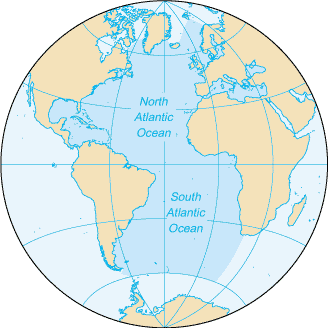
The Atlantic Ocean occupies an elongated, S-shaped basin extending longitudinally between Europe and Africa to the east, and the Americas to the west. As one component of the interconnected World Ocean, it is connected in the north to the Arctic Ocean, to the Pacific Ocean in the southwest, the Indian Ocean in the southeast, and the Southern Ocean in the south. Other definitions describe the Atlantic as extending southward to Antarctica. The Atlantic Ocean is divided in two parts, the northern and southern Atlantic, by the Equator.
The oldest known mentions of an "Atlantic" sea come from Stesichorus around mid-sixth century BC (Sch. A. R. 1. 211): Atlantikôi pelágei (Ancient Greek: Ἀτλαντικῷ πελάγει, 'the Atlantic sea', etym. 'Sea of Atlas') and in The Histories of Herodotus around 450 BC (Hdt. 1.202.4): Atlantis thalassa (Ancient Greek: Ἀτλαντὶς θάλασσα, 'Sea of Atlas' or 'the Atlantic sea') where the name refers to "the sea beyond the pillars of Hercules" which is said to be part of the sea that surrounds all land. In these uses, the name refers to Atlas, the Titan in Greek mythology, who supported the heavens and who later appeared as a frontispiece in medieval maps and also lent his name to modern atlases. On the other hand, to early Greek sailors and in ancient Greek mythological literature such as the Iliad and the Odyssey, this all-encompassing ocean was instead known as Oceanus, the gigantic river that encircled the world; in contrast to the enclosed seas well known to the Greeks: the Mediterranean and the Black Sea. In contrast, the term "Atlantic" originally referred specifically to the Atlas Mountains in Morocco and the sea off the Strait of Gibraltar and the West African coast.
The term "Aethiopian Ocean", derived from Ancient Ethiopia, was applied to the southern Atlantic as late as the mid-19th century. During the Age of Discovery, the Atlantic was also known to English cartographers as the Great Western Ocean.
The pond is a term often used by British and American speakers in reference to the northern Atlantic Ocean, as a form of meiosis, or ironic understatement. It is used mostly when referring to events or circumstances "on this side of the pond" or "on the other side of the pond" or "across the pond", rather than to discuss the ocean itself. The term dates to 1640, first appearing in print in a pamphlet released during the reign of Charles I, and reproduced in 1869 in Nehemiah Wallington's Historical Notices of Events Occurring Chiefly in The Reign of Charles I, where "great Pond" is used in reference to the Atlantic Ocean by Francis Windebank, Charles I's Secretary of State.
The International Hydrographic Organization (IHO) defined the limits of the oceans and seas in 1953, but some of these definitions have been revised since then and some are not recognized by various authorities, institutions, and countries, for example the CIA World Factbook. Correspondingly, the extent and number of oceans and seas vary.
Hub AI
Atlantic Ocean AI simulator
(@Atlantic Ocean_simulator)
Atlantic Ocean
The Atlantic Ocean is the second largest of the world's five oceanic divisions, with an area of about 85,133,000 km2 (32,870,000 sq mi). It covers approximately 17% of Earth's surface and about 24% of its water surface area. During the Age of Discovery, it was known for separating the New World of the Americas (North America and South America) from the Old World of Afro-Eurasia (Africa, Asia, and Europe).
Through its separation of Afro-Eurasia from the Americas, the Atlantic Ocean has played a central role in the development of human society, globalization, and the histories of many nations. While the Norse were the first known humans to cross the Atlantic, it was the expedition of Christopher Columbus in 1492 that proved to be the most consequential. Columbus's expedition ushered in an age of exploration and colonization of the Americas by European powers, most notably Portugal, Spain, France, and the United Kingdom. From the 16th to 19th centuries, the Atlantic Ocean was the center of both an eponymous slave trade and the Columbian exchange while occasionally hosting naval battles. Such naval battles, as well as growing trade from regional American powers like the United States and Brazil, both increased in degree during the early 20th century. After World War II, major military operations became rarer, though notable postwar conflicts include the Cuban Missile Crisis and the Falklands War. The ocean remains a core component of trade around the world.
The Atlantic Ocean's temperatures vary by location. For example, the South Atlantic maintains warm temperatures year-round, as its basin countries are tropical. The North Atlantic maintains a temperate climate, as its basin countries are temperate and have seasons of extremely low temperatures and high temperatures.
The Atlantic Ocean occupies an elongated, S-shaped basin extending longitudinally between Europe and Africa to the east, and the Americas to the west. As one component of the interconnected World Ocean, it is connected in the north to the Arctic Ocean, to the Pacific Ocean in the southwest, the Indian Ocean in the southeast, and the Southern Ocean in the south. Other definitions describe the Atlantic as extending southward to Antarctica. The Atlantic Ocean is divided in two parts, the northern and southern Atlantic, by the Equator.
The oldest known mentions of an "Atlantic" sea come from Stesichorus around mid-sixth century BC (Sch. A. R. 1. 211): Atlantikôi pelágei (Ancient Greek: Ἀτλαντικῷ πελάγει, 'the Atlantic sea', etym. 'Sea of Atlas') and in The Histories of Herodotus around 450 BC (Hdt. 1.202.4): Atlantis thalassa (Ancient Greek: Ἀτλαντὶς θάλασσα, 'Sea of Atlas' or 'the Atlantic sea') where the name refers to "the sea beyond the pillars of Hercules" which is said to be part of the sea that surrounds all land. In these uses, the name refers to Atlas, the Titan in Greek mythology, who supported the heavens and who later appeared as a frontispiece in medieval maps and also lent his name to modern atlases. On the other hand, to early Greek sailors and in ancient Greek mythological literature such as the Iliad and the Odyssey, this all-encompassing ocean was instead known as Oceanus, the gigantic river that encircled the world; in contrast to the enclosed seas well known to the Greeks: the Mediterranean and the Black Sea. In contrast, the term "Atlantic" originally referred specifically to the Atlas Mountains in Morocco and the sea off the Strait of Gibraltar and the West African coast.
The term "Aethiopian Ocean", derived from Ancient Ethiopia, was applied to the southern Atlantic as late as the mid-19th century. During the Age of Discovery, the Atlantic was also known to English cartographers as the Great Western Ocean.
The pond is a term often used by British and American speakers in reference to the northern Atlantic Ocean, as a form of meiosis, or ironic understatement. It is used mostly when referring to events or circumstances "on this side of the pond" or "on the other side of the pond" or "across the pond", rather than to discuss the ocean itself. The term dates to 1640, first appearing in print in a pamphlet released during the reign of Charles I, and reproduced in 1869 in Nehemiah Wallington's Historical Notices of Events Occurring Chiefly in The Reign of Charles I, where "great Pond" is used in reference to the Atlantic Ocean by Francis Windebank, Charles I's Secretary of State.
The International Hydrographic Organization (IHO) defined the limits of the oceans and seas in 1953, but some of these definitions have been revised since then and some are not recognized by various authorities, institutions, and countries, for example the CIA World Factbook. Correspondingly, the extent and number of oceans and seas vary.
Recent media