
Recent from talks
South Pacific Coast Railroad
Knowledge base stats:
Talk channels stats:
Members stats:
South Pacific Coast Railroad
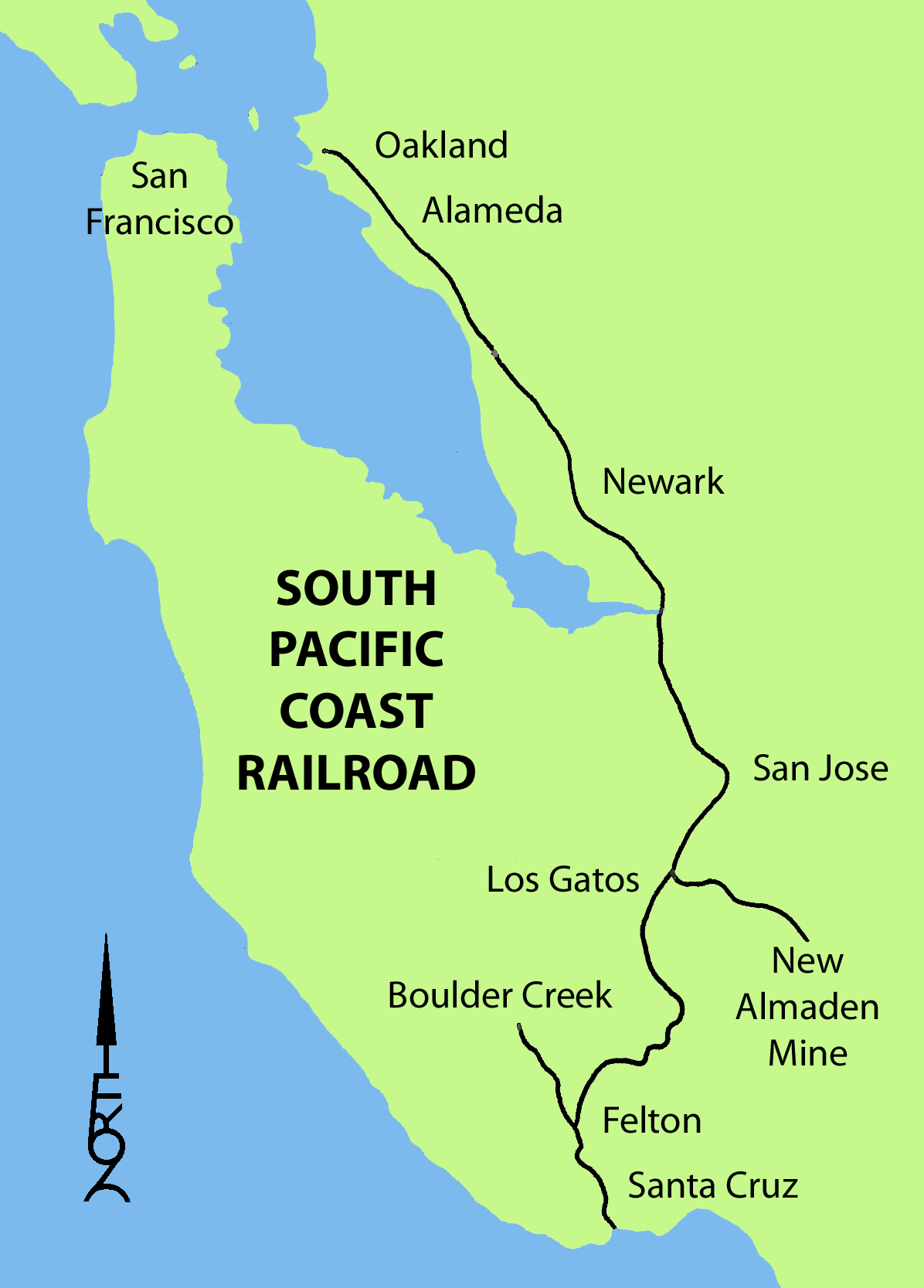
The South Pacific Coast Railroad (SPC) was a 3 ft (914 mm) narrow gauge steam railroad running between Santa Cruz, California, and Alameda, with a ferry connection in Alameda to San Francisco. The railroad was created as the Santa Clara Valley Railroad, founded by local strawberry growers as a way to get their crops to market in San Francisco and provide an alternative to the Southern Pacific Railroad. In 1876, James Graham Fair, a Comstock Lode silver baron, bought the line and extended it into the Santa Cruz Mountains to capture the significant lumber traffic coming out of the redwood forests. The narrow-gauge line was originally laid with 52-pound-per-yard (26 kg/m) rail on 8-foot (2.44 m) redwood ties; and was later acquired by the Southern Pacific and converted to 4 ft 8+1⁄2 in (1,435 mm) standard gauge.
SPC was incorporated in 1876 to purchase the unfinished Santa Clara Valley Company railroad at Dumbarton Point. Dumbarton Point was then a landing to transfer agricultural produce from the Santa Clara Valley for transport to San Francisco. Railway shops were built in Newark and a 3 ft (914 mm) narrow gauge line to San Jose was completed in 1876. The SPC ferry Newark offered connecting service from Newark to San Francisco in 1877. In 1878 the SPC was extended from San Jose to Los Gatos; and the subsidiary Bay and Coast Railroad completed a line of trestles and fill along the eastern edge of San Francisco Bay from Newark to Alameda. The ferry connection to San Francisco shifted to Alameda as SPC ferrys Bay City and Garden City increased the frequency and reliability of connecting service.
Two years and eight tunnels were required to extend the SPC through the Santa Cruz Mountains from Los Gatos to California's third busiest seaport at Santa Cruz in 1880. SPC leased the San Lorenzo Flume and Transportation Company to acquire their subsidiary Santa Cruz and Felton Railroad as a route through the city to Santa Cruz municipal pier. The big lumber transport flume was replaced by a 7 miles (11 km) logging branch in 1883. In 1886 another branch line was built to the New Almaden mercury mine; and the SPC main line was extended from Alameda to Oakland. Additional horsedrawn branch lines served Centerville (now Fremont) and Agnews State Hospital. Commuter trains fed the San Francisco ferries from east bay communities, two daily trains served Santa Cruz, and four daily locals served the logging branch to Boulder Creek. Excursion trains ran from the ferries to resorts of the south bay and Santa Cruz Mountains. Freight trains carried redwood lumber, mercury, sacked lime, gunpowder from the California Powder Works, and local agricultural produce.
Building the South Pacific Coast Railroad dramatically reduced the cost of transportation for both passengers and freight. In 1857, the stagecoach from San Francisco to Santa Cruz took two full days, and the fare was $13 (one way) plus the cost of lodging and meals. After the completion of the railroad, the travel time dropped to a few hours, and cost only $6 (round trip). Freight rates dropped to only half of what they had been previously. As a result, farming and all other forms of economic activity in the region increased significantly.
By 1887 SPC was a major California transportation concern; and Southern Pacific paid six million dollars to merge it into their California transportation system (equivalent to $210 million in 2024). An 1893 winter storm caused a landslide in the Santa Cruz Mountains requiring major reconstruction to restore service. The Alameda ferry terminal burned in 1902 and was replaced with the modern terminal which survived until ferry service was discontinued by the San Francisco–Oakland Bay Bridge in 1939. The 3 ft (914 mm) gauge line had 23 locomotives, 85 passenger cars and 500 freight cars before the conversion to standard gauge began. The transition to standard gauge was interrupted by the 1906 San Francisco earthquake. The line through the Santa Cruz Mountains suffered major damage including a lateral slip of 5 feet (1.5 m) in the tunnel where it crossed the San Andreas Fault. The bridge across San Leandro Bay was damaged and abandoned. Conversion to standard gauge was completed in 1909. 3 ft (914 mm) narrow gauge locomotives numbered 9, 23, and 26 were eventually acquired by the Ilwaco Railway and Navigation Company. Other SPC 3 ft (914 mm) gauge equipment was sold to the Carson and Colorado Railway, the White Pass and Yukon Route, the Nevada County Narrow Gauge Railroad, the Pacific Coast Railway, the Lake Tahoe Railway and Transportation Company, and the Northwestern Pacific Railroad.
The track in Alameda could only be used for local service after being isolated by the 1906 earthquake. It was electrified in 1911 and operated as part of the SP's East Bay Electric Lines until 1941. The remaining line from San Jose to San Leandro Bay became part of the Southern Pacific coast division main line.
However, the southern end of the system from San Jose to Santa Cruz was reclassified as a branch line by 1915, useful only to lighter locomotives, as two or three were required to move trains over the grade. Beginning in 1927, it was used by SP's Suntan Special seasonal excursion trains which came down the San Francisco Peninsula every summer Sunday and took passengers right to the Santa Cruz Beach Boardwalk. The Boulder Creek branch was dismantled in 1934 after a few years of service by a McKeen railmotor. The tracks through the Santa Cruz Mountains suffered major damage during a storm on February 29, 1940. The last train ran on 26 February 1940 and the line was officially abandoned on June 4, 1940.
The line from San Jose to Los Gatos remained in freight service after the last commuter train ran in 1955. The two southernmost tunnels (#8/Mission Hill and #6/Rincon) continued to be used until 1993, when a fire inside the Rincon Tunnel led to a landslide which collapsed it. The Santa Cruz depot was used for SP's surviving coastal line from Watsonville Junction until the building was sold the 1970s and converted to a restaurant.
Hub AI
South Pacific Coast Railroad AI simulator
(@South Pacific Coast Railroad_simulator)
South Pacific Coast Railroad
The South Pacific Coast Railroad (SPC) was a 3 ft (914 mm) narrow gauge steam railroad running between Santa Cruz, California, and Alameda, with a ferry connection in Alameda to San Francisco. The railroad was created as the Santa Clara Valley Railroad, founded by local strawberry growers as a way to get their crops to market in San Francisco and provide an alternative to the Southern Pacific Railroad. In 1876, James Graham Fair, a Comstock Lode silver baron, bought the line and extended it into the Santa Cruz Mountains to capture the significant lumber traffic coming out of the redwood forests. The narrow-gauge line was originally laid with 52-pound-per-yard (26 kg/m) rail on 8-foot (2.44 m) redwood ties; and was later acquired by the Southern Pacific and converted to 4 ft 8+1⁄2 in (1,435 mm) standard gauge.
SPC was incorporated in 1876 to purchase the unfinished Santa Clara Valley Company railroad at Dumbarton Point. Dumbarton Point was then a landing to transfer agricultural produce from the Santa Clara Valley for transport to San Francisco. Railway shops were built in Newark and a 3 ft (914 mm) narrow gauge line to San Jose was completed in 1876. The SPC ferry Newark offered connecting service from Newark to San Francisco in 1877. In 1878 the SPC was extended from San Jose to Los Gatos; and the subsidiary Bay and Coast Railroad completed a line of trestles and fill along the eastern edge of San Francisco Bay from Newark to Alameda. The ferry connection to San Francisco shifted to Alameda as SPC ferrys Bay City and Garden City increased the frequency and reliability of connecting service.
Two years and eight tunnels were required to extend the SPC through the Santa Cruz Mountains from Los Gatos to California's third busiest seaport at Santa Cruz in 1880. SPC leased the San Lorenzo Flume and Transportation Company to acquire their subsidiary Santa Cruz and Felton Railroad as a route through the city to Santa Cruz municipal pier. The big lumber transport flume was replaced by a 7 miles (11 km) logging branch in 1883. In 1886 another branch line was built to the New Almaden mercury mine; and the SPC main line was extended from Alameda to Oakland. Additional horsedrawn branch lines served Centerville (now Fremont) and Agnews State Hospital. Commuter trains fed the San Francisco ferries from east bay communities, two daily trains served Santa Cruz, and four daily locals served the logging branch to Boulder Creek. Excursion trains ran from the ferries to resorts of the south bay and Santa Cruz Mountains. Freight trains carried redwood lumber, mercury, sacked lime, gunpowder from the California Powder Works, and local agricultural produce.
Building the South Pacific Coast Railroad dramatically reduced the cost of transportation for both passengers and freight. In 1857, the stagecoach from San Francisco to Santa Cruz took two full days, and the fare was $13 (one way) plus the cost of lodging and meals. After the completion of the railroad, the travel time dropped to a few hours, and cost only $6 (round trip). Freight rates dropped to only half of what they had been previously. As a result, farming and all other forms of economic activity in the region increased significantly.
By 1887 SPC was a major California transportation concern; and Southern Pacific paid six million dollars to merge it into their California transportation system (equivalent to $210 million in 2024). An 1893 winter storm caused a landslide in the Santa Cruz Mountains requiring major reconstruction to restore service. The Alameda ferry terminal burned in 1902 and was replaced with the modern terminal which survived until ferry service was discontinued by the San Francisco–Oakland Bay Bridge in 1939. The 3 ft (914 mm) gauge line had 23 locomotives, 85 passenger cars and 500 freight cars before the conversion to standard gauge began. The transition to standard gauge was interrupted by the 1906 San Francisco earthquake. The line through the Santa Cruz Mountains suffered major damage including a lateral slip of 5 feet (1.5 m) in the tunnel where it crossed the San Andreas Fault. The bridge across San Leandro Bay was damaged and abandoned. Conversion to standard gauge was completed in 1909. 3 ft (914 mm) narrow gauge locomotives numbered 9, 23, and 26 were eventually acquired by the Ilwaco Railway and Navigation Company. Other SPC 3 ft (914 mm) gauge equipment was sold to the Carson and Colorado Railway, the White Pass and Yukon Route, the Nevada County Narrow Gauge Railroad, the Pacific Coast Railway, the Lake Tahoe Railway and Transportation Company, and the Northwestern Pacific Railroad.
The track in Alameda could only be used for local service after being isolated by the 1906 earthquake. It was electrified in 1911 and operated as part of the SP's East Bay Electric Lines until 1941. The remaining line from San Jose to San Leandro Bay became part of the Southern Pacific coast division main line.
However, the southern end of the system from San Jose to Santa Cruz was reclassified as a branch line by 1915, useful only to lighter locomotives, as two or three were required to move trains over the grade. Beginning in 1927, it was used by SP's Suntan Special seasonal excursion trains which came down the San Francisco Peninsula every summer Sunday and took passengers right to the Santa Cruz Beach Boardwalk. The Boulder Creek branch was dismantled in 1934 after a few years of service by a McKeen railmotor. The tracks through the Santa Cruz Mountains suffered major damage during a storm on February 29, 1940. The last train ran on 26 February 1940 and the line was officially abandoned on June 4, 1940.
The line from San Jose to Los Gatos remained in freight service after the last commuter train ran in 1955. The two southernmost tunnels (#8/Mission Hill and #6/Rincon) continued to be used until 1993, when a fire inside the Rincon Tunnel led to a landslide which collapsed it. The Santa Cruz depot was used for SP's surviving coastal line from Watsonville Junction until the building was sold the 1970s and converted to a restaurant.
Recent media