Recent from talks
Nothing was collected or created yet.
Southern Bavarian
View on Wikipedia| Southern Bavarian | |
|---|---|
| Südbairisch | |
| Native to | Austria (Tyrol, Carinthia, Upper Styria) Italy (South Tyrol) Germany (Werdenfelser Land) Switzerland (Samnaun) Brazil (Treze Tílias), United States, Canada |
| Latin (German alphabet) | |
| Language codes | |
| ISO 639-3 | – |
| Glottolog | sout2632 South Bavarianglob1242 Global South Bavarian |
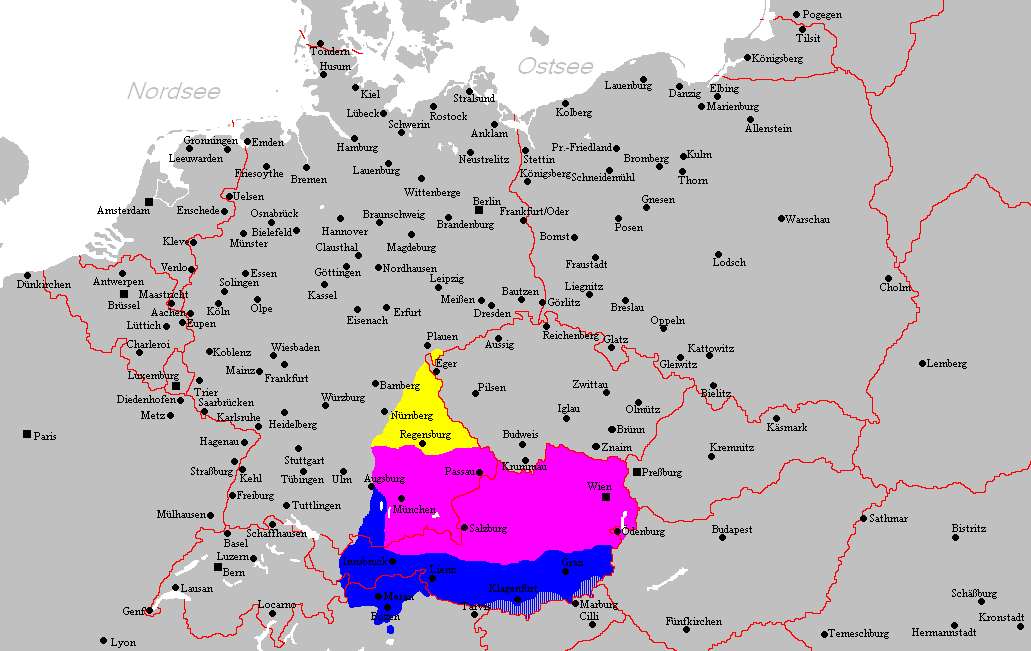
Southern Bavarian or South Bavarian, is a cluster of Upper German dialects of the Bavarian group. They are primarily spoken in Tyrol (i.e. the Austrian state of Tyrol and the Italian province of South Tyrol), in Carinthia and in the western parts of Upper Styria. Before 1945 and the expulsions of the Germans, it was also spoken in speech islands in Italy and Yugoslavia.[2] Due to these Alpine regions, many features of the Old Bavarian language from the Middle High German period have been preserved. On the other hand, the Southern Bavarian dialect area is influenced by the Rhaeto-Romance languages, locally also Slovene and to a lesser extent Italian.
The speech area historically included the former linguistic enclaves in Carniola (present-day Slovenia) around Kočevje in the Gottschee region (Gottscheerish), Sorica (Zarz) and Nemški Rovt (Deutsch Ruth). The Cimbrian language still spoken in several language-islands in north-eastern Italy (Friuli, Veneto and Trentino) mostly counts as a separate Bavarian language variant. Southern Bavarian is also spoken in the Werdenfelser Land region around Mittenwald and Garmisch-Partenkirchen in German Upper Bavaria.[citation needed]
The Tyrolean Unterland, the Alpine regions of Salzburg (Pinzgau, Pongau and Lungau), as well as the adjacent parts of Styria and southern Burgenland form the dialect continuum with the Central Bavarian language area in the north.[citation needed]
Phonology
[edit]Vowels
[edit]Southern Bavarian has 8 vowels:
| Front | Back | ||
|---|---|---|---|
| Unrounded | Unrounded | Rounded | |
| Close | i | ɯ | |
| Close-mid | e | ɤ | |
| Open-mid | ɛ | ʌ | |
| Open | a | ɒ | |
Consonants
[edit]Southern Bavarian has about 33 consonants:
| Bilabial | Labiodental | Alveolar | Postalveolar | Palatal | Velar | Glottal | ||||||||
|---|---|---|---|---|---|---|---|---|---|---|---|---|---|---|
| Plosive | p | b̥ | t | d̥ | k | ɡ̊ | ||||||||
| Nasal | m | n | ŋ | |||||||||||
| Fricative | β, β̬ | f | v̥ | s | z̥ | ʃ | ʒ̊ | ç | ʝ | x | ɣ̊ | h | ||
| Affricate | p͡f | b̥͡v̥ | t͡s | d̥͡z̥ | t͡ʃ | d̥͡ʒ̥ | ɡ̊͡ɣ̊ | |||||||
| Trill | r | |||||||||||||
| Approximant | l, lʲ | j | ||||||||||||
See also
[edit]References
[edit]- ^ Ethnologue entry
- ^ Kurt Gustav Goblirsch, Consonant Strength in Upper German Dialects, John Benjamins Publishing Company 2012 as NOWELE Supplement Series vol. 10 (originally Odense University Press 1994), p. 23
Southern Bavarian
View on GrokipediaClassification and Status
Linguistic Affiliation
Southern Bavarian constitutes the southernmost subgroup of the Bavarian dialects, which are themselves classified as East Upper German varieties within the High German branch of West Germanic languages.[3] This positioning places Southern Bavarian in the Indo-European > Germanic > West Germanic > High German > Upper German > Bavarian family tree, marked by participation in the High German consonant shift around the 8th century, involving changes such as p to pf (e.g., apful to Apfel, "apple") and t to ts (e.g., apuz to Apuz, "buzzard").[4] The Bavarian group encompasses three main subgroups—Northern, Central, and Southern—differentiated by phonological isoglosses like the treatment of the High German diphthongization and umlaut patterns, with Southern Bavarian showing more conservative vowel systems in peripheral areas.[1][5] Linguistically, Southern Bavarian aligns closely with Austro-Bavarian varieties, sharing lexical and morphological traits such as periphrastic verb forms (e.g., "i hob's g'sogt" for "I said it") and diminutive suffixes (-l, -el) that distinguish it from neighboring Alemannic dialects to the west, which exhibit stronger West Upper German affiliations like greater simplification of consonant clusters.[6] While often termed dialects of German due to sociopolitical standardization toward Standard German (Hochdeutsch), Southern Bavarian's mutual unintelligibility with Standard German—estimated at 40-60% comprehension for naive speakers—prompts debates in dialectology over its status as a distinct language, akin to how Glottolog catalogs it separately under South Bavarian with subgroups like Tyrolean and Carinthian.[7] These affiliations are evidenced in comparative studies of real-time phonological variation, confirming shared innovations like monophthongization in stressed syllables across Bavarian subgroups but with Southern variants retaining alveolar fricatives longer than Central ones.[8] The subgroup's unity is further supported by historical migrations of Bavarian tribes from the 6th century onward, fostering a dialect continuum across the Eastern Alps, though modern borders influence divergence; for instance, South Tyrolean varieties preserve more archaic features due to isolation from German standardization pressures post-1919 annexation.[1] Dialectometric analyses quantify these ties, showing Southern Bavarian clustering at 70-80% lexical similarity with Central Bavarian but only 50-60% with Alemannic, underscoring its core affiliation within the Bavarian continuum rather than broader Upper German outliers.[6]Dialect or Language Distinction
Southern Bavarian, a subgroup of the Austro-Bavarian varieties, is conventionally classified as a dialect of the German language within the Upper German branch, reflecting its historical and cultural integration into German-speaking speech communities. This designation persists due to sociopolitical factors, including the absence of political independence for its speakers, reliance on Standard German for writing and formal communication, and a diglossic context where Standard German dominates high-prestige domains.[9][5] Linguistically, however, Southern Bavarian exhibits traits that align it more closely with the criteria for a distinct language, such as substantial phonological, lexical, and grammatical deviations from Standard High German, which is based on Central German dialects. Key divergences include preserved Middle High German features like monophthongization of diphthongs (e.g., Standard German Haus [haʊs] vs. Southern Bavarian Hous [huəs]) and unique consonant shifts, rendering spoken Southern Bavarian opaque to unexposed Standard German speakers, especially in rural Alpine varieties from Tyrol or Carinthia. Mutual intelligibility is asymmetric and low: Southern Bavarian speakers, accustomed to Standard German via education and media, comprehend it readily, but northern or non-dialect-speaking Germans often require subtitles or context to follow rapid Southern Bavarian discourse, akin to the gap between Dutch and German.[9][10] Classification bodies provide mixed signals amplifying the debate. The ISO 639-3 standard assigns "bar" to Bavarian as a whole, treating it as a language separate from German ("deu"), while Glottolog categorizes it as a dialect cluster within Germanic, emphasizing internal variation over autonomy from Standard German. Ethnologue lists Bavarian as a macrolanguage comprising individual languages like Southern Bavarian, citing its 14 million speakers and vulnerability from standardization pressures. Scholarly analyses underscore that the dialect label prevails not from empirical linguistic unity but from the unified German nation-state framework post-19th century, which prioritizes Standard German as the roof language, suppressing recognition of substrate varieties like Southern Bavarian as independent.[11][9]Historical Development
Origins in Upper German
Southern Bavarian dialects form a subgroup of the Bavarian language continuum, classified within the Upper German branch of High German languages, which arose in the southern German-speaking regions through the High German consonant shift between approximately 500 and 800 AD. This shift transformed intervocalic and word-initial stops—such as Proto-West Germanic *p, *t, *k into affricates and fricatives (e.g., *p to pf, *t to ts, *k to ch)—setting Upper German apart from Central and Low German varieties that underwent partial or no such changes.[1][5] The Bavarian dialects, including Southern Bavarian, originated with the linguistic practices of the Baiuvarii (Bavarians), a Germanic tribal confederation that settled the area between the Danube River and the Alps during the Migration Period, roughly from the 5th to 6th centuries AD, amid the decline of Roman provincial administration. These settlers brought a form of early Old High German (c. 750–1050 AD), characterized by conservative phonological traits and initial written attestations in glosses and names from the 8th century, such as the Wessobrunn Prayer.[1][5] By the Old High German period, Bavarian had diverged from neighboring Alemannic dialects, with lexical and phonological distinctions emerging due to regional settlement patterns and interactions with substrate languages in the former Roman provinces.[5] Southern Bavarian specifically developed in the alpine core areas of Tyrol, Carinthia, and parts of northern Italy (South Tyrol), where geographical isolation in mountainous terrain preserved archaic features from early Bavarian stages into the Middle High German period (c. 1050–1350 AD). These include retention of affricates (e.g., "Kchua" for "Kuh" or cow), distinctions in d-/t- sounds (e.g., "do" for "da" or there), and preservation of the prefix ge- in past participles (e.g., "getrunkchn" for drunk), which were lost or altered in northern Bavarian subgroups influenced by broader High German standardization.[1][12] Such conservatism limited adoption of Central Bavarian innovations, like vocalization of /l/ to /i/, reinforcing Southern Bavarian's position as the most dialectally distinct within the continuum by the 12th century, when lexical divergences in semantics and regional terms (e.g., baking vocabulary tied to 13th-century practices) became prominent.[1][5]Evolution Through Periods
Southern Bavarian dialects, as a subgroup of the broader Bavarian varieties within Upper German, trace their earliest attestations to the Old High German period (c. 750–1050), emerging in written form through glosses, names, and single words in Latin texts such as the late 8th-century Wessobrunn Prayer.[1] These initial records highlight conservative phonetic traits, including dulled Middle High German a-sounds and diphthongs like -oa-, distinguishing them from northern varieties while aligning with the Upper German continuum.[1] In the Middle High German period (c. 1050–1350), Southern Bavarian underwent phonetic and lexical differentiation, influenced by external pressures such as post-10th-century Hungarian invasions that reinforced Frankish-influenced written norms but preserved spoken vernacular autonomy.[1] Secular texts like the mid-12th-century Regensburg Kaiserchronik exhibit regional spellings reflecting Bavarian pronunciation, marking increased vernacular tradition.[1] By around 1300, an East Upper German-Austrian written standard had formed, diverging from spoken dialects and accelerating subdialectal variation, with Southern forms retaining archaic elements due to Alpine isolation.[1] Lexical innovations also began distinguishing Bavarian from neighboring Alemannic, rooted in 12th-century cultural practices.[5] The Early New High German period (c. 1350–1650) saw Southern Bavarian consolidate conservative features in core areas like Tyrol and Carinthia, such as affricate preservation in words like Kchua ("Kuh," cow), amid broader standardization pressures from literary German.[1] Deliberate dialectal texts proliferated from the 17th century, fostering literary expression while the spoken form evolved in relative seclusion, incorporating Gothic loanwords (e.g., Dult for "fair") from earlier contacts.[1] In the modern period, Southern Bavarian has maintained archaic Old Bavarian traits from the Middle High German era, bolstered by geographic barriers, while developing region-specific lexicon tied to traditions like 13th-century baking (e.g., a resche Brezn for dried pretzel).[1][5] Dialect dominance persisted into the 20th century, with usage at 81% in Altbayern per 1975 surveys, though post-mid-century shifts toward Standard German introduced diglossia and gradual convergence in urban peripheries.[1]Geographic Distribution
Core Regions and Varieties
Southern Bavarian dialects form a conservative subgroup of Bavarian, primarily distributed across the southern Alpine regions of Austria, Italy, and small pockets in Germany. The core areas encompass the Austrian federal states of Tyrol and Carinthia, where the dialects have persisted due to geographic isolation in mountainous terrain.[1] In Italy, they are spoken in the province of South Tyrol, with additional language islands in Trentino (such as Fersental) and Veneto (around Asiago).[1] Within Austria, extensions occur into eastern Styria and southern Salzburg, though these border transitional zones with Central Bavarian varieties.[6] In southern Bavaria, Germany, Southern Bavarian is confined to the Werdenfelser Land district around Garmisch-Partenkirchen, representing a minor enclave amid predominantly Central Bavarian speech.[1] These dialects distinguish themselves phonologically by retaining postvocalic /l/ (e.g., /ɔl/ rather than vocalized forms like /ɔɪ/ found in Central Bavarian) and preserving initial affricates and distinctions between d- and t- sounds.[6][1] The main varieties include Tyrolean Bavarian, prevalent in North Tyrol, East Tyrol, and South Tyrol, characterized by western Alpine influences and relative uniformity across valleys.[6] Carinthian Bavarian covers central and southern Carinthia, showing eastern extensions with subtle shifts in vowel systems.[6] South Styrian Bavarian occupies southeastern margins in Styria, often blending with Slovene substrate effects in border areas.[6] Dialectometric analyses of 31 phonological features from historical and contemporary data (spanning over 3 million lexical records and 293 recordings) confirm stability in these distributions, with minor retreats in southeastern Austria.[6]Speaker Population and Usage Patterns
Southern Bavarian dialects serve as the everyday vernacular for the German-speaking populations in Austria's Tyrol (population approximately 760,000) and southern Carinthia, as well as Italy's [South Tyrol](/page/South Tyrol) province (German speakers around 330,000 as of recent censuses). These varieties are integral to local identity in alpine and rural communities, where nearly all residents employ them proficiently in informal speech.[13] Usage patterns exhibit diglossia, with Southern Bavarian dominating private and local interactions—such as family discussions, traditional festivals, and village commerce—while Standard German prevails in schools, official administration, and mass media. In South Tyrol, locals routinely use the dialect over High German in daily life, reflecting its embedded role in social cohesion.[13] Code-switching occurs frequently, especially in urban centers like Innsbruck or Bolzano, where exposure to tourism and migration influences hybrid forms. Vitality persists through oral traditions, regional broadcasting, and cultural preservation efforts, though younger urban speakers increasingly favor Standard German, contributing to gradual erosion. Bavarian dialects overall, encompassing Southern variants, are deemed vulnerable by UNESCO owing to standardization pressures and demographic shifts.[14] Intergenerational transmission remains robust in isolated valleys, sustaining usage among children in traditional households.[15]Phonological Features
Vowel Inventory
Southern Bavarian dialects distinguish short and long vowels primarily through duration, without a systematic tense-lax opposition as in Standard German.[16] Long vowels are approximately 44% longer than their short counterparts, and the system typically lacks front rounded vowels, resulting in a leaner monophthong inventory compared to Standard German.[16] [17] In the Meran variety of Tyrolean—a representative Southern Bavarian dialect—seven short monophthongs (/i, e, ɛ, a, ɒ, o, u/) contrast with seven long counterparts (/i:, e:, ɛ:, a:, ɒ:, o:, u:/), yielding 14 monophthongs total.[16] This includes distinct qualities for /e/-/ɛ/ and /a/-/ɒ/, with /ɒ/ realized as a near-back low rounded vowel.[16] Diphthongs are numerous, often opening and derived from historical monophthong shifts or umlaut processes, contributing to a rich system of nine in Meran Tyrolean: /ai, au, ea, ei, ia/ (or /iə/), oa, ou, ui, ua/ (or /uə/).[16] Variations like /ia/ ~ /iə/ and /ua/ ~ /uə/ occur contextually, with the schwa-like offglides appearing before alveolar codas.[16] High lax vowels such as /ɪ/ and /ʊ/ are generally absent, unlike in northern varieties.[18] Vowel nasalization may emerge phonemically in some Southern Bavarian subdialects, particularly near nasal consonants, but remains marginal.[19]| Monophthongs | Front unrounded | Central | Back unrounded/rounded |
|---|---|---|---|
| High | i, i: | u, u: (rounded) | |
| High-mid | e, e: | o, o: (rounded) | |
| Low-mid | ɛ, ɛ: | ||
| Low | a, a: | ɒ, ɒ: (rounded) |
Consonant Inventory
The consonant inventory of Southern Bavarian dialects features a set of stops, affricates, fricatives, nasals, liquids, and glides typical of Upper German varieties, with distinctions in voicing for stops but primarily voiceless fricatives except for /v/. Stops include bilabial /p b/, alveolar /t d/, and velar /k g/, where /p t k/ are voiceless and /b d g/ voiced, though younger speakers may realize /b/ as the fricative [β] intervocalically. Affricates comprise /pf/, /ts/, /tʃ/, and often an affricated variant of /k/ as [kʷ] or [kx] initially or before nasals and liquids, a characteristic extension in dialects like those of South Tyrol.[21][22] Fricatives are predominantly voiceless: labiodental /f/, alveolar /s/, postalveolar /ʃ/, velar /x/ (with palatal allophone [ç]), and glottal /h/, alongside the voiced labiodental /v/ which appears in positions derived from historical /f/ or borrowings. Nasals include /m n ŋ/, with assimilatory variants such as [ŋ] before velars and occasional uvular [ɴ] after /k g/. Liquids consist of alveolar /l/ and uvular /ʀ/ (realized as [ʀ] or [ʁ]), the latter contrasting with apical rhotics in neighboring varieties. The palatal glide /j/ occurs in onsets and diphthongs. Rare voiced counterparts like /z ʒ dʒ/ may appear in specific contexts or loans but are not core phonemes.[21] Unlike Standard German, Southern Bavarian generally lacks final obstruent devoicing, preserving voicing contrasts word-finally (e.g., /baʀd/ 'board' vs. /baʀt/ 'hard'), though /r/-final contexts can trigger occasional devoicing. Consonant length is not phonemic, but fortis-lenis distinctions influence vowel quantity via Pfalz's Law, with short vowels preceding geminated or fortis obstruents. Affrication and fricativization are more pronounced in southern varieties, reflecting conservative retention from Middle High German shifts.[21][22]| Manner/Place | Bilabial | Labiodental | Alveolar | Postalveolar | Palatal | Velar | Uvular | Glottal |
|---|---|---|---|---|---|---|---|---|
| Stops | p, b | t, d | k, g | |||||
| Affricates | pf | ts | tʃ | (kx) | ||||
| Fricatives | f, v | s | ʃ | x | h | |||
| Nasals | m | n | ŋ | |||||
| Liquids | l | ʀ | ||||||
| Glides | j |