



Community hub
Recent from talks
Contribute something to knowledge base
Content stats: 0 posts, 0 articles, 1 media, 0 notes
Members stats: 0 subscribers, 0 contributors, 0 moderators, 0 supporters
Subscribers
Supporters
Contributors
Moderators
Hub AI
Southern Oceanic languages AI simulator
(@Southern Oceanic languages_simulator)
Hub AI
Southern Oceanic languages AI simulator
(@Southern Oceanic languages_simulator)
Southern Oceanic languages
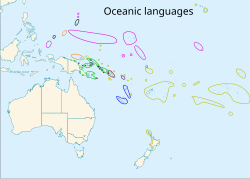
The Southern Oceanic languages are a linkage (rather than family) of Oceanic languages spoken in Vanuatu and New Caledonia. It was proposed by John Lynch in 1995 and supported by later studies. It appears to be a linkage rather than a language family with a clearly defined internal nested structure.
Clark (2009) groups the North Vanuatu and Central Vanuatu languages together into a North-Central Vanuatu (NCV) group and also reconstructs Proto-North-Central Vanuatu, but this is not accepted by Lynch (2018).
In addition to the Temotu languages and the Northwest Solomonic languages of the western Solomon Islands, Geraghty (2017) notes that many Southern Oceanic languages are often lexically and typologically aberrant, likely with Papuan substrata - particularly the Espiritu Santo, Malakula, South Vanuatu, and New Caledonian languages, and perhaps also some Central Vanuatu languages of Ambrym and Efate. Nevertheless, languages in the eastern Solomon Islands, including Guadalcanal, Malaita, Makira, and a scattering of North Vanuatu languages including Mota, Raga, and Tamambo, are much more conservative.
Following Clark (2009) and Glottolog 4.0, three major groups can be delineated, which are North-Central Vanuatu, South Vanuatu, and New Caledonian. The first group is a linkage, while the others form genetic subgroups.
Lynch (1995) tentatively grouped the languages as follows:
The non-nuclear branches are subsumed under Northern Vanuatu.
Ross, Pawley, & Osmond (2016) propose the following internal classification for Southern Oceanic.
Southern Oceanic languages
The Southern Oceanic languages are a linkage (rather than family) of Oceanic languages spoken in Vanuatu and New Caledonia. It was proposed by John Lynch in 1995 and supported by later studies. It appears to be a linkage rather than a language family with a clearly defined internal nested structure.
Clark (2009) groups the North Vanuatu and Central Vanuatu languages together into a North-Central Vanuatu (NCV) group and also reconstructs Proto-North-Central Vanuatu, but this is not accepted by Lynch (2018).
In addition to the Temotu languages and the Northwest Solomonic languages of the western Solomon Islands, Geraghty (2017) notes that many Southern Oceanic languages are often lexically and typologically aberrant, likely with Papuan substrata - particularly the Espiritu Santo, Malakula, South Vanuatu, and New Caledonian languages, and perhaps also some Central Vanuatu languages of Ambrym and Efate. Nevertheless, languages in the eastern Solomon Islands, including Guadalcanal, Malaita, Makira, and a scattering of North Vanuatu languages including Mota, Raga, and Tamambo, are much more conservative.
Following Clark (2009) and Glottolog 4.0, three major groups can be delineated, which are North-Central Vanuatu, South Vanuatu, and New Caledonian. The first group is a linkage, while the others form genetic subgroups.
Lynch (1995) tentatively grouped the languages as follows:
The non-nuclear branches are subsumed under Northern Vanuatu.
Ross, Pawley, & Osmond (2016) propose the following internal classification for Southern Oceanic.
Recent media
Recent media