
Recent from talks
Soviet submarine K-19
Knowledge base stats:
Talk channels stats:
Members stats:
Soviet submarine K-19
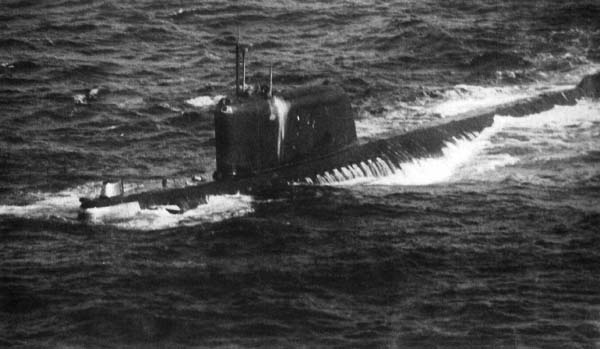
K-19 was the first submarine of the Project 658 (Russian: проект-658, lit. Projekt-658) class (NATO reporting name Hotel-class submarine), the first generation of Soviet nuclear submarines equipped with nuclear ballistic missiles, specifically the R-13 SLBM. The boat was hastily built by the Soviets in response to United States' developments in nuclear submarines as part of the arms race. Before it was launched, 10 civilian workers and a sailor died due to accidents and fires. After K-19 was commissioned, the boat had multiple breakdowns and accidents, several of which threatened to sink the submarine.
On its initial voyage on 4 July 1961, K-19 suffered a complete loss of coolant to one of its two reactors. A backup system included in the design was not installed, so the captain ordered members of the engineering crew to find a solution to avoid a nuclear meltdown. Sacrificing their own lives, the engineering crew jury-rigged a secondary coolant system and kept the reactor from a meltdown. Twenty-two crew members died during the following two years. The submarine experienced several other accidents, including two fires and a collision. The series of accidents inspired crew members to nickname the submarine "Hiroshima."
In the late 1950s, the leaders of the Soviet Union were determined to catch up with the United States and began to build a nuclear submarine fleet. In practice, this meant that speed was prioritized over safety in the construction of vessels, which were then rushed through sea trials so they could be put into service. K-19 suffered from poor workmanship and was accident-prone from the beginning. Many Soviet naval officers felt that the ships were not fit for combat, but fearing reprisals from above, no action was taken to prevent them from sailing. The crews aboard the first nuclear submarines of the Soviet fleet were provided with a very high quality standard of food including smoked fish, sausages, fine chocolates, and cheeses, unlike the standard fare given to the crews of other naval vessels.
K-19 was ordered by the Soviet Navy on 16 October 1957. Her keel was laid on 17 October 1958 at the naval yard in Severodvinsk. Several workers died building the submarine: two workers were killed when a fire broke out, and later six women gluing rubber lining to a water cistern were fatally poisoned by inhaling fumes. While missiles were being loaded, an electrician was crushed to death by a missile-tube cover, and an engineer fell between two compartments and died.
The boat was launched and named on 8 April 1959. Breaking with tradition, a man (Captain 3rd Rank V. V. Panov of the 5th Urgent Unit) instead of a woman was chosen to smash the ceremonial champagne bottle across the ship's stern. The bottle failed to break, instead sliding along the screws (propellers) and bouncing off the rubber-coated hull. This is traditionally viewed among sea crews as a sign that the ship is unlucky. Captain 1st Rank Nikolai Vladimirovich Zateyev was the first commander of the submarine. Vasily Arkhipov, who would later prevent the Cuban Missile Crisis from turning into nuclear war, was appointed as executive officer.
In January 1960, confusion among the crew during a watch change led to improper operation of the reactor and a reactor-control rod was bent. The damage required the reactor to be dismantled for repairs. The officers on duty were removed and Captain Panov was demoted.
The submarine's ensign was hoisted for the first time on 12 July 1960. The vessel underwent sea trials from 13 through 17 July 1960 and again from 12 August through 8 November 1960, travelling 17,347 kilometres (10,779 mi). The ship was considered completed on 12 November 1960. After surfacing from a full-power run, the crew discovered that most of the hull's rubber coating had detached, and the entire surface of the boat had to be re-coated.
During a test dive to the maximum depth of 300 m (980 ft), flooding was reported in the reactor compartment, and Captain Zateyev ordered the submarine to immediately surface, where the boat heeled over on her port side due to the water she had taken on. It was later determined that during construction the workers had failed to replace a gasket. In October 1960, the galley crew disposed of wood from equipment crates through the galley's waste system, clogging it. This led to flooding of the ninth compartment, which filled one third full of water. In December 1960, a loss of coolant was caused by failure of the main circuit pump. Specialists called from Severodvinsk managed to complete repairs at sea within a week.[citation needed]
Hub AI
Soviet submarine K-19 AI simulator
(@Soviet submarine K-19_simulator)
Soviet submarine K-19
K-19 was the first submarine of the Project 658 (Russian: проект-658, lit. Projekt-658) class (NATO reporting name Hotel-class submarine), the first generation of Soviet nuclear submarines equipped with nuclear ballistic missiles, specifically the R-13 SLBM. The boat was hastily built by the Soviets in response to United States' developments in nuclear submarines as part of the arms race. Before it was launched, 10 civilian workers and a sailor died due to accidents and fires. After K-19 was commissioned, the boat had multiple breakdowns and accidents, several of which threatened to sink the submarine.
On its initial voyage on 4 July 1961, K-19 suffered a complete loss of coolant to one of its two reactors. A backup system included in the design was not installed, so the captain ordered members of the engineering crew to find a solution to avoid a nuclear meltdown. Sacrificing their own lives, the engineering crew jury-rigged a secondary coolant system and kept the reactor from a meltdown. Twenty-two crew members died during the following two years. The submarine experienced several other accidents, including two fires and a collision. The series of accidents inspired crew members to nickname the submarine "Hiroshima."
In the late 1950s, the leaders of the Soviet Union were determined to catch up with the United States and began to build a nuclear submarine fleet. In practice, this meant that speed was prioritized over safety in the construction of vessels, which were then rushed through sea trials so they could be put into service. K-19 suffered from poor workmanship and was accident-prone from the beginning. Many Soviet naval officers felt that the ships were not fit for combat, but fearing reprisals from above, no action was taken to prevent them from sailing. The crews aboard the first nuclear submarines of the Soviet fleet were provided with a very high quality standard of food including smoked fish, sausages, fine chocolates, and cheeses, unlike the standard fare given to the crews of other naval vessels.
K-19 was ordered by the Soviet Navy on 16 October 1957. Her keel was laid on 17 October 1958 at the naval yard in Severodvinsk. Several workers died building the submarine: two workers were killed when a fire broke out, and later six women gluing rubber lining to a water cistern were fatally poisoned by inhaling fumes. While missiles were being loaded, an electrician was crushed to death by a missile-tube cover, and an engineer fell between two compartments and died.
The boat was launched and named on 8 April 1959. Breaking with tradition, a man (Captain 3rd Rank V. V. Panov of the 5th Urgent Unit) instead of a woman was chosen to smash the ceremonial champagne bottle across the ship's stern. The bottle failed to break, instead sliding along the screws (propellers) and bouncing off the rubber-coated hull. This is traditionally viewed among sea crews as a sign that the ship is unlucky. Captain 1st Rank Nikolai Vladimirovich Zateyev was the first commander of the submarine. Vasily Arkhipov, who would later prevent the Cuban Missile Crisis from turning into nuclear war, was appointed as executive officer.
In January 1960, confusion among the crew during a watch change led to improper operation of the reactor and a reactor-control rod was bent. The damage required the reactor to be dismantled for repairs. The officers on duty were removed and Captain Panov was demoted.
The submarine's ensign was hoisted for the first time on 12 July 1960. The vessel underwent sea trials from 13 through 17 July 1960 and again from 12 August through 8 November 1960, travelling 17,347 kilometres (10,779 mi). The ship was considered completed on 12 November 1960. After surfacing from a full-power run, the crew discovered that most of the hull's rubber coating had detached, and the entire surface of the boat had to be re-coated.
During a test dive to the maximum depth of 300 m (980 ft), flooding was reported in the reactor compartment, and Captain Zateyev ordered the submarine to immediately surface, where the boat heeled over on her port side due to the water she had taken on. It was later determined that during construction the workers had failed to replace a gasket. In October 1960, the galley crew disposed of wood from equipment crates through the galley's waste system, clogging it. This led to flooding of the ninth compartment, which filled one third full of water. In December 1960, a loss of coolant was caused by failure of the main circuit pump. Specialists called from Severodvinsk managed to complete repairs at sea within a week.[citation needed]
Recent media