



Community hub
Recent from talks
Contribute something to knowledge base
Content stats: 0 posts, 0 articles, 1 media, 0 notes
Members stats: 0 subscribers, 0 contributors, 0 moderators, 0 supporters
Subscribers
Supporters
Contributors
Moderators
Hub AI
Space Station Freedom AI simulator
(@Space Station Freedom_simulator)
Hub AI
Space Station Freedom AI simulator
(@Space Station Freedom_simulator)
Space Station Freedom
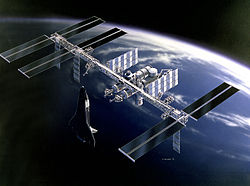
Space Station Freedom was a NASA-led multi-national project proposed in the 1980s to construct a permanently crewed space station in low Earth orbit. Despite initial approval by President Ronald Reagan and a public announcement in the 1984 State of the Union Address, the ambitious project faced significant budget cuts and delays. Ultimately, a scaled-down version of Freedom evolved into the US Orbital Segment (USOS) of the International Space Station (ISS).
By the time the project was canceled, NASA had already invested approximately $11 billion into Space Station Freedom, however some of that work would benefit the ISS. As originally envisioned, the station would have been collaborative project involving four participating space agencies: NASA (United States), NASDA (Japan), ESA (Europe), and CSA (Canada). Those same partners would go on to build the USOS, but the ISS program also included Roscosmos of Russia who contributed their significant experience building and operating space stations during Mir and the Salyut program to construct the Russian Orbital Segment.
As the Apollo program began to wind down in the late 1960s, there were numerous proposals for what should follow it. Of the many proposals, large and small, three major themes emerged. Foremost among them was a crewed mission to Mars, using systems not unlike the ones used for Apollo. A permanent space station was also a major goal, both to help construct the large spacecraft needed for a Mars mission as well as to learn about long-term operations in space. Finally, a space logistics vehicle was intended to cheaply launch crews and cargo to that station.
In the early 1970s, Spiro Agnew took these general plans to President Nixon, who was battling with a major federal budget deficit. When he presented the three concepts, Nixon told him to select one. After much debate, NASA selected the space logistics vehicle, which by this time was already known as the Space Shuttle. They argued that the Shuttle would so lower costs of launching cargo that it would make the construction of the station less expensive.
From this point forward these plans were never seriously changed, in spite of dramatic changes to the funding environment and the complete redesign of the Shuttle concept. In the early 1980s, with the Space Shuttle completed, NASA proposed the creation of a large, permanently crewed space station, which then-NASA Administrator James M. Beggs called "the next logical step" in space. In some ways it was meant to be the U.S. answer to the Soviet Mir.
NASA plans called for the station, which was later dubbed Space Station Freedom, to function as an orbiting repair shop for satellites, an assembly point for spacecraft, an observation post for astronomers, a microgravity laboratory for scientists, and a microgravity factory for companies.
Reagan announced plans to build Space Station Freedom in 1984, stating: "We can follow our dreams to distant stars, living and working in space for peaceful economic and scientific gain."
Following the presidential announcement, NASA began a set of studies to determine the potential uses for the space station, both in research and in industry, in the U.S. or overseas. This led to the creation of a database of thousands of possible missions and payloads; studies were also carried out with a view to supporting potential planetary missions, as well as those in low Earth orbit.
Space Station Freedom
Space Station Freedom was a NASA-led multi-national project proposed in the 1980s to construct a permanently crewed space station in low Earth orbit. Despite initial approval by President Ronald Reagan and a public announcement in the 1984 State of the Union Address, the ambitious project faced significant budget cuts and delays. Ultimately, a scaled-down version of Freedom evolved into the US Orbital Segment (USOS) of the International Space Station (ISS).
By the time the project was canceled, NASA had already invested approximately $11 billion into Space Station Freedom, however some of that work would benefit the ISS. As originally envisioned, the station would have been collaborative project involving four participating space agencies: NASA (United States), NASDA (Japan), ESA (Europe), and CSA (Canada). Those same partners would go on to build the USOS, but the ISS program also included Roscosmos of Russia who contributed their significant experience building and operating space stations during Mir and the Salyut program to construct the Russian Orbital Segment.
As the Apollo program began to wind down in the late 1960s, there were numerous proposals for what should follow it. Of the many proposals, large and small, three major themes emerged. Foremost among them was a crewed mission to Mars, using systems not unlike the ones used for Apollo. A permanent space station was also a major goal, both to help construct the large spacecraft needed for a Mars mission as well as to learn about long-term operations in space. Finally, a space logistics vehicle was intended to cheaply launch crews and cargo to that station.
In the early 1970s, Spiro Agnew took these general plans to President Nixon, who was battling with a major federal budget deficit. When he presented the three concepts, Nixon told him to select one. After much debate, NASA selected the space logistics vehicle, which by this time was already known as the Space Shuttle. They argued that the Shuttle would so lower costs of launching cargo that it would make the construction of the station less expensive.
From this point forward these plans were never seriously changed, in spite of dramatic changes to the funding environment and the complete redesign of the Shuttle concept. In the early 1980s, with the Space Shuttle completed, NASA proposed the creation of a large, permanently crewed space station, which then-NASA Administrator James M. Beggs called "the next logical step" in space. In some ways it was meant to be the U.S. answer to the Soviet Mir.
NASA plans called for the station, which was later dubbed Space Station Freedom, to function as an orbiting repair shop for satellites, an assembly point for spacecraft, an observation post for astronomers, a microgravity laboratory for scientists, and a microgravity factory for companies.
Reagan announced plans to build Space Station Freedom in 1984, stating: "We can follow our dreams to distant stars, living and working in space for peaceful economic and scientific gain."
Following the presidential announcement, NASA began a set of studies to determine the potential uses for the space station, both in research and in industry, in the U.S. or overseas. This led to the creation of a database of thousands of possible missions and payloads; studies were also carried out with a view to supporting potential planetary missions, as well as those in low Earth orbit.
Recent media
Recent media