Hubbry Logo
SpandrelSpandrelMain
Open search
Spandrel
Community hub
Spandrel
logo
8 pages, 0 posts
0 subscribers
Be the first to start a discussion here.
Spandrel
Spandrel
from Wikipedia
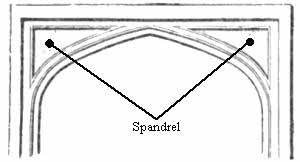
Spandrels of a Tudor arch
Spandrels of a circle within a square
Spandrel figures of winged victories, Arc de Triomphe du Carrousel, Paris
Spandrel panels

A spandrel[1] is a roughly triangular space, usually found in pairs, between the top of an arch and a rectangular frame, between the tops of two adjacent arches,[2] or one of the four spaces between a circle within a square. They are frequently filled with decorative elements.

Meaning

[edit]

There are four or five accepted and cognate meanings of the term spandrel in architectural and art history, mostly relating to the space between a curved figure and a rectangular boundary – such as the space between the curve of an arch and a rectilinear bounding moulding, or the wallspace bounded by adjacent arches in an arcade and the stringcourse or moulding above them, or the space between the central medallion of a carpet and its rectangular corners, or the space between the circular face of a clock and the corners of the square revealed by its hood. Also included is the space under a flight of stairs, if it is not occupied by another flight of stairs.[3]

In a building with more than one floor, the term spandrel is also used to indicate the space between the top of the window in one story and the sill of the window in the story above.[4] The term is typically employed when there is a sculpted panel or other decorative element in this space, or when the space between the windows is filled with opaque or translucent glass, in this case called "spandrel glass". In concrete or steel construction, an exterior beam extending from column to column usually carrying an exterior wall load is known as a "spandrel beam".[5]

In architectural ornamentation, the horizontal decorative elements that are hung over interior and exterior openings between the posts are called spandrels. They can be made of sawn out wood, ball-and-dowels, and spindles. Wooden ornamental spandrels are known as gingerbread spandrels. If they are in an arch form, they are called gingerbread arch spandrels.[6] The spandrels over doorways in perpendicular work are generally richly decorated. At Magdalen College, Oxford, is one which is perforated. The spandrel of doors is sometimes ornamented in the Decorated period, but seldom forms part of the composition of the doorway itself, being generally over the label.[7]

Domes

[edit]

Spandrels can also occur in the construction of domes and are typical in grand architecture from the medieval period onwards. Where a dome needed to rest on a square or rectangular base, the dome was raised above the level of the supporting pillars, with three-dimensional spandrels called pendentives taking the weight of the dome and concentrating it onto the pillars.[citation needed]

See also

[edit]

References

[edit]
[edit]
Revisions and contributorsEdit on WikipediaRead on Wikipedia
from Grokipedia
A spandrel is a term originating in architecture to describe the roughly triangular space formed between the top of an arch and an enclosing rectangular frame, or between two adjacent arches and the horizontal molding or ceiling above them. In this context, spandrels are incidental byproducts of structural design choices, such as mounting rounded arches or domes on rectangular supports, and they often serve decorative functions filled with ornamental motifs, sculptures, or panels. The concept has been extended metaphorically to evolutionary biology, where a spandrel denotes a phenotypic trait that arises as a non-adaptive byproduct of the evolution of another characteristic, rather than through direct natural selection for its own function. In architecture, spandrels appear prominently in styles like Romanesque, Gothic, and Renaissance buildings, where they provide opportunities for artistic expression while concealing structural elements. For instance, the famous pendentives in the Basilica of San Marco in Venice—tapering triangular spaces supporting the central dome—were constructed in the 11th century as necessary byproducts of the architectural configuration, later adorned with intricate mosaics in the late 12th century to illustrate their non-essential origin. Modern usage also includes spandrel panels in curtain wall systems, which are non-structural infill areas between floor slabs and window heads in high-rise facades, often glazed or clad to enhance aesthetics and weatherproofing. These elements highlight spandrels' role in bridging form and function without being load-bearing themselves. The biological application of the term was popularized by paleontologist Stephen Jay Gould and geneticist Richard C. Lewontin in their influential 1979 paper, "The Spandrels of San Marco and the Panglossian Paradigm: A Critique of the Adaptationist Programme," which used the architectural analogy to challenge the prevailing adaptationist view in evolutionary theory that attributes every trait to direct selective advantage. They argued that spandrels represent "neutral or even maladaptive" features co-opted later for utility, such as the human chin (a byproduct of reduced jaw size) or the umbilicus in certain snails repurposed as a brooding chamber (as later exemplified by Gould). This framework encouraged distinguishing between a trait's historical origin as a spandrel and its potential subsequent exaptation for a new role, enriching debates on evolutionary mechanisms and countering overly simplistic "just-so" stories of adaptation. The spandrel concept remains a cornerstone in discussions of evolutionary byproducts, with ongoing refinements in fields like developmental biology and ecology.

Architecture

Definition and Etymology

In architecture, a spandrel is the approximately triangular space between the extrados (outer curve) of an arch and the rectangular molding or framework that encloses it, typically occurring in pairs above the arch. These spaces are often filled with decorative elements, such as relief carvings or ornamental panels, to enhance aesthetic appeal without serving a primary structural function. The term "spandrel" entered English in the late 15th century, derived from Anglo-French spandre, a diminutive form possibly linked to Old French espandre ("to spread" or "expand"), from Latin expandere, reflecting the expansive shape of the area. An alternative explanation posits it as a corruption of "expander," emphasizing the geometric spreading between curved and straight elements. Geometrically, a spandrel above a single arch forms a curvilinear triangle bounded by the arch's curve, a horizontal line above, and vertical sides of the frame. In cases of intersecting arches, such as two rounded arches meeting at right angles, the spandrel becomes a tapering triangular space that may incorporate more intricate shapes like quatrefoils within Gothic tracery designs. Traditional decorative spandrels are commonly crafted from materials including carved stone, molded plaster, or inlaid mosaic to accommodate detailed ornamentation. This architectural feature is distinct from a pendentive, which is a curved, three-dimensional triangular surface that transitions a square bay to a circular dome by supporting it at the corners. The concept of the spandrel has been metaphorically extended in evolutionary biology to denote non-adaptive byproducts of other selected traits.

In Arches and Vaults

In arches and vaults, spandrels primarily fulfill a structural role by filling the triangular or curved spaces formed between adjacent arches or at the intersections of barrel vaults in groin vault systems, thereby providing stability and distributing vertical loads from the superstructure to the supporting piers below. This infilling prevents the collapse of unsupported voids and helps transfer the weight of walls, roofs, or ceilings evenly across the architectural framework, enhancing overall rigidity in load-bearing masonry construction. Construction techniques for spandrels in these elements involve assembling the primary arch using voussoirs—wedge-shaped stones precisely cut to lock together under compression— which naturally create the spandrel voids above the arch crown and between extrados curves. These spaces are then infilled with secondary materials such as rubble masonry, brickwork, or lightweight aggregates like pumice or hollow tiles to minimize dead load while maintaining compressive strength, allowing for taller and more expansive vaulted interiors without excessive foundation demands. In groin vaults, this infilling occurs after erecting the crossing barrel vaults, often using temporary centering to support the voussoirs until the mortar sets and the spandrel material bonds the assembly. Over time, the decorative treatment of spandrels evolved from simple, unadorned masonry fills in Romanesque architecture to highly elaborated sculptures in Gothic designs, where they often featured intricate foliation—leaf-like motifs carved in relief—or heraldic symbols signifying patronage and lineage, adding both aesthetic depth and narrative elements to the structure. A notable application appears in blind arcading, where shallow, non-piercing arches are superimposed on walls for ornamental effect, with spandrels serving as panels to frame subsidiary motifs or smaller decorative arches, as seen in the facades of structures like Wells Cathedral. This progression reflected advancements in stone carving techniques and a shift toward verticality and lightness in design. From an engineering perspective, spandrels contribute to managing thrust forces, particularly in pointed arches, which channel loads more directly downward compared to round arches, thereby reducing the horizontal outward thrust by 45% to 55% and allowing for slender piers and reduced need for extensive abutments. In round arches, the more uniform curvature distributes forces with greater lateral components, necessitating thicker spandrel infills or additional bracing to counteract spreading, whereas pointed forms optimize load-bearing by aligning the thrust line closer to the vertical axis of supports. This principle enabled the construction of soaring vaulted spaces in medieval cathedrals while maintaining structural integrity under self-weight and live loads.

In Domes and Ceilings

In domes and ceilings, spandrels function as transitional panels that bridge structural elements, such as the spaces between ribs in ribbed dome constructions or the areas between pendentives and the dome's base in Byzantine architecture. These panels accommodate the curvature of overhead structures, distributing loads while providing surfaces for aesthetic enhancement. Distinct forms of spandrels emerge in dome transitions from square or rectangular bases to circular crowns. Squinch spandrels consist of triangular fills that span the corners, redirecting the dome's thrust downward for stability, as seen in early Islamic examples like the Samanid Mausoleum in Bukhara. In contrast, pendentive spandrels are curved triangular supports that form a smooth spherical transition, enabling the dome to rest seamlessly on rounded arches, a technique refined in Byzantine designs such as the pendentives of St. Mark's Basilica in Venice. Decorative treatments elevate spandrels beyond their structural role, particularly in curved ceilings and domes. In Islamic architecture, spandrel-like spaces are often filled with muqarnas—honeycomb-like stalactite vaulting—using painting, gilding, or intricate tiling to create optical illusions of depth and lightness, as applied in Mamluk portals and mosque interiors. During the Renaissance, ceiling spandrels became canvases for frescoes, with Michelangelo incorporating prophetic figures and sibyls into the spandrel panels of the Sistine Chapel vault to frame central narratives. The historical evolution of spandrels in domes reflects advancing construction techniques. Roman concrete domes, such as the Pantheon, required minimal spandrels due to their direct placement on circular drum bases, relying on monolithic pours for seamless spans. This simplicity gave way to more elaborate forms in later periods, culminating in Ottoman architecture where spandrels featured intricate stalactite work in niches and transitions, enhancing both support and ornamentation in structures like the portals of Mashhad al-Imam 'Awn al-Din.

Historical and Cultural Examples

In medieval European Gothic architecture, spandrels provided incidental spaces for elaborate sculptural decoration that conveyed religious narratives and symbolism. At Notre-Dame de Paris, constructed between 1163 and 1345, the spandrels above the portals and along the facade feature carved figures including angels, biblical kings, and scenes from the Last Judgment, such as the archangel Michael weighing souls, which symbolized divine authority and structural stability under heavenly protection. These elements, integral to the cathedral's theological program, elevated the viewer's experience by integrating architecture with didactic art, reinforcing the church's role as a conduit for spiritual elevation. In Islamic architecture, spandrels similarly served as canvases for intricate, symbolic ornamentation evoking paradisiacal themes. The Alhambra in Granada, Spain, built during the Nasrid dynasty in the 14th century, exemplifies this in the Court of the Lions, where the spandrels of the horseshoe arches are adorned with carved arabesques—intertwining vegetal and geometric patterns—and Kufic or cursive calligraphy quoting Qur'anic verses and poetic inscriptions. These motifs, including floral designs symbolizing the gardens of paradise and mottos like "Wa-la ghalib illa Allah" (There is no victor but God), underscored themes of divine sovereignty and eternal bliss, transforming structural necessities into expressions of spiritual harmony. During the Renaissance and Baroque periods, spandrels continued to host narrative and illusionistic art, blending structure with artistic innovation. In St. Peter's Basilica in Vatican City, Michelangelo's design for the dome, initiated in 1547 and completed in 1590, incorporated four large spandrels between the square piers and circular drum, featuring 8.5-meter medallions depicting the Evangelists—Matthew with an ox, Mark with a lion, Luke with an angel, and John with an eagle—painted by Giovanni de’ Vecchi and Cesare Nebbia. These images symbolized the foundational spread of Christian doctrine, linking the basilica's architectural grandeur to apostolic authority. In Venetian palaces of the same era, such as those influenced by Sansovino's designs in the 16th century, painted spandrels employed trompe l'oeil techniques to create illusionistic effects, simulating architectural extensions or mythological scenes that enhanced the perception of space and opulence. In the 20th century, modern interpretations adapted spandrels for ornamental facades within Art Deco aesthetics, prioritizing stylized motifs over religious narrative. The Chrysler Building in New York City, completed in 1930 by architect William Van Alen, features spandrel panels clad in stainless steel and chrome with geometric patterns, eagle gargoyles, and automotive-inspired motifs like hubcaps, which celebrated industrial progress and the era's machine-age glamour. These elements, integrated into the building's setbacks and crown, transformed functional panels into symbols of modernity and American ingenuity. Across these historical contexts, spandrels functioned as "incidental" spaces—byproducts of arched or vaulted constructions—that architects and artists repurposed for narrative art, embedding cultural and symbolic meanings into otherwise utilitarian voids. This practice highlighted spandrels' versatility in conveying deeper conceptual layers, from divine intervention to paradisiacal ideals and secular triumph, without altering their structural origins.

Evolutionary Biology

Origin of the Concept

The concept of the spandrel in evolutionary biology was introduced by paleontologist Stephen Jay Gould and geneticist Richard Lewontin in their seminal 1979 paper, "The Spandrels of San Marco and the Panglossian Paradigm: A Critique of the Adaptationist Programme," published in the Proceedings of the Royal Society of London. Series B, Biological Sciences. In this work, they employed the architectural term "spandrel"—referring to the roughly triangular spaces formed between the curved edges of arches and the rectangular frame enclosing them—to analogize biological traits that arise as non-adaptive byproducts of other adaptations or structural constraints, rather than as direct products of natural selection. The authors drew direct inspiration from the ornate spandrels (technically pendentives) in Venice's Basilica di San Marco, where elaborate mosaics fill spaces necessitated by the building's structural design supporting its domes, illustrating how incidental areas can become decorated without being the primary architectural intent. This metaphor served to challenge the prevailing "adaptationist programme" in evolutionary biology, which posits that nearly every trait must be explained as an adaptation shaped by selection for its specific function. The paper emerged amid intense 1970s debates over sociobiology, particularly following entomologist E.O. Wilson's 1975 book Sociobiology: The New Synthesis, which applied evolutionary explanations to social behaviors and was criticized by Gould, Lewontin, and others for overemphasizing genetic determinism and adaptive "just-so stories" without sufficient evidence. Their analogy aimed to redirect focus toward constraints, pleiotropy, and historical contingencies in evolution, countering what they termed a "Panglossian" optimism that every trait is optimally adapted. Initial reception within evolutionary circles was mixed: the paper garnered widespread praise for its rhetorical eloquence and vivid imagery, which popularized discussions of non-adaptive evolution and has been cited over 5,000 times, influencing fields from developmental biology to anthropology. However, it faced criticism for architectural imprecision, as the San Marco pendentives were intentionally designed and decorated rather than mere byproducts, prompting debates over the analogy's literal accuracy while affirming its metaphorical value.

Key Characteristics and Examples

In evolutionary biology, a spandrel refers to a phenotypic trait that emerges as a non-adaptive byproduct of other evolutionary processes, rather than being directly shaped by natural selection for a specific function. These traits initially confer neither a fitness advantage nor disadvantage, arising instead as inevitable consequences of adaptations, developmental constraints, or genetic correlations. For instance, spandrels may result from pleiotropy, where a single gene influences multiple traits, causing incidental changes alongside the selected one, or from architectural constraints in development that limit possible evolutionary outcomes. The concept emphasizes that not all biological features are optimizations; many are epiphenomena tied to the integrated nature of organisms. Unlike adaptations, which evolve through direct selective pressure to enhance survival or reproduction—such as the streamlined body of fish for swimming—spandrels lack this teleological origin and are not "designed" for utility. They may later become exapted for new roles, but their initial presence stems from correlated evolution or historical contingencies. Identifying a spandrel requires demonstrating that the trait's appearance correlates with a selected feature without independent evidence of its own selective benefit, often through comparative studies or genetic analysis revealing pleiotropic effects or developmental linkages. The architectural spandrels of the Basilica of San Marco serve as a brief analogy, illustrating how functional designs (arches) necessarily produce incidental spaces without purposeful intent. Classic examples illustrate these characteristics. The human chin exemplifies a spandrel arising from the reduction in jaw size and dentition during Homo sapiens' evolution; as the mandible shortened and the face flattened, the chin formed as an incidental bony prominence at the jaw's anterior edge, with no direct adaptive role in chewing, speech, or ornamentation. Similarly, the white coloration of vestigial eyes in blind cavefish, such as Astyanax mexicanus, results from the adaptive loss of functional eyes in dark environments to conserve energy; the unpigmented, opaque appearance is a non-adaptive side effect of degenerated ocular tissue and linked melanin pathway disruptions, rather than selected for camouflage or signaling. In cavefish, pleiotropy in genes like shh (sonic hedgehog) drives eye regression while enhancing constructive traits like increased taste buds, making the white eye color an incidental outcome of this genetic tradeoff. Criteria for recognizing spandrels often involve tracing pleiotropic or constraint-driven origins. In the chin example, genes reducing overall facial robusticity pleiotropically generate the chin as a correlated byproduct. For cavefish, pleiotropy in genes like shh (sonic hedgehog) drives eye regression while enhancing constructive traits like increased taste buds, making the white eye color an incidental outcome of this genetic tradeoff. Developmental constraints similarly explain giraffe hernias, where the biomechanical demands of a protracted neck impose limits on umbilical closure, exemplifying how selection for one trait (height for foraging) produces non-selected sequelae in others.

Criticisms and Debates

One major criticism of the spandrel concept centers on the empirical difficulty in demonstrating that a trait is truly non-adaptive, as evolutionary histories are often reconstructed from limited fossil and genetic evidence, leading to frequent "contrast failure" where data cannot distinguish between selection and by-product hypotheses. This challenge is exacerbated by the fact that many purported spandrels, such as intermediate structures in organ evolution, may rapidly acquire adaptive functions under selection, as modeled in simulations of eye development where incremental changes lead to functional complexity in fewer than 400,000 generations. Critics argue that labeling traits as spandrels risks prematurely dismissing potential adaptive explanations without rigorous testing protocols that account for developmental constraints and historical contingency. The architectural metaphor itself has faced scrutiny for inaccuracy, with some scholars noting that the spandrels in the Basilica of San Marco are not incidental by-products but intentionally designed pendentives shaped to support the dome and decorated with mosaics, thus undermining the analogy to non-adaptive traits. In response, proponents like Gould defended the term's value as a heuristic prototype, emphasizing that even if the specific example is flawed terminologically, it effectively illustrates how by-products can be co-opted without implying they were non-functional from the outset. Philosophically, the spandrel framework has been accused of promoting a non-Darwinian perspective by underemphasizing natural selection's primacy in favor of drift, constraints, and contingency, potentially encouraging unfalsifiable narratives that dilute evolutionary explanation. Gould countered that the concept actually enriches Darwinism by highlighting selection's operation on historically contingent structures, preventing overly Panglossian views of perfection in design and urging pluralistic consideration of causal mechanisms. Key responses to these critiques include clarifications on exaptation, where spandrels—initially non-adaptive by-products—can be co-opted for novel functions via subsequent selection, as seen in bird feathers, which likely originated for insulation before being repurposed for flight. This process underscores the concept's compatibility with selection rather than opposition to it. Empirical challenges further illustrate these tensions, such as debates over human laryngeal descent, proposed as a spandrel byproduct of bipedalism that enabled speech but contested as a direct adaptation for vocal communication or body size signaling in other mammals. Overall, the spandrel idea is viewed less as a strict categorical tool and more as a valuable heuristic for prompting scrutiny of adaptationist claims, though its application requires careful evidence to avoid overgeneralization.

Applications in Modern Research

In developmental biology, the spandrel concept has informed evolutionary developmental (evo-devo) studies by highlighting how non-adaptive byproducts arise from conserved genetic mechanisms, such as Hox gene clusters that pattern body axes and appendages. For instance, in vertebrate limb evolution, Hox genes regulate proximal-distal patterning, but certain resulting traits may emerge as spandrel-like byproducts of broader developmental constraints rather than direct adaptations to locomotion or predation pressures. This perspective underscores developmental biases, where the modular nature of Hox expression produces incidental variations that can later be co-opted, influencing how researchers model trait origins beyond strict adaptationism. In behavioral and cognitive evolution, the spandrel idea has sparked debates on human-specific traits, notably the capacity for music, which some argue derives as a byproduct from adaptations for language processing and emotional signaling. Steven Pinker famously described music as "auditory cheesecake," a pleasurable spandrel exploiting neural circuits evolved for syntax and rhythm in speech, rather than a standalone adaptation for social cohesion or mate attraction. This view clashed with Stephen Jay Gould's broader pluralism, who contended in exchanges with Pinker that many cognitive faculties, including music and religion, originate non-adaptively from complex brain architectures but may gain secondary utility, challenging overly adaptationist interpretations of mental evolution. The spandrel framework has broader implications for neutral theory and genetic drift research, emphasizing non-selective processes in generating phenotypic diversity. In studies of molecular chaperones like Hsp90, buffering of genetic variation allows nearly neutral mutations to accumulate via drift, releasing spandrel-like traits only under stress, thus bridging neutralist views with evo-devo by showing how drift-fixed variants can mimic adaptive shifts without selection. In conservation biology, this informs management of non-adaptive genomic variation, where overlooking spandrel-like diversity—such as neutral alleles in wild populations—risks eroding evolutionary potential; for example, fisheries strategies now prioritize genome-wide heterozygosity over solely adaptive loci to preserve resilience against environmental change. Recent 21st-century genomic studies have advanced the spandrel concept through analyses of pleiotropy, revealing how genes with multiple effects produce non-adaptive byproducts alongside beneficial ones. Classic cases like sickle-cell anemia illustrate this, where the HBB gene mutation confers malaria resistance in heterozygotes but causes anemia in homozygotes—a pleiotropic spandrel of hemoglobin adaptation that 2010s genome-wide association studies (GWAS) have mapped across populations to quantify dual roles in human evolution. Integration with systems biology models further refines this, simulating protein networks where folding and binding emerge as evolutionary spandrels from core metabolic pathways, aiding predictions of how incidental traits influence robustness in complex organisms.

References

Add your contribution
Related Hubs
User Avatar
No comments yet.