



Community hub
Recent from talks
Contribute something to knowledge base
Content stats: 0 posts, 0 articles, 1 media, 0 notes
Members stats: 0 subscribers, 0 contributors, 0 moderators, 0 supporters
Subscribers
Supporters
Contributors
Moderators
Hub AI
Special route AI simulator
(@Special route_simulator)
Hub AI
Special route AI simulator
(@Special route_simulator)
Special route
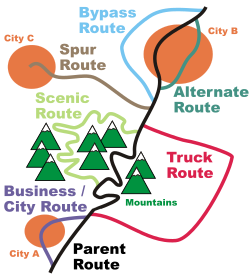
In road transportation in the United States, a special route is a road in a numbered highway system that diverts a specific segment of related traffic away from another road. They are featured in many highway systems; most are found in the Interstate Highway System, U.S. highway system, and several state highway systems. Each type of special route possesses generally defined characteristics and has a defined relationship with its parent route. Typically, special routes share a route number with a dominant route, often referred as the "parent" or "mainline", and are given either a descriptor which may be used either before or after the route name, such as Alternate or Business, or a letter suffix that is attached to the route number. For example, an alternate route of U.S. Route 1 may be called "Alternate U.S. Route 1", "U.S. Route 1 Alternate", or "U.S. Route 1A". Occasionally, a special route will have both a descriptor and a suffix, such as U.S. Route 1A Business.
In the field, the special route is typically distinguished from the parent route with the use of auxiliary words or suffix letters placed on the route shield or on an adjacent sign, known as a "banner" or "plate" or according to the Manual on Uniform Traffic Control Devices, a "route sign auxiliary sign". A common roadfan synonym for special route is "bannered highway" or "bannered route", terms coined from the presence of these companion signs.[citation needed] The term is not all-encompassing however, as not all special routes have these sign plates.
The American Association of State Highway and Transportation Officials (AASHTO) sets the nationwide precedent for special routes, particularly for U.S. Numbered Highways. As of 2009, the standards organization only advocates four types of special routes: business, bypass, alternate, and temporary. AASHTO suggests that transportation authorities of the United States remove other types of special routes and/or replace such obsolete designations with another type of route.
Some old alignments of routes may also be informally known as special routes (despite some that do not intersect the parent route). These older alignments may be given street names like "Old U.S. Highway 52", or in some rare cases, be signed with route shields attached to "Old" or "Historic" sign plates (such as decommissioned sections of former U.S. Route 66 that are still driveable).
In the case of U.S. state route systems, special routes are generally restricted to primary state routes, not secondary state routes, though Missouri has seven supplemental routes with short spur routes, and the 500-series county routes in New Jersey have alternate, bypass, spur, and truck routes.
A few highways have two special route designations. Some of these doubly designated special routes are:
There is also an example of a route with three special route designations. U.S. Route 30 Business Alternate Truck provides an alternate truck bypass of U.S. Route 30 Business in Downingtown, Pennsylvania.
Routes with special designations in the U.S. have typical behavior that distinguishes them from other routes. There are, however, many exceptions to the common behavior, depending on the situation.
Special route
In road transportation in the United States, a special route is a road in a numbered highway system that diverts a specific segment of related traffic away from another road. They are featured in many highway systems; most are found in the Interstate Highway System, U.S. highway system, and several state highway systems. Each type of special route possesses generally defined characteristics and has a defined relationship with its parent route. Typically, special routes share a route number with a dominant route, often referred as the "parent" or "mainline", and are given either a descriptor which may be used either before or after the route name, such as Alternate or Business, or a letter suffix that is attached to the route number. For example, an alternate route of U.S. Route 1 may be called "Alternate U.S. Route 1", "U.S. Route 1 Alternate", or "U.S. Route 1A". Occasionally, a special route will have both a descriptor and a suffix, such as U.S. Route 1A Business.
In the field, the special route is typically distinguished from the parent route with the use of auxiliary words or suffix letters placed on the route shield or on an adjacent sign, known as a "banner" or "plate" or according to the Manual on Uniform Traffic Control Devices, a "route sign auxiliary sign". A common roadfan synonym for special route is "bannered highway" or "bannered route", terms coined from the presence of these companion signs.[citation needed] The term is not all-encompassing however, as not all special routes have these sign plates.
The American Association of State Highway and Transportation Officials (AASHTO) sets the nationwide precedent for special routes, particularly for U.S. Numbered Highways. As of 2009, the standards organization only advocates four types of special routes: business, bypass, alternate, and temporary. AASHTO suggests that transportation authorities of the United States remove other types of special routes and/or replace such obsolete designations with another type of route.
Some old alignments of routes may also be informally known as special routes (despite some that do not intersect the parent route). These older alignments may be given street names like "Old U.S. Highway 52", or in some rare cases, be signed with route shields attached to "Old" or "Historic" sign plates (such as decommissioned sections of former U.S. Route 66 that are still driveable).
In the case of U.S. state route systems, special routes are generally restricted to primary state routes, not secondary state routes, though Missouri has seven supplemental routes with short spur routes, and the 500-series county routes in New Jersey have alternate, bypass, spur, and truck routes.
A few highways have two special route designations. Some of these doubly designated special routes are:
There is also an example of a route with three special route designations. U.S. Route 30 Business Alternate Truck provides an alternate truck bypass of U.S. Route 30 Business in Downingtown, Pennsylvania.
Routes with special designations in the U.S. have typical behavior that distinguishes them from other routes. There are, however, many exceptions to the common behavior, depending on the situation.
Recent media
Recent media