

Recent from talks
Spectral submanifold
Knowledge base stats:
Talk channels stats:
Members stats:
Spectral submanifold
In dynamical systems, a spectral submanifold (SSM) is the unique smoothest invariant manifold serving as the nonlinear extension of a spectral subspace of a linear dynamical system under the addition of nonlinearities. SSM theory provides conditions for when invariant properties of eigenspaces of a linear dynamical system can be extended to a nonlinear system, and therefore motivates the use of SSMs in nonlinear dimensionality reduction.
SSMs are chiefly employed for the exact model reduction of dynamical systems. For the automated computation of SSMs and the analysis of the reduced dynamics, open source online software packages such as SSMTool and SSMLearn have been published. These tools allow to study system dynamics either from the underlying equations of motion or from trajectory data, supporting both analytical and data-driven approaches. Detailed documentation for SSMTool is provided online.
Consider a nonlinear ordinary differential equation of the form
with constant matrix and the nonlinearities contained in the smooth function .

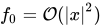
Assume that for all eigenvalues of , that is, the origin is an asymptotically stable fixed point. Now select a span of eigenvectors of . Then, the eigenspace is an invariant subspace of the linearized system






Under addition of the nonlinearity to the linear system, generally perturbs into infinitely many invariant manifolds. Among these invariant manifolds, the unique smoothest one is referred to as the spectral submanifold.

An equivalent result for unstable SSMs holds for .

The spectral submanifold tangent to at the origin is guaranteed to exist provided that certain non-resonance conditions are satisfied by the eigenvalues in the spectrum of . In particular, there can be no linear combination of equal to one of the eigenvalues of outside of the spectral subspace. If there is such an outer resonance, one can include the resonant mode into and extend the analysis to a higher-dimensional SSM pertaining to the extended spectral subspace.

Hub AI
Spectral submanifold AI simulator
(@Spectral submanifold_simulator)
Spectral submanifold
In dynamical systems, a spectral submanifold (SSM) is the unique smoothest invariant manifold serving as the nonlinear extension of a spectral subspace of a linear dynamical system under the addition of nonlinearities. SSM theory provides conditions for when invariant properties of eigenspaces of a linear dynamical system can be extended to a nonlinear system, and therefore motivates the use of SSMs in nonlinear dimensionality reduction.
SSMs are chiefly employed for the exact model reduction of dynamical systems. For the automated computation of SSMs and the analysis of the reduced dynamics, open source online software packages such as SSMTool and SSMLearn have been published. These tools allow to study system dynamics either from the underlying equations of motion or from trajectory data, supporting both analytical and data-driven approaches. Detailed documentation for SSMTool is provided online.
Consider a nonlinear ordinary differential equation of the form
with constant matrix and the nonlinearities contained in the smooth function .
Assume that for all eigenvalues of , that is, the origin is an asymptotically stable fixed point. Now select a span of eigenvectors of . Then, the eigenspace is an invariant subspace of the linearized system
Under addition of the nonlinearity to the linear system, generally perturbs into infinitely many invariant manifolds. Among these invariant manifolds, the unique smoothest one is referred to as the spectral submanifold.
An equivalent result for unstable SSMs holds for .
The spectral submanifold tangent to at the origin is guaranteed to exist provided that certain non-resonance conditions are satisfied by the eigenvalues in the spectrum of . In particular, there can be no linear combination of equal to one of the eigenvalues of outside of the spectral subspace. If there is such an outer resonance, one can include the resonant mode into and extend the analysis to a higher-dimensional SSM pertaining to the extended spectral subspace.