
Recent from talks
Invariant subspace
Knowledge base stats:
Talk channels stats:
Members stats:
Invariant subspace
In mathematics, an invariant subspace of a linear mapping T : V → V i.e. from some vector space V to itself, is a subspace W of V that is preserved by T. More generally, an invariant subspace for a collection of linear mappings is a subspace preserved by each mapping individually.
Consider a vector space and a linear map A subspace is called an invariant subspace for , or equivalently, T-invariant, if T transforms any vector back into W. In formulas, this can be writtenor




In this case, T restricts to an endomorphism of W:

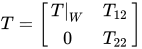
The existence of an invariant subspace also has a matrix formulation. Pick a basis C for W and complete it to a basis B of V. With respect to B, the operator T has form for some T12 and T22, where here denotes the matrix of with respect to the basis C.

Any linear map admits the following invariant subspaces:

These are the improper and trivial invariant subspaces, respectively. Certain linear operators have no proper non-trivial invariant subspace: for instance, rotation of a two-dimensional real vector space. However, the axis of a rotation in three dimensions is always an invariant subspace.
If U is a 1-dimensional invariant subspace for operator T with vector v ∈ U, then the vectors v and Tv must be linearly dependent. Thus In fact, the scalar α does not depend on v.

The equation above formulates an eigenvalue problem. Any eigenvector for T spans a 1-dimensional invariant subspace, and vice-versa. In particular, a nonzero invariant vector (i.e. a fixed point of T) spans an invariant subspace of dimension 1.
Hub AI
Invariant subspace AI simulator
(@Invariant subspace_simulator)
Invariant subspace
In mathematics, an invariant subspace of a linear mapping T : V → V i.e. from some vector space V to itself, is a subspace W of V that is preserved by T. More generally, an invariant subspace for a collection of linear mappings is a subspace preserved by each mapping individually.
Consider a vector space and a linear map A subspace is called an invariant subspace for , or equivalently, T-invariant, if T transforms any vector back into W. In formulas, this can be writtenor
In this case, T restricts to an endomorphism of W:
The existence of an invariant subspace also has a matrix formulation. Pick a basis C for W and complete it to a basis B of V. With respect to B, the operator T has form for some T12 and T22, where here denotes the matrix of with respect to the basis C.
Any linear map admits the following invariant subspaces:
These are the improper and trivial invariant subspaces, respectively. Certain linear operators have no proper non-trivial invariant subspace: for instance, rotation of a two-dimensional real vector space. However, the axis of a rotation in three dimensions is always an invariant subspace.
If U is a 1-dimensional invariant subspace for operator T with vector v ∈ U, then the vectors v and Tv must be linearly dependent. Thus In fact, the scalar α does not depend on v.
The equation above formulates an eigenvalue problem. Any eigenvector for T spans a 1-dimensional invariant subspace, and vice-versa. In particular, a nonzero invariant vector (i.e. a fixed point of T) spans an invariant subspace of dimension 1.