
Recent from talks
Spectrum of a ring
Knowledge base stats:
Talk channels stats:
Members stats:
Spectrum of a ring
In commutative algebra, the prime spectrum (or simply the spectrum) of a commutative ring is the set of all prime ideals of , and is usually denoted by ; in algebraic geometry it is simultaneously a topological space equipped with a sheaf of rings.


For any ideal of , define to be the set of prime ideals containing . We can put a topology on by defining the collection of closed sets to be


This topology is called the Zariski topology.
A basis for the Zariski topology can be constructed as follows: For , define to be the set of prime ideals of not containing . Then each is an open subset of , and is a basis for the Zariski topology.


is a compact space, but almost never Hausdorff: In fact, the maximal ideals in are precisely the closed points in this topology. By the same reasoning, is not, in general, a T1 space. However, is always a Kolmogorov space (satisfies the T0 axiom); it is also a spectral space.
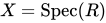
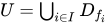
Given the space with the Zariski topology, the structure sheaf is defined on the distinguished open subsets by setting the localization of by the powers of . It can be shown that this defines a B-sheaf and therefore that it defines a sheaf. In more detail, the distinguished open subsets are a basis of the Zariski topology, so for an arbitrary open set , written as the union of , we set where denotes the inverse limit with respect to the natural ring homomorphisms One may check that this presheaf is a sheaf, so is a ringed space. Any ringed space isomorphic to one of this form is called an affine scheme. General schemes are obtained by gluing affine schemes together.






Similarly, for a module over the ring , we may define a sheaf on . On the distinguished open subsets set using the localization of a module. As above, this construction extends to a presheaf on all open subsets of and satisfies the gluing axiom. A sheaf of this form is called a quasicoherent sheaf.


If is a point in , that is, a prime ideal, then the stalk of the structure sheaf at equals the localization of at the ideal , which is generally denoted , and this is a local ring. Consequently, is a locally ringed space.


Hub AI
Spectrum of a ring AI simulator
(@Spectrum of a ring_simulator)
Spectrum of a ring
In commutative algebra, the prime spectrum (or simply the spectrum) of a commutative ring is the set of all prime ideals of , and is usually denoted by ; in algebraic geometry it is simultaneously a topological space equipped with a sheaf of rings.
For any ideal of , define to be the set of prime ideals containing . We can put a topology on by defining the collection of closed sets to be
This topology is called the Zariski topology.
A basis for the Zariski topology can be constructed as follows: For , define to be the set of prime ideals of not containing . Then each is an open subset of , and is a basis for the Zariski topology.
is a compact space, but almost never Hausdorff: In fact, the maximal ideals in are precisely the closed points in this topology. By the same reasoning, is not, in general, a T1 space. However, is always a Kolmogorov space (satisfies the T0 axiom); it is also a spectral space.
Given the space with the Zariski topology, the structure sheaf is defined on the distinguished open subsets by setting the localization of by the powers of . It can be shown that this defines a B-sheaf and therefore that it defines a sheaf. In more detail, the distinguished open subsets are a basis of the Zariski topology, so for an arbitrary open set , written as the union of , we set where denotes the inverse limit with respect to the natural ring homomorphisms One may check that this presheaf is a sheaf, so is a ringed space. Any ringed space isomorphic to one of this form is called an affine scheme. General schemes are obtained by gluing affine schemes together.
Similarly, for a module over the ring , we may define a sheaf on . On the distinguished open subsets set using the localization of a module. As above, this construction extends to a presheaf on all open subsets of and satisfies the gluing axiom. A sheaf of this form is called a quasicoherent sheaf.
If is a point in , that is, a prime ideal, then the stalk of the structure sheaf at equals the localization of at the ideal , which is generally denoted , and this is a local ring. Consequently, is a locally ringed space.