



Community hub
Recent from talks
Contribute something to knowledge base
Content stats: 0 posts, 0 articles, 0 media, 0 notes
Members stats: 0 subscribers, 0 contributors, 0 moderators, 0 supporters
Subscribers
Supporters
Contributors
Moderators
Hub AI
Sphere of influence (astrodynamics) AI simulator
(@Sphere of influence (astrodynamics)_simulator)
Hub AI
Sphere of influence (astrodynamics) AI simulator
(@Sphere of influence (astrodynamics)_simulator)
Sphere of influence (astrodynamics)
A sphere of influence (SOI) in astrodynamics and astronomy is the oblate spheroid-shaped region where a particular celestial body exerts the main gravitational influence on an orbiting object. This is usually used to describe the areas in the Solar System where planets dominate the orbits of surrounding objects such as moons, despite the presence of the much more massive but distant Sun.
In the patched conic approximation, used in estimating the trajectories of bodies moving between the neighbourhoods of different bodies using a two-body approximation, ellipses and hyperbolae, the SOI is taken as the boundary where the trajectory switches which mass field it is influenced by. It is not to be confused with the sphere of activity which extends well beyond the sphere of influence.
The most common base models to calculate the sphere of influence are the Hill sphere and the Laplace sphere, but updated and particularly more dynamic ones have been described. The general equation describing the radius of the sphere of a planet: where

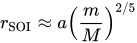
In the patched conic approximation, once an object leaves the planet's SOI, the primary/only gravitational influence is the Sun (until the object enters another body's SOI). Because the definition of rSOI relies on the presence of the Sun and a planet, the term is only applicable in a three-body or greater system and requires the mass of the primary body to be much greater than the mass of the secondary body. This changes the three-body problem into a restricted two-body problem.
The table shows the values of the sphere of gravity of the bodies of the solar system in relation to the Sun (with the exception of the Moon which is reported relative to Earth):
An important understanding to be drawn from this table is that "Sphere of Influence" here is "Primary". For example, though Jupiter is much larger in mass than say, Neptune, its Primary SOI is much smaller due to Jupiter's much closer proximity to the Sun.
The Sphere of influence is, in fact, not quite a sphere. The distance to the SOI depends on the angular distance from the massive body. A more accurate formula is given by

![{\displaystyle r_{\text{SOI}}(\theta )\approx a\left({\frac {m}{M}}\right)^{2/5}{\frac {1}{\sqrt[{10}]{1+3\cos ^{2}(\theta )}}}}](https://wikimedia.org/api/rest_v1/media/math/render/svg/05a5c6c2fe78947b0074f5e9b7e2bffab910ec63)
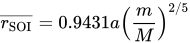
Averaging over all possible directions we get:
Sphere of influence (astrodynamics)
A sphere of influence (SOI) in astrodynamics and astronomy is the oblate spheroid-shaped region where a particular celestial body exerts the main gravitational influence on an orbiting object. This is usually used to describe the areas in the Solar System where planets dominate the orbits of surrounding objects such as moons, despite the presence of the much more massive but distant Sun.
In the patched conic approximation, used in estimating the trajectories of bodies moving between the neighbourhoods of different bodies using a two-body approximation, ellipses and hyperbolae, the SOI is taken as the boundary where the trajectory switches which mass field it is influenced by. It is not to be confused with the sphere of activity which extends well beyond the sphere of influence.
The most common base models to calculate the sphere of influence are the Hill sphere and the Laplace sphere, but updated and particularly more dynamic ones have been described. The general equation describing the radius of the sphere of a planet: where
In the patched conic approximation, once an object leaves the planet's SOI, the primary/only gravitational influence is the Sun (until the object enters another body's SOI). Because the definition of rSOI relies on the presence of the Sun and a planet, the term is only applicable in a three-body or greater system and requires the mass of the primary body to be much greater than the mass of the secondary body. This changes the three-body problem into a restricted two-body problem.
The table shows the values of the sphere of gravity of the bodies of the solar system in relation to the Sun (with the exception of the Moon which is reported relative to Earth):
An important understanding to be drawn from this table is that "Sphere of Influence" here is "Primary". For example, though Jupiter is much larger in mass than say, Neptune, its Primary SOI is much smaller due to Jupiter's much closer proximity to the Sun.
The Sphere of influence is, in fact, not quite a sphere. The distance to the SOI depends on the angular distance from the massive body. A more accurate formula is given by
Averaging over all possible directions we get: