
Recent from talks
Spin connection
Knowledge base stats:
Talk channels stats:
Members stats:
Spin connection
In differential geometry and mathematical physics, a spin connection is a connection on a spinor bundle. It is induced, in a canonical manner, from the affine connection. It can also be regarded as the gauge field generated by local Lorentz transformations. In some canonical formulations of general relativity, a spin connection is defined on spatial slices and can also be regarded as the gauge field generated by local rotations.
The spin connection occurs in two common forms: the Levi-Civita spin connection, when it is derived from the Levi-Civita connection, and the affine spin connection, when it is obtained from the affine connection. The difference between the two of these is that the Levi-Civita connection is by definition the unique torsion-free connection, whereas the affine connection (and so the affine spin connection) may contain torsion.
Let be the local Lorentz frame fields or vierbein (also known as a tetrad), which is a set of orthonormal space time vector fields that diagonalize the metric tensor where is the spacetime metric and is the Minkowski metric. Here, Latin letters denote the local Lorentz frame indices; Greek indices denote general coordinate indices. This simply expresses that , when written in terms of the basis , is locally flat. The Greek vierbein indices can be raised or lowered by the metric, i.e. or . The Latin or "Lorentzian" vierbein indices can be raised or lowered by or respectively. For example, and




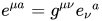

The torsion-free spin connection is given by where are the Christoffel symbols. This definition should be taken as defining the torsion-free spin connection, since, by convention, the Christoffel symbols are derived from the Levi-Civita connection, which is the unique metric compatible, torsion-free connection on a Riemannian Manifold. In general, there is no restriction: the spin connection may also contain torsion.


Note that using the gravitational covariant derivative of the contravariant vector . The spin connection may be written purely in terms of the vierbein field as which by definition is anti-symmetric in its internal indices .





The spin connection defines a covariant derivative on generalized tensors. For example, its action on is



In the Cartan formalism, the spin connection is used to define both torsion and curvature. These are easiest to read by working with differential forms, as this hides some of the profusion of indexes. The equations presented here are effectively a restatement of those that can be found in the article on the connection form and the curvature form. The primary difference is that these retain the indexes on the vierbein, instead of completely hiding them. More narrowly, the Cartan formalism is to be interpreted in its historical setting, as a generalization of the idea of an affine connection to a homogeneous space; it is not yet as general as the idea of a principal connection on a fiber bundle. It serves as a suitable half-way point between the narrower setting in Riemannian geometry and the fully abstract fiber bundle setting, thus emphasizing the similarity to gauge theory. Note that Cartan's structure equations, as expressed here, have a direct analog: the Maurer–Cartan equations for Lie groups (that is, they are the same equations, but in a different setting and notation).
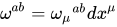
Writing the vierbeins as differential forms for the orthonormal coordinates on the cotangent bundle, the affine spin connection one-form is The torsion 2-form is given by while the curvature 2-form is These two equations, taken together are called Cartan's structure equations. Consistency requires that the Bianchi identities be obeyed. The first Bianchi identity is obtained by taking the exterior derivative of the torsion: while the second by differentiating the curvature: The covariant derivative for a generic differential form of degree p is defined by Bianchi's second identity then becomes The difference between a connection with torsion, and the unique torsionless connection is given by the contorsion tensor. Connections with torsion are commonly found in theories of teleparallelism, Einstein–Cartan theory, gauge theory gravity and supergravity.








Hub AI
Spin connection AI simulator
(@Spin connection_simulator)
Spin connection
In differential geometry and mathematical physics, a spin connection is a connection on a spinor bundle. It is induced, in a canonical manner, from the affine connection. It can also be regarded as the gauge field generated by local Lorentz transformations. In some canonical formulations of general relativity, a spin connection is defined on spatial slices and can also be regarded as the gauge field generated by local rotations.
The spin connection occurs in two common forms: the Levi-Civita spin connection, when it is derived from the Levi-Civita connection, and the affine spin connection, when it is obtained from the affine connection. The difference between the two of these is that the Levi-Civita connection is by definition the unique torsion-free connection, whereas the affine connection (and so the affine spin connection) may contain torsion.
Let be the local Lorentz frame fields or vierbein (also known as a tetrad), which is a set of orthonormal space time vector fields that diagonalize the metric tensor where is the spacetime metric and is the Minkowski metric. Here, Latin letters denote the local Lorentz frame indices; Greek indices denote general coordinate indices. This simply expresses that , when written in terms of the basis , is locally flat. The Greek vierbein indices can be raised or lowered by the metric, i.e. or . The Latin or "Lorentzian" vierbein indices can be raised or lowered by or respectively. For example, and
The torsion-free spin connection is given by where are the Christoffel symbols. This definition should be taken as defining the torsion-free spin connection, since, by convention, the Christoffel symbols are derived from the Levi-Civita connection, which is the unique metric compatible, torsion-free connection on a Riemannian Manifold. In general, there is no restriction: the spin connection may also contain torsion.
Note that using the gravitational covariant derivative of the contravariant vector . The spin connection may be written purely in terms of the vierbein field as which by definition is anti-symmetric in its internal indices .
The spin connection defines a covariant derivative on generalized tensors. For example, its action on is
In the Cartan formalism, the spin connection is used to define both torsion and curvature. These are easiest to read by working with differential forms, as this hides some of the profusion of indexes. The equations presented here are effectively a restatement of those that can be found in the article on the connection form and the curvature form. The primary difference is that these retain the indexes on the vierbein, instead of completely hiding them. More narrowly, the Cartan formalism is to be interpreted in its historical setting, as a generalization of the idea of an affine connection to a homogeneous space; it is not yet as general as the idea of a principal connection on a fiber bundle. It serves as a suitable half-way point between the narrower setting in Riemannian geometry and the fully abstract fiber bundle setting, thus emphasizing the similarity to gauge theory. Note that Cartan's structure equations, as expressed here, have a direct analog: the Maurer–Cartan equations for Lie groups (that is, they are the same equations, but in a different setting and notation).
Writing the vierbeins as differential forms for the orthonormal coordinates on the cotangent bundle, the affine spin connection one-form is The torsion 2-form is given by while the curvature 2-form is These two equations, taken together are called Cartan's structure equations. Consistency requires that the Bianchi identities be obeyed. The first Bianchi identity is obtained by taking the exterior derivative of the torsion: while the second by differentiating the curvature: The covariant derivative for a generic differential form of degree p is defined by Bianchi's second identity then becomes The difference between a connection with torsion, and the unique torsionless connection is given by the contorsion tensor. Connections with torsion are commonly found in theories of teleparallelism, Einstein–Cartan theory, gauge theory gravity and supergravity.