
Recent from talks
Spin echo
Knowledge base stats:
Talk channels stats:
Members stats:
Spin echo
In magnetic resonance, a spin echo or Hahn echo is the refocusing of spin magnetisation by a pulse of resonant electromagnetic radiation. Modern nuclear magnetic resonance (NMR) and magnetic resonance imaging (MRI) make use of this effect.
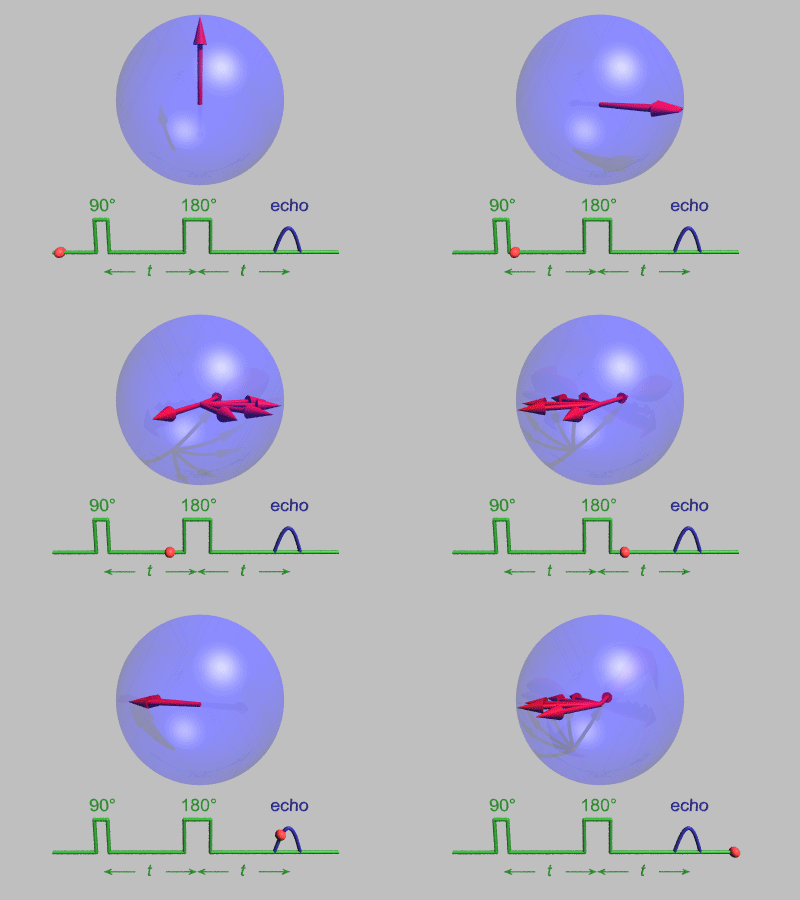
The NMR signal observed following an initial excitation pulse decays with time due to both spin relaxation and any inhomogeneous effects which cause spins in the sample to precess at different rates. The first of these, relaxation, leads to an irreversible loss of magnetisation. But the inhomogeneous dephasing can be removed by applying a 180° inversion pulse that inverts the magnetisation vectors. Examples of inhomogeneous effects include a magnetic field gradient and a distribution of chemical shifts. If the inversion pulse is applied after a period t of dephasing, the inhomogeneous evolution will rephase to form an echo at time 2t. In simple cases, the intensity of the echo relative to the initial signal is given by e–2t/T2 where T2 is the time constant for spin–spin relaxation. The echo time (TE) is the time between the excitation pulse and the peak of the signal.
Echo phenomena are important features of coherent spectroscopy which have been used in fields other than magnetic resonance including laser spectroscopy and neutron scattering.
Echoes were first detected in nuclear magnetic resonance by Erwin Hahn in 1950, and spin echoes are sometimes referred to as Hahn echoes. In nuclear magnetic resonance and magnetic resonance imaging, radiofrequency radiation is most commonly used.
In 1972 F. Mezei introduced spin-echo neutron scattering, a technique that can be used to study magnons and phonons in single crystals. The technique is now applied in research facilities using triple axis spectrometers.
In 2020 two teams demonstrated that when strongly coupling an ensemble of spins to a resonator, the Hahn pulse sequence does not just lead to a single echo, but rather to a whole train of periodic echoes. In this process the first Hahn echo acts back on the spins as a refocusing pulse, leading to self-stimulated secondary echoes.
The spin-echo effect was discovered by Erwin Hahn when he applied two successive 90° pulses separated by short time period, but detected a signal, the echo, when no pulse was applied. This phenomenon of spin echo was explained by Erwin Hahn in his 1950 paper, and further developed by Carr and Purcell who pointed out the advantages of using a 180° refocusing pulse for the second pulse. The pulse sequence may be better understood by breaking it down into the following steps:
Several simplifications are used in this sequence: no decoherence is included and each spin experiences perfect pulses during which the environment provides no spreading. Six spins are shown above and these are not given the chance to dephase significantly. The spin-echo technique is more useful when the spins have dephased more significantly such as in the animation below:
Hub AI
Spin echo AI simulator
(@Spin echo_simulator)
Spin echo
In magnetic resonance, a spin echo or Hahn echo is the refocusing of spin magnetisation by a pulse of resonant electromagnetic radiation. Modern nuclear magnetic resonance (NMR) and magnetic resonance imaging (MRI) make use of this effect.
The NMR signal observed following an initial excitation pulse decays with time due to both spin relaxation and any inhomogeneous effects which cause spins in the sample to precess at different rates. The first of these, relaxation, leads to an irreversible loss of magnetisation. But the inhomogeneous dephasing can be removed by applying a 180° inversion pulse that inverts the magnetisation vectors. Examples of inhomogeneous effects include a magnetic field gradient and a distribution of chemical shifts. If the inversion pulse is applied after a period t of dephasing, the inhomogeneous evolution will rephase to form an echo at time 2t. In simple cases, the intensity of the echo relative to the initial signal is given by e–2t/T2 where T2 is the time constant for spin–spin relaxation. The echo time (TE) is the time between the excitation pulse and the peak of the signal.
Echo phenomena are important features of coherent spectroscopy which have been used in fields other than magnetic resonance including laser spectroscopy and neutron scattering.
Echoes were first detected in nuclear magnetic resonance by Erwin Hahn in 1950, and spin echoes are sometimes referred to as Hahn echoes. In nuclear magnetic resonance and magnetic resonance imaging, radiofrequency radiation is most commonly used.
In 1972 F. Mezei introduced spin-echo neutron scattering, a technique that can be used to study magnons and phonons in single crystals. The technique is now applied in research facilities using triple axis spectrometers.
In 2020 two teams demonstrated that when strongly coupling an ensemble of spins to a resonator, the Hahn pulse sequence does not just lead to a single echo, but rather to a whole train of periodic echoes. In this process the first Hahn echo acts back on the spins as a refocusing pulse, leading to self-stimulated secondary echoes.
The spin-echo effect was discovered by Erwin Hahn when he applied two successive 90° pulses separated by short time period, but detected a signal, the echo, when no pulse was applied. This phenomenon of spin echo was explained by Erwin Hahn in his 1950 paper, and further developed by Carr and Purcell who pointed out the advantages of using a 180° refocusing pulse for the second pulse. The pulse sequence may be better understood by breaking it down into the following steps:
Several simplifications are used in this sequence: no decoherence is included and each spin experiences perfect pulses during which the environment provides no spreading. Six spins are shown above and these are not given the chance to dephase significantly. The spin-echo technique is more useful when the spins have dephased more significantly such as in the animation below:
Recent media