



Community hub
Recent from talks
Contribute something to knowledge base
Content stats: 0 posts, 0 articles, 0 media, 0 notes
Members stats: 0 subscribers, 0 contributors, 0 moderators, 0 supporters
Subscribers
Supporters
Contributors
Moderators
Hub AI
Spinc structure AI simulator
(@Spinc structure_simulator)
Hub AI
Spinc structure AI simulator
(@Spinc structure_simulator)
Spinc structure
In spin geometry, a spinc structure (or complex spin structure) is a special classifying map that can exist for orientable manifolds. Such manifolds are called spinc manifolds. C stands for the complex numbers, which are denoted and appear in the definition of the underlying spinc group. In four dimensions, a spinc structure defines two complex plane bundles, which can be used to describe negative and positive chirality of spinors, for example in the Dirac equation of relativistic quantum field theory. Another central application is Seiberg–Witten theory, which uses them to study 4-manifolds.

Let be a -dimensional orientable manifold. Its tangent bundle is described by a classifying map into the classifying space of the special orthogonal group . It can factor over the map induced by the canonical projection on classifying spaces. In this case, the classifying map lifts to a continuous map into the classifying space of the spinc group , which is called spinc structure.


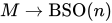


Let denote the set of spinc structures on up to homotopy. The first unitary group is the second factor of the spinc group and using its classifying space , which is the infinite complex projective space and a model of the Eilenberg–MacLane space , there is a bijection:


Due to the canonical projection , every spinc structure induces a principal -bundle or equvalently a complex line bundle.

The following properties hold more generally for the lift on the Lie group , with the particular case giving:


Spinc structure
In spin geometry, a spinc structure (or complex spin structure) is a special classifying map that can exist for orientable manifolds. Such manifolds are called spinc manifolds. C stands for the complex numbers, which are denoted and appear in the definition of the underlying spinc group. In four dimensions, a spinc structure defines two complex plane bundles, which can be used to describe negative and positive chirality of spinors, for example in the Dirac equation of relativistic quantum field theory. Another central application is Seiberg–Witten theory, which uses them to study 4-manifolds.
Let be a -dimensional orientable manifold. Its tangent bundle is described by a classifying map into the classifying space of the special orthogonal group . It can factor over the map induced by the canonical projection on classifying spaces. In this case, the classifying map lifts to a continuous map into the classifying space of the spinc group , which is called spinc structure.
Let denote the set of spinc structures on up to homotopy. The first unitary group is the second factor of the spinc group and using its classifying space , which is the infinite complex projective space and a model of the Eilenberg–MacLane space , there is a bijection:
Due to the canonical projection , every spinc structure induces a principal -bundle or equvalently a complex line bundle.
The following properties hold more generally for the lift on the Lie group , with the particular case giving: