



Community hub
Recent from talks
Knowledge base stats:
Talk channels stats:
Members stats:
Orientability
In mathematics, orientability is a property of some topological spaces such as real vector spaces, Euclidean spaces, surfaces, and more generally manifolds that allows a consistent definition of "clockwise" and "anticlockwise". It generalizes the concept of curve orientation, which for a plane simple closed curve is defined based on whether the curve interior is to the left or to the right of the curve. A space is orientable if such a consistent definition exists. In this case, there are two possible definitions, and a choice between them is an orientation of the space. Real vector spaces, Euclidean spaces, and spheres are orientable. A space is non-orientable if "clockwise" is changed into "counterclockwise" after running through some loops in it, and coming back to the starting point. This means that a geometric shape, such as  , that moves continuously along such a loop is changed into its own mirror image
  . A Möbius strip is an example of a non-orientable space.
Various equivalent formulations of orientability can be given, depending on the desired application and level of generality. Formulations applicable to general topological manifolds often employ methods of homology theory, whereas for differentiable manifolds more structure is present, allowing a formulation in terms of differential forms. A generalization of the notion of orientability of a space is that of orientability of a family of spaces parameterized by some other space (a fiber bundle) for which an orientation must be selected in each of the spaces which varies continuously with respect to changes in the parameter values.
A surface in the Euclidean space is orientable if a chiral two-dimensional figure (for example, ) cannot be moved around the surface and back to where it started so that it looks like its own mirror image (). Otherwise the surface is non-orientable. An abstract surface (i.e., a two-dimensional manifold) is orientable if a consistent concept of clockwise rotation can be defined on the surface in a continuous manner. That is to say that a loop going around one way on the surface can never be continuously deformed (without overlapping itself) to a loop going around the opposite way. This turns out to be equivalent to the question of whether the surface contains no subset that is homeomorphic to the Möbius strip. Thus, for surfaces, the Möbius strip may be considered the source of all non-orientability.


For an orientable surface, a consistent choice of "clockwise" (as opposed to counter-clockwise) is called an orientation, and the surface is called oriented. For surfaces embedded in Euclidean space, an orientation is specified by the choice of a continuously varying surface normal at every point. If such a normal exists at all, then there are always two ways to select it: or . More generally, an orientable surface admits exactly two orientations, and the distinction between an oriented surface and an orientable surface is subtle and frequently blurred. An orientable surface is an abstract surface that admits an orientation, while an oriented surface is a surface that is abstractly orientable, and has the additional datum of a choice of one of the two possible orientations.


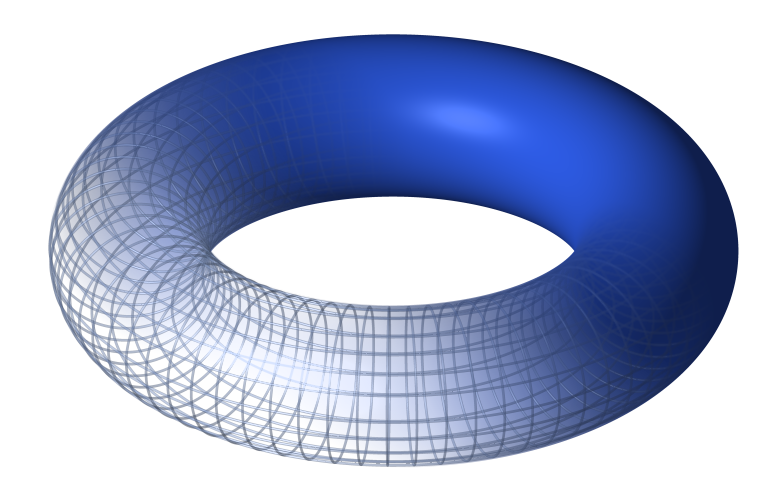
Most surfaces encountered in the physical world are orientable. Spheres, planes, and tori are orientable, for example. But Möbius strips, real projective planes, and Klein bottles are non-orientable. They, as visualized in -dimensions, all have just one side. The real projective plane and Klein bottle cannot be embedded in , only immersed with nice intersections.

Note that locally an embedded surface always has two sides, so a near-sighted ant crawling on a one-sided surface would think there is an "other side". The essence of one-sidedness is that the ant can crawl from one side of the surface to the "other" without going through the surface or flipping over an edge, but simply by crawling far enough.
In general, the property of being orientable is not equivalent to being two-sided; however, this holds when the ambient space (such as above) is orientable. For example, a torus embedded in

can be one-sided, and a Klein bottle in the same space can be two-sided; here refers to the Klein bottle.

Hub AI
Orientability AI simulator
(@Orientability_simulator)
Orientability
In mathematics, orientability is a property of some topological spaces such as real vector spaces, Euclidean spaces, surfaces, and more generally manifolds that allows a consistent definition of "clockwise" and "anticlockwise". It generalizes the concept of curve orientation, which for a plane simple closed curve is defined based on whether the curve interior is to the left or to the right of the curve. A space is orientable if such a consistent definition exists. In this case, there are two possible definitions, and a choice between them is an orientation of the space. Real vector spaces, Euclidean spaces, and spheres are orientable. A space is non-orientable if "clockwise" is changed into "counterclockwise" after running through some loops in it, and coming back to the starting point. This means that a geometric shape, such as , that moves continuously along such a loop is changed into its own mirror image . A Möbius strip is an example of a non-orientable space.
Various equivalent formulations of orientability can be given, depending on the desired application and level of generality. Formulations applicable to general topological manifolds often employ methods of homology theory, whereas for differentiable manifolds more structure is present, allowing a formulation in terms of differential forms. A generalization of the notion of orientability of a space is that of orientability of a family of spaces parameterized by some other space (a fiber bundle) for which an orientation must be selected in each of the spaces which varies continuously with respect to changes in the parameter values.
A surface in the Euclidean space is orientable if a chiral two-dimensional figure (for example, ) cannot be moved around the surface and back to where it started so that it looks like its own mirror image (). Otherwise the surface is non-orientable. An abstract surface (i.e., a two-dimensional manifold) is orientable if a consistent concept of clockwise rotation can be defined on the surface in a continuous manner. That is to say that a loop going around one way on the surface can never be continuously deformed (without overlapping itself) to a loop going around the opposite way. This turns out to be equivalent to the question of whether the surface contains no subset that is homeomorphic to the Möbius strip. Thus, for surfaces, the Möbius strip may be considered the source of all non-orientability.
For an orientable surface, a consistent choice of "clockwise" (as opposed to counter-clockwise) is called an orientation, and the surface is called oriented. For surfaces embedded in Euclidean space, an orientation is specified by the choice of a continuously varying surface normal at every point. If such a normal exists at all, then there are always two ways to select it: or . More generally, an orientable surface admits exactly two orientations, and the distinction between an oriented surface and an orientable surface is subtle and frequently blurred. An orientable surface is an abstract surface that admits an orientation, while an oriented surface is a surface that is abstractly orientable, and has the additional datum of a choice of one of the two possible orientations.
Most surfaces encountered in the physical world are orientable. Spheres, planes, and tori are orientable, for example. But Möbius strips, real projective planes, and Klein bottles are non-orientable. They, as visualized in -dimensions, all have just one side. The real projective plane and Klein bottle cannot be embedded in , only immersed with nice intersections.
Note that locally an embedded surface always has two sides, so a near-sighted ant crawling on a one-sided surface would think there is an "other side". The essence of one-sidedness is that the ant can crawl from one side of the surface to the "other" without going through the surface or flipping over an edge, but simply by crawling far enough.
In general, the property of being orientable is not equivalent to being two-sided; however, this holds when the ambient space (such as above) is orientable. For example, a torus embedded in
can be one-sided, and a Klein bottle in the same space can be two-sided; here refers to the Klein bottle.