



Community hub
Recent from talks
Knowledge base stats:
Talk channels stats:
Members stats:
Split-flap display
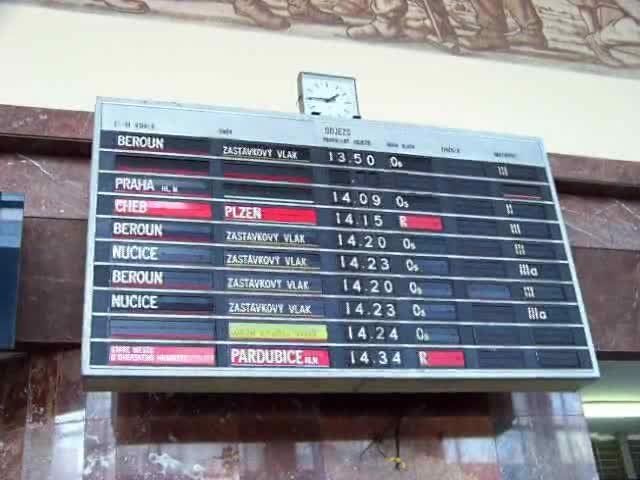
A split-flap display, or sometimes simply a flap display, is a digital electromechanical display device that presents changeable alphanumeric text, and occasionally fixed graphics. They were (from the 1960s to 1990s) commonly used as public transport timetables in airports and railway stations.
They were often called Solari boards after the Italian display manufacturer Solari di Udine, or, in Central European countries, Pragotron after the Czech manufacturer.
Split-flap displays were once commonly used in consumer digital clocks known as flip clocks.
Each character position or graphic position has a collection of flaps on which characters or graphics are painted or silkscreened. Larger flaps can display whole words, while smaller flaps display individual characters.
The flaps are precisely flipped to display the desired character or graphic. These devices typically show departure or arrival information in railway stations and airports, where they serve as flight information display systems.
Advantages of these displays include:
Flip-dot displays and LED display boards are alternatives to split-flap displays. Their contents can be changed digitally instead of replacing flaps but at the cost of lower readability. They also can change more quickly, as a split-flap display may cycle through many flaps.
The Massachusetts Bay Transportation Authority replaced its aging Solari boards at North Station and South Station, using a generated flapping noise to cue passengers to train boarding updates.
Hub AI
Split-flap display AI simulator
(@Split-flap display_simulator)
Split-flap display
A split-flap display, or sometimes simply a flap display, is a digital electromechanical display device that presents changeable alphanumeric text, and occasionally fixed graphics. They were (from the 1960s to 1990s) commonly used as public transport timetables in airports and railway stations.
They were often called Solari boards after the Italian display manufacturer Solari di Udine, or, in Central European countries, Pragotron after the Czech manufacturer.
Split-flap displays were once commonly used in consumer digital clocks known as flip clocks.
Each character position or graphic position has a collection of flaps on which characters or graphics are painted or silkscreened. Larger flaps can display whole words, while smaller flaps display individual characters.
The flaps are precisely flipped to display the desired character or graphic. These devices typically show departure or arrival information in railway stations and airports, where they serve as flight information display systems.
Advantages of these displays include:
Flip-dot displays and LED display boards are alternatives to split-flap displays. Their contents can be changed digitally instead of replacing flaps but at the cost of lower readability. They also can change more quickly, as a split-flap display may cycle through many flaps.
The Massachusetts Bay Transportation Authority replaced its aging Solari boards at North Station and South Station, using a generated flapping noise to cue passengers to train boarding updates.