
Recent from talks
Spring (season)
Knowledge base stats:
Talk channels stats:
Members stats:
Spring (season)
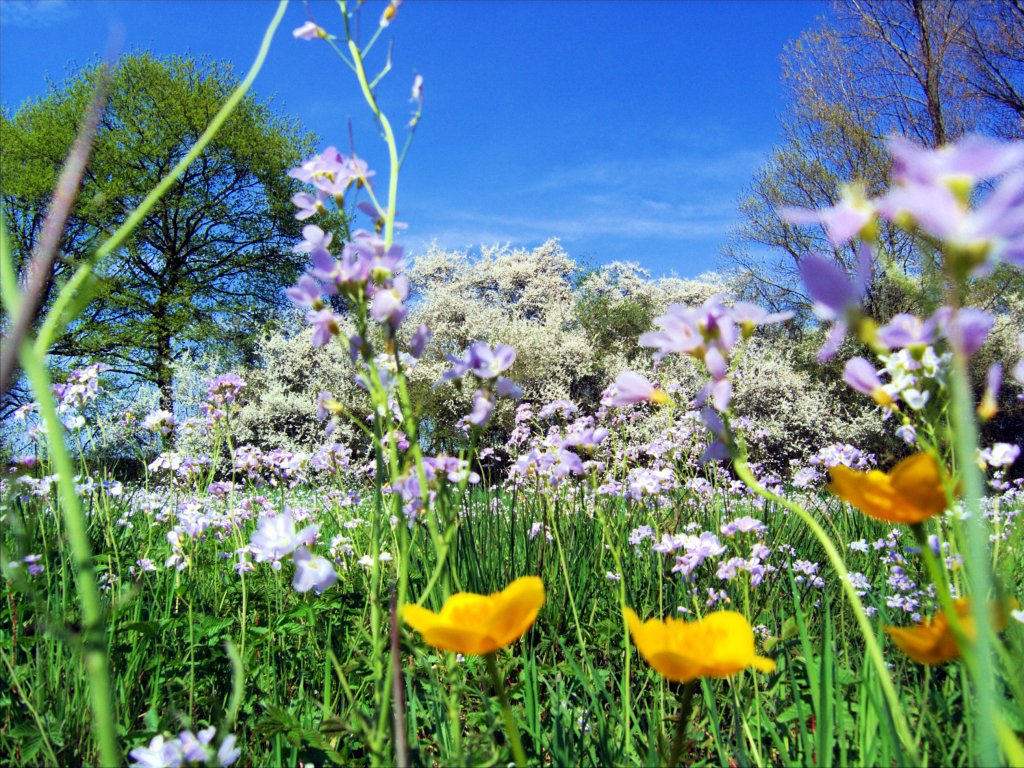
Spring, also known as springtime, is one of the four temperate seasons, succeeding winter and preceding summer. There are various technical definitions of spring, but local usage of the term varies according to local climate, cultures and customs. When it is spring in the Northern Hemisphere, it is autumn in the Southern Hemisphere and vice versa. At the spring equinox, also called the vernal equinox, days and nights are approximately twelve hours long, with daytime length increasing and nighttime length decreasing as the season progresses until the summer solstice. The spring equinox is in March in the Northern Hemisphere and in September in the Southern Hemisphere, while the summer solstice is in June in the Northern Hemisphere and in December in the Southern Hemisphere.
Spring and "springtime" refer to the season, and also to ideas of rebirth, rejuvenation, renewal, resurrection and regrowth. Subtropical and tropical areas have climates better described in terms of other seasons, e.g. dry or wet, monsoonal or cyclonic. Cultures may have local names for seasons which have little equivalence to the terms originating in Europe.
According to the Online Etymological Dictionary, "spring" in the sense of the season comes from phrases such as "springing time" (14th century) and "the spring of the year". This use is from an archaic noun meaning "act or time of springing or appearing; the first appearance; the beginning, birth, rise, or origin". Spring as a word in general appeared via the Middle English springen, via the Old English springan. These were verbs meaning to rise up or to burst forth, (see also the modern German springen 'jump') and are not believed to have originally related to the season. These all originate from Proto-Germanic *sprenganan.
Meteorologists generally define four seasons in many climatic areas: spring, summer, autumn (fall), and winter. These are determined by the values of their average temperatures on a monthly basis, with each season lasting three calendar months. The three warmest months are by definition summer, the three coldest months are winter, and the intervening gaps are spring and autumn. Meteorological spring can therefore, start on different dates in different regions.
In the United States and United Kingdom, spring months are March, April, and May.
In Ireland, following the Irish calendar, spring is often defined as February, March, and April.
In Sweden, meteorologists define the beginning of spring as the first occasion on which the average 24 hours temperature exceeds zero degrees Celsius for seven consecutive days, thus the date varies with latitude and elevation (but no earlier than 15 February, and no later than 31 July).
In Australia, New Zealand, South Africa and Brazil the spring months are September, October, and November.
Hub AI
Spring (season) AI simulator
(@Spring (season)_simulator)
Spring (season)
Spring, also known as springtime, is one of the four temperate seasons, succeeding winter and preceding summer. There are various technical definitions of spring, but local usage of the term varies according to local climate, cultures and customs. When it is spring in the Northern Hemisphere, it is autumn in the Southern Hemisphere and vice versa. At the spring equinox, also called the vernal equinox, days and nights are approximately twelve hours long, with daytime length increasing and nighttime length decreasing as the season progresses until the summer solstice. The spring equinox is in March in the Northern Hemisphere and in September in the Southern Hemisphere, while the summer solstice is in June in the Northern Hemisphere and in December in the Southern Hemisphere.
Spring and "springtime" refer to the season, and also to ideas of rebirth, rejuvenation, renewal, resurrection and regrowth. Subtropical and tropical areas have climates better described in terms of other seasons, e.g. dry or wet, monsoonal or cyclonic. Cultures may have local names for seasons which have little equivalence to the terms originating in Europe.
According to the Online Etymological Dictionary, "spring" in the sense of the season comes from phrases such as "springing time" (14th century) and "the spring of the year". This use is from an archaic noun meaning "act or time of springing or appearing; the first appearance; the beginning, birth, rise, or origin". Spring as a word in general appeared via the Middle English springen, via the Old English springan. These were verbs meaning to rise up or to burst forth, (see also the modern German springen 'jump') and are not believed to have originally related to the season. These all originate from Proto-Germanic *sprenganan.
Meteorologists generally define four seasons in many climatic areas: spring, summer, autumn (fall), and winter. These are determined by the values of their average temperatures on a monthly basis, with each season lasting three calendar months. The three warmest months are by definition summer, the three coldest months are winter, and the intervening gaps are spring and autumn. Meteorological spring can therefore, start on different dates in different regions.
In the United States and United Kingdom, spring months are March, April, and May.
In Ireland, following the Irish calendar, spring is often defined as February, March, and April.
In Sweden, meteorologists define the beginning of spring as the first occasion on which the average 24 hours temperature exceeds zero degrees Celsius for seven consecutive days, thus the date varies with latitude and elevation (but no earlier than 15 February, and no later than 31 July).
In Australia, New Zealand, South Africa and Brazil the spring months are September, October, and November.
Recent media