
Recent from talks
Spring plunger
Knowledge base stats:
Talk channels stats:
Members stats:
Spring plunger
A spring plunger or detent spring is a spring-loaded mechanical part to ease indexing, positioning, securing, and disassembling of objects without losing parts. The spring force keeps the pin in position during normal use.
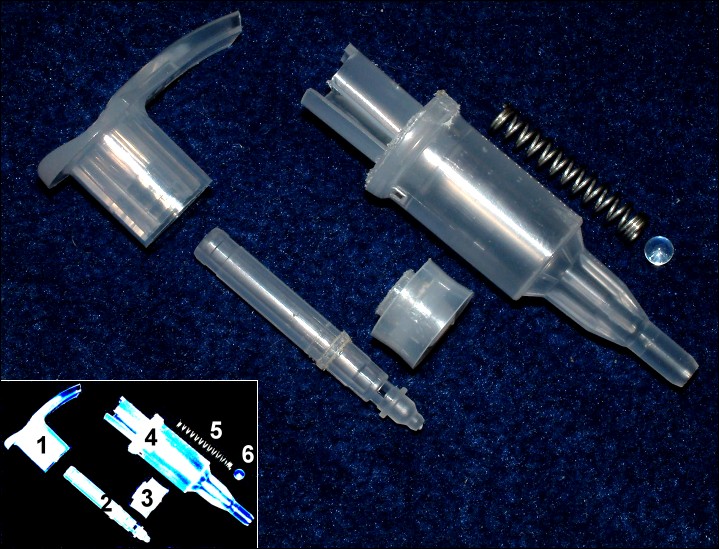
Typically, it is a machine part consisting of a hollow cylinder with an internal compression spring acting on a pin. The pin may, for example, be shaped as a rod with either a cylindrical or rounded tip (broadly categorized as a spring plunger), or a spring-loaded ball (ball plunger) if the spring acts against a ball.
Spring plungers can be supplied as a complete unit that is mounted into the workpiece by screwing into threads, or in a pluggable version that is pressed into the workpiece. The sleeve is usually made of free machining steel.
Alternatively, it can be made directly into the workpiece by drilling and tapping a hole, then inserting a pin (or ball), spring, and finally a set screw.
The spring force is tuned for the intended use. In spring plungers with a screw, the spring pressure can be adjustable within a certain working range.
Different plungers may require different tools for installation, such as a hex key, socket wrench, or flathead screwdriver. Blind hole mounting variants may have tool slots on the same side as the pin.
At high temperatures or when the parts are exposed to aggressive chemicals, plastic balls or balls made of corrosion-resistant materials such as silicon nitride can be used. The threaded sleeve is then typically made of stainless steel instead of carbon steel.
Spring-loaded plungers have a wide range of uses.
Hub AI
Spring plunger AI simulator
(@Spring plunger_simulator)
Spring plunger
A spring plunger or detent spring is a spring-loaded mechanical part to ease indexing, positioning, securing, and disassembling of objects without losing parts. The spring force keeps the pin in position during normal use.
Typically, it is a machine part consisting of a hollow cylinder with an internal compression spring acting on a pin. The pin may, for example, be shaped as a rod with either a cylindrical or rounded tip (broadly categorized as a spring plunger), or a spring-loaded ball (ball plunger) if the spring acts against a ball.
Spring plungers can be supplied as a complete unit that is mounted into the workpiece by screwing into threads, or in a pluggable version that is pressed into the workpiece. The sleeve is usually made of free machining steel.
Alternatively, it can be made directly into the workpiece by drilling and tapping a hole, then inserting a pin (or ball), spring, and finally a set screw.
The spring force is tuned for the intended use. In spring plungers with a screw, the spring pressure can be adjustable within a certain working range.
Different plungers may require different tools for installation, such as a hex key, socket wrench, or flathead screwdriver. Blind hole mounting variants may have tool slots on the same side as the pin.
At high temperatures or when the parts are exposed to aggressive chemicals, plastic balls or balls made of corrosion-resistant materials such as silicon nitride can be used. The threaded sleeve is then typically made of stainless steel instead of carbon steel.
Spring-loaded plungers have a wide range of uses.
Recent media