
Recent from talks
Squat (exercise)
Knowledge base stats:
Talk channels stats:
Members stats:
Squat (exercise)
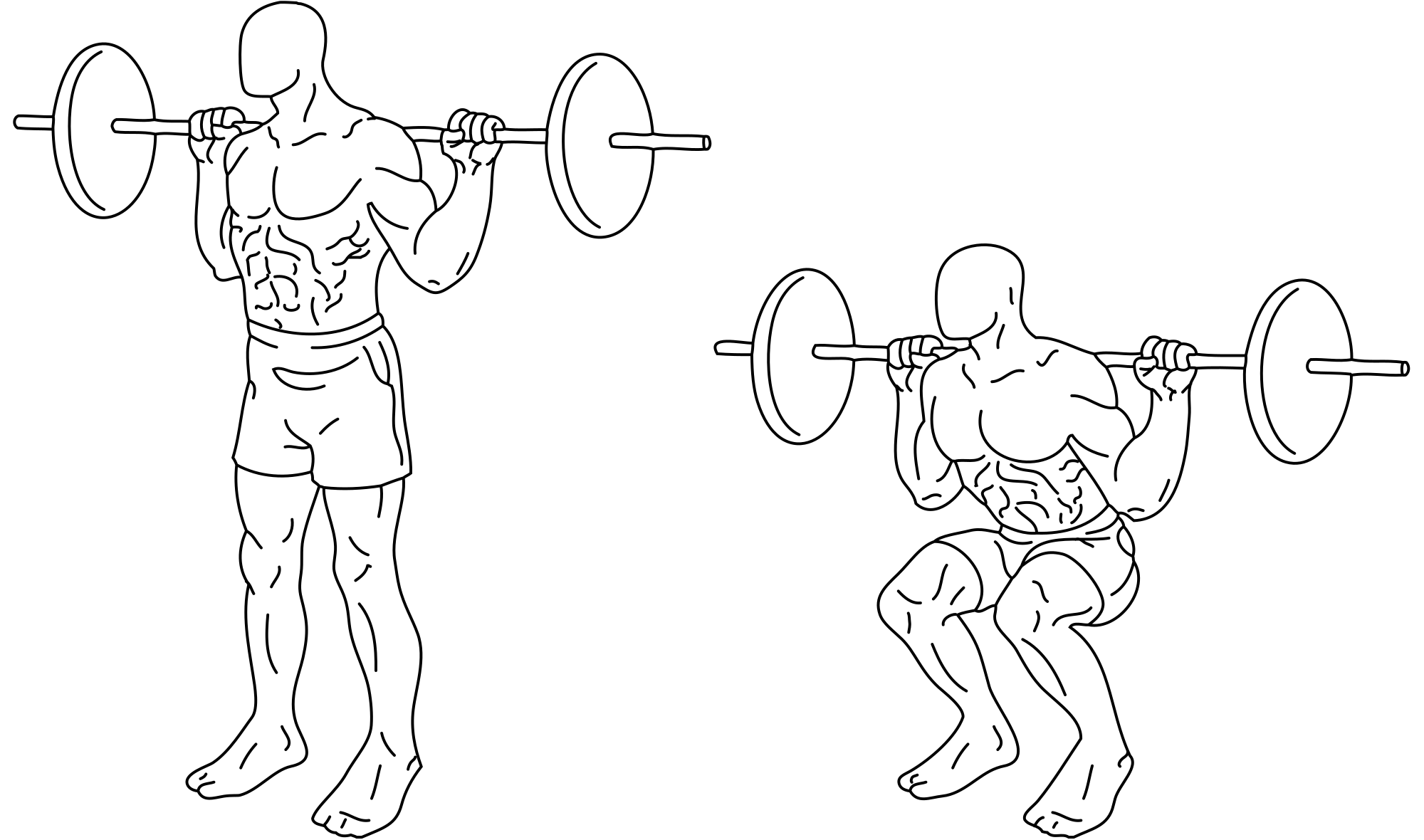
A squat is a strength exercise in which the trainee lowers their hips from a standing position and then stands back up. During the descent, the hip and knee joints flex while the ankle joint dorsiflexes; conversely the hip and knee joints extend and the ankle joint plantarflexes when standing up.
Squats are considered a vital exercise for increasing the strength and size of the lower body muscles as well as developing core strength. The primary agonist muscles used during the squat are the quadriceps femoris, the adductor magnus, and the gluteus maximus. The squat also isometrically uses the erector spinae and the abdominal muscles, among others.
The squat is one of the three lifts in the strength sport of powerlifting, together with the deadlift and the bench press. It is also considered a staple exercise in many popular recreational exercise programs.
The squat begins from a standing position. The squatting movement is initiated by moving the hips back and bending the knees and hips to lower the torso and accompanying weight, then returning to the upright position.
Weight is often added and is typically in the form of a loaded barbell. Dumbbells and kettlebells may also be used. When a barbell is used, it may be braced across the upper trapezius muscle, which is termed a high bar squat, or held lower across the back and rear deltoids, termed a low bar squat. Various torso bracing techniques are used wherever the bar is placed on the back to prevent direct contact with the spine, which can cause pain and injury. This can be a problem for new squatters who squat in a high bar style as they may not have enough muscle mass to form a cushion for the bar and prevent it from applying pressure directly to their spine.
Squats can be performed to varying depths. The competition standard is for the crease of the hip (top surface of the leg at the hip joint) to fall below the top of the knee; this is colloquially known as "parallel" depth. Although it may be confusing, many other definitions for "parallel" depth abound, none of which represents the standard in organized powerlifting. From shallowest to deepest, these other standards are: bottom of hamstring parallel to the ground;[citation needed] the hip joint itself below the top of the knee, or femur parallel to the floor; and the top of the upper thigh (i.e., top of the quadriceps) below the top of the knee. Squatting below parallel is considered a full or deep squat, while squatting above it qualifies as shallow. Though the forces on the ACL and PCL decrease at high flexion, compressive forces on the menisci and articular cartilages in the knee peak at these same high angles. This makes the relative safety of deep versus shallow squats difficult to determine.
As the body descends, the hips and knees undergo flexion, the ankle extends (dorsiflexes) and muscles around the joint contract eccentrically, reaching maximal contraction at the bottom of the movement while slowing and reversing descent. The muscles around the hips provide the power out of the bottom. If the knees slide forward or cave in then tension is taken from the hamstrings, hindering power on the ascent. Returning to vertical contracts the muscles concentrically, and the hips and knees undergo extension while the ankle plantarflexes.
Common errors of squat form include descending too rapidly and flexing the torso too far forward. Rapid descent risks being unable to complete the lift or causing injury. This occurs when the descent causes the brace to relax and tightness at the bottom is lost as a result. Over-flexing the torso greatly increases the forces exerted on the lower back, risking a spinal disc herniation. Another error is when the knee is not aligned with the direction of the toes, entering a valgus position, which can adversely stress the knee joint. An additional common error is the raising of heels off the floor, which reduces the contribution of the gluteus muscles.
Hub AI
Squat (exercise) AI simulator
(@Squat (exercise)_simulator)
Squat (exercise)
A squat is a strength exercise in which the trainee lowers their hips from a standing position and then stands back up. During the descent, the hip and knee joints flex while the ankle joint dorsiflexes; conversely the hip and knee joints extend and the ankle joint plantarflexes when standing up.
Squats are considered a vital exercise for increasing the strength and size of the lower body muscles as well as developing core strength. The primary agonist muscles used during the squat are the quadriceps femoris, the adductor magnus, and the gluteus maximus. The squat also isometrically uses the erector spinae and the abdominal muscles, among others.
The squat is one of the three lifts in the strength sport of powerlifting, together with the deadlift and the bench press. It is also considered a staple exercise in many popular recreational exercise programs.
The squat begins from a standing position. The squatting movement is initiated by moving the hips back and bending the knees and hips to lower the torso and accompanying weight, then returning to the upright position.
Weight is often added and is typically in the form of a loaded barbell. Dumbbells and kettlebells may also be used. When a barbell is used, it may be braced across the upper trapezius muscle, which is termed a high bar squat, or held lower across the back and rear deltoids, termed a low bar squat. Various torso bracing techniques are used wherever the bar is placed on the back to prevent direct contact with the spine, which can cause pain and injury. This can be a problem for new squatters who squat in a high bar style as they may not have enough muscle mass to form a cushion for the bar and prevent it from applying pressure directly to their spine.
Squats can be performed to varying depths. The competition standard is for the crease of the hip (top surface of the leg at the hip joint) to fall below the top of the knee; this is colloquially known as "parallel" depth. Although it may be confusing, many other definitions for "parallel" depth abound, none of which represents the standard in organized powerlifting. From shallowest to deepest, these other standards are: bottom of hamstring parallel to the ground;[citation needed] the hip joint itself below the top of the knee, or femur parallel to the floor; and the top of the upper thigh (i.e., top of the quadriceps) below the top of the knee. Squatting below parallel is considered a full or deep squat, while squatting above it qualifies as shallow. Though the forces on the ACL and PCL decrease at high flexion, compressive forces on the menisci and articular cartilages in the knee peak at these same high angles. This makes the relative safety of deep versus shallow squats difficult to determine.
As the body descends, the hips and knees undergo flexion, the ankle extends (dorsiflexes) and muscles around the joint contract eccentrically, reaching maximal contraction at the bottom of the movement while slowing and reversing descent. The muscles around the hips provide the power out of the bottom. If the knees slide forward or cave in then tension is taken from the hamstrings, hindering power on the ascent. Returning to vertical contracts the muscles concentrically, and the hips and knees undergo extension while the ankle plantarflexes.
Common errors of squat form include descending too rapidly and flexing the torso too far forward. Rapid descent risks being unable to complete the lift or causing injury. This occurs when the descent causes the brace to relax and tightness at the bottom is lost as a result. Over-flexing the torso greatly increases the forces exerted on the lower back, risking a spinal disc herniation. Another error is when the knee is not aligned with the direction of the toes, entering a valgus position, which can adversely stress the knee joint. An additional common error is the raising of heels off the floor, which reduces the contribution of the gluteus muscles.
Recent media