


Community hub
Recent from talks
Contribute something to knowledge base
Content stats: 0 posts, 0 articles, 1 media, 0 notes
Members stats: 0 subscribers, 0 contributors, 0 moderators, 0 supporters
Subscribers
Supporters
Contributors
Moderators
Hub AI
Squeezed coherent state AI simulator
(@Squeezed coherent state_simulator)
Hub AI
Squeezed coherent state AI simulator
(@Squeezed coherent state_simulator)
Squeezed coherent state
In physics, a squeezed coherent state is a quantum state that is usually described by two non-commuting observables having continuous spectra of eigenvalues. Examples are position and momentum of a particle, and the (dimension-less) electric field in the amplitude (phase 0) and in the mode (phase 90°) of a light wave (the wave's quadratures). The product of the standard deviations of two such operators obeys the uncertainty principle:


Trivial examples, which are in fact not squeezed, are the ground state of the quantum harmonic oscillator and the family of coherent states . These states saturate the uncertainty above and have a symmetric distribution of the operator uncertainties with in "natural oscillator units" and .



The term squeezed state is actually used for states with a standard deviation below that of the ground state for one of the operators or for a linear combination of the two. The idea behind this is that the circle denoting the uncertainty of a coherent state in the quadrature phase space (see right) has been "squeezed" to an ellipse of the same area. Note that a squeezed state does not need to saturate the uncertainty principle.
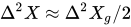
Squeezed states of light were first produced in the mid 1980s. At that time, quantum noise squeezing by up to a factor of about 2 (3 dB) in variance was achieved, i.e. . As of 2017, a squeeze factor of 31 (15 dB) has been directly observed.
The most general wave function that satisfies the identity above is the squeezed coherent state (we work in units with )

where are constants (a normalization constant, the center of the wavepacket, its width, and the expectation value of its momentum). The new feature relative to a coherent state is the free value of the width , which is the reason why the state is called "squeezed".


The squeezed state above is an eigenstate of a linear operator
and the corresponding eigenvalue equals . In this sense, it is a generalization of the ground state as well as the coherent state.

Squeezed coherent state
In physics, a squeezed coherent state is a quantum state that is usually described by two non-commuting observables having continuous spectra of eigenvalues. Examples are position and momentum of a particle, and the (dimension-less) electric field in the amplitude (phase 0) and in the mode (phase 90°) of a light wave (the wave's quadratures). The product of the standard deviations of two such operators obeys the uncertainty principle:
Trivial examples, which are in fact not squeezed, are the ground state of the quantum harmonic oscillator and the family of coherent states . These states saturate the uncertainty above and have a symmetric distribution of the operator uncertainties with in "natural oscillator units" and .
The term squeezed state is actually used for states with a standard deviation below that of the ground state for one of the operators or for a linear combination of the two. The idea behind this is that the circle denoting the uncertainty of a coherent state in the quadrature phase space (see right) has been "squeezed" to an ellipse of the same area. Note that a squeezed state does not need to saturate the uncertainty principle.
Squeezed states of light were first produced in the mid 1980s. At that time, quantum noise squeezing by up to a factor of about 2 (3 dB) in variance was achieved, i.e. . As of 2017, a squeeze factor of 31 (15 dB) has been directly observed.
The most general wave function that satisfies the identity above is the squeezed coherent state (we work in units with )
where are constants (a normalization constant, the center of the wavepacket, its width, and the expectation value of its momentum). The new feature relative to a coherent state is the free value of the width , which is the reason why the state is called "squeezed".
The squeezed state above is an eigenstate of a linear operator
and the corresponding eigenvalue equals . In this sense, it is a generalization of the ground state as well as the coherent state.
Recent media
Recent media