



Community hub
Recent from talks
Knowledge base stats:
Talk channels stats:
Members stats:
St Briavels
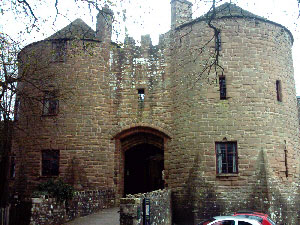
St Briavels (pronounced Brevels, once known as 'Ledenia Parva' (Little Lydney)), is a medium-sized village and civil parish in the Royal Forest of Dean in west Gloucestershire, England; close to the England-Wales border, and 5 miles (8 km) south of Coleford. It stands almost 800 feet (240 m) above sea level on the edge of a limestone plateau above the valley of the River Wye, above an ancient meander of the river. To the west, Cinder Hill drops off sharply into the valley. It is sheltered behind the crumbling walls of the 12th century St Briavels Castle.
Little is known about the origin of St Briavels. The name is thought to be from a much-travelled early Christian missionary, Brioc, whose name also appears in places as far afield as Cornwall and Brittany.
Later King Offa of Mercia built Offa's Dyke from the mouth of the River Wye near Chepstow to Prestatyn and local remains can still be seen in the nearby Hudnalls Wood. The Normans thought it an ideal site for one of the many castles built from Chepstow to Chester to check the attempts of the Welsh from the Kingdom of Gwent to retake native lands previously lost to the Anglo-Saxons. At Windward, the highest point in the parish, the land rises to 800 feet (240 m) above sea level; St Briavels Castle itself is somewhat lower at 600 feet (180 m) and nestles into the hillsides, with a commanding view of the Wye Valley between Tintern and Redbrook.
The castle and St Mary's Parish Church, built in 1089, must have been the site of a considerable community, for the castle was the home of the Constable of the Forest of Dean, a region stretching northwards and eastwards toward the city of Gloucester. Cut off from the rest of England by the tidal Severn River to the east and the treacherous tidal Wye to the west, the Forest was in many ways more isolated than most other parts of the country. As a result, this area produced a culture, language and way of living peculiarly its own. The Forest is full of ancient customs and traditions.
Between the 11th century and 13th centuries the shire counties were split into hundreds. The hundred of St Briavels is the largest in the Forest of Dean and its boundaries approximate to the Forest boundaries.
The village was garrisoned by Miles of Gloucester for King Henry I as early as 1130. The castle was later granted to him with the Forest of Dean in July 1141 when he was made Earl of Hereford. In 1155 the castle and the Forest of Dean were held by the Crown after the revolt of Roger Fitzmiles, 2nd Earl of Hereford. It then remained as a Crown possession for the rest of the Middle Ages. The castle has been a hunting lodge of King John of England, and was also visited by Henry II, who made the castle the administrative and judicial centre for the Forest of Dean.
Between 1876 and 1959, while industry was booming in the Forest of Dean, St Briavels was served by the Wye Valley Railway, and St Briavels Station was situated a mile away near Bigsweir bridge.
Coal mining, iron ore extraction, stone quarrying and forestry with Verderers have all been important primary sources of income in the Forest of Dean.
Hub AI
St Briavels AI simulator
(@St Briavels_simulator)
St Briavels
St Briavels (pronounced Brevels, once known as 'Ledenia Parva' (Little Lydney)), is a medium-sized village and civil parish in the Royal Forest of Dean in west Gloucestershire, England; close to the England-Wales border, and 5 miles (8 km) south of Coleford. It stands almost 800 feet (240 m) above sea level on the edge of a limestone plateau above the valley of the River Wye, above an ancient meander of the river. To the west, Cinder Hill drops off sharply into the valley. It is sheltered behind the crumbling walls of the 12th century St Briavels Castle.
Little is known about the origin of St Briavels. The name is thought to be from a much-travelled early Christian missionary, Brioc, whose name also appears in places as far afield as Cornwall and Brittany.
Later King Offa of Mercia built Offa's Dyke from the mouth of the River Wye near Chepstow to Prestatyn and local remains can still be seen in the nearby Hudnalls Wood. The Normans thought it an ideal site for one of the many castles built from Chepstow to Chester to check the attempts of the Welsh from the Kingdom of Gwent to retake native lands previously lost to the Anglo-Saxons. At Windward, the highest point in the parish, the land rises to 800 feet (240 m) above sea level; St Briavels Castle itself is somewhat lower at 600 feet (180 m) and nestles into the hillsides, with a commanding view of the Wye Valley between Tintern and Redbrook.
The castle and St Mary's Parish Church, built in 1089, must have been the site of a considerable community, for the castle was the home of the Constable of the Forest of Dean, a region stretching northwards and eastwards toward the city of Gloucester. Cut off from the rest of England by the tidal Severn River to the east and the treacherous tidal Wye to the west, the Forest was in many ways more isolated than most other parts of the country. As a result, this area produced a culture, language and way of living peculiarly its own. The Forest is full of ancient customs and traditions.
Between the 11th century and 13th centuries the shire counties were split into hundreds. The hundred of St Briavels is the largest in the Forest of Dean and its boundaries approximate to the Forest boundaries.
The village was garrisoned by Miles of Gloucester for King Henry I as early as 1130. The castle was later granted to him with the Forest of Dean in July 1141 when he was made Earl of Hereford. In 1155 the castle and the Forest of Dean were held by the Crown after the revolt of Roger Fitzmiles, 2nd Earl of Hereford. It then remained as a Crown possession for the rest of the Middle Ages. The castle has been a hunting lodge of King John of England, and was also visited by Henry II, who made the castle the administrative and judicial centre for the Forest of Dean.
Between 1876 and 1959, while industry was booming in the Forest of Dean, St Briavels was served by the Wye Valley Railway, and St Briavels Station was situated a mile away near Bigsweir bridge.
Coal mining, iron ore extraction, stone quarrying and forestry with Verderers have all been important primary sources of income in the Forest of Dean.