Recent from talks
Nothing was collected or created yet.
St Asaph
View on Wikipedia
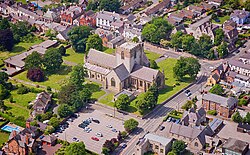
St Asaph (/ˈæsəf/;[3] Welsh: Llanelwy [ɬanˈɛlʊɨ̯] "church on the Elwy"[4]) is a cathedral city[5] and community on the River Elwy in Denbighshire, Wales. At the 2021 census the community had a population of 3,485, making it the second-smallest city in the United Kingdom in terms of population. It was historically in Flintshire.
Key Information
The city of St Asaph is surrounded by countryside and views of the Vale of Clwyd. It is situated close to a number of towns including Denbigh, Rhuddlan, Rhyl, Holywell and Abergele.
History
[edit]The earliest inhabitants of the vale of Elwy lived at the nearby Paleolithic site of Pontnewydd (Bontnewydd), which was excavated from 1978 by a team from the University of Wales, led by Stephen Aldhouse Green. Teeth and part of a jawbone excavated in 1981 were dated to 225,000 years ago. This site is the most north-western site in Eurasia for remains of early hominids and is considered of international importance. Based on the morphology and age of the teeth, particularly the evidence of taurodontism, the teeth are believed to belong to a group of Neanderthals who hunted game in the vale of Elwy in an interglacial period.
Later some historians postulate that the Roman fort of Varae sat on the site of the cathedral. However, the city is believed to have developed around a sixth-century Celtic monastery founded by Saint Kentigern, and is now home to the small 14th century St Asaph Cathedral. This is dedicated to Saint Asaph (also spelt in Welsh as Asaff), its second bishop.
The cathedral has had a chequered history. In the 13th century, the troops of Edward I of England burnt the cathedral almost to the ground, and in 1402 Owain Glyndŵr's troops went on the rampage, causing severe damage to the furnishings and fittings. Two hundred and fifty years later, during the Commonwealth, the building was used to house farm animals: pigs, cattle and horses.[6]
City status
[edit]
As the seat of a medieval cathedral and diocese, St Asaph was historically regarded as a city, and the 1911 Encyclopædia Britannica refers to it as a city on that basis;[7] however the UK government clarified that St Asaph was previously the only one of the twenty two ancient cathedral dioceses in England and Wales (pre-Reformation) not to have been awarded city status.[8] The town applied for the status in competitions held by the British government in 2000 (for the Millennium) and 2002 (Queen's Golden Jubilee) but was unsuccessful. In 2012 it again competed for city status during the Queen's Diamond Jubilee celebrations. It was announced on 14 March 2012 that the application was successful, and city status was to be bestowed upon St Asaph alongside Chelmsford and Perth.[9][10] The status was formally granted by letters patent dated 1 June 2012.[11]
The award of city status is typically granted to a local authority,[12] whose administrative area is then considered to be the formal borders of the city. By this definition, the whole community area of St Asaph is considered to be the extent of the city, including its urban and rural areas. St Asaph contains the second lowest population of all the cities of the UK, and has the second smallest urban area of 0.5 sq mi (1.3 km2), both measures behind St Davids which has 1,841 residents and covers 0.23 sq mi (0.60 km2). However, with the formal city sizing defined by its community council area of 2.49 sq mi (6.4 km2), two other UK cities are smaller than St Asaph by boundary: the City of London smallest at 1.12 sq mi (2.9 km2) and Wells second with 2.11 sq mi (5.5 km2). In Wales, St Asaph is the smallest by council area, with Bangor a close second at 2.79 sq mi (7.2 km2).
Community
[edit]Despite the previous lack of official city status, the community council had referred to itself as the City of St Asaph Town Council. The local community is passionate about St Asaph's historic claim to be known as a city like its Welsh cousin St Davids, which has led to a number of local businesses using 'City' as part of their business name. The city is promoted locally as the "City of Music".
The past few decades have seen the local economy in St Asaph thrive, first with the opening of the A55 road in 1970, which took east–west traffic away from the city, and, more recently, with a business park being built, attracting investment from home and overseas.
The crowded roads in St Asaph have been a hot political issue for many years. In recent years, increasing volumes of traffic on the A525, St Asaph High Street, which links A55 with the Clwyd Valley, Denbigh and Ruthin, have led to severe congestion in the city. This congestion is having a detrimental effect on the city, and residents have repeatedly called for a bypass to take this north–south road and its traffic away from the city, but the National Assembly for Wales rejected these calls in 2004, presenting a further setback for residents campaigning on the issue.
St Asaph is now home to Ysgol Glan Clwyd, a Welsh medium secondary school that opened in Rhyl in 1956 and moved to St Asaph in 1969. It was the first Welsh medium secondary school in Wales.
An original copy of the Welsh Bible is kept on public display in St Asaph Cathedral. It was used at the investiture of Prince Charles as Prince of Wales in 1969.
Twinning
[edit]St Asaph is twinned with the town of Bégard in Brittany, France.[13]
Festivities
[edit]Every year the city hosts the North Wales International Music Festival, which takes place at several venues in the city and attracts musicians and music lovers from all over Wales and beyond. In past years, the main event in September at the cathedral has been covered on television by the BBC.
Other annual events in the city include the increasingly popular Woodfest Wales crafts festival in June, the Beat the Bounds charity walk in July and the Gala Day in August.
Churches
[edit]In addition to the cathedral, there are five other churches in St Asaph covering all the major Christian denominations. The Parish Church of St Asaph and St Kentigern (Church in Wales) is placed prominently at the bottom of the High Street, across the river in Lower Denbigh Road is Penniel Chapel (Welsh Methodist) and halfway up the High Street there is Llanelwy Community Church (Baptist). At the top of the city, in Chester Street is St Winifride's (Roman Catholic) and Bethlehem Chapel (Welsh Presbyterian) in Bronwylfa Square.
Governance
[edit]There are two tiers of local government covering St Asaph, at community (city) and county level: St Asaph City Council (Cyngor Dinas Llanelwy) and Denbighshire County Council (Cyngor Sir Ddinbych). The city council meets at Roe Plas.[14]
Administrative history
[edit]St Asaph was an ancient parish.[15] It appears to have historically been on the borders of the commote of Rhuddlan in the cantref of Tegeingl, and the commote of Isdulas in the cantref of Rhufoniog. Under the Statute of Rhuddlan in 1284, Tegeingl became part of the new county of Flintshire and Rhufoniog became part of the marcher lordship of Denbighland. The Statute of Rhuddlan does not specifically name St Asaph, and there is some ambiguity as to whether it was in Flintshire or Denbighland; it may have been administered as a separate liberty.[16]
In 1536, the new county of Denbighshire was created under the Laws in Wales Act 1535, comprising the old lordship of Denbighland plus other "lordships, townships, parishes, commotes and cantreds", one of which was "Saint Tasse", being St Asaph.[17] Six years later, in 1542, St Asaph was transferred instead to Flintshire, with the act of parliament which transferred it noting that it had "...of old time been reputed accepted and taken as part and parcel of the county of Flint...".[18][16]
The parish of St Asaph covered a large rural area as well as the settlement itself, and straddled the hundred of Isdulas in Denbighshire and the hundred of Rhuddlan in Flintshire. It was subdivided into 13 townships:[19][20][21]
- Bodelwyddan
- Bodeugan
- Brynpolyn
- Cilowen
- Cyrchynan
- Faenol
- Gwernglefryd
- Gwernigron
- Meriadog
- Pengwern
- Rhyllon
- Talar
- Wigfair
Meriadog and Wigfair were in Denbighshire, the rest of the parish was in Flintshire. The cathedral, the parish church of St Kentigern, and the core of the urban area were in the Brynpolyn township.[22][23] An ecclesiastical parish of Bodelwyddan was created in 1860 covering the Bodelwyddan, Pengwern and Faenol townships, but it remained part of the civil parish of St Asaph.[24] Another ecclesiastical parish, called Cefn, was created in 1865 covering the two Denbighshire townships of the civil parish.[25]
The Local Government Act 1894 directed that civil parishes could no longer straddle county boundaries. The two Denbighshire townships of Meriadog and Wigfair were therefore together made a new civil parish called Cefn in 1895.[26] The following year, the reduced parish of St Asaph within Flintshire ceded an area to Rhuddlan, and the remainder was split into three civil parishes: Bodelwyddan, Waen and a much reduced St Asaph parish.[27]
St Asaph was then administered as a rural parish with a parish council within the St Asaph Rural District of Flintshire until 1974. In that year, the parish of St Asaph was converted into a community in the new borough of Rhuddlan and county of Clwyd.[28][29] The upper tiers of local government were reorganised again in 1996, when St Asaph was included in the modern Denbighshire.[30]
Transport
[edit]St Asaph is served by regular buses to Denbigh, Rhuddlan and Rhyl. The city was once served by a station on the Vale of Clwyd Railway line, which closed in the 1960s. However, the station remains and the site is now in use as a builders yard. The nearest stations are now in Rhyl and Pensarn. The city is also close to the heritage railways at Llangollen and Bala Lake in the town of Bala.
Notable people
[edit]


A number of famous people have strong links to St Asaph, having been born, raised, lived, worked or died in the city. These include:
- William Morgan (1545–1604), translated the Bible into Welsh, later Lord Bishop of St Asaph
- Georgiana Hare-Naylor (c. 1755 – 1806) an English painter and art patron.
- Dic Aberdaron (1780–1843), traveller and polyglot who taught himself Latin at the age of 11
- Felicia Hemans (1793–1835), poet who wrote the poem Casabianca[31]
- G. W. Hemans (1814–1885), architect and engineer, engineered the Vale of Clwyd Railway line through St Asaph[32]
- Sir Henry Morton Stanley (1841–1904), explorer and journalist.[33]
- A. G. Edwards, (1848–1937), Lord Bishop of St Asaph the first Lord Archbishop of Wales in the Church in Wales
- Felix Powell (1878–1942), British Army Staff Sergeant wrote the music to Pack Up Your Troubles in Your Old Kit Bag
- George Henry Powell (1880–1951), songwriter who wrote the lyrics to Pack Up Your Troubles in Your Old Kit Bag
- William Mathias (1934–1992), composer of choral works, lived and was buried in St Asaph.
- Geoffrey James (born 1942), Canadian photographer
- Gareth Jones (born 1961), television presenter
- Jo Caulfield (born 1963), actress, writer and comedian
- Antony John Williams (born 1964), chemist, science-blogger and author
- Russell Morris (born 1967), Professor of Chemistry at the University of St Andrews and former first-class cricketer
- Carl Sargeant (1968–2017), Welsh politician[34]
- Greg Davies (born 1968), comedian, presenter, actor and writer
- Steve Williams (born 1971), keyboard player, founder of Power Quest and former member of DragonForce
- Spencer Wilding (born 1972), actor and stunt performer
- Richard Ian Cox (born 1973), Vancouver-based voice actor and online radio host
- Lisa Scott-Lee (born 1975), singer, member of Steps
- Paul Mealor (born 1975), composer, much of his output is for chorus
- James Davies (born 1980), Conservative Party politician and former MP for the Vale of Clwyd
- Bryan Parry (born 1992), actor
Sport
[edit]- Rosamund Colman (1885–1950) international golf and tennis player a member of the Salusbury family.


- Alan Rudkin (1941–2010), British, Commonwealth and European bantamweight boxing champion
- Brynley Jones (born 1959), footballer with over 190 club caps
- Ian Rush (born 1961), footballer, former Wales captain and record goalscorer for Liverpool with 346 goals
- Barry Horne (born 1962), footballer with over 540 club caps and 59 for Wales
- Paul Affleck (born 1966), professional golfer who has played on the European Tour
- Darren Owen (born 1967), horse racing commentator
- David Harrison (born 1972), jockey, winner of 1992 Royal Hunt Cup at Royal Ascot
- Rob Higgitt (born 1981), rugby union player
- Eifion Lewis-Roberts (born 1981), rugby union prop forward
- Becky Brewerton (born 1982), golfer on the Ladies European Tour
- Mark Webster (born 1983), former professional darts player
- Pat Leach (born 1985), rugby union player for Newport RFC and the Newport Gwent Dragons regional team
- Andy Fenby (born 1985), former rugby union footballer
- Victoria Thornley (born 1987), rower, team silver medalist in the women's double sculls at the 2016 Summer Olympics
- Neil Taylor (born 1989), footballer, with 338 club caps and 43 for Wales international and Team GB squad member for the London 2012 Olympics
- Dyddgu Hywel (born 1989), rugby union fullback for Gloucester–Hartpury and Wales women
- Chris Maxwell (born 1990), football goalkeeper with over 400 club caps and captain of Blackpool
- Rebecca Chin (born 1991), athlete, silver medalist at the 2015 World Rowing Championships and represented Great Britain in discus and shot put at the 2008 Summer Paralympics
Another well-known individual, Geoffrey of Monmouth, served as Lord Bishop of St Asaph from 1152 to 1155; however, due to war and unrest in Wales at the time, he probably never set foot in his see.
The hospital in the city (formerly the St Asaph Union Workhouse) was named H.M. Stanley Hospital in honour of Sir Henry Morton Stanley; it closed in 2012. The city's hospice was named after Saint Kentigern.
References
[edit]Notes
[edit]- ^ "St Asaph (Denbighshire)". The Flag Institute. Retrieved 10 June 2025.
- ^ "St Asaph community". City Population. Retrieved 19 March 2025.
- ^ St Asaph—John Wells's phonetic blog Archived 18 June 2012 at the Wayback Machine, 15 March 2012. Retrieved 1 April 2012
- ^ Mills, A. D. (2003). A Dictionary of British Place-Names. Oxford: Oxford University Press. ISBN 9780198527589.
- ^ BBC News—St Asaph in north Wales named Diamond Jubilee city Archived 30 October 2018 at the Wayback Machine Retrieved 14 March 2012
- ^ T. W. Pritchard St Asaph Cathedral Guidebooks
- ^ . Encyclopædia Britannica. Vol. 23 (11th ed.). 1911. p. 1016.
- ^ "St Asaph: A new Diamond city for North Wales". GOV.UK. 14 March 2012. Archived from the original on 18 September 2018. Retrieved 18 September 2018.
www.nationalarchives.gov.uk/doc/open-government-licence/version/3/ Contains public sector information licensed under the Open Government Licence v3.0.
- ^ "WELCOME TO ST ASAPH". www.stasaph.co.uk. Archived from the original on 30 May 2000.
- ^ "Three towns win city status for Diamond Jubilee". BBC News. 14 March 2012. Archived from the original on 25 April 2012. Retrieved 14 March 2012.
- ^ "No. 60167". The London Gazette. 11 June 2012. p. 11125.
- ^ "Corby City Bid" (PDF). www.corby.gov.uk. Corby Borough Council.
Applications may only be made by an elected local authority – normally, in respect of the entire local authority area.
- ^ "Cathedral to New Inn". St Asaph City Council. Archived from the original on 4 October 2018. Retrieved 4 October 2018.
- ^ "Council Meetings". St Asaph City Council. Retrieved 21 March 2025.
- ^ "St Asaph Ancient Parish / Civil Parish". A Vision of Britain through Time. GB Historical GIS / University of Portsmouth. Retrieved 20 March 2025.
- ^ a b Tout, Thomas Frederick (1934). "Flintshire: Its history and records". Collected Papers: Volume II. Manchester: Manchester University Press. p. 30. Retrieved 20 March 2025.
- ^ "Section VIII". Laws in Wales Act. 1535. p. 247. Retrieved 20 March 2025.
- ^ "Section III". An Act concerning certain Lordships translated from the County of Denbigh to the County of Flint. 1542. p. 359. Retrieved 20 March 2025.
- ^ Thomas, David Richard (1874). A History of the Diocese of St Asaph, General, Cathedral, and Parochial. James Parker. p. 273. Retrieved 19 March 2025.
- ^ Book of Reference to the Plan of the Parish of St Asaph (part of), Hundred of Rhuddlan, in the County of Flint. London: Ordnance Survey. 1872. Retrieved 20 March 2025.
- ^ Book of Reference to the Plan of the Parish of St Asaph (part of), Hundred of Isdulas, in the County of Denbigh. London: Ordnance Survey. 1875. Retrieved 20 March 2025.
- ^ "Flintshire Sheet IV". National Library of Scotland. Ordnance Survey. 1878. Retrieved 19 March 2025.
- ^ "St Asaph". A Vision of Britain through Time. GB Historical GIS / University of Portsmouth. Retrieved 19 March 2025.
- ^ "No. 22409". The London Gazette. 3 August 1860. p. 2882.
- ^ "No. 22937". The London Gazette. 7 February 1865. p. 568.
- ^ Annual Report of the Local Government Board. H.M. Stationery Office. 1896. p. 372. Retrieved 19 March 2025.
- ^ Parliamentary Papers. H.M. Stationery Office. 1899. p. 196. Retrieved 19 March 2025.
- ^ "Local Government Act 1972", legislation.gov.uk, The National Archives, 1972 c. 70, retrieved 1 November 2022
- ^ "The Districts in Wales (Names) Order 1973", legislation.gov.uk, The National Archives, SI 1973/34, retrieved 30 October 2022
- ^ "Local Government (Wales) Act 1994", legislation.gov.uk, The National Archives, 1994 c. 19, retrieved 30 October 2022
- ^ . Encyclopædia Britannica. Vol. 13 (11th ed.). 1911. pp. 256–257.
- ^ "George Willoughby Hemans". Grace's Guide. Archived from the original on 20 July 2017. Retrieved 6 July 2017.
- ^ Cana, Frank Richardson (1911). . Encyclopædia Britannica. Vol. 8 (11th ed.). pp. 779–781.
- ^ Carl Sargeant: Profile of long-serving AM's career - BBC News
Bibliography
[edit]- T. W. Pritchard, St Asaph Cathedral, R. J. L. Smith, Much Wenlock (1997) ISBN 1-872665-91-8
- Dr Chis Stringer, Homo Brittanicus, 319 pages, publisher: Allen Lane (5 October 2006) ISBN 0-7139-9795-8, ISBN 978-0-7139-9795-8
External links
[edit]St Asaph
View on GrokipediaGeography and Demographics
Location and Topography
St Asaph is situated in Denbighshire, north-east Wales, United Kingdom, at geographic coordinates 53°15′27″N 3°26′38″W.[6] The city lies on the banks of the River Elwy, a tributary that joins the River Clwyd approximately 1.5 miles (2.4 km) to the north.[7] It occupies a position between the coastal resort of Rhyl to the north and the town of Denbigh to the south, within the broader Vale of Clwyd region.[8] The topography of St Asaph features a lowland valley setting characteristic of the Vale of Clwyd, with the city center elevated on a modest hill overlooking the River Elwy valley. Ground levels near the river confluence drop to around 10 meters above Ordnance Datum, while surrounding terrain includes gently rising slopes formed by glacial and fluvial deposits.[9] This positioning provides a strategic vantage, historically influencing settlement patterns, amid fertile alluvial plains flanked by higher ground such as the Clwydian Hills to the east. The area's elevation generally ranges from 10 to 50 meters above sea level, contributing to its vulnerability to fluvial flooding from the Elwy and Clwyd rivers.[9]Population Trends and Community Composition
The population of St Asaph, recorded at 3,485 in the 2021 census, reflects a small, stable community characteristic of historic Welsh cathedral cities.[10] Historical data indicate fluctuations: 3,144 residents in 1831, declining to 2,000 by 1901 amid rural depopulation trends in north Wales, before rising to 3,491 in 2001.[11] From 2001 to 2011, the figure fell to 3,355, possibly due to broader regional economic pressures, followed by modest growth at an annual rate of 0.38% through 2021.[10]| Census Year | Population |
|---|---|
| 1831 | 3,144 |
| 1901 | 2,000 |
| 2001 | 3,491 |
| 2011 | 3,355 |
| 2021 | 3,485 |
Historical Development
Early Foundation and Christian Origins
The settlement of St Asaph, known in Welsh as Llanelwy ("church on the Elwy"), derives its early foundation from a monastic community established by Saint Kentigern (also called Mungo), a 6th-century bishop exiled from his see in Scotland around 553 AD, who sought refuge in northern Wales.[15] Kentigern reputedly founded a religious cell or monastery on the banks of the River Elwy circa 560 AD, selecting the site for its strategic location between the Elwy and Clwyd rivers, which facilitated early Christian missionary activity amid Romano-British and Celtic populations.[16] This establishment marked the inception of organized Christianity in the region, predating formalized diocesan structures and reflecting the Celtic monastic tradition of isolated, riverine foundations conducive to ascetic life and evangelism.[3] Kentigern appointed Saint Asaph (or Asa), his disciple, as the community's leader and first bishop, with consecration occurring around 573 AD according to hagiographic accounts preserved in medieval Welsh traditions.[15] Asaph, who succeeded Kentigern upon the latter's return to Scotland circa 576 AD, oversaw the expansion of the monastery into a significant ecclesiastical center, emphasizing scriptural study, liturgy, and pastoral care within a community of monks numbering potentially up to 965 by later estimates, though such figures stem from legendary vitae rather than contemporary records.[3] The bishopric of Llanelwy thus emerged as one of the ancient sees of Wales, aligned with the sub-Roman ecclesiastical model where bishops held authority over clustered monastic cells rather than territorial parishes.[17] Archaeological and documentary evidence for these origins remains sparse, reliant primarily on post-Conquest chronicles like those of Gerald of Wales (c. 1188), which affirm the site's continuity as a Christian enclave resisting pagan Anglo-Saxon incursions from the east.[4] No pre-Christian settlement of note is attested at Llanelwy, suggesting the location's prominence arose specifically from Kentigern's initiative, which integrated incoming Scottish monastic influences with indigenous Brythonic Christianity, fostering resilience against 7th- and 8th-century Viking raids that thrice destroyed early wooden structures.[18] This foundational era laid the groundwork for the enduring diocese, with Asaph's feast observed on May 1, underscoring his role in embedding orthodox faith amid Wales' fragmented post-Roman landscape.[19]Medieval and Post-Conquest Evolution
Following the Norman Conquest of England in 1066, the Diocese of St Asaph experienced increasing Norman influence by the early 12th century, reflecting broader Anglo-Norman penetration into Welsh ecclesiastical affairs. The first documented post-conquest bishop, Gilbert—a Norman appointee—was consecrated in 1143 by Theobald, Archbishop of Canterbury, signaling the diocese's alignment with Canterbury's authority and the erosion of purely Celtic independence in church governance.[20] His successor, Geoffrey of Monmouth, consecrated around 1152, authored the Historia Regum Britanniae, a chronicle blending Welsh legend with historical narrative that bolstered native traditions amid foreign dominance, though its factual reliability remains debated among historians for conflating myth with evidence.[20] Cathedral construction advanced in the early 13th century with the initiation of an early Gothic structure by 1239, replacing earlier wooden or rudimentary buildings tied to the 6th-century monastic foundation.[20] This progress halted amid Edward I's Edwardian Conquest of Wales; the cathedral was burned in 1282 by English forces during the Second Welsh War, following initial plans for fortification after the 1277 campaign.[20] Reconstruction commenced under Bishop Anian II (r. 1268–1293), who had initially supported Welsh prince Llywelyn ap Gruffudd but adapted to English rule post-conquest; work extended from 1284 to 1381 on the cruciform nave and choir, using local carboniferous limestone, with the tower finalized in 1391–1392.[20] The edifice, documented as Ecclesia Cathedralis de Sancto Asaph in Pope Nicholas IV's 1291 taxation, symbolized the diocese's endurance and partial reconstruction under crown oversight, though finances strained due to war damages and sparse tithes from a rural, contested territory.[20] The settlement of St Asaph evolved modestly as an episcopal hub rather than a commercial or fortified town, lacking borough charters or significant lay defenses typical of post-conquest marcher developments elsewhere in Wales.[20] By the late medieval period, it comprised a compact cluster of ecclesiastical structures, including the bishop's palace precursor at Esgobty, along the High Street and river confluence, with population growth curtailed by recurrent conflicts; John Speed's 1610 map depicts under 50 dwellings, a mill, and bridge, underscoring its peripheral role in the anglicized north-east Welsh landscape.[20] Further upheaval came in 1402 when rebel forces under Owain Glyndŵr torched the cathedral anew during his uprising against English rule, delaying full stabilization until 15th-century restorations under Henry VII's reign, which reinforced its status as a modest diocesan seat amid the transition to Tudor integration.[20]Modern Transformations and Challenges
In the late 20th and early 21st centuries, St Asaph underwent economic diversification driven by the establishment and expansion of the St Asaph Business Park, a modern site hosting sectors in science, engineering, energy, creative industries, and services, which attracted domestic and international investment and contributed to local economic vitality.[21][22] The opening of the A55 expressway through the area in the 1970s enhanced connectivity, facilitating growth by diverting long-distance traffic while supporting commuter access to nearby urban centers like Rhyl and Chester, though it also intensified local road congestion.[22][23] Residential expansions, including proposals for 28 homes on the former Welsh Ambulance Service headquarters site in 2023 and developments on ex-hospital grounds, reflected efforts to accommodate modest population stability around 3,500 residents amid broader regional housing needs.[24][12] Regeneration initiatives by Denbighshire County Council have targeted town center revitalization, addressing vacant properties and enhancing community facilities, such as the 2017 St Asaph Cathedral extension adding a tea room, meeting rooms, and toilets at a cost of £330,000 to bolster tourism and local use.[23][25] Projects like community nature spaces initiated in 2024 and proposed nature reserves on agricultural land aim to integrate environmental enhancements with urban development.[26][27] Persistent challenges include recurrent flooding from the River Elwy, with major events in 1964, 2012 (evacuating over 500 properties), and 2020 during Storm Ciara, when river levels reached records since 1974, prompting a flood risk management scheme that raised a local bridge to mitigate 1-in-100-year events.[28][29][30] Community resistance to certain developments, evidenced by the 2014 rejection of a crematorium proposal amid protests and the 2024 denial of converting the library into flats to preserve public services, highlights tensions between growth, heritage preservation, and infrastructure strain from traffic.[31][32][23]Religious Heritage
St Asaph Cathedral: Architecture and History
The Cathedral of St Asaph traces its origins to the mid-6th century, when Saint Kentigern established a monastic community around 560–573 AD and ordained Saint Asaph as his successor circa 596 AD, naming the site Llanelwy after the River Elwy.[4] An episcopal see was formalized around 1073 under Norman influence, with Bishop Gilbert consecrated by Archbishop Theobald of Canterbury.[4] The present building, recognized as the smallest ancient cathedral in Britain, emerged from extensive 13th- and 14th-century reconstructions following earlier destructions, incorporating elements that survive to this day.[33] In 1282, the medieval cathedral was accidentally burned by English forces during conflicts involving Bishop Anian II (1268–1293), prompting Archbishop John Pecham to order its rebuilding starting in 1284, a process extending to 1392 under bishops like Llywelyn of Bromfield (1293–1315), who oversaw the nave and transepts completed by 1320.[4] Further damage occurred in 1402 amid Owain Glyndŵr's revolt, leading to 15th-century repairs, including the addition of canopied choir stalls in 1482 by Bishop Richard Redman (1471–1501), the only such surviving medieval set in Wales.[34] The structure endured additional harm during the English Civil War and a 1714 storm that toppled the tower's upper portion, with major Victorian restoration conducted by Sir George Gilbert Scott from 1867 to 1875, preserving its core medieval fabric.[34] Architecturally, St Asaph Cathedral adopts a modest Gothic style marked by simplicity and austerity, featuring arches and pillars without decorative capitals, built on a Latin cross plan using red sandstone supplemented by gray limestone, alongside yellowish sandstone from Flint or Talacre quarries and local purple variants evident in the exterior.[35][33] Key elements include the 14th-century bell tower finished by 1392, the presbytery with its bishop's throne and the tomb of Bishop William Morgan (d. 1604), translator of the Welsh Bible, east of the choir featuring 1482 stalls, and clerestory windows added post-1403.[4][33] Notable interior features encompass medieval stone carvings, 19th-century stained glass, and the effigy tomb of Bishop Anian II in the south aisle, while a chemical reaction between limestone and sandstone has contributed to ongoing maintenance needs.[33][34] The roof was restored and decorated in 1968, underscoring the cathedral's adaptation through centuries while retaining its compact scale.[33]The Diocese of St Asaph: Role and Influence
The Diocese of St Asaph functions as one of six dioceses in the Church in Wales, an independent Anglican province disestablished from the Church of England in 1920, overseeing spiritual, pastoral, and administrative affairs across north-east and central Wales.[36] It organizes its ministry through over 200 churches grouped into mission areas, facilitating local worship, community outreach, and clergy deployment under episcopal authority.[36] The diocese's role extends to education, where its bishop serves as the lead on Church in Wales educational matters, influencing church schools and faith-based initiatives.[37] Geographically, the diocese spans Denbighshire, Flintshire, Wrexham county borough, half of Conwy, eastern parts of Gwynedd, and northern Powys, serving a population exceeding 500,000 with a focus on rural and urban parishes alike.[36] The current Bishop of St Asaph, the Right Reverend Gregory Cameron—the 79th in succession—elected in 2009, directs these efforts from the diocesan see at St Asaph Cathedral, emphasizing jubilee commemorations, priestly ordinations, and responses to contemporary challenges like secularization.[38] Archdeacons and canons support this structure, handling deanery affairs and cathedral governance.[38] Historically, the diocese traces its origins to circa 573 AD, when Saint Kentigern, exiled from Scotland, established a monastic community and consecrated Saint Asaph as his successor, naming the see after him; this foundation marked 1,450 years in 2023 with diocesan-wide events including special services and the admission of members to the Order of St Asaph.[39] Its influence on Welsh society has been profound, particularly through bishops who preserved Celtic Christian traditions amid Norman incursions and later exercised civil jurisdiction over temporal matters in their territories.[40] Notable figures include William Morgan (bishop 1601–1604), whose complete Welsh Bible translation advanced literacy and cultural identity in the vernacular, countering anglicization pressures.[4] Similarly, William Lloyd (bishop 1680–1692) exemplified episcopal resistance to monarchical overreach as one of the Seven Bishops tried under James II, reinforcing Anglican orthodoxy.[41] In medieval and early modern eras, diocesan bishops wielded significant temporal power, aligning with Welsh principalities like Powys before English conquests reshaped boundaries, yet maintained influence via ecclesiastical courts and patronage.[42] This legacy persists in modern societal roles, where the diocese supports charitable works, interfaith dialogue, and responses to social issues, though attendance has declined amid broader Welsh secular trends; its commitment to Welsh-language services underscores ongoing cultural custodianship.[36]Civic Status and Administration
Acquisition of City Status
St Asaph, home to one of the smallest cathedrals in the United Kingdom, had long lacked formal city status despite its ancient ecclesiastical significance as the seat of a diocese established in the 6th century. Prior to 2012, it was the only one of the six medieval Welsh cathedrals without such recognition, unlike contemporaries such as Bangor and St David's, which received city status by historical prerogative or later grants.[43] The town's community council submitted bids for city status in 2000 and 2002, framing the request as a "re-admission" based on its pre-Reformation diocesan heritage, but both were unsuccessful.[44] In 2011, St Asaph entered a national competition launched by the UK government to award city status to selected localities in honor of Queen Elizabeth II's Diamond Jubilee in 2012, inviting bids from across the United Kingdom with an emphasis on historical, cultural, and economic merits.[5] The bid highlighted the town's role as a regional hub for commerce, technology, and business in North Wales, alongside its rich heritage centered on the cathedral, which serves as the administrative heart of the Diocese of St Asaph. With a modest budget of approximately £300 for the application—contrasting sharply with competitors like Wrexham, which invested around £20,000—St Asaph's submission emphasized its compact metropolitan function and longstanding civic identity without extensive promotional expenditure. On 14 March 2012, it was announced that St Asaph had been selected alongside Chelmsford in England and Perth in Scotland, prevailing over more than 30 other applicants including larger contenders such as Bolton, Stockport, and Wrexham.[45] The grant was formalized through letters patent issued under the royal prerogative, dated 1 June 2012, conferring city status effective immediately and entitling the locality to use the title in official capacities.[7] This elevation marked a rare modern conferral outside traditional criteria, recognizing St Asaph's disproportionate influence relative to its population of around 3,500, and it joined a select group of UK cities defined not by size but by exceptional historical or ceremonial distinction. The status has since been celebrated locally, including through the adoption of a city flag in 2022 to commemorate the tenth anniversary.[46][47]Governance and Administrative History
St Asaph's civil administration has evolved through successive reforms in Welsh local government. From the establishment of the rural district system under the Local Government Act 1894 until 1974, the area formed part of the St Asaph Rural District within the historic county of Flintshire.[48] The Local Government Act 1972, effective from 1 April 1974, abolished the rural districts and placed St Asaph in the newly created county of Clwyd, specifically within the Rhuddlan district, which encompassed former Flintshire territories along the north Wales coast.[49] Further reorganisation under the Local Government (Wales) Act 1994 dissolved Clwyd effective 1 April 1996, transferring St Asaph to the unitary authority of Denbighshire County Borough, where it has remained the principal tier for county-level services such as education, planning, and public health.[50] At the community level, governance is provided by St Asaph City Council, comprising 14 elected councillors responsible for local amenities, events, and minor infrastructure.[3] This body succeeded earlier parish councils and, prior to formal city recognition, informally styled itself as the City of St Asaph Town Council in deference to the site's longstanding ecclesiastical prominence. On 14 March 2012, St Asaph received official city status via letters patent issued to mark Queen Elizabeth II's Diamond Jubilee, elevating its ceremonial standing despite its modest size and prior absence of such designation among Britain's ancient cathedral seats.[5] The award acknowledged the city's historical role in Welsh cultural preservation, including early Bible translations, and its function as a regional hub, though administrative powers remained unchanged.[5]Economy, Infrastructure, and Transport
Economic Growth and Key Industries
St Asaph's economy is anchored by the St Asaph Business Park, a 90-acre site hosting over 70 companies specializing in science, engineering, opto-electronics, energy, and creative industries.[21] This park serves as a hub for advanced manufacturing and innovation, attracting firms such as TRB Ltd, which operates a 1,500 m² assembly plant for automotive product development as a subsidiary of Japanese multinational Toka Rika.[51] Other notable employers include Sewell Industries and various entities in manufacturing, computing, and energy sectors.[52] The OpTIC Technology Centre, located within the business park and operated by Wrexham University, focuses on optics, photonics, and engineering, linking research and development with industry and academia to foster product innovation and specialist technical services.[53] Recent expansions, including the Enterprise Engineering and Optics Centre funded by £11.55 million from the North Wales Growth Deal, aim to create 70-90 new jobs and enhance facilities for efficient, low-emission technologies.[54] Construction on this project exceeded its social and local economic value targets by June 2025, surpassing the 67% goal with 71.7% achievement during the build phase.[55] Denbighshire County Council's 2025-2035 economic strategy emphasizes developing a tech-rich cluster at St Asaph Business Park to drive innovation-led growth and bolster the knowledge economy, addressing regional barriers through targeted investments.[56] While broader Denbighshire growth has seen construction jobs rise 43% from 2021 to 2022, St Asaph's contributions stem primarily from high-tech sectors rather than tourism or traditional manufacturing, with the park's diverse tenants supporting employment in professional services and advanced production.[57]Transportation Networks
The primary road network in St Asaph centers on the A55 North Wales Expressway, a major dual carriageway with Junction 27A offering direct access to the city center and surrounding areas. This route connects eastward to the M56 near Chester for links to the M6 and Midlands, and westward through Conwy to the A470 and ultimately Holyhead for Irish Sea ferry services. Local roads such as the A541 link St Asaph southward to Denbigh, supporting commuter and commercial traffic within Denbighshire.[58][59] Rail access requires travel to nearby stations, as St Asaph has no operational railway halt following the closure of its Vale of Clwyd line station in the mid-20th century. The closest facility is Rhyl station, 6 miles north on the electrified North Wales Coast Line, offering frequent Transport for Wales services to Holyhead, Chester, Crewe, and connections to London Euston via the West Coast Main Line. Travel from Rhyl to St Asaph typically involves a 10-15 minute bus or taxi journey.[60][61] Public bus services provide essential intra-regional connectivity, operated primarily by Arriva Wales and supplemented by local operators. Key routes include the 51, 51B, and 52, which run between Rhyl and Denbigh via St Asaph with frequencies up to every 20 minutes during peak hours, serving the cathedral, business parks, and Glan Clwyd Hospital. Express options like the X50 and X52 extend to Wrexham through Ruthin, accommodating longer-distance commuters. Additional services, such as the 54 to local hospitals and T-fleXi demand-responsive options, support rural and flexible travel needs; full timetables are managed by Denbighshire County Council and accessible via Traveline Cymru.[62][63][64]Cultural Life and Traditions
Local Festivities and Community Events
The North Wales International Music Festival serves as the principal annual cultural festivity in St Asaph, held each September primarily within the acoustics-renowned St Asaph Cathedral.[65] This classical music event spans approximately ten days, featuring world-class performances, masterclasses, world premieres, and fringe activities that engage local participants.[66] The 2025 iteration is set for 11–20 September, including concerts by ensembles such as the BBC National Orchestra of Wales and brass bands like Foden's and Black Dyke.[67] [68] Organized to highlight the city's musical heritage, the festival incorporates community elements like outreach projects and tours, drawing visitors while fostering local involvement.[69] Beyond the music festival, community events in St Asaph often center on the Cathedral's seasonal and ad hoc gatherings, which promote social cohesion in the small city of around 3,500 residents.[70] These include recurring choral concerts, tribute performances, and holiday-themed spectacles, such as Christmas candlelit music evenings and carol services that attract families and draw on Welsh traditions of communal singing.[71] For example, March and April typically feature male voice choirs and regional ensembles like the North Wales Choral Festival participants, reflecting the area's strong nonconformist chapel influences and eisteddfod-style vocal heritage.[72] Such events, while not always formalized as festivals, underscore St Asaph's identity as a "city of music," with the Cathedral acting as a hub for both religious and secular community bonding.[73] Local traditions emphasize participatory arts over large-scale fairs, with occasional integration of broader Denbighshire happenings like nearby agricultural shows influencing rural community ties.[8] Parish-level activities, including lunches and craft groups at St Asaph Parish Church, complement these by providing ongoing social outlets, though they remain modest in scale compared to the international draw of the music festival.[74] Overall, festivities prioritize acoustic heritage and collective musical expression, aligning with the Cathedral's historical role in diocesan life.[3]Twinning and International Links
St Asaph is twinned with Bégard, a commune in the Côtes-d'Armor department of Brittany, France, with the partnership formalized in 1985.[43] The arrangement promotes cultural exchange through activities coordinated by the St Asaph Twinning Society, which has approximately 290 members and facilitates annual visits between residents of the two locations to encourage mutual understanding and social connections.[43] This link is symbolized locally by the Pont Bégard, a foot and bicycle bridge spanning the River Elwy, constructed to link eastern and western parts of the city and named in honor of the twin town.[75] No other formal twinning agreements or significant international partnerships are documented for St Asaph beyond this Franco-Welsh connection, which remains active in supporting community-level interactions rather than broader economic or institutional collaborations.[43]Notable Sites and Monuments
Churches and Ecclesiastical Buildings
St Asaph Cathedral, the seat of the Bishop of St Asaph in the Church in Wales, traces its origins to a 6th-century foundation attributed to Saint Kentigern, who established a church and monastery on the site before appointing Saint Asaph as his successor.[4] The structure has endured multiple destructions, including a burning by Norman forces in 1143, leading to a 13th-century Gothic rebuilding that forms the core of the present edifice, which underwent significant 15th-century reconstruction.[33] Recognized as the smallest cathedral in Britain, it measures approximately 150 feet in length and features a nave, chancel, and tower rebuilt in 1770 after a storm collapse, while housing the 1588 Welsh Bible translated by Bishop William Morgan, pivotal for standardizing the Welsh language.[33][76] The cathedral's architecture exemplifies Perpendicular Gothic elements, with a low-pitched roof, clerestory windows, and intricate stonework, including the reredos and sedilia from the 15th century, alongside modern restorations such as the 1979-1986 nave refurbishment.[33] It serves as the mother church for the Diocese of St Asaph, encompassing over 200 parishes, and maintains active liturgical functions with daily services and choral traditions supported by its organ, originally installed in 1824 and rebuilt in 1913.[77][4] St Asaph Parish Church, dedicated to Saints Kentigern and Asaph, dates to the 13th century and was documented in the Norwich Taxation of 1254, functioning as a complementary Anglican site for local worship distinct from the cathedral's diocesan role.[78] Other ecclesiastical buildings include St Winefride's Roman Catholic Church on Chester Street, serving the local Catholic community since its establishment in the diocese of Wrexham, and St Asaph Baptist Church, reflecting nonconformist traditions in the area.[79] These structures collectively underscore St Asaph's enduring religious heritage amid its small population of under 4,000.[80]Memorials and Controversial Monuments
The St Asaph War Memorial, a rough-hewn wheel cross of local stone erected after the First World War, stands near the River Elwy bridge and commemorates local residents killed or missing in both world wars, including 28 names from 1914–1918 and 9 from 1939–1945.[81][82] Additional plaques inside St Asaph Cathedral honor parishioners and Welsh nurses who died in service, such as a copper memorial to five nurses lost in the world wars.[83] The Bible Translators' Memorial, an octagonal Gothic tower unveiled on 8 September 1892 to mark the 300th anniversary of the 1588 Welsh Bible translation by William Morgan and collaborators, features a crucifix finial and inscriptions honoring the scholars' contributions to Welsh literacy and religious reform.[84][85] Erected through public subscription, it symbolizes the enduring impact of the translation, which standardized Welsh orthography and facilitated Protestant Reformation adherence in Wales.[84] A prominent controversial monument is the obelisk dedicated to explorer Henry Morton Stanley (born John Rowlands near Denbigh in 1841), erected in 1887 in the cathedral close to celebrate his African expeditions, including locating David Livingstone in 1871 and his service in King Leopold II's Congo Free State.[86] Controversy intensified in 2020 amid Black Lives Matter protests, with critics, including the Bishop of St Asaph, arguing for its removal due to Stanley's documented harsh treatment of porters, advocacy for racial hierarchies, and role in establishing the Congo regime later notorious for atrocities under Leopold, though Stanley's defenders note such practices were common in 19th-century exploration and he opposed some excesses.[87][88] St Asaph City Council voted unanimously on 24 June 2020 to retain the obelisk but add a contextual plaque detailing Stanley's achievements alongside criticisms of his methods and colonial ties, prioritizing historical preservation over erasure.[86][89] Earlier objections surfaced in 2011 against a related Stanley sculpture nearby, cited by the bishop as glorifying a "cruel" figure whose actions included punitive expeditions with high casualties.[90] The decision reflects broader debates on commemorating complex historical figures without sanitizing or omitting empirical records of their conduct.[91]Prominent Individuals
Explorers and Historical Figures
Sir Henry Morton Stanley, born John Rowlands in Denbigh in 1841, spent much of his childhood in the St Asaph Union Workhouse after being abandoned by his parents, forging a significant early connection to the city.[92] He later became a renowned explorer, journalist, and colonial administrator, most famous for his 1871 expedition in central Africa where he located the missing missionary David Livingstone with the words "Dr. Livingstone, I presume?"[92] Stanley's subsequent explorations included tracing the course of the Congo River from 1874 to 1877 and his role in establishing the Congo Free State under King Leopold II of Belgium, though his methods drew criticism for brutality toward local populations.[92] Ash Dykes, a contemporary explorer from St Asaph, has achieved multiple world-first expeditions, including the first unsupported solo trek across Mongolia's 1,500 miles through the Altai Mountains and Gobi Desert in 2014.[93] In 2013, he completed the first recorded longitudinal traverse of Madagascar, covering 1,600 miles and encountering extreme dangers such as wildlife and rugged terrain.[94] Dykes further accomplished the first hike along the full 4,000-mile length of China's Yangtze River in 352 days, highlighting his focus on extreme, self-reliant adventures in remote regions.[95] Saint Asaph, a 6th-century Celtic saint and bishop, is the eponymous historical figure after whom the city and its diocese are named; he succeeded Saint Kentigern as bishop of Llanelwy around 573 AD, establishing the see as a center of early Christianity in north Wales.[4] Tradition holds that Asaph, son of a regional king, led a monastic community there until his death circa 600 AD, with his cult enduring through local dedications like Llanasa church.[96] William Morgan (c. 1545–1604), appointed Bishop of St Asaph in 1601, was a pivotal Reformation-era figure who translated the entire Bible into Welsh in 1588, making scripture accessible to Welsh speakers and standardizing the language's literary form.[97] Born in Caernarvonshire, Morgan's scholarly work, including revisions of earlier partial translations, preserved Welsh culture amid anglicization pressures, though he faced opposition for defending diocesan privileges.[98] Georgiana Hare-Naylor (c. 1758–1842), born Georgiana Shipley in St Asaph as daughter of Bishop Jonathan Shipley, was an artist, patron, and traveller who resided in Italy and Weimar, Germany, corresponding with figures like Benjamin Franklin and Johann Wolfgang von Goethe.[99] Trained under Joshua Reynolds, she commissioned works from artists like John Flaxman and navigated European intellectual circles, exemplifying 18th-century female cultural mobility despite limited formal opportunities.[100]Political and Cultural Contributors
Georgiana Hare-Naylor (c. 1755–1806), born in St Asaph as Georgiana Shipley, daughter of Bishop Jonathan Shipley, contributed to cultural life through her work as an artist and writer.[99] She produced pastel portraits and maintained notable correspondence with Benjamin Franklin, exchanging letters on topics including education and politics from 1772 to 1780.[101] Her artistic output, including views of Italian landscapes, reflects influences from her travels and family connections in ecclesiastical and intellectual circles.[102] In politics, Carl Sargeant (1968–2017), born in St Asaph, represented the Labour Party as an Assembly Member for Alyn and Deeside from 2003 until his death.[103] He held ministerial roles, including Cabinet Secretary for Natural Resources from 2016 to 2017 and earlier positions in housing and local government, focusing on social justice and environmental policy.[104] Sargeant was dismissed in 2017 amid sexual harassment allegations but was posthumously cleared by an inquiry.[105] Dewi Owens, a former councillor in St Asaph, received an MBE in the 2023 New Year's Honours for services to politics and public life in North Wales.[106] Culturally, Felix Powell (1878–1942), born in St Asaph, composed the melody for the 1915 World War I morale-boosting song "Pack Up Your Troubles in Your Old Kit-Bag," co-written with his brother George Henry Powell.[107] Educated at St Asaph Cathedral where he played organ from age 12, Powell served as an Army Staff Sergeant during the war and later in the Home Guard.[108] Paul Mealor (born 1975), born in St Asaph, has advanced choral music composition, with "Lux Aeterna" featured at the 2011 wedding of the Prince and Princess of Wales and an anthem performed at the 2023 coronation of King Charles III.[109] Trained under William Mathias and John Pickard, Mealor directs the North Wales International Music Festival and teaches at the University of Aberdeen.[110]Sports and Contemporary Notables
St Asaph supports several local sports clubs, reflecting community engagement in recreational and competitive activities. St Asaph City Football Club, established in 1885 as St Asaph Athletic, fields teams in the Ardal North West League, the third tier of the Welsh football pyramid, with senior and junior squads competing regionally.[111][112] St Asaph Cricket Club, founded in 1862, participates in the North Wales Premier League and offers memberships for seniors, students, juniors, and social members at Elwy Grove Park.[113] The St Asaph City Striders running group promotes inclusive participation across all abilities, fostering community fitness events.[114] Prominent sports figures from St Asaph include Ian Rush, born on 20 October 1961, a former professional footballer who scored 346 goals for Liverpool FC between 1980 and 1996, making him the club's all-time leading scorer, and earned 73 caps for Wales.[115] Mark Webster, born 12 August 1983, is a retired darts player who won the BDO World Championship in 2008 and later competed on the PDC circuit.[116] David Harrison, born 8 July 1972, was a flat racing jockey who secured victory in the 1999 Hong Kong Derby aboard Holy Grail.[117] Among contemporary notables, Greg Davies, born 14 May 1968, is a comedian and actor recognized for roles in The Inbetweeners and hosting Taskmaster, having been born locally to Welsh parents.[118] Spencer Wilding, an actor and stunt performer born in St Asaph, served as the body double for Darth Vader in Rogue One: A Star Wars Story (2016) and appeared in films like Doctor Strange (2016).[119] These individuals highlight the city's contributions to entertainment and athletics beyond its historical ecclesiastical focus.References
- https://en.wikisource.org/wiki/Catholic_Encyclopedia_%281913%29/Ancient_Diocese_of_Saint_Asaph
