
Recent from talks
St Rollox Chemical Works
Knowledge base stats:
Talk channels stats:
Members stats:
St Rollox Chemical Works
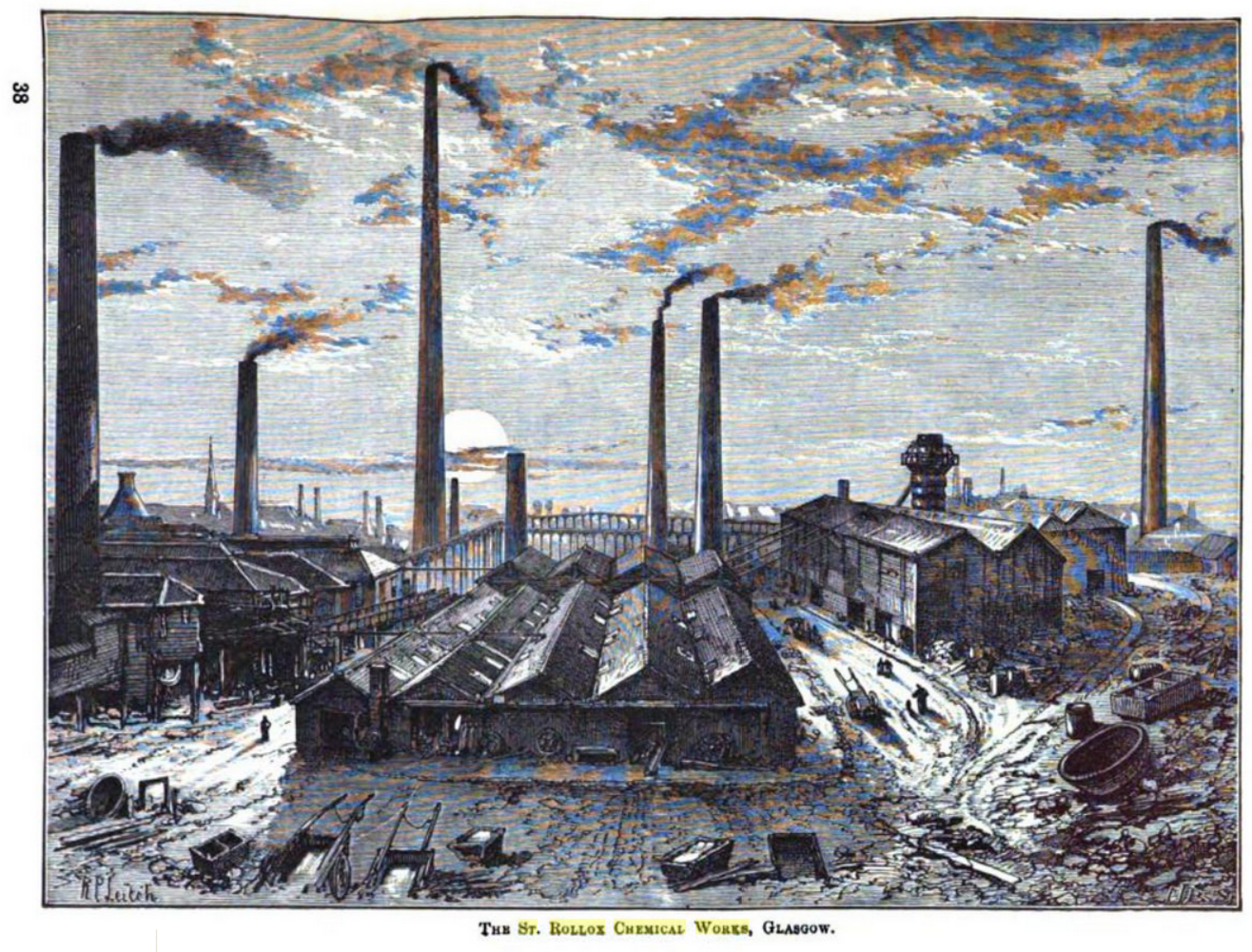
St Rollox Chemical Works was an industrial manufacturer of chemicals located in Glasgow, Scotland, that began in 1799 and stood until 1964. It was created by Scottish industrialist Charles Tennant and owned and operated by his family and descendants. It was described as the largest plant in Europe, if not the world.
In 1787, Tennant attended a demonstration of Claude Louis Berthollet's chlorine bleaching process that was held by Watt in Birmingham. Tennant adapted the bleaching process by substituting lime for potash, solving the problem of lime's inability to form a solution in water and opening the way to produce bleach. He received a patent No. 2209 on 23 January 1798 for the manufacture of a bleaching liquor by passing chlorine into a well-agitated mixture of lime and water.
The new process reduced both the cost of the bleaching liquor and the damage caused by the liquor to the cloth. The new liquid had a short shelf life, so Tennant and Macintosh licensed their process and toured Lancashire manufacturers to sell the process for £200 each. In the beginning, the scheme worked relatively well, with each bleach manufacturer reporting that they were saving between £1000-£2500 per year. As the process became more widely known, Lancashire manufacturers used it without obtaining a licence from Tennant. He sued for infringement of patent rights but lost in court. Tennant took the case to the Crown Court in 1802 but lost again. In the intervening period, he came up with a new process, that was granted a patent No. 2312 on 30 April 1799 for a new bleaching powder (calcium hypochlorite). Tennant decided to open a new factory to commercially develop the product.
In 1799, Tennant, with three business partners, created the legal entity. The first of these, William Couper, was the legal advisor to the partnership. The second partner was Alexander Dunlop (his brother married Charles's eldest daughter), who served as accountant to the group. The third partner, James Knox, managed the sales department. The chemist Charles Macintosh was the fourth partner. The new factory was at St Rollox in North Glasgow, close to the Monkland Canal that enabled it to transport coal and ironstone from the coal mines in Lanarkshire.
In October 1838, Charles Tennant died and his son John Tennant (1796–1878) became general manager of the company. In 1890, the general decline of the company caused by the transfer to the Solvay process which was externally patented, led the company to merge with many other chemical manufacturers in the UK to form the United Alkali Company but it continued to trade as Charles Tennant & Co. In 1913 the company was incorporated as Charles Tennant & Co Ltd.
St Rollox was started as a chlorine bleaching manufacturer that used the Claude Louis Berthollet potash-chlorine bleaching liquor and then chemically modified by substituting the potash with lime to produce a bleach. In 1799, the process changed when the company moved to the Macintosh-Tennant process to produce dry bleaching powder
The powder was made from chlorine and slaked lime and became known as Tennant's bleaching salt. It was produced by mixing 4 parts of water, 4+1⁄2 parts salt, 2 parts of manganese and 4 parts of sulfuric acid known as "vitriol" in a lead vessel heated in a water bath. The powder sold well and this enabled the factory to expand and diversify. At the time, sulfuric acid cost £60 per ton and large quantities were needed in the production of chlorine, so Tennant started producing it. By 1802, the factory was producing 252,270 lb (114,430 kg) of vitriol per year and selling 151,117 lb (68,546 kg) of bleaching powder per year, valued at £7500.
In 1803, St Rollox had installed six lead vessels to produce the bleach, measuring 10 ft × 12 ft (3.0 m × 3.7 m) by 10 ft (3.0 m) high In 1803, the house that contained the vessels was of three floors about 50 ft (15 m) long by 24 ft (7.3 m). The upper floor contained the vessels, the floor below the glass retorts for concentrating acid and the bottom floor contained the lead evaporating boilers used to bring the acid up to strength for the glass retorts. In 1807, eight more were added. By 1809, production capacity had been increased further, with 26 vessels in total. This was further increased by six in 1811, taking the total number to 32 and were much larger, measuring 60 ft × 14 ft × 12 ft (18.3 m × 4.3 m × 3.7 m) high, arranged in sets of two or three. The chambers were constructed to use external furnaces that burned the sulfur and supplied gas by use of a flue. These were supplied by Bealy and Radcliffe of Manchester.
Hub AI
St Rollox Chemical Works AI simulator
(@St Rollox Chemical Works_simulator)
St Rollox Chemical Works
St Rollox Chemical Works was an industrial manufacturer of chemicals located in Glasgow, Scotland, that began in 1799 and stood until 1964. It was created by Scottish industrialist Charles Tennant and owned and operated by his family and descendants. It was described as the largest plant in Europe, if not the world.
In 1787, Tennant attended a demonstration of Claude Louis Berthollet's chlorine bleaching process that was held by Watt in Birmingham. Tennant adapted the bleaching process by substituting lime for potash, solving the problem of lime's inability to form a solution in water and opening the way to produce bleach. He received a patent No. 2209 on 23 January 1798 for the manufacture of a bleaching liquor by passing chlorine into a well-agitated mixture of lime and water.
The new process reduced both the cost of the bleaching liquor and the damage caused by the liquor to the cloth. The new liquid had a short shelf life, so Tennant and Macintosh licensed their process and toured Lancashire manufacturers to sell the process for £200 each. In the beginning, the scheme worked relatively well, with each bleach manufacturer reporting that they were saving between £1000-£2500 per year. As the process became more widely known, Lancashire manufacturers used it without obtaining a licence from Tennant. He sued for infringement of patent rights but lost in court. Tennant took the case to the Crown Court in 1802 but lost again. In the intervening period, he came up with a new process, that was granted a patent No. 2312 on 30 April 1799 for a new bleaching powder (calcium hypochlorite). Tennant decided to open a new factory to commercially develop the product.
In 1799, Tennant, with three business partners, created the legal entity. The first of these, William Couper, was the legal advisor to the partnership. The second partner was Alexander Dunlop (his brother married Charles's eldest daughter), who served as accountant to the group. The third partner, James Knox, managed the sales department. The chemist Charles Macintosh was the fourth partner. The new factory was at St Rollox in North Glasgow, close to the Monkland Canal that enabled it to transport coal and ironstone from the coal mines in Lanarkshire.
In October 1838, Charles Tennant died and his son John Tennant (1796–1878) became general manager of the company. In 1890, the general decline of the company caused by the transfer to the Solvay process which was externally patented, led the company to merge with many other chemical manufacturers in the UK to form the United Alkali Company but it continued to trade as Charles Tennant & Co. In 1913 the company was incorporated as Charles Tennant & Co Ltd.
St Rollox was started as a chlorine bleaching manufacturer that used the Claude Louis Berthollet potash-chlorine bleaching liquor and then chemically modified by substituting the potash with lime to produce a bleach. In 1799, the process changed when the company moved to the Macintosh-Tennant process to produce dry bleaching powder
The powder was made from chlorine and slaked lime and became known as Tennant's bleaching salt. It was produced by mixing 4 parts of water, 4+1⁄2 parts salt, 2 parts of manganese and 4 parts of sulfuric acid known as "vitriol" in a lead vessel heated in a water bath. The powder sold well and this enabled the factory to expand and diversify. At the time, sulfuric acid cost £60 per ton and large quantities were needed in the production of chlorine, so Tennant started producing it. By 1802, the factory was producing 252,270 lb (114,430 kg) of vitriol per year and selling 151,117 lb (68,546 kg) of bleaching powder per year, valued at £7500.
In 1803, St Rollox had installed six lead vessels to produce the bleach, measuring 10 ft × 12 ft (3.0 m × 3.7 m) by 10 ft (3.0 m) high In 1803, the house that contained the vessels was of three floors about 50 ft (15 m) long by 24 ft (7.3 m). The upper floor contained the vessels, the floor below the glass retorts for concentrating acid and the bottom floor contained the lead evaporating boilers used to bring the acid up to strength for the glass retorts. In 1807, eight more were added. By 1809, production capacity had been increased further, with 26 vessels in total. This was further increased by six in 1811, taking the total number to 32 and were much larger, measuring 60 ft × 14 ft × 12 ft (18.3 m × 4.3 m × 3.7 m) high, arranged in sets of two or three. The chambers were constructed to use external furnaces that burned the sulfur and supplied gas by use of a flue. These were supplied by Bealy and Radcliffe of Manchester.
Recent media