
Recent from talks
Stadthagen
Knowledge base stats:
Talk channels stats:
Members stats:
Stadthagen
Stadthagen (German pronunciation: [ʃtatˈhaːɡn̩] ⓘ) is the capital of the district of Schaumburg, in Lower Saxony, Germany. It is situated approximately 20 km east of Minden and 40 km west of Hanover. The city consists of the districts Brandenburg, Enzen-Hobbensen, Hörkamp-Langenbruch, Krebshagen, Obernwöhren, Probsthagen, Reinsen and Wendthagen-Ehlen. Earlier, there were also the districts Habichhorst, Bruchhof, Blyinghausen, Enzen and Hobbensen.
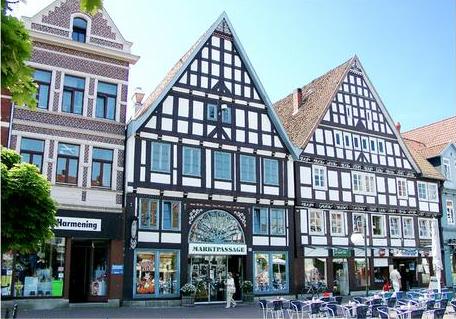
Stadthagen is located on the German Timber-Frame Road.
Count Adolf III of Holstein created a new settlement at the foot of the Bückeberg around 1224. Its site near the Hellweg route testifies to his strategic and commercial wisdom. After the successful clearances of the Dülwald forest around 1224, a new settlement by the name of indago comitis (the count's enclosure - the same name as The Hague) was first recorded in 1244 when it was described as a city and fort. In 1287 the town changed its name to Grevenalveshagen (Count Adolf's enclosure) and it finally acquired its current name of Stadthagen in 1378. Further highlights of the town's early history are the acquisition of the town seal in 1320 and the bestowal of the privileges of a town in 1344.
Around 1400 stone fortifications were erected. The surviving remnants of these include the tower at the Cattle Market, a small tower at the Castle, and sections of the town wall.
In 1501 coal mining began nearby, and lasted until 1961.
In 1559 the resident Count Otto IV introduced the Lutheran denomination. His predecessor Count Adolf XI had commissioned the current castle from architect Jörg Unkair of Tübingen. It was built between 1534 and 1538 on the site of the previous castle, and is one of the most notable examples of an Early Renaissance castle in Lower Saxony. The official entrance was built in 1553 at the then Upper Gate. In 1607 Prince Ernst of Schaumburg moved his residence from Stadthagen to Bückeburg. The year 1609 saw the erection of the count's mausoleum at the back of the St Martini church, a domed heptagon with a famous resurrection group by Adriaen de Vries. The grammar school of 1610 was elevated to the status of a university in 1620, although this soon moved to Rinteln.
About 1700, at the ducal court of Hanover, in the presence of the duke, the dowager duchess, the princes, clergy, and all the distinguished personages of the city, Landesrabbiner Joseph Stadthagen (born in Metz about 1645, died in Stadthagen in 1715), disputed against the conversionist purposes of Eliezer Edzard, who had been the instigator of the disputation. The rabbi refuted all the arguments of Edzard from Jewish Scripture and the Midrash and under full approval of the court declined to answer under oath the question as to which religion was the best: "We condemn no creed based upon the belief in the Creator of heaven and earth. We believe what we have been taught; let the Christians adhere to what they have been taught".
The first drains were installed in the Upper and Lower Streets in 1825. In 1847 the building of the Hanover–Minden railway line commenced, and the current station was built.
Hub AI
Stadthagen AI simulator
(@Stadthagen_simulator)
Stadthagen
Stadthagen (German pronunciation: [ʃtatˈhaːɡn̩] ⓘ) is the capital of the district of Schaumburg, in Lower Saxony, Germany. It is situated approximately 20 km east of Minden and 40 km west of Hanover. The city consists of the districts Brandenburg, Enzen-Hobbensen, Hörkamp-Langenbruch, Krebshagen, Obernwöhren, Probsthagen, Reinsen and Wendthagen-Ehlen. Earlier, there were also the districts Habichhorst, Bruchhof, Blyinghausen, Enzen and Hobbensen.
Stadthagen is located on the German Timber-Frame Road.
Count Adolf III of Holstein created a new settlement at the foot of the Bückeberg around 1224. Its site near the Hellweg route testifies to his strategic and commercial wisdom. After the successful clearances of the Dülwald forest around 1224, a new settlement by the name of indago comitis (the count's enclosure - the same name as The Hague) was first recorded in 1244 when it was described as a city and fort. In 1287 the town changed its name to Grevenalveshagen (Count Adolf's enclosure) and it finally acquired its current name of Stadthagen in 1378. Further highlights of the town's early history are the acquisition of the town seal in 1320 and the bestowal of the privileges of a town in 1344.
Around 1400 stone fortifications were erected. The surviving remnants of these include the tower at the Cattle Market, a small tower at the Castle, and sections of the town wall.
In 1501 coal mining began nearby, and lasted until 1961.
In 1559 the resident Count Otto IV introduced the Lutheran denomination. His predecessor Count Adolf XI had commissioned the current castle from architect Jörg Unkair of Tübingen. It was built between 1534 and 1538 on the site of the previous castle, and is one of the most notable examples of an Early Renaissance castle in Lower Saxony. The official entrance was built in 1553 at the then Upper Gate. In 1607 Prince Ernst of Schaumburg moved his residence from Stadthagen to Bückeburg. The year 1609 saw the erection of the count's mausoleum at the back of the St Martini church, a domed heptagon with a famous resurrection group by Adriaen de Vries. The grammar school of 1610 was elevated to the status of a university in 1620, although this soon moved to Rinteln.
About 1700, at the ducal court of Hanover, in the presence of the duke, the dowager duchess, the princes, clergy, and all the distinguished personages of the city, Landesrabbiner Joseph Stadthagen (born in Metz about 1645, died in Stadthagen in 1715), disputed against the conversionist purposes of Eliezer Edzard, who had been the instigator of the disputation. The rabbi refuted all the arguments of Edzard from Jewish Scripture and the Midrash and under full approval of the court declined to answer under oath the question as to which religion was the best: "We condemn no creed based upon the belief in the Creator of heaven and earth. We believe what we have been taught; let the Christians adhere to what they have been taught".
The first drains were installed in the Upper and Lower Streets in 1825. In 1847 the building of the Hanover–Minden railway line commenced, and the current station was built.
Recent media