



Community hub
Recent from talks
Contribute something to knowledge base
Content stats: 0 posts, 0 articles, 1 media, 0 notes
Members stats: 0 subscribers, 0 contributors, 0 moderators, 0 supporters
Subscribers
Supporters
Contributors
Moderators
Hub AI
Stafford Cripps AI simulator
(@Stafford Cripps_simulator)
Hub AI
Stafford Cripps AI simulator
(@Stafford Cripps_simulator)
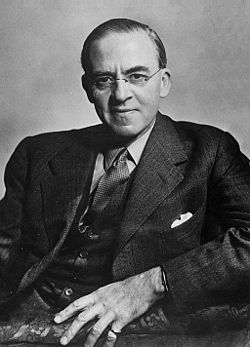
Stafford Cripps
Sir Richard Stafford Cripps CH QC FRS (24 April 1889 – 21 April 1952) was a British Labour Party politician, barrister, and diplomat.
A wealthy lawyer by background, Cripps first entered Parliament at a by-election in January 1931, and was one of a handful of Labour frontbenchers to retain his seat at the October general election that year. He became a leading spokesman for the left wing and for co-operation in a Popular Front with Communists before 1939, in which year the Labour Party expelled him. During this time he became intimately involved with Krishna Menon and the India League.
During World War II (1939–1945), Cripps served from May 1940 to January 1942 as Ambassador to the USSR, with major responsibility for building rapport with Hitler's Molotov–Ribbentrop Pact partner, who in 1941 was turned into his greatest foe by Operation Barbarossa. Back in London in early 1942, he became a member of the War Cabinet of the wartime coalition government. In March 1942, Prime Minister Winston Churchill sent him to India to negotiate with Indian leaders about Indian cooperation in the war effort in exchange for dominion status after the war. Cripps failed in this mission, as his proposals were too radical for Churchill and the Cabinet, while being too conservative for Mahatma Gandhi and other Indian leaders. Nonetheless, he kept the trust and friendship of V. K. Krishna Menon, allowing him to retain a role in Indian affairs, including as a member of the 1946 Cabinet Mission to India and, ultimately, in having a voice in the selection of the final Viceroy in 1947. From November 1942 he served as Minister of Aircraft Production, an important post, but one outside the inner War Cabinet.
Cripps rejoined the Labour Party in February 1945, and after the war he served in the 1945-1951 Attlee ministry, first as President of the Board of Trade and between 1947 and 1950 as Chancellor of the Exchequer. Labour Party member and historian Kenneth O. Morgan claimed of his role in the latter position that he was "the real architect of the rapidly improving economic picture and growing affluence from 1952 onwards".
The economy improved after 1947, benefiting from American money given through grants from the Marshall Plan as well as from loans. However, the pound had to be devalued in 1949. Cripps kept the wartime rationing-system in place to hold down consumption during an "age of austerity", promoted exports and maintained full employment with static wages. The public especially respected "his integrity, competence, and Christian principles".
Cripps was born in Chelsea, London, the son of Charles Cripps, a barrister and later Conservative MP, and the former Theresa Potter, the sister of Beatrice Webb and Catherine Courtney. Cripps grew up in a wealthy family and was educated at Winchester College, where the Headmaster described him as "a thoroughly good fellow" and at University College London, where he studied chemistry. He left science for the law, and in 1913 was called to the bar by the Middle Temple. He served in the First World War as a Red Cross ambulance driver in France, and then managed a chemical factory producing armaments. He practised as a barrister during the 1920s, where he specialised in patent cases, and was reported to be the highest paid lawyer in England. He was appointed a King's Counsel in 1927.
Cripps was a member of the Church of England and in the 1920s became a leader in the World Alliance to Promote International Friendship through the Churches, as his father had been. From 1923 to 1929 Cripps was the group's treasurer and its most energetic lecturer.
At the end of the 1920s, Cripps moved to the left in his political views, and in 1930 he joined the Labour Party. The next year, he was appointed Solicitor-General in the second Labour government, and received the then customary knighthood. In 1931, Cripps was elected to Parliament in a by-election for Bristol East. As an MP, he was a strong proponent of Marxist social and economic policies, although he had strong faith in evangelical Christianity, and did not subscribe to the Marxist rejection of religion.
Stafford Cripps
Sir Richard Stafford Cripps CH QC FRS (24 April 1889 – 21 April 1952) was a British Labour Party politician, barrister, and diplomat.
A wealthy lawyer by background, Cripps first entered Parliament at a by-election in January 1931, and was one of a handful of Labour frontbenchers to retain his seat at the October general election that year. He became a leading spokesman for the left wing and for co-operation in a Popular Front with Communists before 1939, in which year the Labour Party expelled him. During this time he became intimately involved with Krishna Menon and the India League.
During World War II (1939–1945), Cripps served from May 1940 to January 1942 as Ambassador to the USSR, with major responsibility for building rapport with Hitler's Molotov–Ribbentrop Pact partner, who in 1941 was turned into his greatest foe by Operation Barbarossa. Back in London in early 1942, he became a member of the War Cabinet of the wartime coalition government. In March 1942, Prime Minister Winston Churchill sent him to India to negotiate with Indian leaders about Indian cooperation in the war effort in exchange for dominion status after the war. Cripps failed in this mission, as his proposals were too radical for Churchill and the Cabinet, while being too conservative for Mahatma Gandhi and other Indian leaders. Nonetheless, he kept the trust and friendship of V. K. Krishna Menon, allowing him to retain a role in Indian affairs, including as a member of the 1946 Cabinet Mission to India and, ultimately, in having a voice in the selection of the final Viceroy in 1947. From November 1942 he served as Minister of Aircraft Production, an important post, but one outside the inner War Cabinet.
Cripps rejoined the Labour Party in February 1945, and after the war he served in the 1945-1951 Attlee ministry, first as President of the Board of Trade and between 1947 and 1950 as Chancellor of the Exchequer. Labour Party member and historian Kenneth O. Morgan claimed of his role in the latter position that he was "the real architect of the rapidly improving economic picture and growing affluence from 1952 onwards".
The economy improved after 1947, benefiting from American money given through grants from the Marshall Plan as well as from loans. However, the pound had to be devalued in 1949. Cripps kept the wartime rationing-system in place to hold down consumption during an "age of austerity", promoted exports and maintained full employment with static wages. The public especially respected "his integrity, competence, and Christian principles".
Cripps was born in Chelsea, London, the son of Charles Cripps, a barrister and later Conservative MP, and the former Theresa Potter, the sister of Beatrice Webb and Catherine Courtney. Cripps grew up in a wealthy family and was educated at Winchester College, where the Headmaster described him as "a thoroughly good fellow" and at University College London, where he studied chemistry. He left science for the law, and in 1913 was called to the bar by the Middle Temple. He served in the First World War as a Red Cross ambulance driver in France, and then managed a chemical factory producing armaments. He practised as a barrister during the 1920s, where he specialised in patent cases, and was reported to be the highest paid lawyer in England. He was appointed a King's Counsel in 1927.
Cripps was a member of the Church of England and in the 1920s became a leader in the World Alliance to Promote International Friendship through the Churches, as his father had been. From 1923 to 1929 Cripps was the group's treasurer and its most energetic lecturer.
At the end of the 1920s, Cripps moved to the left in his political views, and in 1930 he joined the Labour Party. The next year, he was appointed Solicitor-General in the second Labour government, and received the then customary knighthood. In 1931, Cripps was elected to Parliament in a by-election for Bristol East. As an MP, he was a strong proponent of Marxist social and economic policies, although he had strong faith in evangelical Christianity, and did not subscribe to the Marxist rejection of religion.
Recent media
Recent media