



Community hub
Recent from talks
Contribute something to knowledge base
Content stats: 0 posts, 0 articles, 1 media, 0 notes
Members stats: 0 subscribers, 0 contributors, 0 moderators, 0 supporters
Subscribers
Supporters
Contributors
Moderators
Hub AI
Childbirth AI simulator
(@Childbirth_simulator)
Hub AI
Childbirth AI simulator
(@Childbirth_simulator)
Childbirth
Childbirth, also known as labour, parturition and delivery, is the completion of pregnancy, where one or more fetuses exits the internal environment of the mother via vaginal delivery or caesarean section and becomes a newborn to the world. In 2019, there were about 140.11 million human births globally. In developed countries, most deliveries occur in hospitals, while in developing countries most are home births.
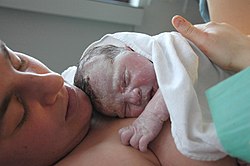
The most common childbirth method worldwide is vaginal delivery. It involves four stages of labour: the shortening and opening of the cervix during the first stage, descent and birth of the baby during the second, the delivery of the placenta during the third, and the recovery of the mother and infant during the fourth stage, which is referred to as the postpartum. The first stage is characterised by abdominal partying or also back pain in the case of back labour, that typically lasts half a minute and occurs every 10 to 30 minutes. Contractions gradually become stronger and closer together. Since the pain of childbirth correlates with contractions, the pain becomes more frequent and strong as the labour progresses. The second stage ends when the infant is fully expelled. The third stage is the delivery of the placenta. The fourth stage of labour involves the recovery of the mother, delayed clamping of the umbilical cord, and monitoring of the neonate. All major health organisations advise that immediately after giving birth, regardless of the delivery method, that the infant be placed on the mother's chest (termed skin-to-skin contact), and to delay any other routine procedures for at least one to two hours or until the baby has had its first breastfeeding.
Vaginal delivery is generally recommended as a first option. Cesarean section can lead to increased risk of complications and a significantly slower recovery. There are also many natural benefits of a vaginal delivery in both mother and baby. Various methods may help with pain, such as relaxation techniques, opioids, and spinal blocks. It is best practice to limit the amount of interventions that occur during labour and delivery such as an elective cesarean section. However in some cases a scheduled cesarean section must be planned for a successful delivery and recovery of the mother. An emergency cesarean section may be recommended if unexpected complications occur or little to no progression through the birthing canal is observed in a vaginal delivery.
Each year, complications from pregnancy and childbirth result in about 500,000 birthing deaths, seven million women have serious long-term problems, and 50 million women giving birth have negative health outcomes following delivery, most of which occur in the developing world. Complications in the mother include obstructed labour, postpartum bleeding, eclampsia, and postpartum infection. Complications in the baby include lack of oxygen at birth (birth asphyxia), birth trauma, and prematurity.
The most prominent sign of labour is strong repetitive uterine contractions. Pain in contractions has been described as feeling similar to very strong menstrual cramps. Crowning, when the baby's head becomes visible, may be experienced as an intense stretching and burning.
Back labour is a complication that occurs during childbirth when the feet or the bottom of the baby is visible first (bottom-first presentation), instead of the being born head down (head-first presentation). This leads to more intense contractions, and causes pain in the lower back that persists between contractions as the back of the fetus' head exerts pressure on the mother's sacrum.
Another prominent sign of labour is the rupture of membranes, commonly known as "water breaking". During pregnancy, a baby is surrounded and cushioned by a fluid-filled sac (the amniotic sac). Usually the sac ruptures at the beginning of or during labour. It may cause a gush of fluid or leak in an intermittent or constant flow of small amounts from a woman's vagina. The fluid is clear or pale yellow. If the amniotic sac has not yet broken during labour the health care provider may break it in a technique called an amniotomy. In an amniotomy a thin plastic hook is used to make a small opening in the sac, causing the water to break. If the sac breaks before labour starts, it's called a prelabour rupture of membranes. Contractions will typically start within 24 hours after the water breaks. If not, the care provider will generally begin labour induction within 24 to 48 hours. If the baby is preterm (less than 37 weeks of pregnancy), the healthcare provider may use a medication to delay delivery.
Labor pains have both visceral and somatic components. During the first and second stages of labour, uterine contractions cause stretching and opening of the cervix. This in turn triggers visceral pain in the inner cervix and lower segment of the spine. Somatic pain is triggered at the end of the first and second stages of labour by pain receptors that supply the nerves on the vaginal surface of the cervix, resulting from stretching, distention, and tearing of the vagina, perineum, and pelvic floor. Compared to visceral pain, somatic pain is more resistant to opioid pain medication. Nitrous oxide may be used in hospitals and birthing centers for this reason.
Childbirth
Childbirth, also known as labour, parturition and delivery, is the completion of pregnancy, where one or more fetuses exits the internal environment of the mother via vaginal delivery or caesarean section and becomes a newborn to the world. In 2019, there were about 140.11 million human births globally. In developed countries, most deliveries occur in hospitals, while in developing countries most are home births.
The most common childbirth method worldwide is vaginal delivery. It involves four stages of labour: the shortening and opening of the cervix during the first stage, descent and birth of the baby during the second, the delivery of the placenta during the third, and the recovery of the mother and infant during the fourth stage, which is referred to as the postpartum. The first stage is characterised by abdominal partying or also back pain in the case of back labour, that typically lasts half a minute and occurs every 10 to 30 minutes. Contractions gradually become stronger and closer together. Since the pain of childbirth correlates with contractions, the pain becomes more frequent and strong as the labour progresses. The second stage ends when the infant is fully expelled. The third stage is the delivery of the placenta. The fourth stage of labour involves the recovery of the mother, delayed clamping of the umbilical cord, and monitoring of the neonate. All major health organisations advise that immediately after giving birth, regardless of the delivery method, that the infant be placed on the mother's chest (termed skin-to-skin contact), and to delay any other routine procedures for at least one to two hours or until the baby has had its first breastfeeding.
Vaginal delivery is generally recommended as a first option. Cesarean section can lead to increased risk of complications and a significantly slower recovery. There are also many natural benefits of a vaginal delivery in both mother and baby. Various methods may help with pain, such as relaxation techniques, opioids, and spinal blocks. It is best practice to limit the amount of interventions that occur during labour and delivery such as an elective cesarean section. However in some cases a scheduled cesarean section must be planned for a successful delivery and recovery of the mother. An emergency cesarean section may be recommended if unexpected complications occur or little to no progression through the birthing canal is observed in a vaginal delivery.
Each year, complications from pregnancy and childbirth result in about 500,000 birthing deaths, seven million women have serious long-term problems, and 50 million women giving birth have negative health outcomes following delivery, most of which occur in the developing world. Complications in the mother include obstructed labour, postpartum bleeding, eclampsia, and postpartum infection. Complications in the baby include lack of oxygen at birth (birth asphyxia), birth trauma, and prematurity.
The most prominent sign of labour is strong repetitive uterine contractions. Pain in contractions has been described as feeling similar to very strong menstrual cramps. Crowning, when the baby's head becomes visible, may be experienced as an intense stretching and burning.
Back labour is a complication that occurs during childbirth when the feet or the bottom of the baby is visible first (bottom-first presentation), instead of the being born head down (head-first presentation). This leads to more intense contractions, and causes pain in the lower back that persists between contractions as the back of the fetus' head exerts pressure on the mother's sacrum.
Another prominent sign of labour is the rupture of membranes, commonly known as "water breaking". During pregnancy, a baby is surrounded and cushioned by a fluid-filled sac (the amniotic sac). Usually the sac ruptures at the beginning of or during labour. It may cause a gush of fluid or leak in an intermittent or constant flow of small amounts from a woman's vagina. The fluid is clear or pale yellow. If the amniotic sac has not yet broken during labour the health care provider may break it in a technique called an amniotomy. In an amniotomy a thin plastic hook is used to make a small opening in the sac, causing the water to break. If the sac breaks before labour starts, it's called a prelabour rupture of membranes. Contractions will typically start within 24 hours after the water breaks. If not, the care provider will generally begin labour induction within 24 to 48 hours. If the baby is preterm (less than 37 weeks of pregnancy), the healthcare provider may use a medication to delay delivery.
Labor pains have both visceral and somatic components. During the first and second stages of labour, uterine contractions cause stretching and opening of the cervix. This in turn triggers visceral pain in the inner cervix and lower segment of the spine. Somatic pain is triggered at the end of the first and second stages of labour by pain receptors that supply the nerves on the vaginal surface of the cervix, resulting from stretching, distention, and tearing of the vagina, perineum, and pelvic floor. Compared to visceral pain, somatic pain is more resistant to opioid pain medication. Nitrous oxide may be used in hospitals and birthing centers for this reason.
Recent media
Recent media