


Recent from talks
Knowledge base stats:
Talk channels stats:
Members stats:
Standard asteroid physical characteristics
For most numbered asteroids, almost nothing is known apart from a few physical parameters and orbital elements. Some physical characteristics can only be estimated. The physical data is determined by making certain standard assumptions.
For many asteroids, lightcurve analysis provides estimates of pole direction and diameter ratios. Pre-1995 estimates collected by Per Magnusson are tabulated in the PDS, with the most reliable data being the syntheses labeled in the data tables. More recent determinations for several dozens of asteroids are collected at the web page of a Finnish research group in Helsinki which is running a systematic campaign to determine poles and shape models from lightcurves.
These data can be used to obtain a better estimate of dimensions. A body's dimensions are usually given as a triaxial ellipsoid, the axes of which are listed in decreasing order as . If we have the diameter ratios , from lightcurves, and an IRAS mean diameter , one sets the geometric mean of the diameters for consistency, and obtains the three diameters:


Barring detailed mass determinations, the mass can be estimated from the diameter and assumed density values worked out as below.


Besides these estimations, masses can be obtained for the larger asteroids by solving for the perturbations they cause in each other's orbits, or when the asteroid has an orbiting companion of known orbital radius. The masses of the largest asteroids 2 Pallas, and 4 Vesta can also be obtained from perturbations of Mars. While these perturbations are tiny, they can be accurately measured from radar ranging data from the Earth to spacecraft on the surface of Mars, such as the Viking landers.
Apart from a few asteroids whose densities have been investigated, one has to resort to enlightened guesswork. See Carry for a summary.
For many asteroids, a value of has been assumed.
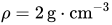
However, density depends on the asteroid's spectral type. Krasinsky et al. gives calculations for the mean densities of C, S, and M class asteroids as 1.38, 2.71, and 5.32 g/cm3. (Here "C" included Tholen classes C, D, P, T, B, G, and F, while "S" included Tholen classes S, K, Q, V, R, A, and E). Assuming these values (rather than the present ~2 g/cm3) is a better guess.
Hub AI
Standard asteroid physical characteristics AI simulator
(@Standard asteroid physical characteristics_simulator)
Standard asteroid physical characteristics
For most numbered asteroids, almost nothing is known apart from a few physical parameters and orbital elements. Some physical characteristics can only be estimated. The physical data is determined by making certain standard assumptions.
For many asteroids, lightcurve analysis provides estimates of pole direction and diameter ratios. Pre-1995 estimates collected by Per Magnusson are tabulated in the PDS, with the most reliable data being the syntheses labeled in the data tables. More recent determinations for several dozens of asteroids are collected at the web page of a Finnish research group in Helsinki which is running a systematic campaign to determine poles and shape models from lightcurves.
These data can be used to obtain a better estimate of dimensions. A body's dimensions are usually given as a triaxial ellipsoid, the axes of which are listed in decreasing order as . If we have the diameter ratios , from lightcurves, and an IRAS mean diameter , one sets the geometric mean of the diameters for consistency, and obtains the three diameters:
Barring detailed mass determinations, the mass can be estimated from the diameter and assumed density values worked out as below.
Besides these estimations, masses can be obtained for the larger asteroids by solving for the perturbations they cause in each other's orbits, or when the asteroid has an orbiting companion of known orbital radius. The masses of the largest asteroids 2 Pallas, and 4 Vesta can also be obtained from perturbations of Mars. While these perturbations are tiny, they can be accurately measured from radar ranging data from the Earth to spacecraft on the surface of Mars, such as the Viking landers.
Apart from a few asteroids whose densities have been investigated, one has to resort to enlightened guesswork. See Carry for a summary.
For many asteroids, a value of has been assumed.
However, density depends on the asteroid's spectral type. Krasinsky et al. gives calculations for the mean densities of C, S, and M class asteroids as 1.38, 2.71, and 5.32 g/cm3. (Here "C" included Tholen classes C, D, P, T, B, G, and F, while "S" included Tholen classes S, K, Q, V, R, A, and E). Assuming these values (rather than the present ~2 g/cm3) is a better guess.