
Recent from talks
Standing asanas
Knowledge base stats:
Talk channels stats:
Members stats:
Standing asanas
The standing asanas are the yoga poses or asanas with one or both feet on the ground, and the body more or less upright. They are among the most distinctive features of modern yoga as exercise. Until the 20th century there were very few of these, the best example being Vrikshasana, Tree Pose. From the time of Krishnamacharya in Mysore, many standing poses have been created. Two major sources of these asanas have been identified: the exercise sequence Surya Namaskar (the salute to the sun); and the gymnastics widely practised in India at the time, based on the prevailing physical culture.
The origin of standing asanas has been controversial since Mark Singleton argued in 2010 that some forms of modern yoga represent a radical reworking of hatha yoga, in particular by adding standing asanas and transitions (vinyasas) between them, and by suppressing most non-postural aspects of yoga, rather than a smooth continuation of ancient traditions. These changes enabled yoga to be practised as a flowing sequence of movements rather than as static poses, and in turn this allowed sessions to focus on aerobic exercise.
Yoga is a group of physical, mental, and spiritual practices or disciplines which originated in ancient India. Its spiritual and philosophical goal was to unite the human spirit with the Divine; its practices were mainly meditative. The branch of yoga that makes use of physical postures in addition to other practices such as meditation and purifications is hatha yoga; it flourished from the 11th century. The term "Yoga" in the Western world often denotes a modern form of hatha yoga, yoga as exercise, consisting largely of the postures called asanas. The earliest asanas were cross-legged meditation seats; other postures were gradually added.
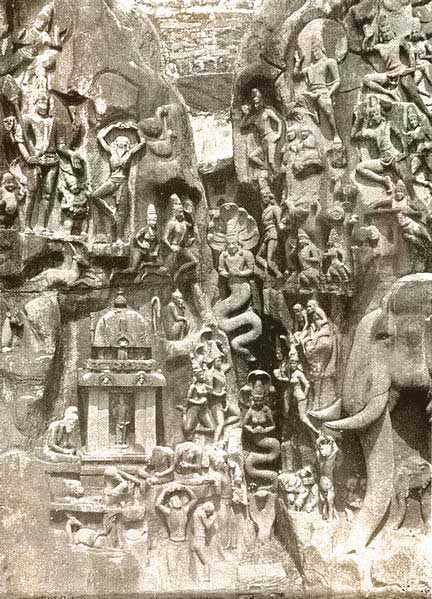
Among the few standing poses definitely practised in hatha yoga before the 20th century is Vrikshasana, tree pose. It is described in the 17th century hatha yoga text Gheraṇḍa Saṃhitā 2.36. It may be far older than that; a 7th-century stone carving in Mahabalipuram appears to contain a figure standing on one leg, perhaps indicating that a pose similar to Vrikshasana was in use at that time. It is said that sadhus disciplined themselves by choosing to meditate in the pose.
Some other standing poses have been suspected of having medieval origins, without reliable evidence. One difficulty is naming; the existence of a medieval pose with the name of a current standing pose is not proof that the two are the same, as the names given to poses may change, and the same name may be used for different poses. For example, the name Garudasana, Eagle Pose, is used for a sitting pose in the Gheraṇḍa Saṃhitā, 2.37. The name Garudasana is given to a pose close to Vrikshasana in the 19th century Sritattvanidhi; the modern standing pose named Garudasana is not seen until the 20th century.
Another issue is the use that is made of a pose; the existence of a pose in medieval times is not proof that it was used in hatha yoga. For example, Natarajasana, the pose of Dancing Shiva, is depicted in 13th - 18th century Bharatnatyam dance statues of the Eastern Gopuram, Nataraja Temple, Chidambaram, implying, according to Ananda Bhavanani, that the pose was used in medieval hatha yoga and that there was a cultural interchange between yoga and dance. However, Elliott Goldberg observes that Natarajasana is not found in any medieval hatha yoga text, nor is it mentioned by any pre-20th century traveller to India, nor is it found in artistic depictions of yoga such as the Sritattvanidhi or the Mahamandir near Jodhpur. Goldberg argues that the pose was among the many introduced into modern yoga by Krishnamacharya in the early 20th century, and taken up by his pupils such as B. K. S. Iyengar, who made the pose a signature of modern yoga.
Another case is Utkatasana, sometimes called chair pose, though its name, Utkata, means "fierce". In modern yoga, it is indeed a challenging squatting pose with the thighs approaching the horizontal, whereas in the 19th century Sritattvanidhi it is illustrated as a low squatting pose with the buttocks resting against the heels; the Gheraṇḍa Saṃhitā 2.27 is similar, but the heels are raised.
Standing asanas such as Adho Mukha Svanasana (Downward Dog), Virabhadrasana (Warrior Pose) and Trikonasana (Triangle Pose) are a conspicuous feature of the yoga practised around the modern world. Nearly all the standing poses now practised were unknown in hatha yoga until the 20th century. Many are described in Iyengar's 1966 Light on Yoga. Some, such as Tadasana, appear in the 1896 Vyayama Dipika, a manual of gymnastics, as part of the "very old" sequence of danda (Sanskrit for "staff" or "stick") exercises. Norman Sjoman suggests that it is one of the poses adopted into yoga in Mysore by Krishnamacharya and forming the "primary foundation" for his vinyasas, the flowing movements between poses. The pose would then have been taken up by his pupils Pattabhi Jois and Iyengar.
Hub AI
Standing asanas AI simulator
(@Standing asanas_simulator)
Standing asanas
The standing asanas are the yoga poses or asanas with one or both feet on the ground, and the body more or less upright. They are among the most distinctive features of modern yoga as exercise. Until the 20th century there were very few of these, the best example being Vrikshasana, Tree Pose. From the time of Krishnamacharya in Mysore, many standing poses have been created. Two major sources of these asanas have been identified: the exercise sequence Surya Namaskar (the salute to the sun); and the gymnastics widely practised in India at the time, based on the prevailing physical culture.
The origin of standing asanas has been controversial since Mark Singleton argued in 2010 that some forms of modern yoga represent a radical reworking of hatha yoga, in particular by adding standing asanas and transitions (vinyasas) between them, and by suppressing most non-postural aspects of yoga, rather than a smooth continuation of ancient traditions. These changes enabled yoga to be practised as a flowing sequence of movements rather than as static poses, and in turn this allowed sessions to focus on aerobic exercise.
Yoga is a group of physical, mental, and spiritual practices or disciplines which originated in ancient India. Its spiritual and philosophical goal was to unite the human spirit with the Divine; its practices were mainly meditative. The branch of yoga that makes use of physical postures in addition to other practices such as meditation and purifications is hatha yoga; it flourished from the 11th century. The term "Yoga" in the Western world often denotes a modern form of hatha yoga, yoga as exercise, consisting largely of the postures called asanas. The earliest asanas were cross-legged meditation seats; other postures were gradually added.
Among the few standing poses definitely practised in hatha yoga before the 20th century is Vrikshasana, tree pose. It is described in the 17th century hatha yoga text Gheraṇḍa Saṃhitā 2.36. It may be far older than that; a 7th-century stone carving in Mahabalipuram appears to contain a figure standing on one leg, perhaps indicating that a pose similar to Vrikshasana was in use at that time. It is said that sadhus disciplined themselves by choosing to meditate in the pose.
Some other standing poses have been suspected of having medieval origins, without reliable evidence. One difficulty is naming; the existence of a medieval pose with the name of a current standing pose is not proof that the two are the same, as the names given to poses may change, and the same name may be used for different poses. For example, the name Garudasana, Eagle Pose, is used for a sitting pose in the Gheraṇḍa Saṃhitā, 2.37. The name Garudasana is given to a pose close to Vrikshasana in the 19th century Sritattvanidhi; the modern standing pose named Garudasana is not seen until the 20th century.
Another issue is the use that is made of a pose; the existence of a pose in medieval times is not proof that it was used in hatha yoga. For example, Natarajasana, the pose of Dancing Shiva, is depicted in 13th - 18th century Bharatnatyam dance statues of the Eastern Gopuram, Nataraja Temple, Chidambaram, implying, according to Ananda Bhavanani, that the pose was used in medieval hatha yoga and that there was a cultural interchange between yoga and dance. However, Elliott Goldberg observes that Natarajasana is not found in any medieval hatha yoga text, nor is it mentioned by any pre-20th century traveller to India, nor is it found in artistic depictions of yoga such as the Sritattvanidhi or the Mahamandir near Jodhpur. Goldberg argues that the pose was among the many introduced into modern yoga by Krishnamacharya in the early 20th century, and taken up by his pupils such as B. K. S. Iyengar, who made the pose a signature of modern yoga.
Another case is Utkatasana, sometimes called chair pose, though its name, Utkata, means "fierce". In modern yoga, it is indeed a challenging squatting pose with the thighs approaching the horizontal, whereas in the 19th century Sritattvanidhi it is illustrated as a low squatting pose with the buttocks resting against the heels; the Gheraṇḍa Saṃhitā 2.27 is similar, but the heels are raised.
Standing asanas such as Adho Mukha Svanasana (Downward Dog), Virabhadrasana (Warrior Pose) and Trikonasana (Triangle Pose) are a conspicuous feature of the yoga practised around the modern world. Nearly all the standing poses now practised were unknown in hatha yoga until the 20th century. Many are described in Iyengar's 1966 Light on Yoga. Some, such as Tadasana, appear in the 1896 Vyayama Dipika, a manual of gymnastics, as part of the "very old" sequence of danda (Sanskrit for "staff" or "stick") exercises. Norman Sjoman suggests that it is one of the poses adopted into yoga in Mysore by Krishnamacharya and forming the "primary foundation" for his vinyasas, the flowing movements between poses. The pose would then have been taken up by his pupils Pattabhi Jois and Iyengar.
Recent media