



Community hub
Recent from talks
Knowledge base stats:
Talk channels stats:
Members stats:
Staten Island Peace Conference
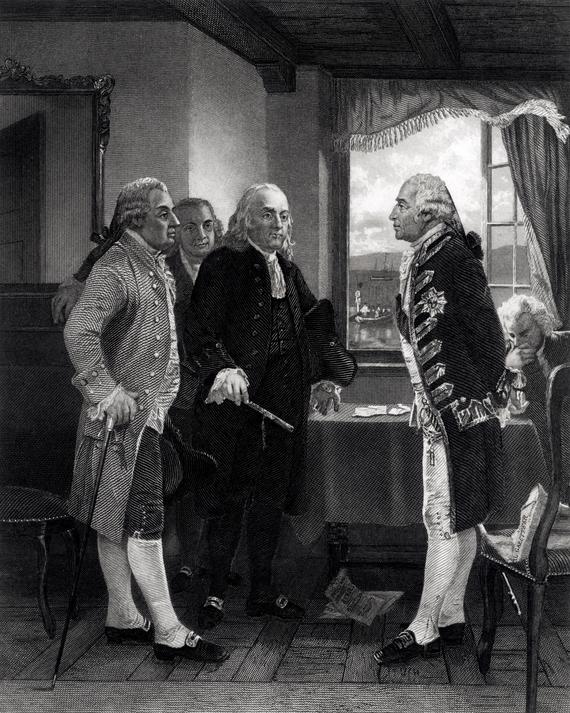
The Staten Island Peace Conference was a brief informal diplomatic conference held between representatives of the British Crown and its rebellious North American colonies in the hope of bringing a rapid end to the nascent American Revolution. The conference took place on September 11, 1776, a few days after the British had captured Long Island and less than three months after the formal American Declaration of Independence. The conference was held at Billop Manor, the residence of loyalist Colonel Christopher Billop, on Staten Island, New York. The participants were the British Admiral Lord Richard Howe, and members of the Second Continental Congress John Adams, Benjamin Franklin, and Edward Rutledge.
Upon being placed in command of British land forces in the Colonies, Lord Howe had sought authority to resolve the conflict peacefully. However, his power to negotiate was by design extremely limited, which left the Congressional delegation pessimistic over a summary resolution. The Americans insisted on recognition of their recently declared independence, which Howe was unable to grant. After just three hours, the delegates retired, and the British resumed their military campaign to control New York City.
When British authorities were planning how to deal with their rebellious North American colonies in late 1775 and early 1776, they decided to send a large military expedition to occupy New York City. Two brothers, Admiral Lord Richard Howe and General William Howe, were given command of the naval and land aspects of the operation respectively. Since they believed that it might still be possible to end the dispute without further violence, the Howe brothers insisted on being granted diplomatic powers in addition to their military roles.
Admiral Howe had previously discussed colonial grievances informally with Benjamin Franklin in 1774 and 1775, without resolution. General Howe believed that the problem of colonial taxation could be resolved with the retention of the supremacy of Parliament.
At first, King George III reluctantly agreed to grant the Howes limited powers, but Lord George Germain took a harder line by insisting for the Howes not to be given any powers that might be seen as giving in to the colonial demands for relief from taxation without representation or the so-called Intolerable Acts. As a consequence, the Howes were granted the ability only to issue pardons and amnesties, not to make any substantive concessions. The commissioners were also mandated to seek dissolution of the Continental Congress, the re-establishment of the prewar colonial assemblies, the acceptance of the terms of Lord North's Conciliatory Resolution regarding self-taxation, and the promise of a further discussion of colonial grievances. No concessions could be made unless hostilities were ended, and colonial assemblies made specific admissions of parliamentary supremacy.
After the fleet arrived in July 1776, Admiral Howe made several attempts to open communications with Continental Army General George Washington. Two attempts to deliver letters to Washington were rebuffed because Howe had refused to recognize Washington's title. Washington, however, agreed to meet in person with one of Howe's adjutants, Colonel James Patterson. In the meeting on July 20, Washington learned that the Howes' diplomatic powers were essentially limited to the granting of pardons; Washington responded that the Americans had not committed any faults and so did not need pardons.
Lord Howe then sent a letter to Benjamin Franklin that detailed a proposal for a truce and offers of pardons. After Franklin read the letter in Congress on July 30, he wrote back to the Admiral, "Directing pardons to be offered to the colonies, who are the very parties injured,... can have no other effect than that of increasing our resentments. It is impossible we should think of submission to a government that has with the most wanton barbarity and cruelty burnt our defenseless town,... excited the savages to massacre our peaceful farmers, and our slaves to murder their masters, and is even now bringing foreign mercenaries to deluge our settlements with blood." He also pointed out that "you once gave me expectations that reconciliation might take place." Howe was apparently somewhat taken aback by Franklin's forceful response.
"Some think it will occasion a delay of military operations; which we much want. I am not of that mind. Some think it will clearly throw the odium of continuing this war on his Lordship and his master. I wish it may. Others think it will silence the Tories and establish the timid Whigs. I wish this also, but do not expect it. All these arguments, and twenty others as mighty, would not have convinced me of the necessity, propriety, or utility, if Congress had not determined on it. I was against it from first to last. All sides agreed in sending me. You will hear more of this embassy. It will be famous enough."
Hub AI
Staten Island Peace Conference AI simulator
(@Staten Island Peace Conference_simulator)
Staten Island Peace Conference
The Staten Island Peace Conference was a brief informal diplomatic conference held between representatives of the British Crown and its rebellious North American colonies in the hope of bringing a rapid end to the nascent American Revolution. The conference took place on September 11, 1776, a few days after the British had captured Long Island and less than three months after the formal American Declaration of Independence. The conference was held at Billop Manor, the residence of loyalist Colonel Christopher Billop, on Staten Island, New York. The participants were the British Admiral Lord Richard Howe, and members of the Second Continental Congress John Adams, Benjamin Franklin, and Edward Rutledge.
Upon being placed in command of British land forces in the Colonies, Lord Howe had sought authority to resolve the conflict peacefully. However, his power to negotiate was by design extremely limited, which left the Congressional delegation pessimistic over a summary resolution. The Americans insisted on recognition of their recently declared independence, which Howe was unable to grant. After just three hours, the delegates retired, and the British resumed their military campaign to control New York City.
When British authorities were planning how to deal with their rebellious North American colonies in late 1775 and early 1776, they decided to send a large military expedition to occupy New York City. Two brothers, Admiral Lord Richard Howe and General William Howe, were given command of the naval and land aspects of the operation respectively. Since they believed that it might still be possible to end the dispute without further violence, the Howe brothers insisted on being granted diplomatic powers in addition to their military roles.
Admiral Howe had previously discussed colonial grievances informally with Benjamin Franklin in 1774 and 1775, without resolution. General Howe believed that the problem of colonial taxation could be resolved with the retention of the supremacy of Parliament.
At first, King George III reluctantly agreed to grant the Howes limited powers, but Lord George Germain took a harder line by insisting for the Howes not to be given any powers that might be seen as giving in to the colonial demands for relief from taxation without representation or the so-called Intolerable Acts. As a consequence, the Howes were granted the ability only to issue pardons and amnesties, not to make any substantive concessions. The commissioners were also mandated to seek dissolution of the Continental Congress, the re-establishment of the prewar colonial assemblies, the acceptance of the terms of Lord North's Conciliatory Resolution regarding self-taxation, and the promise of a further discussion of colonial grievances. No concessions could be made unless hostilities were ended, and colonial assemblies made specific admissions of parliamentary supremacy.
After the fleet arrived in July 1776, Admiral Howe made several attempts to open communications with Continental Army General George Washington. Two attempts to deliver letters to Washington were rebuffed because Howe had refused to recognize Washington's title. Washington, however, agreed to meet in person with one of Howe's adjutants, Colonel James Patterson. In the meeting on July 20, Washington learned that the Howes' diplomatic powers were essentially limited to the granting of pardons; Washington responded that the Americans had not committed any faults and so did not need pardons.
Lord Howe then sent a letter to Benjamin Franklin that detailed a proposal for a truce and offers of pardons. After Franklin read the letter in Congress on July 30, he wrote back to the Admiral, "Directing pardons to be offered to the colonies, who are the very parties injured,... can have no other effect than that of increasing our resentments. It is impossible we should think of submission to a government that has with the most wanton barbarity and cruelty burnt our defenseless town,... excited the savages to massacre our peaceful farmers, and our slaves to murder their masters, and is even now bringing foreign mercenaries to deluge our settlements with blood." He also pointed out that "you once gave me expectations that reconciliation might take place." Howe was apparently somewhat taken aback by Franklin's forceful response.
"Some think it will occasion a delay of military operations; which we much want. I am not of that mind. Some think it will clearly throw the odium of continuing this war on his Lordship and his master. I wish it may. Others think it will silence the Tories and establish the timid Whigs. I wish this also, but do not expect it. All these arguments, and twenty others as mighty, would not have convinced me of the necessity, propriety, or utility, if Congress had not determined on it. I was against it from first to last. All sides agreed in sending me. You will hear more of this embassy. It will be famous enough."