



Community hub
Recent from talks
Knowledge base stats:
Talk channels stats:
Members stats:
Steel guitar
A steel guitar (Hawaiian: kīkākila) is a guitar played while moving a steel bar or similar hard object against plucked strings. The bar itself is called a "steel" and is the source of the name "steel guitar". The instrument differs from a conventional guitar in that it has no frets—but markers that look like frets. Conceptually, it is somewhat akin to playing a guitar with one finger (the bar). Known for its smooth, gliding glissandi over every pitch between notes, the instrument can produce a sinuous crying sound and deep vibrato emulating the human singing voice. Typically, the strings are plucked (not strummed) by the fingers of one hand, while the steel tone bar is pressed lightly against the strings and moved by the opposite hand.
The idea of creating music with a slide of some type has been traced back to early African instruments, but the modern steel guitar was conceived and popularized in the Hawaiian Islands. The Hawaiians began playing a conventional guitar in a horizontal position across the knees instead of flat against the body, using the bar instead of fingers. Joseph Kekuku developed this manner of playing a guitar, known as "Hawaiian style", about 1890 and the technique spread internationally.
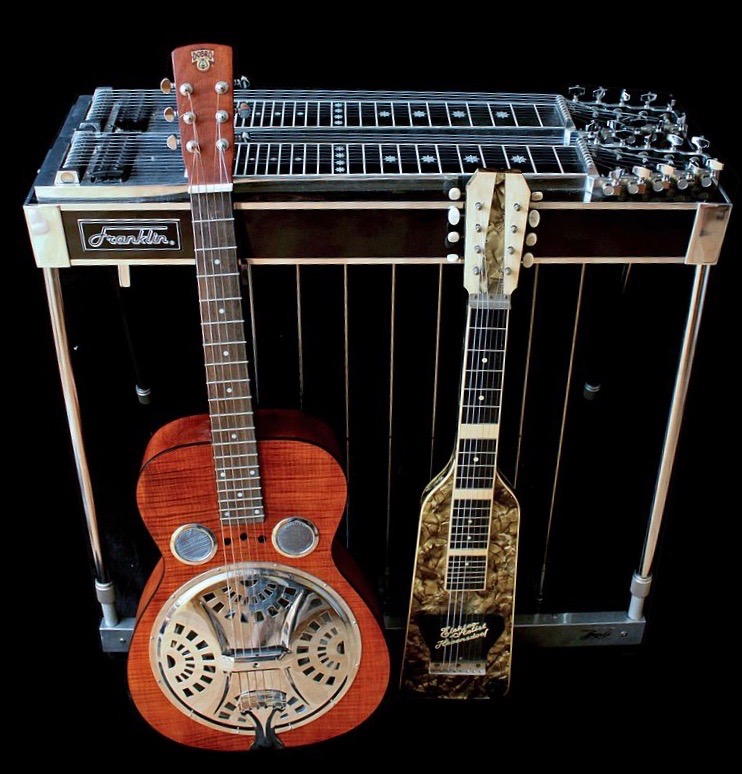
The sound of Hawaiian music featuring steel guitar became an enduring musical fad in the United States in the first half of the twentieth century and in 1916 recordings of indigenous Hawaiian music outsold all other U.S. musical genres. This popularity spawned the manufacture of guitars designed specifically to be played horizontally. The archetypal instrument is the Hawaiian guitar, also called a lap steel. These early acoustic instruments were not loud enough relative to other instruments, but that changed in 1934 when a steel guitarist named George Beauchamp invented the electric guitar pickup. Electrification allowed these instruments to be heard, and it also meant their resonant chambers were no longer essential. After that, steel guitars could be manufactured in any design, even a rectangular block bearing little or no resemblance to the traditional guitar shape. The result were table-like instruments in a metal frame on legs called "console steels", which were technologically improved about 1950 to become the more versatile pedal steel guitar.
In the United States, the steel guitar influenced popular music in the early twentieth century, combining with jazz, swing and country music to be prominently heard in Western swing, honky-tonk, gospel and bluegrass. The instrument influenced Blues artists in the Mississippi Delta who embraced the steel guitar sound but continued holding their guitar in the traditional way; they used a tubular object (the neck of a bottle) called a "slide" around a finger. This technique, historically called "bottleneck" guitar, is now known as "slide guitar" and is commonly associated with blues and rock music. Bluegrass artists adapted the Hawaiian style of playing in a resonator guitar known as a "Dobro", a type of steel guitar with a reinforced neck, sometimes played with the musician standing and the guitar facing upward held horizontally by a shoulder strap.
Several distinct differences exist in both construction and musical capabilities of the steel guitar and the traditional Spanish (classical) guitar. The steel guitar is capable of producing smooth glissandi, enabling it to glide seamlessly between pitches in a manner reminiscent of the human voice—a feat that is not possible on a traditional fretted guitar. This is the hallmark characteristic of the steel guitar. Nevertheless, the steel guitar also presents notable limitations. Unlike a classical guitar, where the fingers press individual strings to produce chords and notes, the steel guitar employs a solid steel bar placed across all the strings. This allows the instrument to play chords only in the tunings to which it is set, significantly reducing harmonic flexibility. Functionally, it is akin to playing with a single rigid "finger" rather than multiple independent ones.
Note articulation differs between the two instruments. On a Spanish guitar, lifting the finger from the fretboard immediately silences the sounding note. By contrast, a note on the steel guitar continues to sound until it is manually dampened by the player or another note is played on the same string. A novice player who has not learned this blocking technique, finds the notes are superimposed and blurred together, much like a piano played with the sustain pedal permanently depressed.
Finally, while frets on a Spanish guitar ensure precise intonation (assuming the instrument is properly tuned), the steel guitar lacks such guides. The performer must place the bar precisely over imaginary fret positions to remain in tune, making accurate pitch control significantly more difficult and demanding greater skill from the performer. The table below compares the two instruments in a simplified general overview, and exceptions abound.[citation needed][original research?]
In the late 19th century, European sailors and Portuguese vaqueros, hired by Hawaii's king to work cattle ranches, introduced Spanish guitars in the Hawaiian Islands. For whatever reason, Hawaiians did not embrace standard guitar tuning that had been in use for centuries. They re-tuned their guitars to make them sound a major chord when all six strings were strummed, now known as an "open tuning". The term for this is "slack-key" because certain strings were "slackened" to achieve it. With the advent of guitar strings made of steel instead of catgut, new possibilities opened for the islanders. They used some smooth object, usually a piece of pipe or metal, sliding it over the strings to the fourth or fifth position, easily playing a three-chord song. It is physically difficult to hold a steel bar against the strings while holding the guitar against the body (hand supinated) so the Hawaiians placed the guitar across the lap and played it with the hand pronated. Playing this way became popular throughout Hawaii and spread internationally.
Hub AI
Steel guitar AI simulator
(@Steel guitar_simulator)
Steel guitar
A steel guitar (Hawaiian: kīkākila) is a guitar played while moving a steel bar or similar hard object against plucked strings. The bar itself is called a "steel" and is the source of the name "steel guitar". The instrument differs from a conventional guitar in that it has no frets—but markers that look like frets. Conceptually, it is somewhat akin to playing a guitar with one finger (the bar). Known for its smooth, gliding glissandi over every pitch between notes, the instrument can produce a sinuous crying sound and deep vibrato emulating the human singing voice. Typically, the strings are plucked (not strummed) by the fingers of one hand, while the steel tone bar is pressed lightly against the strings and moved by the opposite hand.
The idea of creating music with a slide of some type has been traced back to early African instruments, but the modern steel guitar was conceived and popularized in the Hawaiian Islands. The Hawaiians began playing a conventional guitar in a horizontal position across the knees instead of flat against the body, using the bar instead of fingers. Joseph Kekuku developed this manner of playing a guitar, known as "Hawaiian style", about 1890 and the technique spread internationally.
The sound of Hawaiian music featuring steel guitar became an enduring musical fad in the United States in the first half of the twentieth century and in 1916 recordings of indigenous Hawaiian music outsold all other U.S. musical genres. This popularity spawned the manufacture of guitars designed specifically to be played horizontally. The archetypal instrument is the Hawaiian guitar, also called a lap steel. These early acoustic instruments were not loud enough relative to other instruments, but that changed in 1934 when a steel guitarist named George Beauchamp invented the electric guitar pickup. Electrification allowed these instruments to be heard, and it also meant their resonant chambers were no longer essential. After that, steel guitars could be manufactured in any design, even a rectangular block bearing little or no resemblance to the traditional guitar shape. The result were table-like instruments in a metal frame on legs called "console steels", which were technologically improved about 1950 to become the more versatile pedal steel guitar.
In the United States, the steel guitar influenced popular music in the early twentieth century, combining with jazz, swing and country music to be prominently heard in Western swing, honky-tonk, gospel and bluegrass. The instrument influenced Blues artists in the Mississippi Delta who embraced the steel guitar sound but continued holding their guitar in the traditional way; they used a tubular object (the neck of a bottle) called a "slide" around a finger. This technique, historically called "bottleneck" guitar, is now known as "slide guitar" and is commonly associated with blues and rock music. Bluegrass artists adapted the Hawaiian style of playing in a resonator guitar known as a "Dobro", a type of steel guitar with a reinforced neck, sometimes played with the musician standing and the guitar facing upward held horizontally by a shoulder strap.
Several distinct differences exist in both construction and musical capabilities of the steel guitar and the traditional Spanish (classical) guitar. The steel guitar is capable of producing smooth glissandi, enabling it to glide seamlessly between pitches in a manner reminiscent of the human voice—a feat that is not possible on a traditional fretted guitar. This is the hallmark characteristic of the steel guitar. Nevertheless, the steel guitar also presents notable limitations. Unlike a classical guitar, where the fingers press individual strings to produce chords and notes, the steel guitar employs a solid steel bar placed across all the strings. This allows the instrument to play chords only in the tunings to which it is set, significantly reducing harmonic flexibility. Functionally, it is akin to playing with a single rigid "finger" rather than multiple independent ones.
Note articulation differs between the two instruments. On a Spanish guitar, lifting the finger from the fretboard immediately silences the sounding note. By contrast, a note on the steel guitar continues to sound until it is manually dampened by the player or another note is played on the same string. A novice player who has not learned this blocking technique, finds the notes are superimposed and blurred together, much like a piano played with the sustain pedal permanently depressed.
Finally, while frets on a Spanish guitar ensure precise intonation (assuming the instrument is properly tuned), the steel guitar lacks such guides. The performer must place the bar precisely over imaginary fret positions to remain in tune, making accurate pitch control significantly more difficult and demanding greater skill from the performer. The table below compares the two instruments in a simplified general overview, and exceptions abound.[citation needed][original research?]
In the late 19th century, European sailors and Portuguese vaqueros, hired by Hawaii's king to work cattle ranches, introduced Spanish guitars in the Hawaiian Islands. For whatever reason, Hawaiians did not embrace standard guitar tuning that had been in use for centuries. They re-tuned their guitars to make them sound a major chord when all six strings were strummed, now known as an "open tuning". The term for this is "slack-key" because certain strings were "slackened" to achieve it. With the advent of guitar strings made of steel instead of catgut, new possibilities opened for the islanders. They used some smooth object, usually a piece of pipe or metal, sliding it over the strings to the fourth or fifth position, easily playing a three-chord song. It is physically difficult to hold a steel bar against the strings while holding the guitar against the body (hand supinated) so the Hawaiians placed the guitar across the lap and played it with the hand pronated. Playing this way became popular throughout Hawaii and spread internationally.