
Recent from talks
Stereotypes of African Americans
Knowledge base stats:
Talk channels stats:
Members stats:
Stereotypes of African Americans
Stereotypes of African Americans are beliefs about the culture of people with partial or total ancestry from any black racial groups of Africa whose ancestors resided in the United States since before 1865. These stereotypes are largely connected to the racism and the discrimination faced by African Americans. These beliefs date back to the slavery of black people during the colonial era and they have evolved within American society over time.
The first significant display of stereotypes of African Americans was in the form of minstrel shows. Minstrel shows boomed at the beginning of the nineteenth century; these shows were theatrical plays that used white actors who performed in blackface and wore torn attire to portray African-Americans in order to lampoon and disparage black communities. Throughout history, more stereotypes became popular to dehumanize African American communities further. Some nineteenth century stereotypes, such as the sambo, are now considered to be derogatory and racist. The "Mandingo" and "Jezebel" stereotypes portray African-Americans as hypersexual, contributing to their sexualization. The Mammy archetype depicts a motherly black woman who is dedicated to her role working for a white family, a stereotype which dates back to the origin of Southern plantations. Society has also depicted African-Americans as having an unusual appetite for fried chicken, watermelon, and grape drinks.
In the 1980s as well as in the following decades, emerging stereotypes of black men depicted them as being criminals and social degenerates, particularly as drug dealers, crack addicts, hobos, and subway muggers. Jesse Jackson, a prominent civil rights activist, acknowledged how the media portrays black people as less intelligent, less patriotic, and more violent. Throughout different media platforms, stereotypes became far-fetched, such as The magical Negro, a stock character who is depicted as having special insight or powers, and has been depicted (and criticized) in American cinema. However, in recent history, black men are stereotyped as being deadbeat fathers and dangerous criminals. There is a frequent stereotype in America that African Americans are hypersexual, athletic, uncivilized, uneducated and violent. These general and common themes in America have made young African Americans labeled as "gangsters" or "players" who generally reside in the "hood".
A majority of the stereotypes of black women include depictions which portray them as welfare queens or depictions which portray them as angry black women who are loud, aggressive, demanding, and rude. Others depict black women having a maternal, caregiving nature, due to the Mammy archetype.
Laziness, submissiveness, backwardness, lewdness, treachery, and dishonesty are stereotypes historically assigned to African Americans.
In the United States, whiteness is associated with goodness, morality, intelligence and attractiveness while blackness is stereotyped to be the opposite of these traits.
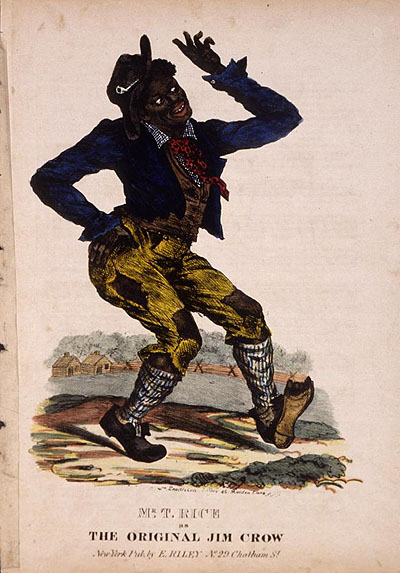
Minstrel shows became a popular form of theater during the nineteenth century, which portrayed African Americans in stereotypical and often disparaging ways, some of the most common being that they are ignorant, lazy, buffoonish, superstitious, joyous, and musical. One of the most popular styles of minstrelsy was Blackface, where White performers used burnt cork and later greasepaint, or applied shoe polish to their skin to blacken it, also exaggerating their lips, and often wearing woolly wigs, gloves, tailcoats, or ragged clothes to give a mocking, racially prejudicial theatrical portrayal of African Americans. This performance helped introduce the use of racial slurs for African Americans, including "darky" and "coon". Blackface performers would often portray black people as lazy, ignorant, superstitious, having a high sex drive, cowardly and as thieves who are prone to thievery.
The best-known stock character is Jim Crow, among several others, featured in innumerable stories, minstrel shows, and early films with racially prejudicial portrayals and messaging about African Americans.
Hub AI
Stereotypes of African Americans AI simulator
(@Stereotypes of African Americans_simulator)
Stereotypes of African Americans
Stereotypes of African Americans are beliefs about the culture of people with partial or total ancestry from any black racial groups of Africa whose ancestors resided in the United States since before 1865. These stereotypes are largely connected to the racism and the discrimination faced by African Americans. These beliefs date back to the slavery of black people during the colonial era and they have evolved within American society over time.
The first significant display of stereotypes of African Americans was in the form of minstrel shows. Minstrel shows boomed at the beginning of the nineteenth century; these shows were theatrical plays that used white actors who performed in blackface and wore torn attire to portray African-Americans in order to lampoon and disparage black communities. Throughout history, more stereotypes became popular to dehumanize African American communities further. Some nineteenth century stereotypes, such as the sambo, are now considered to be derogatory and racist. The "Mandingo" and "Jezebel" stereotypes portray African-Americans as hypersexual, contributing to their sexualization. The Mammy archetype depicts a motherly black woman who is dedicated to her role working for a white family, a stereotype which dates back to the origin of Southern plantations. Society has also depicted African-Americans as having an unusual appetite for fried chicken, watermelon, and grape drinks.
In the 1980s as well as in the following decades, emerging stereotypes of black men depicted them as being criminals and social degenerates, particularly as drug dealers, crack addicts, hobos, and subway muggers. Jesse Jackson, a prominent civil rights activist, acknowledged how the media portrays black people as less intelligent, less patriotic, and more violent. Throughout different media platforms, stereotypes became far-fetched, such as The magical Negro, a stock character who is depicted as having special insight or powers, and has been depicted (and criticized) in American cinema. However, in recent history, black men are stereotyped as being deadbeat fathers and dangerous criminals. There is a frequent stereotype in America that African Americans are hypersexual, athletic, uncivilized, uneducated and violent. These general and common themes in America have made young African Americans labeled as "gangsters" or "players" who generally reside in the "hood".
A majority of the stereotypes of black women include depictions which portray them as welfare queens or depictions which portray them as angry black women who are loud, aggressive, demanding, and rude. Others depict black women having a maternal, caregiving nature, due to the Mammy archetype.
Laziness, submissiveness, backwardness, lewdness, treachery, and dishonesty are stereotypes historically assigned to African Americans.
In the United States, whiteness is associated with goodness, morality, intelligence and attractiveness while blackness is stereotyped to be the opposite of these traits.
Minstrel shows became a popular form of theater during the nineteenth century, which portrayed African Americans in stereotypical and often disparaging ways, some of the most common being that they are ignorant, lazy, buffoonish, superstitious, joyous, and musical. One of the most popular styles of minstrelsy was Blackface, where White performers used burnt cork and later greasepaint, or applied shoe polish to their skin to blacken it, also exaggerating their lips, and often wearing woolly wigs, gloves, tailcoats, or ragged clothes to give a mocking, racially prejudicial theatrical portrayal of African Americans. This performance helped introduce the use of racial slurs for African Americans, including "darky" and "coon". Blackface performers would often portray black people as lazy, ignorant, superstitious, having a high sex drive, cowardly and as thieves who are prone to thievery.
The best-known stock character is Jim Crow, among several others, featured in innumerable stories, minstrel shows, and early films with racially prejudicial portrayals and messaging about African Americans.
Recent media