
Recent from talks
Steve Brodie (bridge jumper)
Knowledge base stats:
Talk channels stats:
Members stats:
Steve Brodie (bridge jumper)
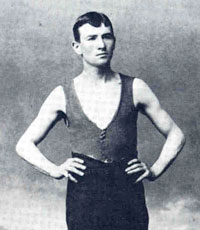
Steve Brodie (December 25, 1861 – January 31, 1901) was an American from Manhattan, New York City, who claimed to have jumped off the Brooklyn Bridge on July 23, 1886, and survived. The supposed jump, of which the veracity was disputed, gave Brodie publicity, a thriving saloon and a career as a performer. Prior to this, he was penniless, having lost significant sums of money on betting and race tracks.
Brodie's fame persisted long past his death, with Brodie portrayed in films and with the slang term "Brodie"—as in to "do a Brodie"—entering American vernacular, meaning to take a chance or a leap, specifically a suicidal one.
During the 1890s, Brodie was compared to one of the best British champion divers and bridge jumpers of the era, Tommy Burns.
Brodie was born on the east side of Bowery in New York City, just three days after his father was killed in a street brawl, and grew up locally, selling newspapers and blacking shoes around the city. In his youth, he was credited with many rescues from the water, such as of two young women who fell from an excursion barge. He is also known to have rescued actress Jennie Rhett, who presented him with a gold locket for his bravery.
The bridge, then known as the East River Bridge, had opened just three years before Brodie's claimed jump. A swimming instructor from Washington, D.C. named Robert Emmet Odlum, the brother of women's rights activist Charlotte Odlum Smith, was killed while attempting the same stunt in May 1885.
By July 1886, Brodie was penniless, having lost a fortune on race tracks and other betting games. With the consent of his wife, the jump supposedly made by Brodie on July 23, 1886, was from a height of 135 feet (41 m), the same as a 14-story building. The contemporary New York Times account said the jump was from a height of about 120 feet (37 m).
The New York Times backed his account of the jump and said that Brodie practiced for the leap by making shorter jumps from other bridges and ships' masts, and that it was witnessed by two reporters. He leaped into the East River, feet first, and emerged uninjured, though with pain on his right side. He was jailed after the jump. The Times described Brodie as a "newsboy and long-distance pedestrian" who jumped from the bridge to win a $200 bet, equal to $7,000 today. In other accounts he is described as a bookmaker and gambler.
A Bowery storekeeper named Isaac Meyers claimed that he encouraged Brodie to jump off the Brooklyn bridge after Brodie said that he wanted to be famous. Another account holds that Moritz Herzber, a liquor dealer, offered to back a saloon for Brodie if he made the jump and lived.
Hub AI
Steve Brodie (bridge jumper) AI simulator
(@Steve Brodie (bridge jumper)_simulator)
Steve Brodie (bridge jumper)
Steve Brodie (December 25, 1861 – January 31, 1901) was an American from Manhattan, New York City, who claimed to have jumped off the Brooklyn Bridge on July 23, 1886, and survived. The supposed jump, of which the veracity was disputed, gave Brodie publicity, a thriving saloon and a career as a performer. Prior to this, he was penniless, having lost significant sums of money on betting and race tracks.
Brodie's fame persisted long past his death, with Brodie portrayed in films and with the slang term "Brodie"—as in to "do a Brodie"—entering American vernacular, meaning to take a chance or a leap, specifically a suicidal one.
During the 1890s, Brodie was compared to one of the best British champion divers and bridge jumpers of the era, Tommy Burns.
Brodie was born on the east side of Bowery in New York City, just three days after his father was killed in a street brawl, and grew up locally, selling newspapers and blacking shoes around the city. In his youth, he was credited with many rescues from the water, such as of two young women who fell from an excursion barge. He is also known to have rescued actress Jennie Rhett, who presented him with a gold locket for his bravery.
The bridge, then known as the East River Bridge, had opened just three years before Brodie's claimed jump. A swimming instructor from Washington, D.C. named Robert Emmet Odlum, the brother of women's rights activist Charlotte Odlum Smith, was killed while attempting the same stunt in May 1885.
By July 1886, Brodie was penniless, having lost a fortune on race tracks and other betting games. With the consent of his wife, the jump supposedly made by Brodie on July 23, 1886, was from a height of 135 feet (41 m), the same as a 14-story building. The contemporary New York Times account said the jump was from a height of about 120 feet (37 m).
The New York Times backed his account of the jump and said that Brodie practiced for the leap by making shorter jumps from other bridges and ships' masts, and that it was witnessed by two reporters. He leaped into the East River, feet first, and emerged uninjured, though with pain on his right side. He was jailed after the jump. The Times described Brodie as a "newsboy and long-distance pedestrian" who jumped from the bridge to win a $200 bet, equal to $7,000 today. In other accounts he is described as a bookmaker and gambler.
A Bowery storekeeper named Isaac Meyers claimed that he encouraged Brodie to jump off the Brooklyn bridge after Brodie said that he wanted to be famous. Another account holds that Moritz Herzber, a liquor dealer, offered to back a saloon for Brodie if he made the jump and lived.
Recent media