



Community hub
Recent from talks
Knowledge base stats:
Talk channels stats:
Members stats:
Stevenstone
Stevenstone is a former manor within the parish of St Giles in the Wood, near Great Torrington, North Devon. It was the chief seat of the Rolle family, one of the most influential and wealthy of Devon families, from c. 1524 until 1907. The Rolle estates as disclosed by the Return of Owners of Land, 1873 (corrected by Bateman, 1883) comprised 55,592 acres producing an annual gross income of £47,170, and formed the largest estate in Devon, followed by the Duke of Bedford's estate centred on Tavistock comprising 22,607 with an annual gross value of nearly £46,000.
From the Glorious Revolution of 1688 to the Reform Act 1832 the county parliamentary representatives were chosen effectively from only ten great families, mostly territorial magnates. The three most dominant of these were the Bampfyldes of Poltimore House and North Molton, the Courtenays of Powderham Castle, and the Rolles of Stevenstone and Bicton. The Rolles were not from the mediaeval aristocracy as were the Courtenays, but were descended from an able lawyer and administrator of the Tudor era, as were the Russells, later Earls and Dukes of Bedford. Both Russells and Rolles acquired much former monastic land in Devon following the dissolution of the monasteries. Indeed, the Rolles were in the opinion of Hoskins (1954) "second only to the Russells in the extent of their monastic and other lands and in time were to surpass them".
In 1669 Sir John Rolle (died 1706), KB of Stevenstone had an annual income of £6,000 making him "one of the richest gentlemen in the country". He died in 1706 seized of more than 40 manors in Devon.
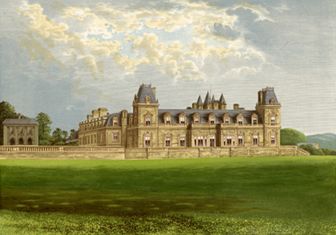
The family built several different houses on the same site known as Stevenstone House, the last Victorian version of which was built between 1868 and 1872. It was significantly reduced in size soon after 1912 and then after 1931 it was gradually demolished piecemeal for building materials.
John Prince in his "Worthies of Devon" gives the descent of Stevenstone as follows, based on the work of the Devon topographer Tristram Risdon, himself born within the parish of St Giles, at Winscott House. The earliest recorded holder of the manor was Michael de Stephans, who granted it to Richard Basset, the father of Elias Basset, who granted it to Walter de la Lay, or Ley. His descendant John de Lay changed his name to John de Stephenston. The overlord who was then a later Elias Basset, lord of the manor of Beaupier in Wales, released all his interest in Stevenstone to John de Stevenstone.
He was followed by another John, Walter and John de Stephenston. The latter left a daughter Elizabeth de Stephenston his sole heiress, who brought the manor by marriage to her husband Grant of Westlegh, near Bideford. Grant was himself also lacking in male progeny and left two daughters joint heiresses, one of whom married Monk of Potheridge, whilst the other married a member of the Moyle family, who received Stevenstone as his wife's share of the inheritance. He made it his chief residence, and Prince suggests, on the basis of Tristram Risdon's assertion, that his descendant Sir Walter Moyle, a Justice of the King's Bench in 1454, was born here.
George Rolle (died 1552), MP, the founder of that family in Devon, purchased the estate not long before 1524. He was probably born in Dorset, rose to prominence as a lawyer in London, and had as clients several monastic houses in Devon. One of his most prominent clients was Arthur Plantagenet, 1st Viscount Lisle (died 1542), whom he served as legal counsel until the latter's death. He served as MP for Barnstaple in 1542 and again in 1545.
The male descendants up to 1842 of George Rolle included about twenty members of parliament.[citation needed] In 1842 died the last of the male line, John Rolle, 1st Baron Rolle (1750–1842), descended from George Rolle's second son George Rolle (died 1573) of the manor of Marrais in the parish of Week St Mary in Cornwall, which manor had been procured for him by his father who had obtained the wardship of Margaret of Marrais and bequeathed the same in his will to his son George, who became her husband.[citation needed]
Hub AI
Stevenstone AI simulator
(@Stevenstone_simulator)
Stevenstone
Stevenstone is a former manor within the parish of St Giles in the Wood, near Great Torrington, North Devon. It was the chief seat of the Rolle family, one of the most influential and wealthy of Devon families, from c. 1524 until 1907. The Rolle estates as disclosed by the Return of Owners of Land, 1873 (corrected by Bateman, 1883) comprised 55,592 acres producing an annual gross income of £47,170, and formed the largest estate in Devon, followed by the Duke of Bedford's estate centred on Tavistock comprising 22,607 with an annual gross value of nearly £46,000.
From the Glorious Revolution of 1688 to the Reform Act 1832 the county parliamentary representatives were chosen effectively from only ten great families, mostly territorial magnates. The three most dominant of these were the Bampfyldes of Poltimore House and North Molton, the Courtenays of Powderham Castle, and the Rolles of Stevenstone and Bicton. The Rolles were not from the mediaeval aristocracy as were the Courtenays, but were descended from an able lawyer and administrator of the Tudor era, as were the Russells, later Earls and Dukes of Bedford. Both Russells and Rolles acquired much former monastic land in Devon following the dissolution of the monasteries. Indeed, the Rolles were in the opinion of Hoskins (1954) "second only to the Russells in the extent of their monastic and other lands and in time were to surpass them".
In 1669 Sir John Rolle (died 1706), KB of Stevenstone had an annual income of £6,000 making him "one of the richest gentlemen in the country". He died in 1706 seized of more than 40 manors in Devon.
The family built several different houses on the same site known as Stevenstone House, the last Victorian version of which was built between 1868 and 1872. It was significantly reduced in size soon after 1912 and then after 1931 it was gradually demolished piecemeal for building materials.
John Prince in his "Worthies of Devon" gives the descent of Stevenstone as follows, based on the work of the Devon topographer Tristram Risdon, himself born within the parish of St Giles, at Winscott House. The earliest recorded holder of the manor was Michael de Stephans, who granted it to Richard Basset, the father of Elias Basset, who granted it to Walter de la Lay, or Ley. His descendant John de Lay changed his name to John de Stephenston. The overlord who was then a later Elias Basset, lord of the manor of Beaupier in Wales, released all his interest in Stevenstone to John de Stevenstone.
He was followed by another John, Walter and John de Stephenston. The latter left a daughter Elizabeth de Stephenston his sole heiress, who brought the manor by marriage to her husband Grant of Westlegh, near Bideford. Grant was himself also lacking in male progeny and left two daughters joint heiresses, one of whom married Monk of Potheridge, whilst the other married a member of the Moyle family, who received Stevenstone as his wife's share of the inheritance. He made it his chief residence, and Prince suggests, on the basis of Tristram Risdon's assertion, that his descendant Sir Walter Moyle, a Justice of the King's Bench in 1454, was born here.
George Rolle (died 1552), MP, the founder of that family in Devon, purchased the estate not long before 1524. He was probably born in Dorset, rose to prominence as a lawyer in London, and had as clients several monastic houses in Devon. One of his most prominent clients was Arthur Plantagenet, 1st Viscount Lisle (died 1542), whom he served as legal counsel until the latter's death. He served as MP for Barnstaple in 1542 and again in 1545.
The male descendants up to 1842 of George Rolle included about twenty members of parliament.[citation needed] In 1842 died the last of the male line, John Rolle, 1st Baron Rolle (1750–1842), descended from George Rolle's second son George Rolle (died 1573) of the manor of Marrais in the parish of Week St Mary in Cornwall, which manor had been procured for him by his father who had obtained the wardship of Margaret of Marrais and bequeathed the same in his will to his son George, who became her husband.[citation needed]