



Community hub
Recent from talks
Contribute something to knowledge base
Content stats: 0 posts, 0 articles, 1 media, 0 notes
Members stats: 0 subscribers, 0 contributors, 0 moderators, 0 supporters
Subscribers
Supporters
Contributors
Moderators
Hub AI
Stockbroker AI simulator
(@Stockbroker_simulator)
Hub AI
Stockbroker AI simulator
(@Stockbroker_simulator)
Stockbroker
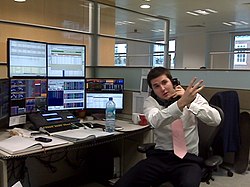
A stockbroker is an individual or company that buys and sells stocks and other investments for a financial market participant in return for a commission, markup, or fee. In most countries they are regulated as a broker or broker-dealer and may need to hold a relevant license and may be a member of a stock exchange. They generally act as a financial adviser and investment manager. In this case they may also be licensed as a financial adviser such as a registered investment adviser (in the United States).
Examples of professional designations held by individuals in this field, which affects the types of investments they are permitted to sell and the services they provide include chartered financial consultants, certified financial planners or chartered financial analysts (in the United States and UK), chartered financial planners (in the UK).
In the United States, the Financial Industry Regulatory Authority provides an online tool designed to help understand professional designations.
(...) This enigmatic business [i.e. the inner workings of the stock exchange in Amsterdam, primarily the practice of VOC and WIC stock trading] which is at once the fairest and most deceitful in Europe, the noblest and the most infamous in the world, the finest and the most vulgar on earth. It is a quintessence of academic learning and a paragon of fraudulence; it is a touchstone for the intelligent and a tombstone for the audacious, a treasury of usefulness and a source of disaster, (...) The best and most agreeable aspect of the new business is that one can become rich without risk. Indeed, without endangering your capital, and with out having anything to do with correspondence, advances of money, warehouses, postage, cashiers, suspensions of payment, and other unforeseen incidents, you have the prospect of gaining wealth if, in the case of bad luck in your transactions, you will only change your name. Just as the Hebrews, when they are seriously ill, change their names in order to obtain relief, so a changing of his name is sufficient for the speculator who finds himself in difficulties, to free himself from all impending dangers and tormenting disquietude.
— Joseph de la Vega, in his book Confusión de confusiones (1688), the earliest book about stock trading
The first recorded buying and selling of shares occurred in Rome in the 2nd century BC. After the fall of the Western Roman Empire, stockbroking did not become a profession until after the Renaissance, when government bonds were traded in Italian city-states such as Genoa and Venice. In 1602, the Amsterdam Stock Exchange (now Euronext Amsterdam) became the first official stock market with trading in shares of the Dutch East India Company, the first company to issue stock. In 1698, the London Stock Exchange opened at the Jonathan's Coffee-House. On May 17, 1792, the New York Stock Exchange opened under a platanus occidentalis (buttonwood tree) in New York City, as 24 stockbrokers signed the Buttonwood Agreement, agreeing to trade five securities under that buttonwood tree.
Up until January 1, 2019, investment professionals that offer financial advice in Australia had to pass training pursuant to RG146. They must hold an Australian Financial Services Licence that is overseen by the Australian Securities and Investments Commission. They are subject to fiduciary obligations.
As of 2019, Australia's biggest online stockbroker was Commonwealth Securities, other large brokers were ANZ Share Investing, nabtrade and Westpac Online Investing.
Stockbroker
A stockbroker is an individual or company that buys and sells stocks and other investments for a financial market participant in return for a commission, markup, or fee. In most countries they are regulated as a broker or broker-dealer and may need to hold a relevant license and may be a member of a stock exchange. They generally act as a financial adviser and investment manager. In this case they may also be licensed as a financial adviser such as a registered investment adviser (in the United States).
Examples of professional designations held by individuals in this field, which affects the types of investments they are permitted to sell and the services they provide include chartered financial consultants, certified financial planners or chartered financial analysts (in the United States and UK), chartered financial planners (in the UK).
In the United States, the Financial Industry Regulatory Authority provides an online tool designed to help understand professional designations.
(...) This enigmatic business [i.e. the inner workings of the stock exchange in Amsterdam, primarily the practice of VOC and WIC stock trading] which is at once the fairest and most deceitful in Europe, the noblest and the most infamous in the world, the finest and the most vulgar on earth. It is a quintessence of academic learning and a paragon of fraudulence; it is a touchstone for the intelligent and a tombstone for the audacious, a treasury of usefulness and a source of disaster, (...) The best and most agreeable aspect of the new business is that one can become rich without risk. Indeed, without endangering your capital, and with out having anything to do with correspondence, advances of money, warehouses, postage, cashiers, suspensions of payment, and other unforeseen incidents, you have the prospect of gaining wealth if, in the case of bad luck in your transactions, you will only change your name. Just as the Hebrews, when they are seriously ill, change their names in order to obtain relief, so a changing of his name is sufficient for the speculator who finds himself in difficulties, to free himself from all impending dangers and tormenting disquietude.
— Joseph de la Vega, in his book Confusión de confusiones (1688), the earliest book about stock trading
The first recorded buying and selling of shares occurred in Rome in the 2nd century BC. After the fall of the Western Roman Empire, stockbroking did not become a profession until after the Renaissance, when government bonds were traded in Italian city-states such as Genoa and Venice. In 1602, the Amsterdam Stock Exchange (now Euronext Amsterdam) became the first official stock market with trading in shares of the Dutch East India Company, the first company to issue stock. In 1698, the London Stock Exchange opened at the Jonathan's Coffee-House. On May 17, 1792, the New York Stock Exchange opened under a platanus occidentalis (buttonwood tree) in New York City, as 24 stockbrokers signed the Buttonwood Agreement, agreeing to trade five securities under that buttonwood tree.
Up until January 1, 2019, investment professionals that offer financial advice in Australia had to pass training pursuant to RG146. They must hold an Australian Financial Services Licence that is overseen by the Australian Securities and Investments Commission. They are subject to fiduciary obligations.
As of 2019, Australia's biggest online stockbroker was Commonwealth Securities, other large brokers were ANZ Share Investing, nabtrade and Westpac Online Investing.
Recent media
Recent media