Hubbry Logo
Stock potStock potMain
Open search
Stock pot
Community hub
Stock pot
logo
8 pages, 0 posts
0 subscribers
Be the first to start a discussion here.
Stock pot
Stock pot
from Wikipedia
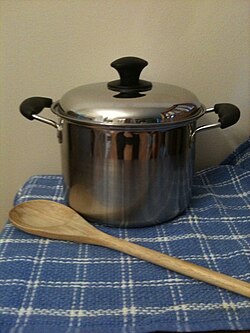
A stainless steel stock pot.

Stock pot or Large cooking pot, is a generic name for a cooking pot used worldwide. A stock pot is traditionally used to make stock or broth, which can be the basis for cooking more complex recipes.

Description

[edit]

A stock pot is a large, often deep pot that is used to prepare soups or simmer liquids.[1] It is a wide pot with a flat bottom, straight sides, a wide opening to the full diameter of the pot, two handles on the sides, and a lid with a handle on top. The most common materials for manufacturing stock pots are stainless steel, aluminum, copper, and enamel (Vitreous enamel) on metal. More expensive types of stock pots have bottoms that are made of layers of different metals, to enhance heat conductivity.[citation needed]

Uses

[edit]

On the first page of his publication “A Guide to Modern Cookery” (1907), French Chef Auguste Escoffier states that "stocks are the keynote of culinary structure" in French cuisine. A stock or broth is made by simmering water for several hours, to continuously cook added foods such as pieces of meat, meat bones, fish, or vegetables. The slow simmering process transfers flavors, colors, and nutrients to the water, where they blend, and a new ingredient is thus created, the broth or stock.[citation needed]

A broth made with meat or meat bones creates a base with concentrated flavors and aromas, even without the addition of salt or herbs or spices. This is what is referred to as a soup base. Stock pots are also used for cooking stews, porridge, boiled foods, steamed shellfish, and many other types of recipes.[citation needed]

Stock pots have great versatility, and so they are used for many cooking purposes, and occasionally non-cooking purposes. For example, large stock pots are often used at home to boil clothing, wool, or yarn for color dying.[2] They do not necessarily come in standard sizes. Manufacturers label pot sizes usually by volume (e.g., "12 liters") or sometimes by diameter (e.g., "28 cm").

See also

[edit]

References

[edit]
Revisions and contributorsEdit on WikipediaRead on Wikipedia
from Grokipedia
A stock pot is a large, deep cooking vessel characterized by its tall, straight sides, wide base, and capacity to hold substantial volumes of liquid, primarily designed for simmering and boiling to prepare stocks, broths, soups, and stews in large batches. These pots typically feature dual looped handles for safe transport and a fitted lid to retain heat and moisture, distinguishing them from shallower pans suited for sautéing or frying. The design of a stock pot emphasizes functionality for slow-cooking methods, with high sides that minimize evaporation and allow for the extraction of flavors from ingredients over extended periods. Common features include a cylindrical shape for even heat distribution and a sturdy construction that supports heavy loads without warping. In professional kitchens, stock pots are essential for high-volume preparation, often ranging from 6 to 32 quarts in capacity to accommodate family meals or commercial-scale cooking. Stock pots are crafted from various materials to suit different cooking needs, including stainless steel for durability and corrosion resistance, aluminum for rapid heating, and enameled cast iron for superior heat retention. Nonstick coatings may be applied for easier cleanup, while traditional copper versions offer excellent conductivity but require maintenance to prevent tarnishing. Sizes vary by purpose: smaller 2- to 5-quart models for individual use, 6- to 8-quart for small households, 10- to 12-quart for batch cooking, and 16-quart or larger for canning or large gatherings. Beyond stock-making—where bones, vegetables, and aromatics are simmered to create foundational broths—stock pots serve versatile roles in the kitchen, such as boiling pasta, grains, or legumes; preparing seafood boils and stews; blanching vegetables; and even canning preserves. They excel in tasks requiring submersion in liquid, like deep-frying or steaming with a basket insert, making them indispensable for both home cooks and chefs. As Auguste Escoffier noted, stocks form the "keynote of culinary structure," underscoring the pot's role in building complex dishes. The origins of stock pots trace back to ancient practices of boiling, where early humans around 30,000 years ago used heated stones in water-filled pits or baskets to cook soups and stews, laying the groundwork for liquid-based cookery. By the Bronze Age (circa 3000 B.C.), metal cauldrons emerged in ancient civilizations such as those in the Near East, enabling more durable large-scale simmering. In the 19th century, English stock pots evolved as hand-crafted copper vessels, with techniques like cramp seaming documented by coppersmiths such as John Fuller, who apprenticed in 1842 and resisted mechanization into the 1920s. Modern iterations reflect these historical foundations while incorporating advanced materials for efficiency.

Overview

Definition and Purpose

A stock pot is a large, deep cooking vessel characterized by its straight sides, often 8 quarts or more for larger batches, though smaller 2- to 8-quart sizes are available for home use, and designed specifically for simmering substantial volumes of liquid over extended periods. Its basic anatomy includes tall sides that reduce evaporation during long cooks, a wide base to promote even heat distribution, a fitted lid to retain moisture and flavors, and dual handles to manage the pot's considerable weight when filled. The primary purpose of a stock pot is to prepare foundational liquids such as stocks, broths, and soup bases through the slow extraction of flavors from ingredients like bones, vegetables, and aromatics. This process involves maintaining a gentle simmer for hours, allowing collagen and nutrients to break down and infuse the liquid, resulting in a rich, versatile base for further culinary applications. Unlike a saucepan, which is shallower and smaller for more precise, smaller-scale tasks like boiling or reducing sauces, a stock pot accommodates larger quantities with its greater depth and capacity. It also differs from a Dutch oven, which features thicker walls and a more rounded, shorter profile suited for oven-to-stovetop transitions in braising. Stock pots have historically served professional kitchens for efficient large-batch preparations.

Historical Development

The use of large cauldrons for preparing broths and stocks dates back to ancient civilizations, where bronze vessels were employed for simmering meats and vegetables over open fires. In ancient Rome, for instance, bronze cauldrons unearthed in Pompeii, dating to the 1st century CE, were suspended over fireplaces to cook soups and broths, serving as essential tools in both domestic and communal settings. Similarly, in ancient Greece around the 5th–4th centuries BCE, cauldrons such as the bronze lebes may have been used to prepare broths, often as multifunctional vessels for cooking and containing liquids like wine or food mixtures. These early pots, typically made from bronze or clay, laid the foundation for stock preparation by enabling slow cooking to extract flavors from bones and aromatics. Similar large vessels for simmering broths appear in ancient Chinese ding cauldrons from the Shang Dynasty (c. 1600–1046 BCE) and Mesoamerican clay pots used by indigenous peoples for communal stews. During the medieval period in Europe (circa 500–1500 CE), cauldrons evolved into iron or copper vessels hung over hearths, central to peasant and monastic kitchens for making pottages and perpetual stews—broths continuously replenished and simmered for days. In England and France, these large, rounded pots facilitated the extraction of gelatin from bones through prolonged boiling, a technique refined in communal cooking to feed households efficiently. By the late Middle Ages, such vessels were widespread across Europe, influencing early culinary practices that emphasized flavorful bases for soups and stews. In the 19th century, European coppersmiths advanced stock pot design through hand-hammered copper construction, prioritizing even heat distribution for long simmers. In England, apprenticeships like that of John Fuller in 1842 near Dorking involved crafting deep cylindrical pots with bail handles and overhanging lids to contain steam and aromas during stock making. Examples from Birmingham coppersmiths, such as Edward Villers Wilkes, produced large copper stock pots with integrated taps for straining, reflecting the era's focus on professional kitchen efficiency. This period's innovations were driven by French culinary traditions, where mirepoix-based stocks—combining onions, carrots, and celery—necessitated pots suited for gentle, extended simmering to build complex flavors without scorching. The 20th century marked a shift to industrial production, with stainless steel stock pots emerging post-World War II for their durability, corrosion resistance, and ease of sanitation in commercial kitchens. Pioneered in the 1930s by French firms like De Buyer, stainless steel became standard after the war, enabling mass manufacturing of hygienic, heavy-gauge pots ideal for high-volume stock preparation in restaurants and institutions. This transition democratized access to reliable stock-making tools, aligning with global culinary standardization while preserving the slow-simmering principles rooted in earlier traditions.

Design and Materials

Construction Features

Stock pots are typically designed with straight, tall sides and height-to-diameter ratios varying from about 0.6 to 1, depending on size and manufacturer, allowing for deep cooking volumes while maintaining stability on the stove; common capacities range from 8 to 40 quarts to accommodate various batch sizes in home and professional kitchens. For example, an 8-quart stock pot often measures about 10 inches in diameter and 6 to 7 inches in height, scaling up proportionally for larger sizes to support extended simmering without excessive evaporation. Key structural components include dual handles, which are usually riveted or welded to the body for durability and secure transport of heavy, hot contents filled with liquids and ingredients. A tight-fitting lid is standard, featuring a slight dome or flat profile to trap steam, retain moisture, and concentrate flavors during prolonged cooking processes. The base is engineered with multi-ply or encapsulated construction, incorporating layers of conductive material sandwiched between stainless steel to promote even heat distribution across the surface and prevent scorching or hot spots during long simmers. This design ensures consistent temperature control, essential for extracting flavors from bones and vegetables without burning. Some models incorporate practical variations such as integrated spouts for controlled pouring of stocks and broths, or internal measuring marks etched along the sides to track liquid levels accurately during preparation. These features enhance usability without compromising the pot's core structural integrity. Additionally, lightweight materials like aluminum can influence handle design for easier maneuvering of larger capacities.

Common Materials and Variations

Stainless steel is the most prevalent material for stock pots in professional kitchens due to its durability, non-reactivity with foods, and resistance to corrosion, making it ideal for long simmering processes. Many professional models feature tri-ply construction, where an aluminum or copper core is sandwiched between stainless steel layers to enhance heat conduction while maintaining the outer material's benefits. This setup provides even heating without hotspots, though stainless steel alone conducts heat more slowly than alternatives, requiring higher initial energy input. Aluminum stock pots offer a lightweight and cost-effective option with superior heat conductivity, allowing for rapid and uniform heating that suits large-volume cooking. However, uncoated aluminum can react with acidic ingredients like tomatoes or vinegar, potentially imparting a metallic flavor, which is mitigated in anodized versions through a hardened oxide layer. While affordable and easy to maneuver, aluminum is prone to denting under heavy use, limiting its longevity in demanding environments compared to sturdier metals. Copper excels in heat responsiveness, enabling precise temperature control essential for delicate simmering in stock preparation, but it is typically lined with tin or stainless steel to avoid reactions with food acids. Its even heat distribution outperforms most materials, yet copper's high cost and substantial weight make it less practical for everyday or large-scale use, often reserved for high-end applications. Among specialized variations, cast iron stock pots provide exceptional heat retention, ideal for slow-cooked stews where consistent low temperatures prevent scorching. They require seasoning to develop a natural non-stick surface and prevent rust, offering durability that can last generations but adding significant weight that complicates handling. Nonstick-coated stock pots, often applied over aluminum bases, facilitate easy food release and cleanup for home cooks preparing stocks or soups, though the coating may wear over time with metal utensils. Enameled cast iron or steel variants deliver a chemical-free non-stick surface that resists staining and reacts neutrally with acids, combining the thermal mass of cast iron with simplified maintenance. These options balance performance and practicality, with enamel's smooth finish aiding in deglazing without residue buildup.

Culinary Applications

Primary Uses

The primary use of a stock pot is to prepare stocks, such as chicken, beef, or vegetable varieties, by simmering bones, meat, vegetables, and aromatics in water for extended periods ranging from 4 to 24 hours to extract rich flavors and create foundational bases for other dishes. This process yields a concentrated liquid that enhances soups, sauces, and braises, with the pot's deep sides accommodating the volume of ingredients and liquid without spillage during prolonged cooking. Beyond stock preparation, stock pots serve other key roles in large-scale liquid-based cooking, including boiling pasta or potatoes in bulk for family or group servings, making substantial quantities of soups, stews, or chili to feed crowds, and blanching vegetables to preserve color and texture before further processing. These applications leverage the pot's capacity to handle high volumes of water and ingredients efficiently, making it indispensable for tasks requiring even heat distribution over time. In commercial settings, stock pots are essential for restaurants and professional kitchens to produce mise en place stocks as part of daily preparations, enabling chefs to create consistent bases for multiple menu items in high-volume operations. At home, they facilitate batch cooking for meal prepping, family gatherings, or canning preserves, allowing users to prepare and store portions for later use. The typical capacity of 10 liters or more ensures ample space for these activities without overflow, supporting both everyday and large-scale culinary needs.

Cooking Techniques and Tips

When preparing stocks or broths in a stock pot, simmering is a fundamental technique that extracts flavors gently while preserving clarity. Maintain a low simmer at temperatures between 180°F and 200°F, where small bubbles intermittently rise to the surface without vigorous agitation. This range allows collagen from bones to break down slowly into gelatin, enhancing body without emulsifying fats that could cloud the liquid. Skim any foam or scum that forms on the surface as needed during the initial simmering period, as this removes coagulated proteins and impurities for a cleaner result. For layering ingredients to achieve optimal clarity and flavor balance, begin by placing bones or meat directly in the stock pot and covering them with cold water by at least 2 inches. The cold start promotes a gradual rise of impurities to the top, which can be skimmed before they dissolve back in. Once simmering begins and initial skimming is complete, incorporate aromatics like onions, carrots, celery, and herbs; adding them later prevents over-extraction and bitterness from prolonged exposure to heat. This method is particularly effective for primary uses such as stock making, where transparency is key. Stock pots excel in efficiency for one-pot meals that build complex flavors through extended simmering, such as gumbo, where roux, proteins, and vegetables meld in a single vessel. Similarly, larger batches of risotto can benefit from the pot's capacity for gradual liquid absorption while stirring. To promote even cooking and heat distribution, avoid overcrowding by filling no more than two-thirds full, ensuring ingredients move freely and temperature remains consistent. Safety is paramount when handling stock pots due to their size and the heat involved. Always use thick oven mitts or pot holders to lift or move a hot, heavy pot, as filled versions can weigh over 20 pounds and cause severe burns if mishandled. On induction stoves, which provide rapid and precise heating, monitor the contents closely to avoid sudden boil-overs by adjusting power levels promptly.

Care and Maintenance

Cleaning and Upkeep

After cooking, stock pots should be cleaned promptly to remove residues and maintain their condition. Begin by filling the pot with hot soapy water and allowing it to soak for 15-30 minutes to loosen stuck-on food particles. Use a soft, non-abrasive sponge or cloth to gently scrub the interior and exterior, avoiding harsh scrubbers that could scratch the surface. This method applies particularly to stainless steel and nonstick varieties, where preserving the smooth finish is essential for performance. Cleaning routines vary by material to prevent damage and ensure longevity. For stainless steel stock pots, hand washing with mild dish soap and a soft sponge is recommended, as dishwashers can dull the finish over time. Copper pots require gentle polishing with a mild acid, such as a halved lemon dipped in salt, to remove tarnish without abrading the metal; always hand wash and avoid dishwashers to protect the lining. For uncoated cast iron stock pots, wash with warm soapy water using a stiff brush or scraper for residues, then thoroughly dry and lightly oil to prevent rust formation. Enameled cast iron stock pots can be hand washed with mild soap and a soft sponge; no oiling is needed, though dishwasher use is possible but not recommended to preserve the finish. Aluminum pots must be hand washed only, as exposure to dishwasher detergents and heat can cause warping or discoloration. For stubborn stains or burnt-on bits, simmer a mixture of water and baking soda or white vinegar in the pot for 10-15 minutes to deglaze and lift debris, followed by gentle scrubbing. This technique is effective across materials like stainless steel and aluminum, helping to restore the pot without aggressive chemicals. To uphold hygiene and avoid flavor transfer between batches, stock pots should be cleaned after every use, regardless of the material. Regular upkeep in this manner ensures consistent performance in stock preparation.

Storage and Durability

To ensure the longevity of stock pots, proper storage is essential to prevent moisture-related damage such as rust, warping, or corrosion. Stock pots should be kept in clean, dry cabinets, on sturdy shelves, or elevated from damp areas like under sinks to avoid exposure to humidity that could compromise their integrity. When stacking stock pots, use soft cloth liners, pot protectors, or padding between them to avoid scratches on surfaces, lids, or rims from metal-on-metal contact, which can lead to aesthetic and functional degradation over time. In commercial kitchens, hanging pot racks are recommended for easy access and to minimize stacking risks, while nesting should be avoided without protective barriers to maintain the pots' shape and finish. Durability of stock pots varies by material, with high-quality stainless steel models typically lasting 10 years or more with regular care, including thorough drying after use and occasional polishing to resist dents and discoloration. Copper stock pots can endure 20 years or longer if polished regularly to prevent tarnish and maintain conductivity, though their linings may require retinning every few years depending on usage. As part of an overall upkeep routine, integrating proper cleaning after each use helps preserve these lifespans by removing residues that accelerate wear. Common signs of wear indicate when replacement is necessary to ensure safe and efficient cooking. In aluminum stock pots, dents can reduce heat distribution and structural integrity, while pitting from prolonged exposure to acids or salts increases the risk of metal leaching into food. For unlined copper stock pots, visible pitting or corrosion signals the need for replacement, as it compromises hygiene and heat performance; even lined versions show wear through damaged coatings or warping that affects stability.

References

Add your contribution
Related Hubs
User Avatar
No comments yet.