



Community hub
Recent from talks
Knowledge base stats:
Talk channels stats:
Members stats:
Insurrection of 10 August 1792
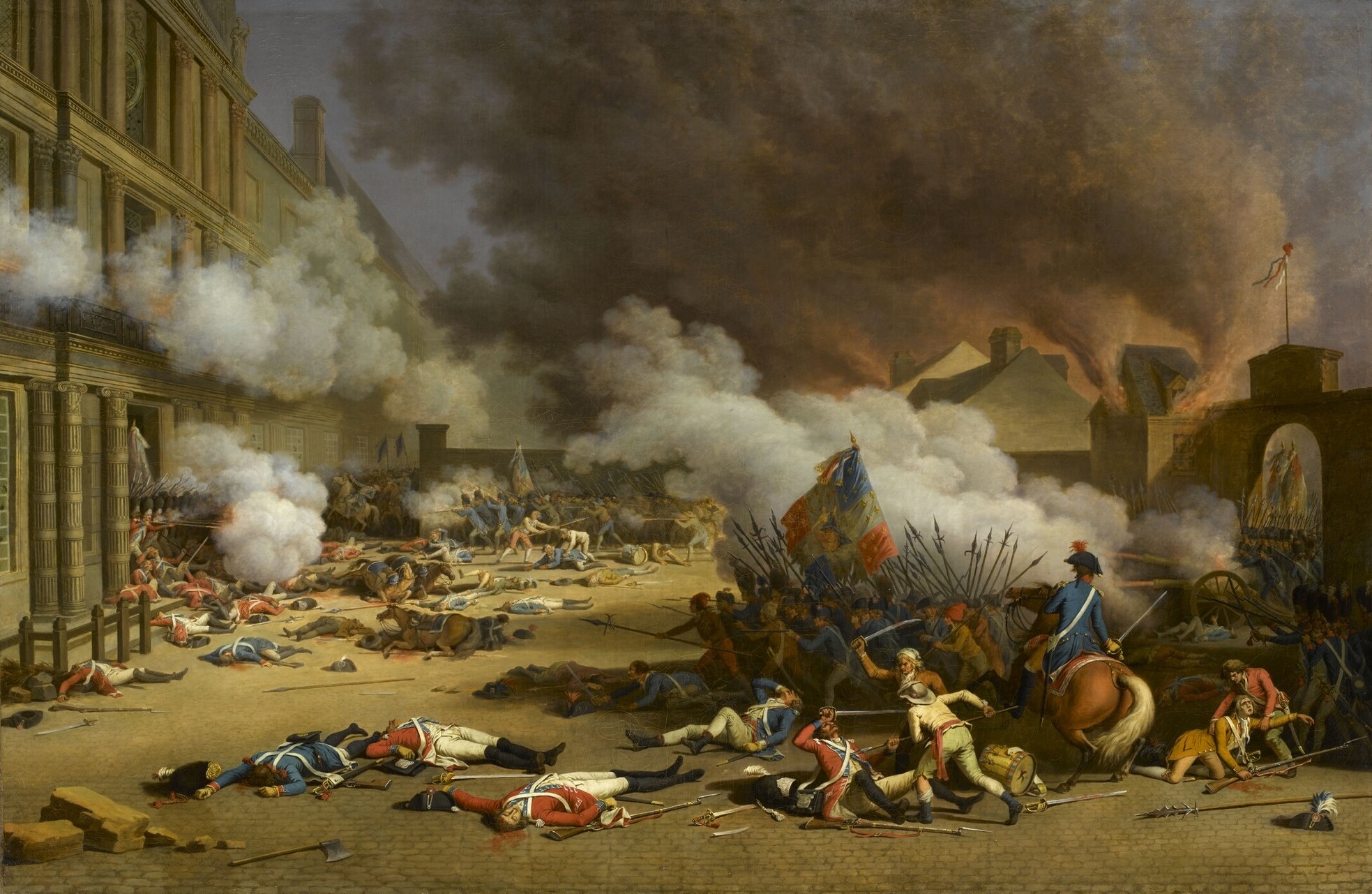
The insurrection of 10 August 1792 was a defining event of the French Revolution, when armed revolutionaries in Paris, increasingly in conflict with the French monarchy, stormed the Tuileries Palace. The conflict led France to abolish the monarchy and establish a republic.
Conflict between King Louis XVI and the country's new revolutionary Legislative Assembly increased through the spring and summer of 1792 as Louis vetoed radical measures voted upon by the Assembly. Tensions accelerated dramatically on 1 August when news reached Paris that the commander of the allied Prussian and Austrian armies had issued the Brunswick Manifesto, threatening "unforgettable vengeance" on Paris should harm be done to the French royal family. On 10 August, the National Guard of the Paris Commune and fédérés from Marseille and Brittany stormed the King's residence in the Tuileries Palace in Paris, which was defended by the Swiss Guards. Hundreds of Swiss guardsmen and 400 revolutionaries were killed in the battle, and Louis and the royal family took shelter with the Legislative Assembly. The formal end of the monarchy occurred six weeks later on 21 September as one of the first acts of the new National Convention, which established a republic on the next day.
The insurrection and its outcomes are most commonly referred to by historians of the Revolution simply as "the 10 August"; other common designations include "the day of the 10 August" or "the Second Revolution".
On 20 April 1792, France declared war against Austria. The initial battles were a disaster for a French army partially disorganised by mutinies, emigration of officers, and political change. Prussia then joined Austria in active alliance against France, eventually declaring war on France on 13 June. The blame for these opening setbacks was put upon the King and his ministers (the Austrian Committee), and after upon the Girondin party.
The Legislative Assembly passed decrees sentencing any priest denounced by twenty citizens to immediate deportation (27 May), dissolving the King's Constitutional Guard, incorrectly alleging that it was manned by aristocrats (29 May), and establishing in the vicinity of Paris a camp of 20,000 fédérés (8 June). The King vetoed the decrees and dismissed Girondists from the Ministry. When the King formed a new cabinet mostly of constitutional monarchists (Feuillants), this widened the breach between the King and the Assembly and the majority of the common people of Paris. These events happened on 16 June when Lafayette sent a letter to the Assembly, recommending suppression of "anarchists" and political clubs in the capital.
Six days later the Assembly declared la patrie est en danger (the homeland is in danger). Banners were placed in the public squares, with the words:
Would you allow foreign hordes to spread like a destroying torrent over your countryside! That they ravage our harvest! That they devastate our fatherland through fire and murder! In a word, that they overcome you with chains dyed with the blood of those whom you hold the most dear... Citizens, the country is in danger!
The ruling spirit of this new revolution was Georges Jacques Danton, a barrister only thirty-two years old, who had not sat in either Assembly, although he had been the leader of the republican Cordeliers (Society of the Friends of the Rights of Man and of the Citizen), which was popular in Paris. Danton and his friends and allies—Maximilien Robespierre, Camille Desmoulins, Fabre d'Églantine, Jean-Paul Marat, etc.—were assisted in their work by the fear of invasion.
Hub AI
Insurrection of 10 August 1792 AI simulator
(@Insurrection of 10 August 1792_simulator)
Insurrection of 10 August 1792
The insurrection of 10 August 1792 was a defining event of the French Revolution, when armed revolutionaries in Paris, increasingly in conflict with the French monarchy, stormed the Tuileries Palace. The conflict led France to abolish the monarchy and establish a republic.
Conflict between King Louis XVI and the country's new revolutionary Legislative Assembly increased through the spring and summer of 1792 as Louis vetoed radical measures voted upon by the Assembly. Tensions accelerated dramatically on 1 August when news reached Paris that the commander of the allied Prussian and Austrian armies had issued the Brunswick Manifesto, threatening "unforgettable vengeance" on Paris should harm be done to the French royal family. On 10 August, the National Guard of the Paris Commune and fédérés from Marseille and Brittany stormed the King's residence in the Tuileries Palace in Paris, which was defended by the Swiss Guards. Hundreds of Swiss guardsmen and 400 revolutionaries were killed in the battle, and Louis and the royal family took shelter with the Legislative Assembly. The formal end of the monarchy occurred six weeks later on 21 September as one of the first acts of the new National Convention, which established a republic on the next day.
The insurrection and its outcomes are most commonly referred to by historians of the Revolution simply as "the 10 August"; other common designations include "the day of the 10 August" or "the Second Revolution".
On 20 April 1792, France declared war against Austria. The initial battles were a disaster for a French army partially disorganised by mutinies, emigration of officers, and political change. Prussia then joined Austria in active alliance against France, eventually declaring war on France on 13 June. The blame for these opening setbacks was put upon the King and his ministers (the Austrian Committee), and after upon the Girondin party.
The Legislative Assembly passed decrees sentencing any priest denounced by twenty citizens to immediate deportation (27 May), dissolving the King's Constitutional Guard, incorrectly alleging that it was manned by aristocrats (29 May), and establishing in the vicinity of Paris a camp of 20,000 fédérés (8 June). The King vetoed the decrees and dismissed Girondists from the Ministry. When the King formed a new cabinet mostly of constitutional monarchists (Feuillants), this widened the breach between the King and the Assembly and the majority of the common people of Paris. These events happened on 16 June when Lafayette sent a letter to the Assembly, recommending suppression of "anarchists" and political clubs in the capital.
Six days later the Assembly declared la patrie est en danger (the homeland is in danger). Banners were placed in the public squares, with the words:
Would you allow foreign hordes to spread like a destroying torrent over your countryside! That they ravage our harvest! That they devastate our fatherland through fire and murder! In a word, that they overcome you with chains dyed with the blood of those whom you hold the most dear... Citizens, the country is in danger!
The ruling spirit of this new revolution was Georges Jacques Danton, a barrister only thirty-two years old, who had not sat in either Assembly, although he had been the leader of the republican Cordeliers (Society of the Friends of the Rights of Man and of the Citizen), which was popular in Paris. Danton and his friends and allies—Maximilien Robespierre, Camille Desmoulins, Fabre d'Églantine, Jean-Paul Marat, etc.—were assisted in their work by the fear of invasion.